Free · France
Village fairs, weekly markets and civic calendars across Mayotte
Start with the people who organise the gathering
Outside Mamoudzou, Mayotte's public life is easier to understand through particular organisers than through a single island-wide events list. A communal debaa, a salt-making festival, a school celebration and a producers' market bring people together for different reasons. Their calendars should not be treated as interchangeable collections of entertainment.
The examples below connect Tsingoni, Bandrélé, Chirongui and Coconi with the institutions and practitioners behind their gatherings. They also distinguish an event reported afterwards from a programme announced beforehand. Sources were checked on 27 October 2026. Dates from earlier editions are identified as such; none is automatically carried forward. In particular, a surviving pre-Chido page is not evidence that a recurring event resumed unchanged after the cyclone.
Tsingoni and the social life of debaa
Tsingoni's municipality reports that its Centre Social organised the first Grand Debaa communal on 17 June 2024, for Aïd el-Kebir. Associations from different villages in the commune participated. The report describes more than 500 people gathering and presents the occasion as an intergenerational community event. This is evidence of a reported gathering, not simply a poster advertising one. Municipal Grand Debaa report.
The same article proposed subsequent meetings every three or four months, rotating between villages. That was an intention recorded in 2024. It does not establish a rolling schedule for 2026. For another edition, ask the Centre Social which village is hosting, which association is receiving participants, and whether the gathering welcomes the general public. A commune-wide name does not identify a particular meeting place.
Understanding the practice matters as much as finding its date. The Ministry of Culture's October 2025 account explains debaa's Sufi roots and its development as a space of women's expression, learning and religious transmission. Groups combine sung poetry with coordinated gestures; associations and families sustain the practice. It can accompany weddings, a return from pilgrimage or other important personal occasions, rather than existing only as a staged festival performance. Ministry account of debaa.
An invitation to a public programme should therefore not be read as permission to enter a private celebration. Ask before photographing or recording people, follow the hosts' directions about where to stand, and do not assume that participation is available on demand. These are practical ways to respect the gathering's purpose without prescribing one uniform etiquette for every association.
Bandrélé and the work behind the salt festival
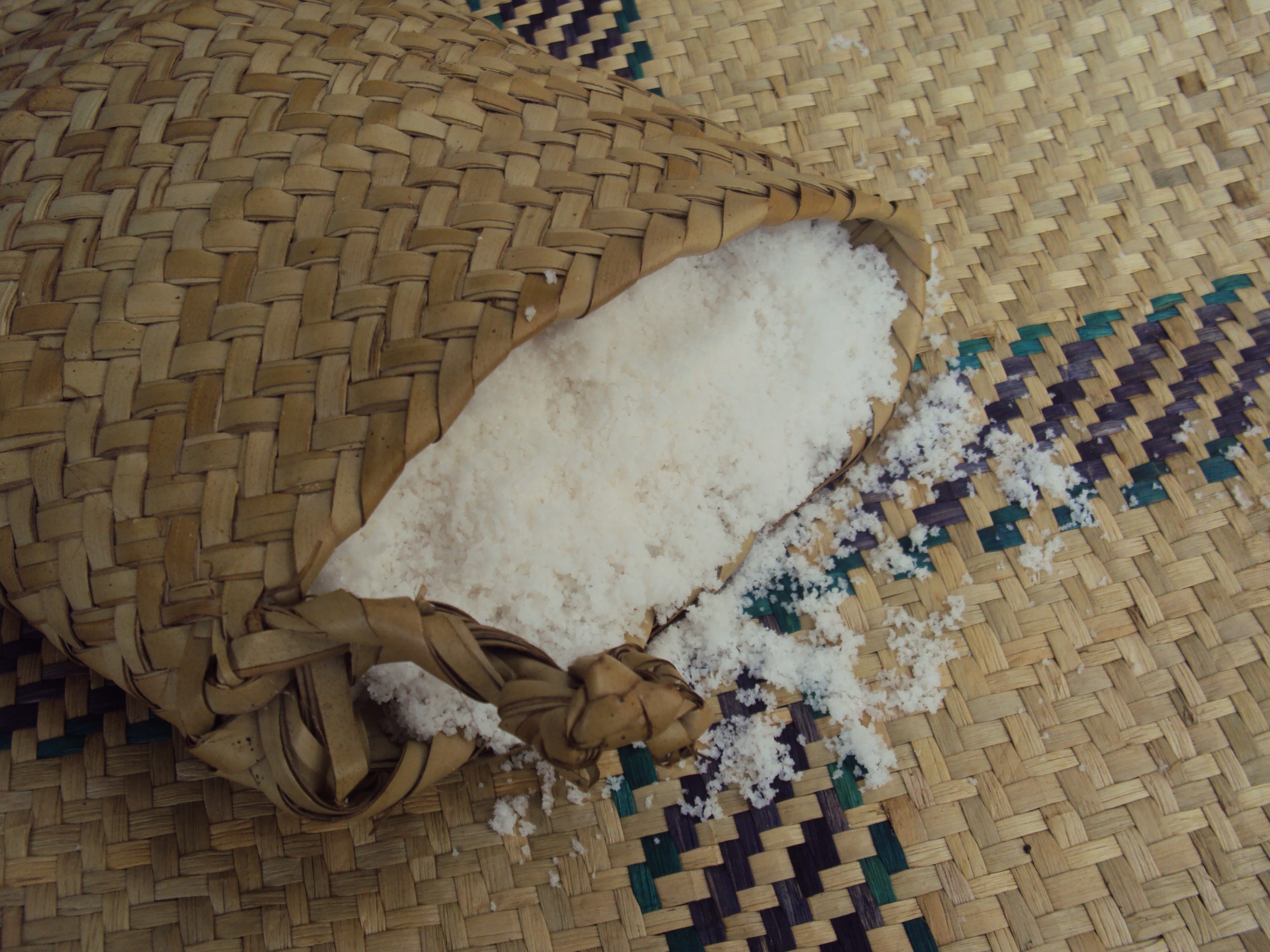
Salt from Bandrélé in a woven basket, photographed on 20 October 2013. The image illustrates the material product, not a particular festival, a museum accession or current sales availability. Photo: Carole.bacarM1FLE.Réunion; CC BY-SA 3.0; original and attribution. Unmodified.

Bandrélé's Fête du sel centres on a productive skill. The national heritage inventory describes the mama shingo, women who make salt by collecting salt-bearing sediment, filtering brine and heating it over wood fires. Their knowledge includes choices learned through practice, not merely a sequence that a visitor can reproduce after watching a demonstration. Salt-making inventory, pp. 1 and 4.
The inventory records the festival's earlier development and municipal cultural-service organisation from 2020. It describes the practitioners' involvement and a role for discussion of environmental questions. Its submission date is 20 December 2024, with inclusion in the national inventory in 2025. That makes it useful evidence about the festival's foundations, but not a dated announcement for a 2026 edition. Salt-making inventory, pp. 17 and 23.
Seek the current notice from Bandrélé's cultural service before choosing a date. At a demonstration, leave working space and ask which stages can be observed. A craft fair can make expertise visible, but buying a product or watching a demonstration does not confer a right to interrupt production, handle equipment or demand an explanation from every practitioner.
Chirongui connects traditions with contemporary performance
The Pôle Culturel de Chirongui provides a useful organiser-led calendar. Its municipal-domain season page displayed an October–December 2026 programme when checked. This is a better starting point than assuming that an older season booklet still applies. Open the individual event notice, because a season listing alone rarely explains reservations or the intended audience. Pôle cultural season.
The announced opening on 10 October 2026 placed M'biwi and Wadaha performances by Association Chiromani de Chirongui alongside children's activities, theatre and a concert. The notice identifies the performers and distinguishes the terrace from the performance room. It is a programme, not an after-event report confirming that every advertised item happened. Season-opening programme.
That arrangement is worth noticing: the local association is named, and traditional forms appear within a wider contemporary arts programme. There is no need to describe the whole afternoon as an undifferentiated display of “village folklore”. Use the names on the programme and ask the organisers about an unfamiliar form rather than assuming that all dances have the same history or social function.
For 6 November 2026, the venue advertised Les Contes de ma grand-mère, bringing theatre and percussion to Hale halele storytelling. The page names El Madjid Saindou and percussionist Hassani Saadi and presents the work as a contemporary creation drawing on transmitted stories. At the checking date this was a future performance, not something already witnessed. Storytelling programme.
A visitor interested in oral traditions can therefore follow the venue's programme without expecting a private family storytelling occasion to become a public attraction. Confirm the performance language, age guidance and ticket arrangements directly; the title alone answers none of those questions.
A market is not necessarily weekly
Chirongui's calendar also announced Les Rencontres du Pôle, a market for crafts, creations and local producers, on 20 September and 8 November 2026. The invitation included associations and residents as well as sellers. Two advertised dates do not establish weekly operation, and the September listing does not by itself prove completion. The November edition remained planned when checked. September market notice; November market notice.
At Coconi, in Ouangani, another distinction matters. The Centre-Ouest tourist office describes the PAPAM market, organised by the Pôle d'Excellence Rurale, as occasional. PAPAM refers to perfume, aromatic and medicinal plants; the listing connects agriculture and local craft production. It is not a weekly timetable, nor should its venue be silently substituted for the lycée's agricultural market. Official PAPAM listing.
There is dated evidence of a post-Chido community gathering at Coconi market. The Académie de Mayotte's retrospective records a Village Santé & Culture on 4 October 2025 as part of the Octobre Rose campaign. That establishes a reported market-associated occasion on one date, not continuous operation or a present opening hour. It also shows why a market calendar may carry civic information as well as sales announcements. Académie campaign retrospective.
The ALIMENTERRE festival platform gives another precise lead: a public screening and debate at the Lycée Agricole de Coconi on 7 November 2026, involving the lycée's development team and local cacao organisations. Its advertised 10:00–12:30 slot belongs to that session, not to the entire market. This remains an announced event. ALIMENTERRE Coconi session.
A weekly rhythm is documented historically: the Rural Network's 2 June 2020 bulletin advertised a Thursday producers' market at Coconi alongside the lycée's Banga outlet. It separately said the Marché Paysan would not reopen that Saturday. Even within one village, those notices concerned different arrangements. The Thursday pattern is a 2020 record, not a post-Chido timetable. DAAF-hosted Rural Network bulletin, p. 1.
No current weekly-market timetable was established from the opened primary sources in this check. That is a verification gap, not evidence that weekly markets do not exist. Before building a weekly routine around a directory entry, obtain the organiser's current day, village, location and cancellation information.
Civic celebrations have their own audiences
Chiconi offers a different kind of calendar entry. The education authority reports a school-network celebration held at Place Sicotram on 20 June 2025, involving pupils from Chiconi and Sohoa. Republican songs, multilingual rhymes, dance and school-transition ceremonies shared the programme. The gathering connected cultural expression with the practical passage from one stage of schooling to another. Académie report from Chiconi.
The report says organisers hoped to develop an annual meeting. It does not confirm a 2026 repeat. Nor does a public account of a school occasion mean that anyone may enter its next edition. For families, the useful sources are school notices and the relevant educational organisers; for an outside visitor, an explicit public invitation is the appropriate basis for attendance.
This is one reason not to reduce a civic calendar to things to watch. It may document pupils' achievements, community services or association work whose primary audience is local participants.
Check the individual notice before leaving
Even official sites need careful reading. Tsingoni's homepage, for example, displayed an “Agenda 2026” heading alongside entries dated 2024 and 2025. A heading or copyright year cannot update an old event. Follow the item through to its own date and wording. Tsingoni municipal homepage.
For each prospective outing, keep a short note containing the full event name, organising body, village, venue and year. Add whether the source is an announcement or a retrospective. Check whether entry is open, invited, ticketed or reserved; “free” does not necessarily mean that no booking is needed. Ask about access requirements and arrange the return journey separately from the event's advertised finishing time.
For Tsingoni, start with the Centre Social and municipality; for Bandrélé's salt festival, the cultural service; for Chirongui's programmed events, the Pôle; for Coconi, identify whether the notice concerns the Pôle d'Excellence Rurale or the agricultural lycée. Keeping those organisers distinct is more useful than collecting an impressive number of dates. It helps locate a real invitation while preserving the different religious, working, educational and artistic lives behind it.
Locate the communities
Google Maps community searches: Tsingoni, Bandrélé, Chirongui, Coconi. These are orientation links, not verified property addresses, building entrances, boarding points or event venues. Check the named commune and village in the source record; confirm current access and the complete journey separately. A search result is not an access invitation or proof of a service or event.
Source register
All sources were opened and their relevant content checked on 27 October 2026. No organiser was contacted and no gathering was observed. Public HTML was retrieved directly where the web reader failed. Short Chirongui links below were tested and redirected to the corresponding event pages.
- S01 — Mairie de Tsingoni, Grand Debaa communal. Report dated 17 June 2024 through its text and homepage listing. Reported first edition; proposed rotation is not verified recurrence.
- S02 — Ministère de la Culture, Le debaa, expression des femmes mahoraises. Published 20 October 2025. Context for religious, intergenerational and associational practice; not a local events calendar. Direct HTML inspected.
- S03 — Ministère de la Culture, Salt-making heritage inventory. Submitted 20 December 2024; included 2025. Relevant text checked on PDF pp. 1, 4, 17 and 23; pp. 17 and 23 also rendered and visually inspected. Craft and festival background, not current opening information.
- S04 — Pôle Culturel de Chirongui, Season calendar. Undated live page displaying October–December 2026. Direct HTML checked; older indexed material on the former .com address showed a different season and was not used for current listings.
- S05 — Pôle Culturel, Season opening. Event scheduled 10 October 2026. Programme only; no completion, attendance or uninterrupted operation claim.
- S06 — Pôle Culturel, Les Contes de ma grand-mère. Event scheduled 6 November 2026. Future programme when checked. Performance language, age conditions and ticket availability unconfirmed.
- S07 — Pôle Culturel, September Rencontres du Pôle and November Rencontres du Pôle. Scheduled 20 September and 8 November 2026 respectively; no weekly rule established. November text retains wording about an inaugural Heritage Days market. Read as individual listings, not proof of an unchanged series. Chirongui years were checked against season context and embedded event dates; calendar exports were not tested and machine timezone offsets were not relied on.
- S08 — Office de Tourisme du Centre-Ouest, Marché PAPAM. Visible description undated; HTML metadata records August 2026 publication and modification. Explicitly occasional; no individual occurrence date or opening hours supplied.
- S09 — Académie de Mayotte, Octobre Rose 2025 retrospective. Updated December 2025. Reports Coconi market's 4 October 2025 community event. Used only for that occasion, not medical guidance or market recurrence.
- S10 — ALIMENTERRE, Marché agricole de Coconi session. Undated listing for 7 November 2026, 10:00–12:30; direct HTML checked. CFSI-coordinated festival platform with lycée-linked organisers. Screening/debate hours only, not a market timetable.
- S11 — Académie de Mayotte, School celebration at Chiconi. Updated July 2025; reports 20 June 2025 event. Annual recurrence is an aspiration, not established fact.
- S12 — Mairie de Tsingoni, Homepage and agenda. Undated live page; differing heading and item years checked. Used to illustrate date verification, not to confirm upcoming gatherings.
- S13 — Réseau rural de Mayotte / DAAF, COVID-period flash bulletin. Printed date 2 June 2020. Page 1 extracted, rendered and visually checked. Explicit historical Thursday producers' market and separate Marché Paysan non-reopening notice. Neither is carried forward as a current schedule.
Verification limits
Image coverage: one verified licensed photograph is included; a second suitably cleared image was not established.
This is an English source draft, not a confirmed outings schedule. It establishes distinct smaller-community traditions and named routes to their calendars, including 2025 reported occasions and 2026 organiser announcements. Current weekly-market days, changed locations, same-day cancellations, venue condition, accessibility, ticket availability and public admission remain unconfirmed. Neither an old recurrence proposal nor national heritage recognition is treated as proof of current operation. Independent Qwen and DeepSeek reviews have not been submitted; final QA is not complete and publication is not live.