Free · France
Ribeauvillé: Street musicians, guild memory and Pfifferdaj traditions
A procession made by the present town
The Pfifferdaj turns Ribeauvillé's memory of musicians into a public performance. Understanding it requires more than recognising medieval-looking costumes. The festival joins stories about patronage, traces of a professional confraternity and the contemporary work of people who make a procession possible. Those elements belong together, but they are not evidence of the same thing.
The useful question is how an inherited identity becomes something people can perform in the streets. Following that process leads from a misleading house name to a museum object, then into sewing and construction spaces. It reveals a tradition maintained through decisions and practical cooperation, not an unchanged ceremony travelling intact through six centuries.
A broken instrument belongs to the legend
A page from Ribeauvillé's December 2008 municipal bulletin, reproduced on the festival website, explicitly presents a legend. A poor musician loses his livelihood when his fife breaks; the lord of Ribeaupierre gives him money, and grateful performers subsequently arrive to honour their benefactor. Municipal retelling of the ménétriers legend, printed page 12.
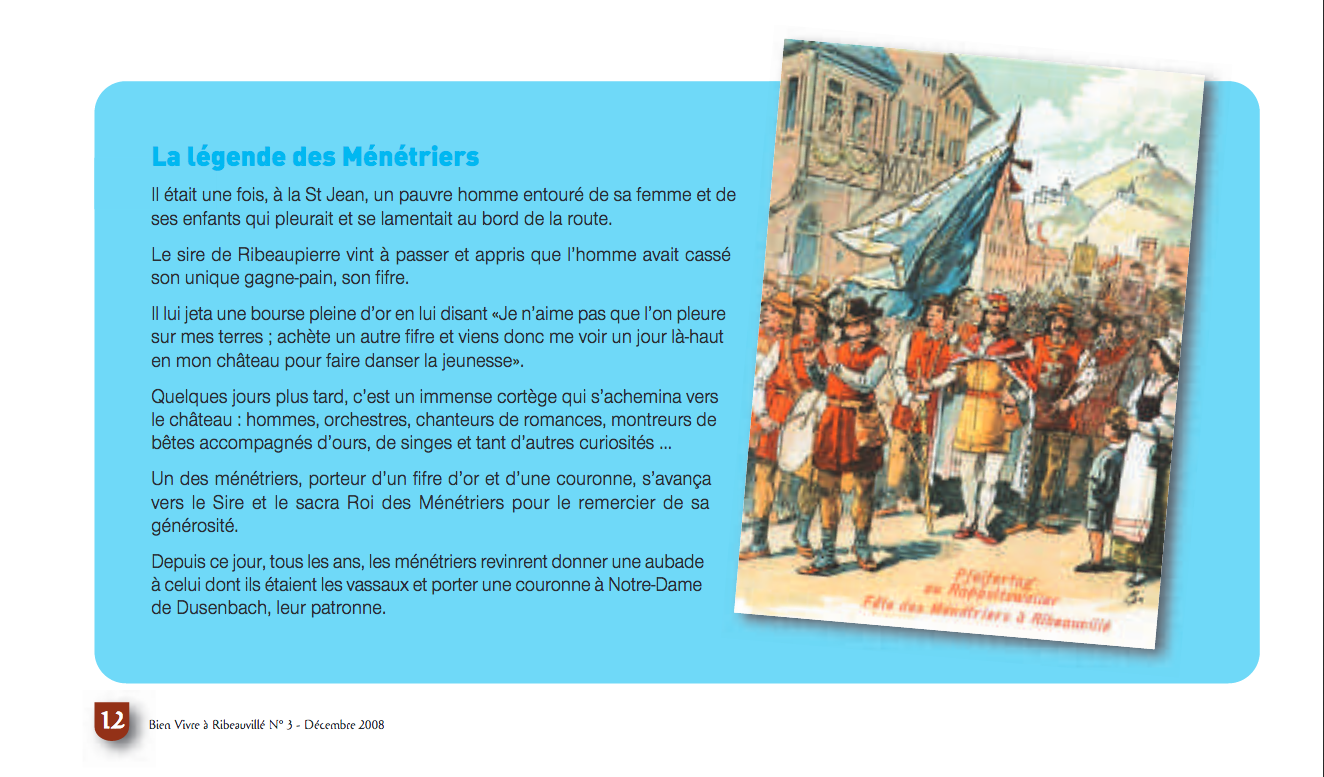
The tale makes protection personal and memorable. An instrument, a distressed family and an act of generosity explain the relationship through recognisable human needs. That is different from a charter establishing corporate rights. Calling it a legend does not make it irrelevant: it identifies the kind of memory being offered. It should not be converted into an eyewitness account of the confraternity's foundation.
The guild had business beyond entertainment
The city's 2014 historical account describes the ménétriers' annual assembly as an occasion for administrative and judicial business as well as ceremony and a banquet. It also distinguishes the office of their king from musical performance: the officeholder could be an influential innkeeper and did not necessarily have to be a musician or a Ribeauvillé resident. Municipal history of the ménétriers, bulletin number 25, printed page 8.
This account shifts the emphasis from colourful wandering entertainers to an organised body with disputes to settle and authority to exercise. It is a modern historical explanation, not the original statutes. Even so, the distinction it draws is important: the remembered guild was not simply a parade troupe, and a person playing its king today is not thereby exercising its former jurisdiction.

The Pfifferhüs photographed in 2015. Its name and carved façade do not prove that annual guild meetings took place here: the architectural inventory distinguishes that traditional claim from the documented venues. The visible business signage records the photographed setting, not a current recommendation. Photo: CTHOE, Wikimedia Commons; CC BY-SA 4.0. Unmodified by publisher.

A house name is not a meeting record
The Maison des Ménétriers, or Pfifferhus, offers a particularly local test of that distinction. Its architectural inventory rejects the traditional identification as the musicians' annual rendezvous. Instead, it lists successive meeting places elsewhere: the Étoile inn until 1715, followed by the Trois Rois, Homme sauvage and Soleil. Maison des Ménétriers inventory, IA68006982.
The same record preserves a genuine personal connection. In 1690, the house belonged to the tanner Jean Beysser, a king of the ménétriers; it subsequently passed to his son. An inn was installed on the ground floor in 1840. Ownership by an officeholder and use as a corporate assembly place are not interchangeable facts.
This is not a reason to erase the familiar name. It is a reason to read it carefully. The building carries the musicians' memory, while the documented geography of their meetings extends beyond the façade that now seems to embody it. IA68006982, ownership and use.
A cup and a painting preserve different histories
A more direct material connection survives outside Ribeauvillé. Musée Unterlinden in Colmar holds the gilded-silver hanap des ménétriers, inventory 94.6.1. Its national catalogue record associates the drinking vessel with the banquet following the annual assembly at Ribeauvillé and records the museum's acquisition in 1994. Joconde record 00280000222.
The regional museums catalogue identifies its maker as Maître D K, while treating the proposed identification with Dominicus Knigolt as tentative. That qualification matters: an object can have a documented institutional association without every detail of its production being settled. This is museum evidence held in Colmar, not a claim that Ribeauvillé has a dedicated guild museum. Musées Grand Est catalogue of the confraternity's hanap.
Ribeauvillé's town hall preserves a different kind of memory in Léo Schnug's painting of the Pfifferdaj. Its inventory places the undated work in the early twentieth century and records municipal purchase in 1961, followed by restoration by Charles Weinzorn. The described scene includes musicians, a civic banner and the three castles. Painting inventory IM68009474.
A vessel associated with a corporate banquet and a later painting of a procession do not offer equivalent testimony. The painting shows how the festival could be pictured long after the Middle Ages. Its historical costumes cannot turn the canvas into a medieval witness.
The archive records change rather than effortless continuity
The Cercle de Recherche Historique de Ribeauvillé et Environs describes holdings that include 84 Pfifferdaj posters spanning 112 years, alongside deposited archives from musical associations and the festivities committee. Its collection also includes recorded memories of older inhabitants. These are the society's descriptions of its holdings, not a claim here to have inspected every item. The historical society's documentary collections.
Such material can preserve more than a recurring date. Posters identify the image chosen for a particular edition; association records can place celebration alongside organisation. Recorded recollections add a different perspective from an official programme. None should be treated as a complete annual record merely because it belongs to a long-established festival.
The society's published contents for its 2026 study make that caution concrete. They separately identify cancellation in 1789, a crisis in 1958, a relaunch in 1959 and the Covid year of 2020. The catalogue is not a substitute for reading those chapters, but its organisation explicitly frames the festival through disruption and renewal. Contents of the society's 2026 Pfifferdaj study.

The Tour des Bouchers on 4 August 2025. The tower is a named setting in the later Pfifferdaj programme discussed below; this photograph shows the building, not a festival performance or evidence of uninterrupted musical custom. Photo: Einaz80, Wikimedia Commons; CC BY-SA 4.0. Unmodified by publisher.

Music occupies particular streets and moments
The programme for 6 September 2026 gave the procession the theme Le joueur de flûte de Ribeauvillé. It scheduled a morning musical awakening by the ménétriers of the municipal Vogésia ensemble at the Tour des Bouchers, followed by bands moving through the Grand'Rue and squares before the afternoon procession. Municipal Pfifferdaj programme for 2026.
Those details describe how the organisers intended music to inhabit the town, rather than confining it to the main parade. The same programme placed a musical aubade and awards on the following day. Different moments gave musicians, participants and audiences different roles.
These were scheduled arrangements, not observations of every performance. Their significance lies in the deliberate allocation of places and time. Streets become performance spaces through an organised programme; the medieval associations of their surroundings do not organise the event by themselves.
The costumes begin away from the crowd
Ribeauvillé's municipal sewing workshop provides a clearer view of the work behind the spectacle. The city describes a volunteer group led by Cathy Pfister-Bernabel, a seamstress responsible for the historical procession's costumes. It undertakes projects throughout the year, with several dozen festival costumes its principal annual undertaking. Municipal presentation of the sewing workshop.
A costume therefore represents present-day skill and time as well as an imagined historical character. The workshop's description does not establish that every garment reproduces an authenticated medieval original. Its evidence concerns people making clothes for a shared performance.
That distinction gives the makers their due. They are not merely passing on untouched objects. Their continuing work allows different participants to inhabit a changing procession. The festival's visual identity depends on that capacity to make again, not only on the age of the story being told.
The procession also needs buildings
On 12 July 2023, Ribeauvillé's council unanimously approved regulations governing the festival hangars and authorised agreements with participating associations. The minutes record an actual decision, rather than simply an intention to support local celebrations. Council minutes, printed page 5.
The accompanying regulation identifies the communal site on rue des Hirondelles and rue Steinkreutz and provides it without charge for preparing the Pfifferdaj and medieval Christmas market. Individual bays are allocated through annual, revocable agreements. Its storage instructions distinguish floats and construction materials in the hangars from costumes kept at the sewing workshop. Adopted regulation, printed pages 1 and 6, PDF pages 2 and 7.
This unglamorous document helps explain the built environment of a supposedly fleeting event. The procession occupies streets briefly, but its preparation needs sheltered working and storage space. Municipal provision and association responsibilities make that possible. The medieval-looking performance depends, in part, on thoroughly contemporary arrangements for using buildings.
Participation is organised rather than automatic
The association Ribototem describes its La Sauce group as multigenerational volunteers contributing logistical, organisational and festive skills to events including the Pfifferdaj. Its own membership information requires a conversation with the group's organisers and specifies that children cannot join without their parents. Ribototem's account of La Sauce.
That is a participant organisation explaining how people become involved, rather than a tourism page praising community spirit. It makes participation look like a relationship with responsibilities. Intergenerational transmission is not just a phrase attached to the festival: the group provides a practical framework in which adults and younger members can take part together.
The association does not speak for every participant. Its account nevertheless helps move attention from anonymous crowds to the groups that contribute skills and make decisions. A town tradition is sustained by particular organisations, not by an abstract population acting with a single voice.
The town judges and reinterprets its own performance
The municipality's results published on 8 September 2026 confirm more than a planned event. They record Délirium Tribu receiving the jury's first prize, while Ribototem received the public's favourite award. The report explicitly thanks builders, costume makers, performers, associations, security personnel and municipal staff. Published results of the 2026 procession.
The different awards give participants and spectators more than one way to value the performance. Alongside celebrating it, the town was also presenting its history: the municipal calendar announced a historical-society exhibition at Chapelle Sainte-Catherine for 12–27 September 2026. The notice describes a temporary historical exhibition, distinct from the museum collections discussed above. Municipal listing of the historical exhibition.
The Pfifferdaj is most convincing as living heritage when these acts of making, organising and reconsidering remain visible. Its historical value does not require every house name to be literal or every edition to repeat an ancient ceremony. The musicians' memory survives because people give it materials, places, skills and new interpretations in the present town.
Locate the town
For regional orientation, open a Google Maps search for Ribeauvillé. This community-level search is not an exact building entrance, a verified walking route or permission to enter a workshop, museum or private property. Check the institution’s own current access information separately.
Editorial source and verification notes
The workflow and pre-image statements below preserve the original authoring stage. Subsequent photo amendments and actual independent reviews are recorded in the current QA manifest; these historical statements are not the current review, image-count or storage status. Relevant regional museum evidence supplies the museum comparison; the absence of a verified village-based museum is not itself an unresolved brief requirement.
These notes are internal production material, not part of the article body. Sources were checked on 2026-10-27.
- Approved scope: Row 106 title and brief retained exactly. The LIVING_HERITAGE flag is editorial classification, not a claim of UNESCO inscription or official inventory designation. F0083's castle architecture and lordly relocation are not repeated.
- Legend and corporate history: The municipal legend image was downloaded and visually read. The 2014 historical page was downloaded, rendered and checked. It is attributed as a retrospective account; no original medieval charter or guild register was inspected. Conflicting dates for the festival march and precise foundation chronology are omitted.
- Place evidence: The Pfifferhus inventory was opened. It distinguishes an officeholder's ownership from assembly venues elsewhere. Architectural dates, carved initials and uncertain attribution of individual decorative features are not used.
- Museum and collection limits: The matching hanap inventory number was checked in both museum catalogues. They disagree on its dating, so no manufacturing date is asserted. Colmar is identified explicitly; a local guild-museum catalogue was not verified. The town-hall painting is a municipal collection object, not relabelled as a museum holding. Its online inventory was read; the original canvas was not inspected.
- Archival and exhibition limits: The society's holdings description and 2026 publication contents were opened; neither the deposited documents nor the full book was read. The announced exhibition was not visited. The separate municipal calendar supports the chapel venue without relying on ambiguous duplicated layout elsewhere.
- Present practitioners and municipal records: The workshop page, Ribototem's own account, 2026 programme and published results were opened. Programme entries remain described as scheduled. The council minutes and annex were downloaded from the municipal website; the approval page and relevant regulation pages were rendered and visually checked. They establish the 2023 decision, not a claim that every clause remains unchanged today.
- Source budgets and self-edit: Each source's cumulative use, including repeated links and these notes, was kept within its 200-word derivative budget. No quotations or lyrics are included; two photographs are reproduced unmodified under CC BY-SA 4.0 and documented in the image manifest. The complete manuscript was reread for original phrasing, chronology, qualifications and distinction between evidence types.
- Workflow state: Source drafting and self-edit only; no reviewer submission, conversion, publication or third-party contact. Qwen and DeepSeek remain PENDING_NOT_SUBMITTED, final QA NOT_COMPLETE, and publication NOT_LIVE.