Free · France
Troyes: Textile production beyond the postcard streets
A factory roof is easier to recognise as industrial heritage than a small replacement part. In Troyes, however, the knitting-machine platine, or sinker, offers a particularly useful way into textile history. It connects the making of fabric to a less conspicuous activity: making the machinery's working components. Following that connection leads from the museum's explanation of a loop to a manufacturer's catalogue and then to an industrial block on rue de Chaillouet. The subject is not another celebrated clothing label, but the equipment on which production depended.
The blade between the needles
A sinker is not a sewing needle. The technical terminology published by the Office québécois de la langue française describes it as a flat sheet-steel component positioned between knitting needles to assist their work. Its precise task varies with the machine and needle system. On some machines it helps form loops; on others it assists the release or retention of existing stitches. The French name identifies a functional family, not one universally interchangeable shape. OQLF, textile definition of platine.
Troyes's museum supplies a specific example. Its educational dossier diagrams a straight knitting frame using bearded needles, whose hooked ends can be pressed closed. The operator lays yarn across the needle row; descending sinkers shape loops between the needles. A press closes the needle beards, allowing the previously knitted fabric to pass over them and a new row of stitches to form. This sequence describes the illustrated mechanism, not every subsequent knitting machine. Musées de Troyes, technical dossier, printed page 10.
A diagram answers a different question from a parts catalogue. One explains movement; the other helps identify an item. Neither should be mistaken for a manufacturing drawing from which a replacement could be made. That distinction becomes essential when trying to connect museum machinery with the businesses that supplied it.
Material matters at this scale. A manufacturer's 2015 account of modern sinkers emphasises rounded edges, straightness, dimensional consistency and resistance to wear where yarn contacts the component. These are contemporary production requirements, not evidence for Lebocey's historical alloys or heat treatment. They nevertheless explain why a small metal part deserves close attention: the surface meeting the yarn is part of the textile-making process. A strong machine frame alone cannot provide that contact quality. Groz-Beckert, sinker development.
A component becomes a commercial product
The Médiathèque de Troyes identifies a 1924 Lebocey brothers catalogue of knitting-machine needles and sinkers. Its reproduced spread arranges notched and hooked components against black backgrounds, alongside headings for different machine families. Variety is the selling point. Médiathèque de Troyes, catalogue identification and reproduced spread, Cl. 4. 11756.
The text attributes the cutting department's move from rue de Paris to the new Chaillouet factory to expansion and insufficient space. It advertises nearly three thousand punches and cutting dies. This is the manufacturer's statement of capacity, not an audited production total. Lebocey catalogue, digitised spread.
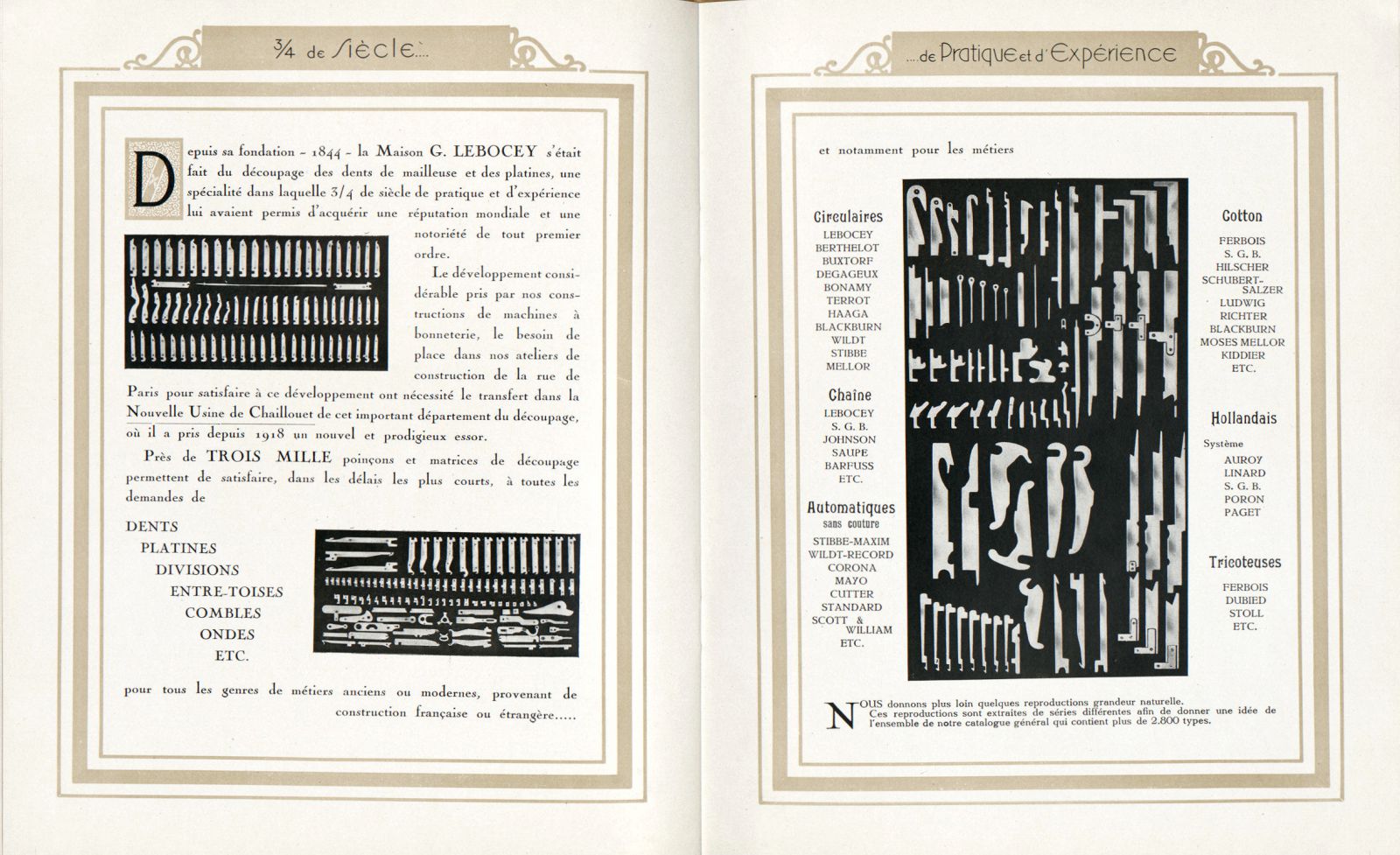
The distinction between a cutting die and the part cut with it is important. Tooling belongs to the production of components; the component then belongs to the production of fabric. Beginning the story only when yarn enters a knitting machine leaves that earlier manufacturing stage out. The distinction also changes what might count as textile heritage: not simply the finished article or the machine that knitted it, but equipment used to make that machine's working parts.
There is a limit to what this commercial evidence can establish. An illustrated range is not an order book. It does not identify which local customers bought each shape, how often they reordered, or whether a specific machine now in the museum ever carried a Lebocey sinker. The connection is between documented activities in the same industrial city, not a reconstructed journey for one surviving object.
Small parts and a substantial city block
The city's 2017 heritage assessment identifies the Lebocey needle-and-sinker works at 3 rue de Chaillouet as occupying an entire block. It distinguishes an ordered brick office frontage from workshops under sawtooth roofs, with tile and glass covering. It also records the loss of a rear workshop after the inventory survey. This is already a history of an altered industrial site, not a guarantee that every documented structure remains. Ville de Troyes, AVAP report, site sheet 7, PDF page 58.
That civic description changes the scale of the investigation. The sinker is small enough to disappear within an account of a complete machine; its production belongs to the history of a whole urban block. Building size and product size clearly need not resemble each other. An industrial landscape cannot be decoded merely by imagining large goods behind large façades.
The assessment proposes attention to boundaries and the courtyard's relationship with the street. Its concern is how an inherited industrial enclosure can function within the city, rather than how many components it could supply. Urban assessment cannot recover a shift's work from a roofline, while a sales publication gives buyers little reason to consider a factory's effect on neighbouring streets. Combining the two requires keeping their purposes separate.
One comparison clarifies the difference between making machinery and using it. The national industrial inventory records winding in the basement and knitting machines above in the former Doué et Lamotte hosiery works on faubourg Croncels. It separately identifies a repair workshop. The description derives from an older survey, not a current operating plan. Its value here is the distinction between preparation, knitting and maintenance within one establishment. Ministry of Culture, industrial inventory IA10000268.
That arrangement is not evidence that Doué et Lamotte purchased Lebocey components. It shows instead why a machine part belongs in a wider account of factory space. Even an establishment described by its finished product contained activities that did not themselves produce a stocking. The machinery needed supporting work, just as the yarn needed preparation.

The Hôtel de Vauluisant, home to Troyes’s hosiery collections, photographed in February 2011. This exterior locates the museum evidence used here; it is not a Lebocey factory, a knitting-machine photograph or proof of any component’s maker. Photo: Rabbitslim, Wikimedia Commons; CC BY-SA 3.0. Unmodified by publisher.

The labour around the mechanism
The local museum's account of the older hand-powered frame makes maintenance part of the operator's competence. It describes coordinating hands and feet, replacing broken needles, casting the lead mounts that held needles, and being able to remake sinkers. This is not an image of an artisan simply feeding yarn into a self-sufficient device. Operating and keeping the equipment usable were connected tasks. Musées de Troyes, technical dossier, printed page 9.
The museum's later guide locates early innovation among artisans, mechanics and clockmakers who travelled between rural workshops repairing equipment. In this account, technical change grew from practical repair networks as well as individual inventions. Musées de Troyes, 2025 guide, page 5.
An automatic machine does not make knowledge unnecessary; it changes which interventions are required and who performs them. Nor does the availability of purchased parts, by itself, prove the disappearance of workshop repair. To establish that change would require evidence from maintenance records, purchasing accounts or testimony from operators. The material examined here does not measure the division of those tasks within individual knitting businesses.
Nor does the person operating a displayed frame represent the entire workforce. The museum's 2025 guide reports that women made up 52.5 per cent of the hosiery workforce in 1906 and discusses recurrent labour conflicts from the 1880s. It also distinguishes knitting from later finishing and stitch-repair operations. These points prevent a history of machines from becoming a history only of their named inventors. The workforce figure is the museum's historical synthesis; it is not a new calculation from census returns. Musées de Troyes, 2025 guide, pages 17 and 19.
A separate documentary trail concerns workers' collective provision. The BnF's record for the Troyes hosiery workers' mutual-aid society traces its foundation in 1814 within Eugène Janson's business and its opening to other hosiery workers in 1827. It identifies successive statutes preserved by the local médiathèque. That record establishes an organisation beyond the individual workshop; it does not reveal a particular member's benefits or prove that Lebocey's component workers belonged to it. BnF, hosiery workers' mutual-aid society publications.
What preserving a factory can preserve
The museum's collections account includes locally made wooden-framed machines alongside other knitting systems and accessories. It presents objects as evidence for technical change. That is a useful alternative to seeing every old machine as merely an earlier, slower version of the latest one. Equipment can be compared by the tasks it performs and the demands it places on its operator, not only by its age. Musées de Troyes, machinery collections.
Troyes's municipal planning account treats the hosiery era as the source of an urban fabric extending beyond individual factory buildings, encompassing workers' housing and employers' residential districts. This is a broader heritage category than a collection of impressive industrial façades. Ville de Troyes, heritage planning overview.
The sinker brings that larger setting back to a manageable scale. Its working role explains a technical requirement; the catalogue shows a business organised to supply components; the Chaillouet assessment locates that activity in a substantial piece of Troyes. None supplies the others' missing evidence. Without workshop records, the sound, pace and earnings of a particular production line remain outside this account.
Preserving a roof or office frontage cannot preserve all those relationships. Keeping the component legible helps: not as an anonymous curiosity beside a large machine, but as something made, selected, fitted and replaced. Beyond the postcard streets, Troyes's textile history includes the work of making textile production possible.
Locate the town
For regional orientation, open a Google Maps search for Troyes. This community-level search is not an exact building entrance, a verified walking route or permission to enter a workshop, museum or private property. Check the institution’s own current access information separately.
Editorial source and verification notes
The workflow and pre-image statements below preserve the original authoring stage. Subsequent photo amendments and actual independent reviews are recorded in the current QA manifest; these historical statements are not the current review, image-count or storage status.
These notes are internal production material, not part of the article body. Sources were checked on 2026-10-27.
- Map and format: Read-only inspection of supplied workbook sheet
01 France, row 114 verified content ID, FREE access, L2 PLACE MICRO tier, region, locality, category, exact title and brief. No workbook changed. TRADITIONAL_OBJECTS follows the parent's approved assignment. F0091 supplied only frontmatter/status and internal-note conventions; no prose, paragraph structure or architectural argument was reused. Explicit established SOURCE.md format retained; no DOCX/PDF deliverable or Page created. - Narrow feature: The knitting-machine platine/sinker, its documented role in one illustrated bearded-needle frame, and the local supply/maintenance infrastructure it reveals. This is an object-type investigation, not a claim to have examined a particular accessioned sinker. No dimensions, historical alloy assay, heat treatment, throughput or customer provenance are asserted.
- Archival primary evidence actually inspected: Opened the médiathèque's economy-and-society collection page. Its public HTML linked the displayed 1924 Lebocey catalogue spread, Cl. 4. 11756; downloaded that ordinary public JPEG and visually read both pages at readable resolution. Illustrated components are not all labelled individually as sinkers. Machine-family headings and commercial claims are treated as advertising evidence, not audited counts, purchases, installed-machine inventories or direct labour testimony. No full catalogue was inspected. Both catalogue links share one source budget.
- Technical sources: Opened OQLF's dated textile terminology entry and Groz-Beckert's 2015 first-party technical/product account. OQLF provides steel-sheet classification and variable functions; it does not establish the composition of a historical Lebocey specimen. The modern manufacturer's claims are limited to its stated technical concerns, not adopted as an endorsement, comparative performance finding or proof of historical manufacture. No equation of all machine systems is made.
- Local museum evidence: Educational dossier pp. 9–10 (PDF 5–6), guide pp. 5, 17, 19, and machinery page read as text. PDF screenshots unavailable. No original census, payroll, site inspection or current-display claim. Full detail retained in QA.
- Civic and built-environment evidence: Opened the municipal heritage-planning page. The 2017 AVAP PDF exceeded the web reader's size ceiling; an ordinary download from the official URL succeeded. Relevant text was read locally, and PDF page 58, site sheet 7, was rendered and visually checked. Architectural text credits the regional inventory; it is not counted as independent corroboration of that inventory. This older assessment is not a current condition survey or parcel-specific planning-law opinion. The Doué et Lamotte POP record was opened; its survey is dated 1986, with later record maintenance. Its historical use descriptions are not presented as current occupancy or proof of a Lebocey supply contract.
- Additional labour documentation: Opened BnF's bibliographic record for the mutual-aid society publications; used only its organisational history and holdings description. No statutes or member accounts were read, and no beneficiary, benefit level or component-worker membership is inferred.
- Access limitations and unused leads: The industrial-archives guide on archives.developpement-durable.gouv.fr returned HTTP 403 and was not retried or used. FranceArchives and the Aube archives homepage returned JavaScript/cookie-only text; no challenge was bypassed. An Aube 1916 exhibition PDF produced a web cache miss and an ordinary official-URL download returned 404; no content from that search-only lead was used. The catalogue JPEG was unavailable through the web image opener but its normally linked public asset downloaded successfully. INA's explanatory page was opened but no video viewed and no INA claim used. No inaccessible originals are represented as inspected.
- Source discipline and self-review: Repeated URLs and the catalogue landing page/image are combined for source-budget checking. Factual paraphrase is kept brief; methodological cautions and the analytical structure are original. No source is used as a hidden template. Contemporary technical comparison is separated from historical evidence. Only brief names and technical terms are quoted; there is no long translation. Full article reread and self-edited for scope, technical distinctions, chronology, attribution and unsupported installation links. This is author self-review only.
- Production state: DRAFT and AWAITING_INDEPENDENT_REVIEW. Qwen and DeepSeek remain PENDING_NOT_SUBMITTED; no submission or independent pass claimed. Final QA remains NOT_COMPLETE and publication NOT_LIVE. No upload, user message, external contact, schedule, map edit, other SKU or publication undertaken.