Free · France
Amiens: Cathedral crafts and medieval town wealth
Reading wealth in a wooden seat
The choir stalls of Amiens Cathedral offer a close-grained way to think about the relationship between a prosperous town and its religious buildings. These are seats, partitions and supports as well as carved images. Their oak joins bodily use to elaborate display. The cathedral's friends association places their production in the early sixteenth century, under the direction of the canons. They are not furnishings left unchanged since the cathedral's thirteenth-century construction. Les Amis de la Cathédrale d'Amiens, “Les Stalles”
That distinction is the starting point. “Medieval town wealth” can become an explanation so broad that every beautiful object seems to follow automatically from commerce. Looking closely at the stalls, then at a related carved frame in the Musée de Picardie, gives a more precise account. Resources had to become commissions; commissions required skilled work; objects then organised worship and represented particular groups. The town's prosperity and the surviving furniture belong to a connected history, but not to one undifferentiated building campaign.
The cathedral was furnished over centuries
The Centre des monuments nationaux dates the beginning of the Gothic rebuilding to 1220 and its principal structural completion to 1269. It associates the rebuilding with Amiens's textile economy and the flourishing trade in waide, or woad. The same account treats the stalls and choir screens as sixteenth-century additions. Centre des monuments nationaux, history of Amiens Cathedral
This supplies context, not a surviving balance sheet. It does not show that a particular sack of dye material paid a particular carver, nor that the same merchants financed both the thirteenth-century masonry and the later woodwork. The interval matters. A cathedral can remain a focus for spending and artistic activity long after its main walls are built.
The objects also ask us to distinguish kinds of wealth. Commercial success, institutional resources and an individual's capacity to offer a devotional painting are not interchangeable measures. They may meet inside the same building without having the same owners or passing through the same accounts. The material history becomes clearer when these routes are kept separate.
Furniture for an organised body
Amiens's municipal archives introduce the stalls through an undated view, reference 10Z2846. Their interpretation describes wooden seats on both sides of the choir, used by clergy to sit or lean during services, and identifies 110 surviving stalls. The archival image record is useful evidence of later documentation, but its undated status prevents using it as a precise restoration benchmark. Amiens municipal and community archives, cathedral feature 10
The functional point deserves attention before the sculpture. A seat establishes a place for a person within an ordered group. Repeated seats establish relationships between people and between the two sides of a room. Carving does not cancel that practical arrangement; it gives it additional meaning.
The traditional object here is therefore not an isolated figurine. It is a fitted ensemble whose parts work together. Studying only a memorable face or a humorous detail can obscure the scale of the furnishing and the requirements of its users. Conversely, treating the stalls as merely seating overlooks the labour invested in making their surfaces visually active. The practical and representational demands meet at the same scale: the distance of a hand, a seated body or a nearby viewer. This is why a small component can matter as much to the interpretation as the imposing outline of the whole ensemble.
Making and commissioning are different questions
A 2021 visit report by the Friends of the National Renaissance Museum records a presentation by specialist Kristiane Lemé-Hébuterne. It explains the hinged seat and its misericord, the small support used while standing, and identifies the canons' initiative in the commission. Importantly, it also warns that gaps in accounts and deliberations prevent certainty about who chose the imagery or recruited the artisans. The report identifies Jean Trupin and Antoine Avernier among the known sculptors, while leaving much of the workforce obscure. Friends of the National Renaissance Museum, note 357, pp. 1–2
This is a published account of a specialist-led visit, not the original workshop documentation. Its caution is more valuable than a convenient story about a single generous patron and a single inspired maker. A large commission could involve people performing different tasks, with uneven chances of having their names preserved.
The research problem is central to Stéphanie Diane Daussy's Sculpter à Amiens en 1500. In the published introduction, she sets the stalls within a broader surviving production and asks how an artisan's individual work relates to professional and social structures. That approach discourages treating style alone as a complete biography of the person who cut the wood. Daussy, research introduction, pp. 17–19
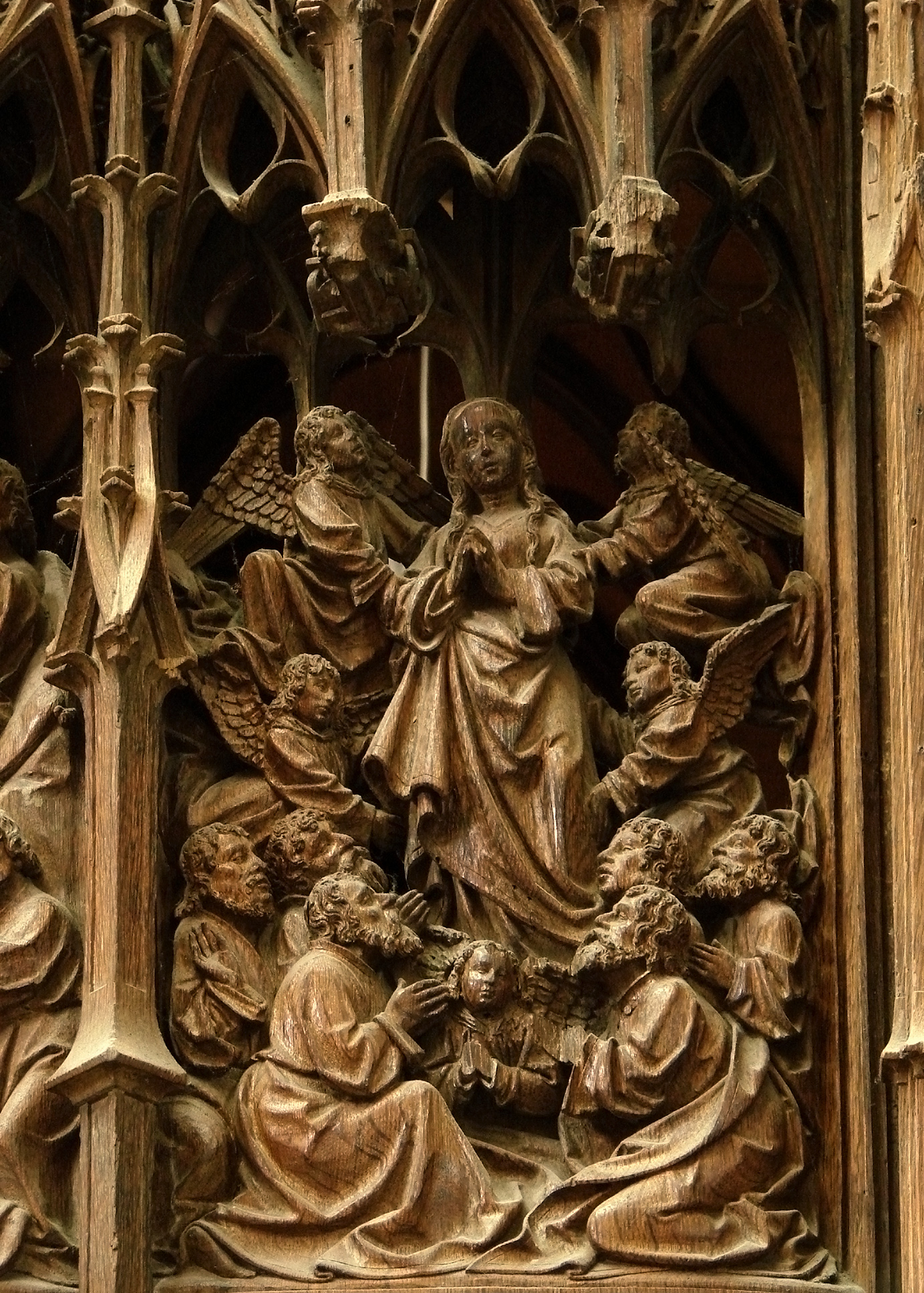
A detail of the Amiens stalls identified by the photographer as the Assumption, photographed in 2008. Figurative carving sits within an elaborate architectural frame; this is not a depiction of a documented local workforce or evidence of who paid for the panel. Photo: Vassil, Wikimedia Commons; CC BY 3.0. Unmodified by publisher.

The carvings are not a census of occupations
The Centre André Chastel's Théophile database describes the stalls as an ensemble originally comprising 120 places, ten of which disappeared during eighteenth-century alterations. It distinguishes major biblical cycles from genre and fantastic figures placed on handrests and other elements. Its catalogue also retains uncertainty in identifying one associated detail as an architect or master mason. Centre André Chastel, Théophile object 68220
Such descriptions support close attention to work and daily life, but not a literal reading of every figure as a portrait of an Amiens tradesperson. Biblical narrative can use familiar clothes or gestures; fantasy can sit beside recognisable activity. The database's question mark is not a defect to remove. It marks the difference between observing a representation and securely identifying its subject.
For the same reason, a sculpted occupation does not prove that its practitioners paid for the panel. Presence in an image and financial patronage are different kinds of evidence. The stalls bring craft into the cathedral twice: as work performed by their makers and as activity represented within the decoration. Those two appearances should not be collapsed into one.
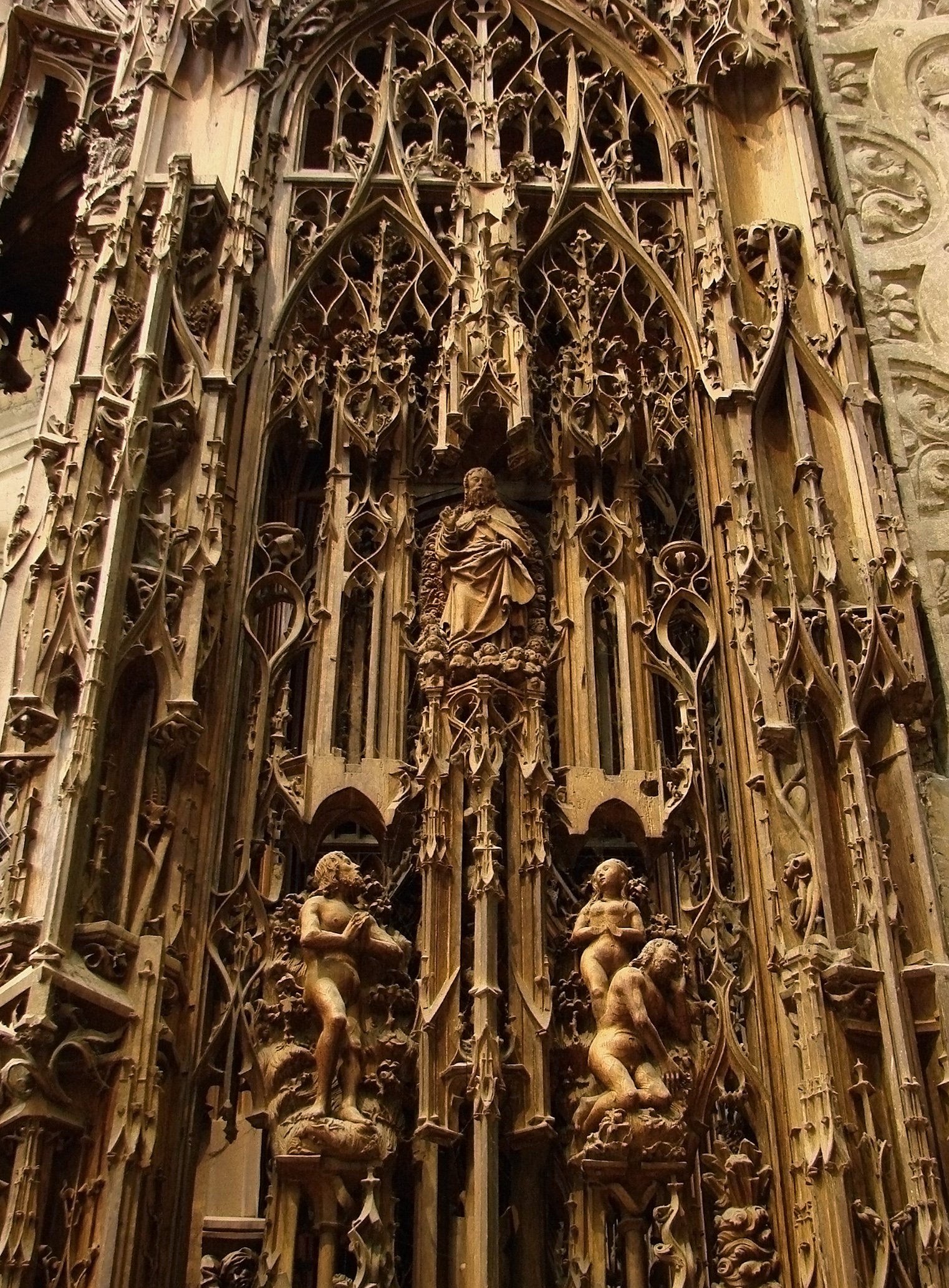
The dean’s stall end, identified in the image record with Adam and the creation of Eve, photographed in 2008. The larger setting makes the relationship between figures and fitted woodwork visible. This is cathedral furniture, not the Musée de Picardie’s Puy frame. Photo: Vassil, Wikimedia Commons; CC BY 3.0. Unmodified by publisher.

A museum frame broadens the view
The Musée de Picardie's record for Au juste pois véritable balance, known as the Puy of 1518, identifies a painting dated 1519 with a carved oak frame retaining traces of colour. Its inventory number is M.P.2004.17.303. The museum names Antoine Picquet, a royal prosecutor, as the donor and connects the central balance with his legal office. This is an unusually specific route from a local person's position to the imagery of an object made for the cathedral. Musée de Picardie, object notice
The distinction between its customary Puy year and the museum's object date should be preserved, rather than corrected into a single number. So should the frame's material history. Traces of polychromy complicate an appreciation based only on the appearance of bare carved oak.
This object is not another choir stall, and Picquet is not thereby established as a patron of the stalls. Its value as a comparison lies in showing another kind of commission within the same cathedral environment. Woodworking could serve a painting's presentation as well as a cleric's seat. Both required decisions about scale, ornament and use.
The cathedral as a place of corporate display
The museum's exhibition dossier explains that the Notre-Dame du Puy confraternity brought together clerical and lay notables and made artistic commissions part of its devotional activity. It also draws a relationship between the monumental oak frames of several early-sixteenth-century Puys and the ornamental language of the stalls. The comparison is the museum's, not an attribution of all those objects to one workshop. Musée de Picardie, Puys exhibition dossier, printed pp. 6–11
Here town wealth becomes visible through social choices rather than an abstract claim about riches. People could organise a commission, select a theme and have themselves represented in a religious setting. A gift could honour the Virgin while also preserving the donor's presence. Those purposes were not necessarily opposites.
The present distribution of objects also matters. The stalls remain cathedral furniture, while the painting and frame are studied through a museum collection. They do not arrive before today's reader under identical conditions. One is encountered as part of a furnished religious space; the other has a collection history, inventory number and conservation record. A comparison must respect those different histories of survival.
What the wood can establish
The strongest argument is not that ornament measures Amiens's wealth in a direct, numerical way. No income series or complete payment account was examined here. Instead, the objects establish the presence of substantial skilled production and differently organised commissions around the cathedral at the transition from the later Middle Ages into the Renaissance.
Their interest lies in the details a distant view of the building misses: a seat which changes position, a handrest carrying a figure, a frame whose remaining colour unsettles assumptions about old wood. These details restore use and making to a monument often discussed primarily through height and architecture.
The stalls and the Puy frame do not tell the whole town's story. They are selective survivals associated with institutions and people able to commission conspicuous work. Read alongside archival and museum records, however, they show how a religious building could gather skilled labour, devotion and social representation over time. Cathedral craft is not an ornamental footnote to urban prosperity. It is one of the material processes through which that prosperity was organised and made visible.
Locate the town
For regional orientation, open a Google Maps search for Amiens. This community-level search is not an exact building entrance, a verified walking route or permission to enter a workshop, museum or private property. Check the institution’s own current access information separately.
Source register and boundaries
All sources accessed 2026-10-27. Claim-adjacent links identify the sources used.
- Les Amis de la Cathédrale, stalls page: opened association interpretation; oak and early-sixteenth-century setting.
- Centre des monuments nationaux: opened monument history; broad textile context, not a quantified financing account.
- Amiens municipal archives, feature 10: opened record and interpretation of undated image 10Z2846; original image not inspected.
- Friends of the National Renaissance Museum, note 357: opened PDF text reporting a specialist-led 2021 visit; mediated scholarly testimony, not original contracts.
- Daussy, 2013 introduction: opened author's research framing; the complete monograph was not consulted.
- Centre André Chastel, Théophile 68220: opened scholarly object record; child entries did not load, so no independent claim about their detailed images is made.
- Musée de Picardie, M.P.2004.17.303: opened object record, keeping Puy year and stated object date distinct.
- Musée de Picardie, exhibition dossier: opened institutional PDF text; used for confraternity and frame comparison, not proof of a shared workshop.
Remaining gaps: Original chapter accounts, contracts, timber provenance, tool marks, conservation files and household or guild income records were not examined. Published summaries differ on the precise completion year of the stalls; this article uses the early-sixteenth-century period rather than resolving that discrepancy. The regional inventory item, academic teaching PDF, conference page, usable FranceArchives record, BnF and Bibale manuscript pages and several detailed images were unavailable and excluded. The physical objects and institutional PDF images were not directly examined; the two separately licensed photographs above are not a substitute for object or conservation study.