Free · France
How Market Days Organize Life in French Towns
A basket of vegetables is one way to remember a market. Another is the route you took through it: the gap between two stalls, the doorway you nearly missed, the square that seemed to have become a different kind of place.
Market days are useful windows onto local life because they bring a calendar and a street plan together. To understand them, look beyond what is for sale. Ask when the market happens, how it occupies space, and what must happen before and after the shopping.
Sarlat-la-Canéda and Revel, two towns in southwestern France, offer concrete examples. Their arrangements are not a model for every French town. They show why “there is a market here” is only the beginning of useful information.
One town can have several market clocks
Sarlat's tourist office lists its traditional open-air market on Wednesdays and Saturdays throughout the year. The days are not interchangeable: Wednesday is a food market in the morning; Saturday combines morning food sales with other goods continuing later. A visitor arriving on Saturday afternoon might therefore see stalls and still have missed the food market they intended to visit. Sarlat Tourism, traditional market.
That distinction matters beyond sightseeing. If you want to buy ingredients, meet someone or combine a market visit with another errand, the relevant appointment is not simply “Saturday.” It is a particular part of Saturday, for a particular purpose. The same place can offer different things at different hours.
Nor does the outdoor market's timetable describe every market in town. Sarlat also has a covered market in the former Sainte-Marie church, with its own season-dependent opening schedule. A building and an outdoor event can sit close together without sharing the same calendar. Sarlat Tourism, covered market.
A useful question: « C'est le marché de plein air ou le marché couvert ? » — “Is that the open-air market or the covered market?” Clarifying which one is meant can be more useful than asking only whether “the market” is open.
Look at the street, not just the stalls
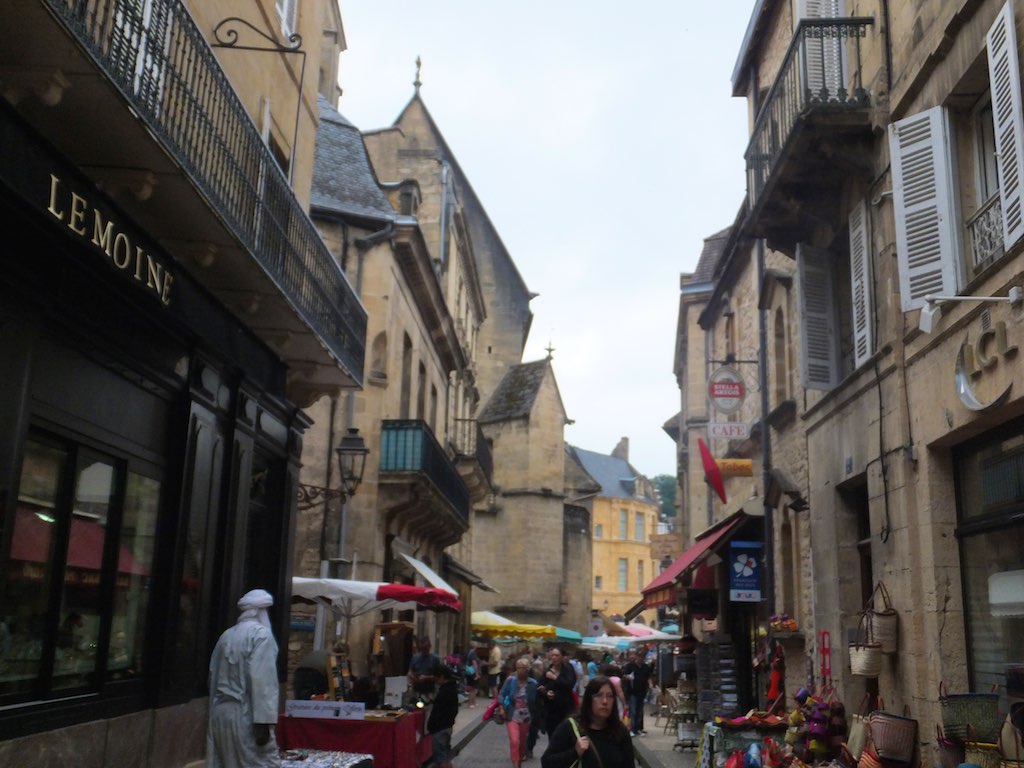
Sarlat, photographed on 5 July 2014. Temporary stalls, permanent shopfronts and a walking route occupy the same small street. Notice where someone can stop to browse and where others still need to pass. This is a dated scene, not a promise of today's stall positions. Photo: angelap2009, “Sarlat Market,” CC BY 2.0. Unmodified photograph; display size only changed.
The photograph suggests a practical way to read a market: follow the spaces between things. A stall is not just a collection of products. Its table, canopy and customers occupy room beside entrances and routes that have other uses. When you stop to check a map or admire a display, choosing a place out of the moving stream helps keep that shared space usable.
Revel: a market has an internal geography
Revel's municipal website identifies Saturday morning as its recurring market time, centered on the town's hall and extending into surrounding areas. The local tourist office describes a more detailed arrangement: producers under the hall, food trades around it on Place Philippe VI de Valois, and clothing and accessories on Boulevard de la République. These are the published patterns, not a guarantee that every trader will occupy an unchanged position on your visit. Ville de Revel, market overview; Aux Sources du Canal du Midi, market description.
This is more informative than imagining one undifferentiated row of stalls. “At the market” can mean under a roof, around the square or farther along a boulevard. If you arrange to meet someone, name a specific visible landmark rather than the whole market. If you are looking for a particular kind of stall, ask which part of the market to try.
A covered space still needs room to move
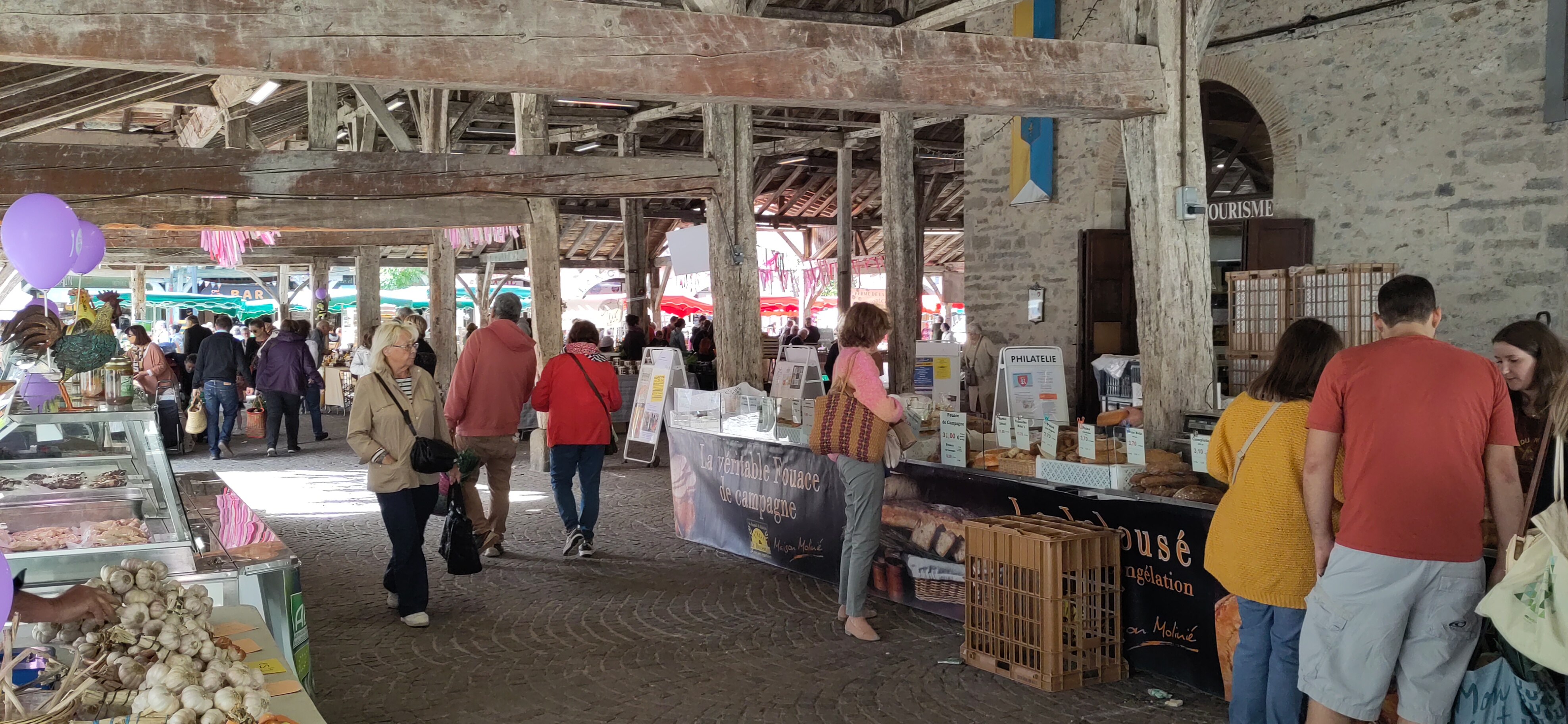
Revel, photographed on 21 October 2023. The timber posts, counters and aisle make the relationship between shelter, selling and passage visible. Compare this broad covered space with the narrow Sarlat street above. These are different towns and dates, not a before-and-after pair. Photo: Rebecca W, “Revel,” CC BY-SA 2.0. Unmodified photograph; display size only changed. The photograph remains available under its stated license.
Look for three things in this image: a fixed feature, a selling area and a passage. The roof and posts remain in place; counters organize transactions; the aisle allows people to move between them. The picture does not tell us who lives nearby, who is visiting or how often anyone shops here. Those are questions about people's lives, not facts visible in their appearance.
The market day extends beyond the last sale
For a shopper, the important time may be when a stall closes. For a town, the sequence is longer. Revel provides a documented example: an October 2024 municipal order addressed market-day circulation and parking, explicitly including the period needed for street cleaning. Its context also included temporary changes linked to work on the hall and belfry. This is a dated example of coordination, not current parking or access advice. Ville de Revel, order 2024.628.AG, page 1.
The lesson is simple: a market's public opening hours are not necessarily the whole period during which its streets are being used for market work. Setting up, serving customers, packing away and cleaning are different stages. An apparently empty selling area may still be a working area. Follow current signs and directions rather than assuming that the disappearance of a stall means a route or parking space is available again.
This also changes what counts as “local life.” It includes the people browsing and talking, but also the less picturesque tasks that make the next use of the space possible. Looking only at the busiest shopping moment leaves out part of the market day.
Familiar does not mean frozen in time
Sarlat's municipal heritage publication, a retrospective of life from 1875 to 1975, describes several specialized markets and records the walnut market's move in the 1970s to Place du 19 Mars 1962. A market can have a long history while its location and organization change. Ville de Sarlat, Sarlat se souvient !, printed pages 10–11.
That is a better starting point than treating a market as an untouched remnant of the past. The recurring day may be familiar while routes, buildings, products and practical arrangements evolve. An old photograph is valuable precisely because it records a particular moment, not because everything in it must still be true.
Regular recurrence also makes a market a possible meeting point. You can arrange to return next week or combine buying something with seeing someone. But the existence of a weekly market does not establish how much of any household's shopping happens there. Some people may make a brief purchase; others may browse without buying. Neither is a test of how “local” someone is.
A five-minute way to observe a market
You do not need to interview strangers or buy anything to notice how a market works. Stand somewhere that does not obstruct a stall or entrance, then try these four prompts:
- Read the time. Find the name and published day of the particular market. Is it weekly, seasonal or a separate special event? Do food and non-food sales have different hours?
- Read the space. Identify a permanent feature, a temporary stall and a route between them. Where would two people meet without blocking the flow?
- Read the transition. If packing or cleaning is under way, observe from outside the working area. Do not treat a quiet patch as permission to enter.
- Separate observation from inference. “Several people are carrying shopping bags” is observable. “Everyone here buys all their food at this market” is not.
For a short exchange, try « Le marché a lieu quel jour ? » — “What day is the market?” Or, for the part you want, « Les stands alimentaires restent jusqu'à quelle heure ? » — “Until what time do the food stalls stay?” These are practical questions, not a script that assumes every trader has time for a long conversation.
Before traveling, check the municipality or tourist office for the exact market, date and current arrangements. The local pages cited here were checked on 28 October 2026; holiday changes, temporary work and later updates can alter what you find. For access or parking, consult current local information rather than using either photograph as a route map.
A market day becomes easier to understand when you keep two clocks in view: the week that brings it back, and the working day that sets it up and clears it away. Between those clocks, the town's ordinary spaces take on a particular, temporary use.