Free · France
Reading a French Facture and Receipt
A narrow strip of paper comes out of a till. A second slip comes from the card machine. Later, an email arrives with a document called a facture. They may relate to the same purchase without answering the same question.
Start with the question you need answered: What was supplied? What amount was charged? What evidence records the payment? Do not decide solely from the paper's size or the boldest word at its top. This guide is for reading everyday consumer documents, not preparing business accounts or determining whether a particular invoice is legally compliant. Official guidance was checked on 28 October 2026.
Identify the document before adding the figures
A facture is an invoice detailing a sale or service, including its price and payment terms. It differs from a devis, the proposal issued before the work or sale. Service Public also explains that names can overlap: a consumer document may be called a note, while a quittance follows payment. A document headed facture should therefore not, by itself, be treated as confirmation that its balance has been settled. Service Public Entreprendre: invoicing.
A ticket de caisse records the purchase at the till. DGCCRF describes it as purchase evidence with seller details, items, quantities, prices and date/time. A ticket de carte bancaire concerns the card transaction; keep the two functions distinct when deciding what evidence you need. For example, a card amount alone does not tell you which item an abbreviated product line refers to. DGCCRF: till and card receipts.
Here is an original way to sort your papers:
| Your question | Where to begin looking | |---|---| | What goods or work does this charge concern? | Item descriptions on the purchase document or invoice | | Is this the quotation I accepted or the later bill? | Heading, issue date and reference to the work | | How much was due and when? | Total, balance and payment terms on the invoice | | What records the payment I made? | Payment acknowledgment and transaction evidence, matched to that purchase | | Which document should I send for a particular request? | The recipient's stated requirements, rather than your guess |
These are reading prompts, not a legal ranking of evidence. If you are asked for a facture, do not assume that a photograph of a card slip is an equivalent replacement.
Read one real example slowly
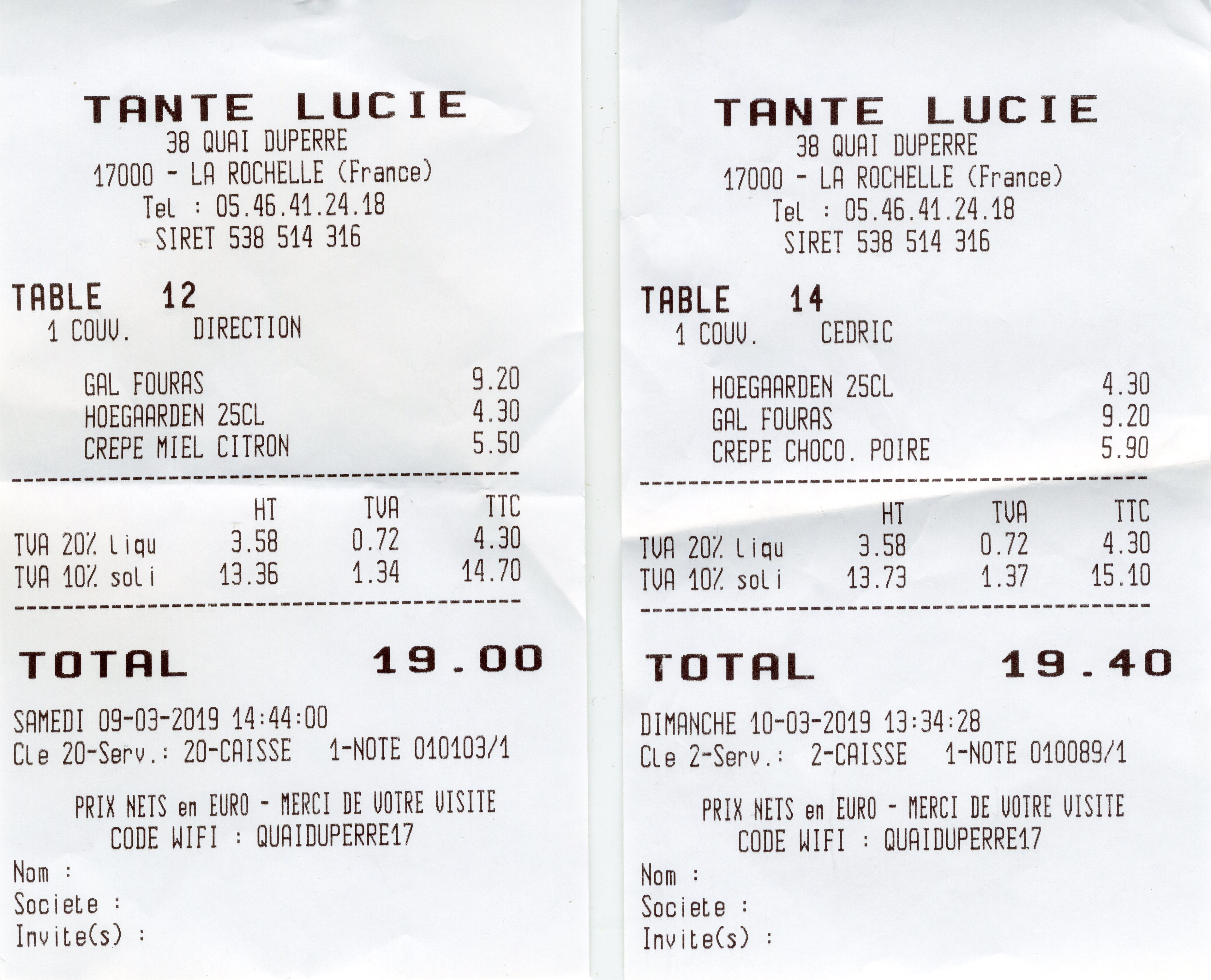
Historical reading example, not current prices or a recommended invoice template. These two March 2019 restaurant receipts display the seller, items, tax breakdown and separate totals. Document source: Crêperie Tante Lucie; digital image uploaded by Jpbazard, 11 March 2019. Original image and provenance, marked public domain as non-original factual material. Unchanged image; no current business or contact details are being recommended.

Look at the left-hand receipt only. Its three item amounts are €9.20, €4.30 and €5.50. They add to €19.00. The tax breakdown below is another view of those amounts, not three more purchases to add to the bill.
The headings help you follow the arithmetic:
- HT — hors taxes: excluding tax.
- TVA — taxe sur la valeur ajoutée: value-added tax.
- TTC — toutes taxes comprises: including taxes.
In this photographed example, one breakdown row reads €3.58 HT plus €0.72 TVA equals €4.30 TTC. The other reads €13.36 plus €1.34 equals €14.70. The two TTC figures total €19.00. Do not add the €1.34 and €0.72 again to the displayed €19.00 total. These are observations of a dated document, not advice on which tax rates should apply to a purchase today.
Now compare the right-hand receipt. Its dessert line and total differ. That is a reason to match the document to the correct meal, not evidence of an error. The date, reference and item list are useful together; a familiar seller name alone is not enough.
Separate a total from an amount still to pay
On an invoice, look for payment conditions and any recorded deduction or payment acknowledgment. When you see acompte (deposit), solde (balance) or net à payer (net amount payable), read the surrounding lines rather than interpreting the word in isolation.
Consider this fictional exercise, not a tax or invoice template:
Agreed total shown: €120. Recorded deposit already paid: €30. Remaining balance shown: €90.
The reconciliation is €30 + €90 = €120. It does not create a second €120 bill. But if your actual document says something different—perhaps the €30 is only requested, not recorded as paid—do not subtract it on your own. Ask the issuer which payment has been recorded and what remains due.
A precise message is more useful than “the amount seems wrong”: “J'ai versé un acompte de 30 euros le [date]. Est-il bien déduit du solde indiqué ?” — I paid a €30 deposit on [date]. Has it been deducted from the balance shown?
Keep the original document while asking for clarification. If a corrected version arrives, preserve the connection between the versions rather than quietly editing the seller's file yourself.
A receipt can contain more than the purchase list
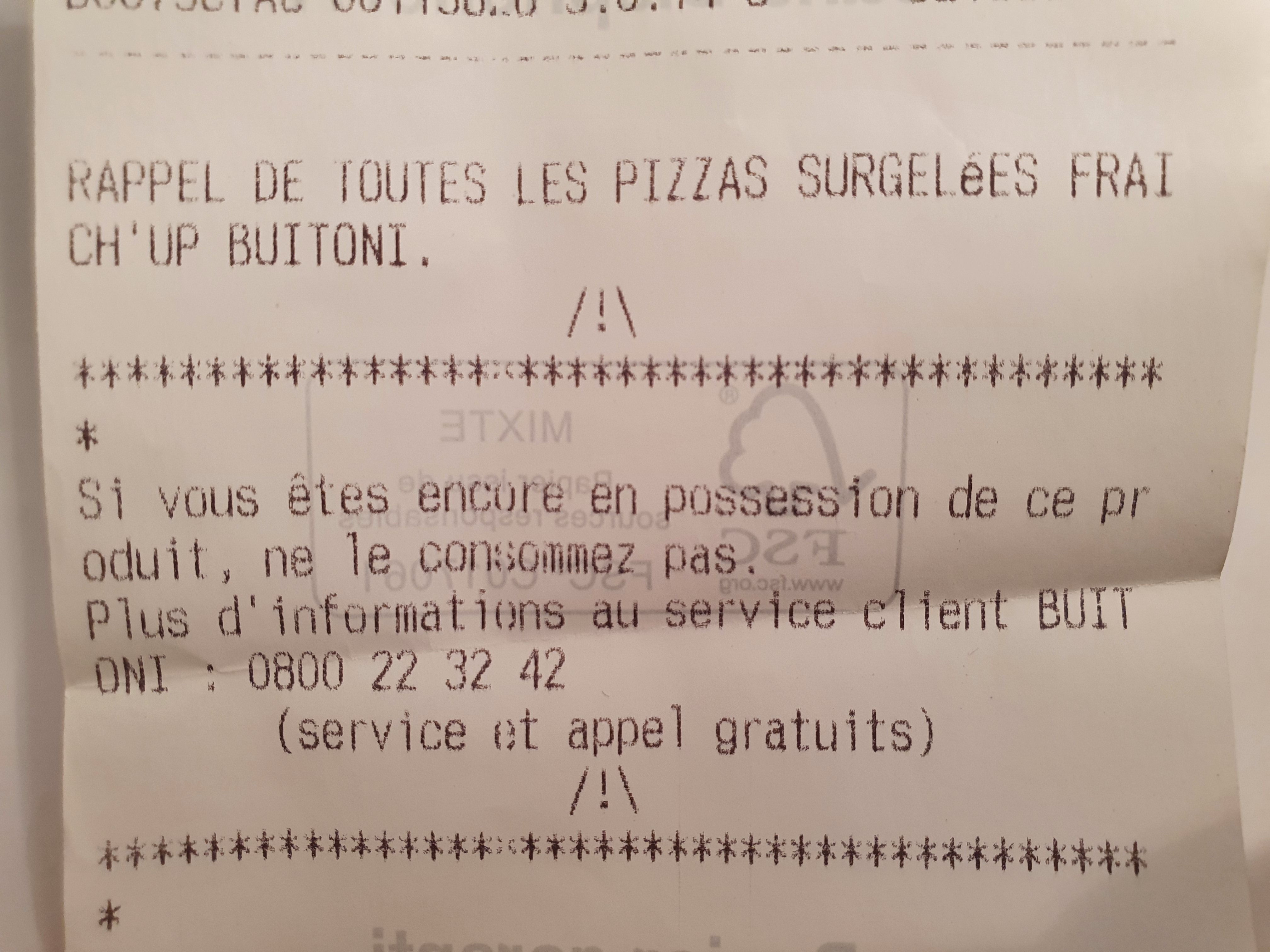
Historical example of an information block, not an item charge or a current alert. The source identifies a receipt dated 7 April 2022, photographed on 19 February 2023. Photo: Baidax, original and provenance, CC BY-SA 4.0. Unchanged photograph; reuse retains its stated license. No present-day recall status is inferred.

The purpose of this photograph is to show why you should read blocks in context. A notice below a transaction is not automatically another item bought, a new debit or evidence that the named product was in that basket. Likewise, a loyalty message or explanatory footer should not be mixed into your arithmetic.
Do not use an old photographed notice to decide what applies to a product today. For this reading exercise, it is enough to identify that the text has a different function from the item lines.
Ask for the record you need at payment
France's move away from automatic printing did not abolish receipts. DGCCRF's guidance says you can request paper; digital delivery depends on what the trader offers. There are exceptions to request-only printing, so “receipts are never printed now” is misleading. Ask at the time you pay, before leaving with no record you can use. DGCCRF: receipt-printing questions.
The CNIL explains that digital delivery cannot be imposed and a loyalty account is not compulsory to obtain your receipt. If you prefer not to give contact details just for delivery, request paper. If you choose digital, read how the data will be used; receipt delivery and marketing are different purposes, with rules that depend on the type of advertising. CNIL: receipt choices and personal data.
Useful requests include:
| Say | You are asking for | |---|---| | Un ticket de caisse, s'il vous plaît. | A till receipt | | Je préfère un ticket papier. | Paper rather than digital delivery | | Puis-je avoir une facture détaillée ? | An itemized invoice | | À quoi correspond cette ligne ? | An explanation of a particular line | | Pouvez-vous confirmer le montant restant à payer ? | Confirmation of the outstanding amount |
Keep a small complete record
For a purchase you may need to revisit, group the itemized document, any relevant accepted quotation and the payment evidence. If something is unclear, write down the exact line, amount and question before contacting the business. Avoid sending unrelated bank transactions or an entire account statement when a narrower record will answer the request.
For a digital receipt, open it once and check that it is actually readable—not merely an email saying a receipt exists. Give your own saved copy a useful name with the date and seller, without changing the issued document. This is a practical organization method, not a claim that every kind of receipt has the same retention period.
The final check is simple: can you connect the item or service, the total and the payment record without adding the same amount twice? If not, ask for the missing explanation before treating an unclear document as settled.