Free · France
The Hidden Signals in Everyday French
Sometimes you know every word and still miss what the sentence is doing. A question can look like a statement. A courteous form can contain a practical request. An affirmative answer can confirm understanding without accepting an invitation.
These are useful signals to notice, but they are not a secret code shared by everyone in France. Nor do they let you diagnose annoyance, sincerity or affection. The aim is smaller and more practical: work out what has been asked, clarified or agreed before deciding how to respond.
All conversations and situations below are original teaching examples, not recorded exchanges or claims about typical French behaviour.
Separate the words, the action and your guess
Try reading an exchange in three layers:
| Layer | What to identify | What not to add automatically | |---|---|---| | Words | The object, person, time and condition actually mentioned | An omitted promise or explanation | | Conversational action | A question, proposal, request, clarification or refusal | Agreement merely because the wording sounds friendly | | Personal interpretation | What you suspect about the speaker's attitude | Certainty about an intention they have not expressed |
You can understand the first two layers well enough to act without solving the third. If someone asks for a document, finding out which document and when it is needed is usually more useful than deciding whether their tone was warm enough.
1. A question may keep statement word order
TV5MONDE illustrates questions that retain statement word order but use rising intonation. This is one pattern, not a rule for every question. TV5MONDE: L'interrogation.
Compare these original examples:
Vous restez ici. — You are staying here.
Vous restez ici ? — Are you staying here?
The second can check a plan rather than announce one. If unsure, ask Vous me demandez si je reste ici ?—“Are you asking whether I'm staying here?” That checks the function, not an imagined emotion.
2. A softened proposal is still a proposal
French offers several ways to suggest something. TV5MONDE includes the interrogative, si with the imperfect, and the polite conditional among its teaching examples. None makes a proposal into an agreed arrangement. TV5MONDE: Suggérer, proposer, “Pour résumer”.
Ça vous dirait de commencer à dix heures ?
Would you like to start at ten?
The speaker is putting forward a time. A practical answer might accept it, suggest another, or decline: Dix heures me convient—“Ten works for me”; Je ne peux pas à dix heures—“I can't at ten.” You need not treat the conditional as evidence that the speaker is uninterested or merely talking about an imaginary possibility.
Notice the difference between understanding an invitation and accepting it. Courteous wording does not create an obligation to say yes.
3. Courtesy changes the manner, not necessarily the task
Larousse identifies grammatical politeness forms, including the conditional, as ways of putting the speaker less prominently forward. That describes a form, not a guarantee about the person's character. Larousse: politesse, expression “De politesse”.
Imagine a colleague asking:
Pourriez-vous m'envoyer le fichier avant jeudi ?
Could you send me the file before Thursday?
The useful information is the requested action and deadline. If the timing is unclear, ask Vous en avez besoin mercredi au plus tard ?—“Do you need it by Wednesday at the latest?” If you cannot do it, say so. Recognising a request does not settle whether you are responsible for fulfilling it.
Equally, a brief instruction is not proof that its writer dislikes you. Assess the actual request and the setting before turning its wording into a relationship verdict.
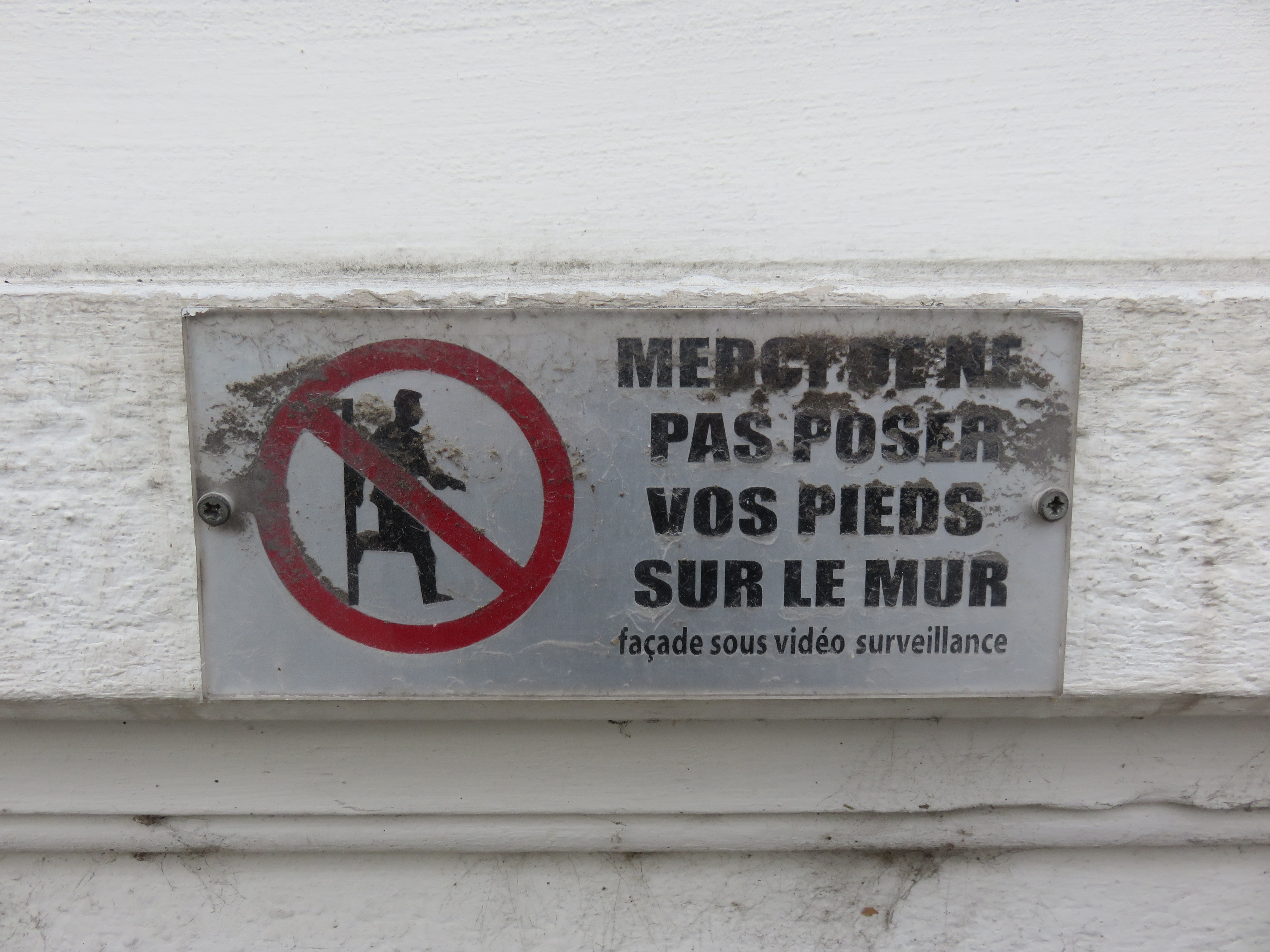
Quai Gailleton, Lyon, 24 January 2019. “Merci de ne pas poser vos pieds sur le mur” asks readers not to put their feet on the wall: the courtesy marker does not remove the requested action. A still photograph cannot establish anyone's tone or feelings. Sebleouf, original photograph, CC BY-SA 4.0, unchanged.

4. Register is not a thermometer of affection
The Académie's vous entry distinguishes its plural use from its use for one person, where it can mark politeness, respect or distance. The same written pronoun therefore does not always carry the same social information. Académie française: vous, section I.
Before interpreting vous, ask whether one person or several are being addressed. If it is one, do not translate formality automatically as dislike. A friendly exchange can remain formal; a familiar form alone cannot establish closeness or permission to ask personal questions.
Keep this cue in proportion. A pronoun is part of the exchange, not its complete meaning. What people ask, answer and agree to still matters.
5. The second phrase can sharpen the first
C'est-à-dire—“that is”—can introduce clarification. Tran, Tutin and Cavalla analyse reformulation markers in research on teaching French through academic-writing corpora. Their study supports this language distinction; it is not a survey of everyday French speakers' habits. Tran, Tutin and Cavalla: sections 3.1 and 4.3.
Il faut arriver tôt, c'est-à-dire avant neuf heures.
We need to arrive early, that is, before nine.
Here, “before nine” makes “early” precise. Stopping at the first phrase loses the most useful detail. You might check Il faut donc être sur place avant neuf heures ?—“So we need to be there before nine?”
Treat clarification as new information to incorporate, not as a reason to speculate about why the speaker did not say it perfectly the first time.
6. Work out what the “yes” answers
The Académie describes oui as an affirmative response to an expressed or implied question. Identify that question before expanding the answer into a wider agreement. Académie française: oui, sense 1.
A: Tu as compris ma proposition ? — Did you understand my proposal?
B: Oui, mais je ne peux pas venir. — Yes, but I can't come.
B confirms understanding and explicitly declines participation. There is no contradiction to decode. The initial question was not “Will you come?”
Read the whole answer: B has not accepted.
Try three small checks
These are fresh fictional examples. For each, identify what is settled and what remains open.
A. Someone says: Vous prenez la salle du fond ?—“Are you taking the room at the back?” You reply, “Thanks,” and start moving equipment. What have you skipped?
B. You ask whether a friend has seen your suggested date. They answer: Oui, j'ai vu ton message. Je te réponds demain.—“Yes, I saw your message. I'll reply tomorrow.” Is the meeting confirmed?
C. An organiser says: Rendez-vous à quinze heures — pardon, à quinze heures trente.—“Meet at three—sorry, at half past three.” Which time should you check back?
Suggested readings: A is phrased as a question, not an allocation or permission. Clarify what is being proposed before acting. B confirms receipt and gives a promised response time, not an accepted meeting date. C explicitly corrects the time to 15:30; repeat that time if the arrangement matters. None of these readings requires you to infer a hidden personality trait.
Ask for clarity, not a performance of fluency
Choose the repair that fits the uncertainty: Quelle heure exactement ?—“What time exactly?”; Vous pouvez l'écrire ?—“Can you write it down?”; or Je n'ai pas compris la dernière partie—“I didn't understand the last part.” A written version, repetition or slower exchange may be more useful than further attention to tone.
You do not need to catch every cue, imitate an accent or justify an access need to use a clarification question. And you do not have to keep analysing a conversation that feels unsafe or intrusive.
The most useful “hidden signal” is often a small, observable change: a question mark, a courteous verb form, a clarification or a limiting clause. Notice it, check what it changes, and leave unspoken motives unproven.