Free · France
Understanding French Appointment Confirmations
Before putting a French appointment in your calendar, ask what the message actually confirms. It may confirm receipt of a request, verify your email address, confirm a particular appointment or acknowledge its cancellation. The word confirmation alone does not tell you which.
Read the message as an update to an arrangement: what is its present status, what details apply, and who must act next? This approach is more useful than memorising one template, because services use different booking systems and procedures.
The sample message sequence and all example wordings below are original fictional teaching examples, not genuine confirmations, live bookings or copies of anyone's private correspondence.
Confirmation of what?
France Travail's published registration walkthrough makes a useful distinction. Its final step confirms that the application has been recorded; the preceding appointment step describes different arrangements depending on the organisation handling the person. A confirmation email about recording a request is not, by its title alone, evidence of a particular meeting time. France Travail: registration walkthrough, steps 5–6.
Look for the noun after confirmation and the sentence describing the result. Is it votre demande—your request—or votre rendez-vous—your appointment? Even then, read the details rather than assuming that a favourable-looking heading settles everything.
A message confirming an appointment also does not establish the outcome of the meeting: it is not, simply for that reason, an approval of a permit, benefit or other application.
Recognise the stage, not just the friendly wording
RDV Service Public distinguishes notifications for appointment creation, reminders, modifications and cancellation. These are separate events within that service, not interchangeable messages or a universal notification timetable. RDV Service Public: notification FAQ.
Use this reading aid with the whole message:
| Wording you might encounter | What to check | |---|---| | Demande reçue / enregistrée | Is only the request recorded, or is a slot also explicitly agreed? | | À confirmer / veuillez confirmer | What action remains, by whom and by what deadline? | | Rendez-vous confirmé | Which date, time, person, place or channel is confirmed? | | Rappel | Which existing appointment is being recalled? | | Modifié / reporté / annulé | What has changed, and is any replacement actually specified? |
The table is an original reading aid, not a quotation of that platform's message templates.
A verification step may still come before the booking
The Pays de Lumbres France Services instructions describe one account-creation route in which an email-verification link returns the user to the process so they can finish the appointment booking. Verification and completion are different steps in that example. CC Pays de Lumbres: Mode d'emploi.
In your own message, distinguish confirmez votre adresse électronique—confirm your email address—from confirmez votre présence—confirm that you will attend. They ask for different actions. Do not assume that replying to an automated message completes either one: use the service's stated process, after checking that the message is genuine.
If it gives a deadline, copy that deadline separately from the appointment date. Do not borrow a time limit from another service's instructions. If the step has failed or its status is unclear, check with the organisation rather than creating a second booking automatically.
Extract the details into a small appointment card
The tax administration's public tutorial explains that its recap screen contains appointment details and, depending on the reason for the meeting, documents to bring. It also distinguishes confirmation from a later reminder. This is a demonstration, not your own appointment record. Impots.gouv.fr: appointment recap tutorial.
For your message, write down:
- Purpose and person: what appointment, for whom, with which service?
- Date and time: the full date, year and stated time; clarify an ambiguous numeric date rather than guessing.
- Channel: in person, telephone or video? If remote, who initiates the contact?
- Location: the actual address, entrance or meeting link—not merely the organisation's general address.
- Preparation: documents or other instructions specifically requested.
- Remaining action: confirmation, attendance reply or another step, with its own deadline.
Keep unknown details visibly unknown. For a remote meeting across time zones, establish which location's time is intended. A calendar entry you made from an earlier message does not resolve an unclear update.
Follow a change through the whole arrangement
Here is a fictional sequence about one appointment. The dates and wording are invented for this exercise.
First message:
Votre demande a bien été reçue. Nous vous proposerons un créneau prochainement.
“Your request has been received. We will propose a time slot shortly.” No appointment time has yet been supplied. Prochainement does not provide a specific date you can enter.
Second message:
Votre rendez-vous est confirmé pour le 5 novembre 2026 à 14 h, dans nos locaux.
“Your appointment is confirmed for 5 November 2026 at 14:00, at our premises.” There is now a stated time and in-person format. The premises still need to be identified if the rest of the message does not do so.
Third message:
Votre rendez-vous du 5 novembre est reporté au 12 novembre 2026 à 14 h. Il aura lieu par téléphone. Nous vous appellerons.
“Your appointment of 5 November is postponed to 12 November 2026 at 14:00. It will take place by telephone. We will call you.” In this example, both the date and the channel change; the time stays the same. Going to the original premises on the new date would miss part of the update.
Before applying a real change, match it to the right appointment using the service, purpose and reference where available. A message received later might concern another booking or repeat older information. If an apparent reminder conflicts with a change, reconcile the conflict with the service; do not choose merely by inbox order.
Reporter is not simply “to report”
For an appointment, reporter means to postpone. Larousse distinguishes this from the verb's other meanings. Larousse French–English: reporter, sense 3.
Reporté à une date ultérieure says the appointment has been postponed to a later date; it does not itself supply that date. Annulé says it has been cancelled. Neither wording, on its own, gives you a replacement slot.
TV5MONDE's appointment-language lesson also separates cancellation or moving an appointment from explaining that you will be late. TV5MONDE: Les mots du rendez-vous.
Telling a service you will arrive late is not the same as receiving permission to attend late. Likewise, asking for a new time does not establish that it has been accepted. If the appointment carries administrative obligations, clarify the service's actual instructions; this vocabulary guide does not decide the consequences of non-attendance.
A public notice is not your individual confirmation
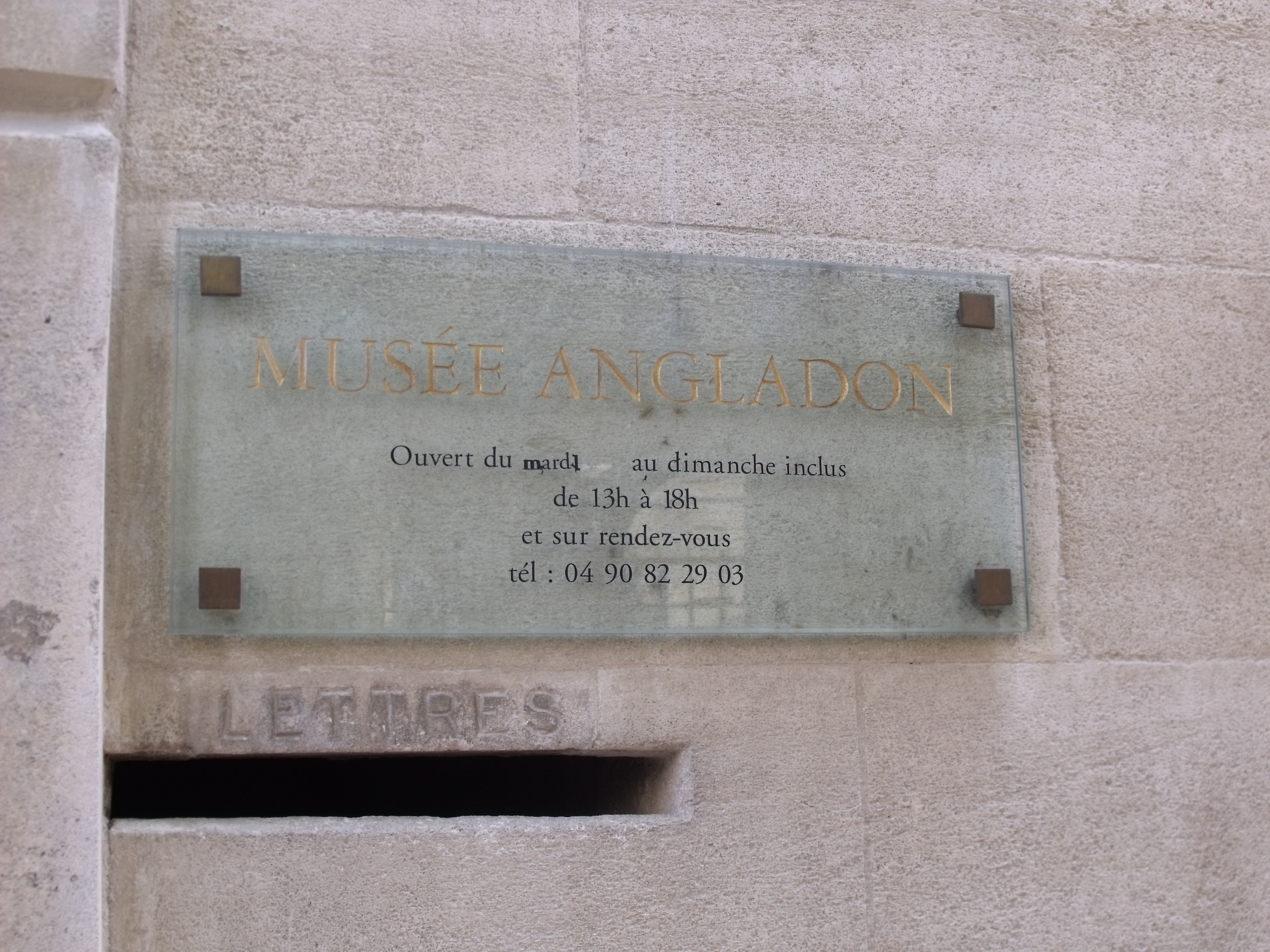
Musée Angladon, Avignon, photographed on 25 May 2011. Historical image—not current opening or contact information.
What does this notice not tell you? It lists hours and an appointment option: et sur rendez-vous means “and by appointment”, not “only by appointment”. It supplies no personal booking date or confirmation status. A public access notice and an individual appointment exchange do different jobs. Neither the old hours nor the pictured contact details should be used to plan a visit today.
Photo: “Avignon - Square Pierre de Deimier - Musee Angladon - sign - opening hours” — Elliott Brown, CC BY 2.0. Supplied original unchanged.
Check the message without surrendering private information
If a message or link seems doubtful, Cybermalveillance.gouv.fr advises checking through the organisation directly or using a trusted route to its site. A convincing-looking name is not enough reason to follow an unexpected link. Cybermalveillance.gouv.fr: phishing prevention, points 2–4.
Use contact details you have verified independently. Do not publish an unredacted confirmation to ask strangers for a translation: it may contain contact details, a booking reference or a link that manages the appointment. You can ask for help with the particular phrase without sharing the entire record.
For an unclear arrangement, a short read-back can be enough:
Pouvez-vous confirmer la date, l'heure et le lieu du rendez-vous ? Y a-t-il encore une action à effectuer de ma part ?
“Could you confirm the appointment's date, time and location? Is there anything I still need to do?” Adapt le lieu to the telephone or video arrangements where relevant.
The goal is a usable answer: which appointment, in what form, at what time, with what next step? If one of those remains uncertain, let the uncertainty prompt a check rather than disappear into your calendar.