Free · France
Regional Languages You Still See in Public
A second line on a street sign can look like a translation provided for visitors. Sometimes it is doing something different: giving a language with a local history a place in the ordinary public environment. A station announcement, a school programme or a page in a municipal magazine can do the same work without resembling a tourist attraction at all.
The useful question is not simply “Why is this not in French?” It is what the language is being used to do. Does it identify a place, provide information, support learning, or let people discuss current life? Those functions overlap, but they should not be confused with proof that everyone nearby speaks the language.
Breton in Quimper and Occitan in Toulouse offer two concrete starting points. They are examples, not a complete map of France's regional languages. The photographs below are explicitly dated historical images; present-day institutional sources supply the separate evidence that public-language activity continues.
Quimper: more than a second version of a place name
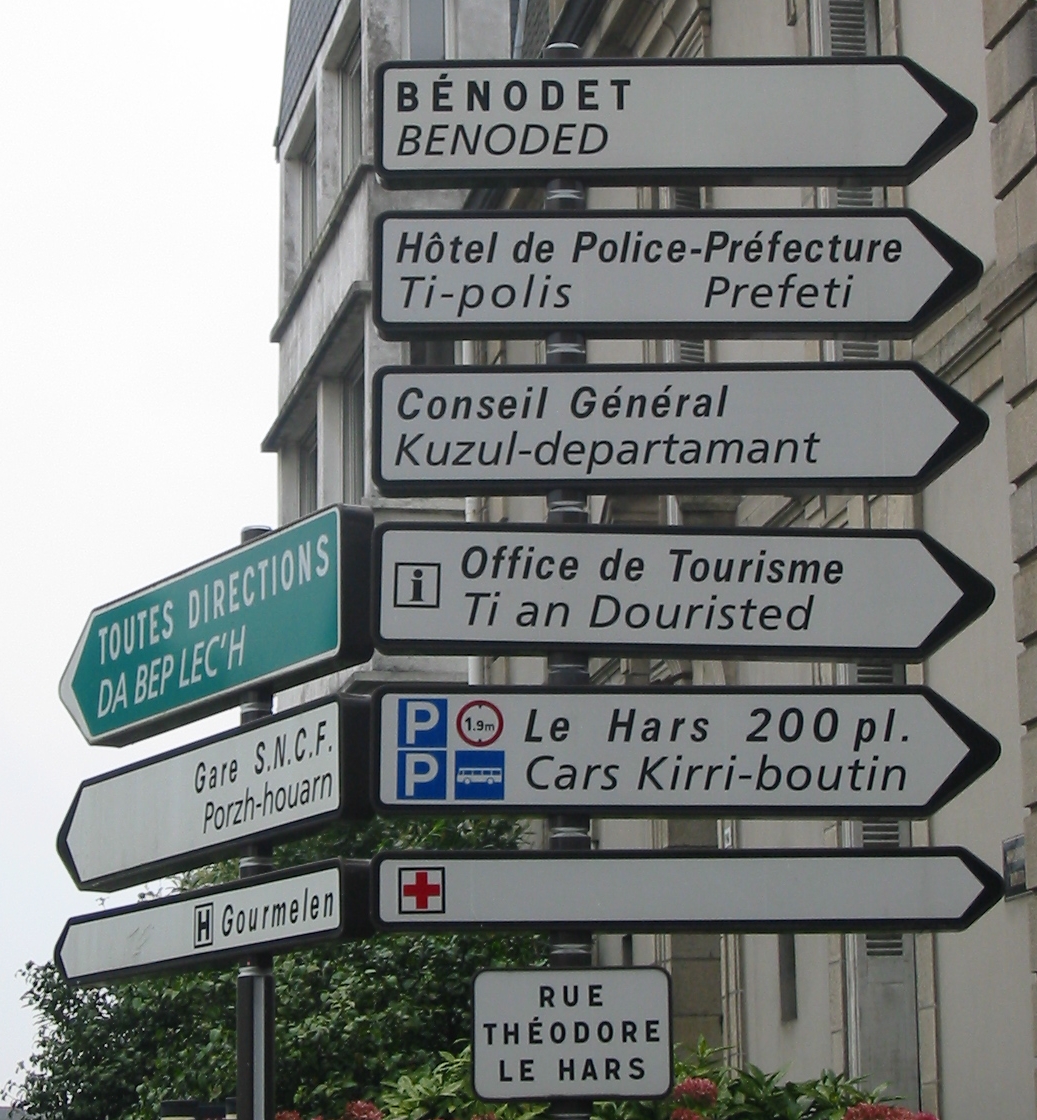
French–Breton directional signs in Quimper/Kemper, photographed on 14 October 2003. The image documents wording and layout at that time, not present office names, routes or service availability. Photograph by Man vyi, released into the public domain by the author. Original photograph and public-domain declaration. Uncropped; displayed at reduced size. Signs and symbols are shown only in documentary context.

Look at the difference between naming a destination and describing a service. A town name can have two written forms, but directions to a station or tourist office also require ordinary vocabulary. In this photograph, Breton is not confined to a decorative greeting. It appears in information intended to help people find their way.
That observation is limited to the image. It does not establish that the photographed signs remain in place, that every sign in Quimper was bilingual, or that a person arriving at an indicated office could conduct every transaction in Breton.
There is separate evidence of continuing work. The Office public de la langue bretonne's 2024 activity report lists work on bilingual street-name signage in numerous municipalities, including Quimper. It distinguishes street plaques from other kinds of signage and describes projects at different stages rather than asserting that every municipality has completed an identical scheme. [1]
The office's design guidance is revealing. It recommends planning bilingual information from the outset, giving both languages comparable visual treatment and translating the full information rather than adding only selected words. These are its recommendations for functional bilingualism, not a claim that every existing sign follows them. [2]
For a reader, the distinction is useful: visibility is not the same as usability. A language may be visible in a heading while the instructions below remain available only in another language. Conversely, a complete set of directions lets the second language do practical work. You can notice that difference without trying to calculate the number of speakers from a photograph.
Toulouse: a language can be seen and heard
Toulouse's municipal culture page describes street names adapted or translated into Occitan, particularly in the historic centre. It also describes French and Occitan station announcements on the métro. Some station names retain their French form; others are rendered in Occitan where their origin warrants it. [3]
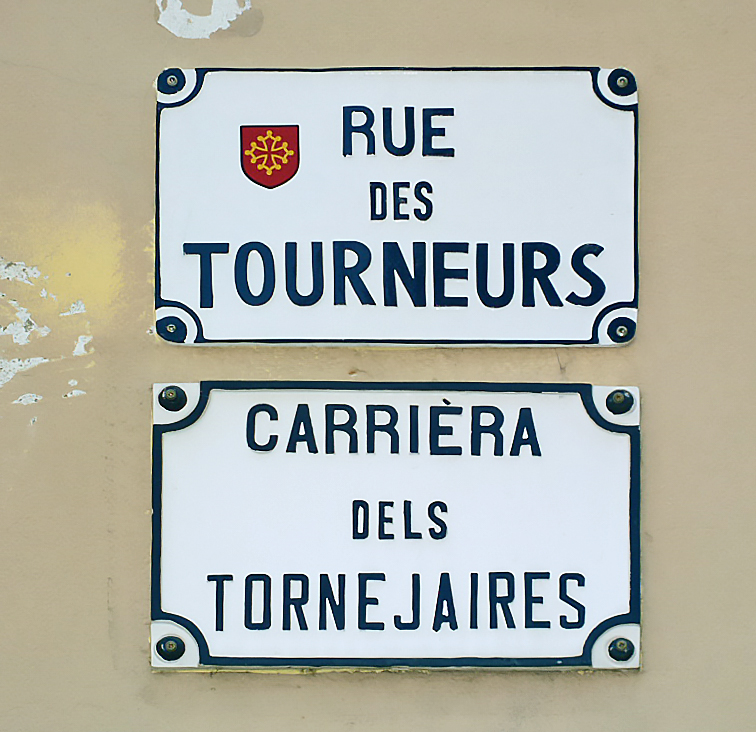
French and Occitan plaques for rue des Tourneurs in Toulouse, photographed on 15 July 2015. The two plaques identify one street; they are not directions to two different streets. Didier Descouens / Wikimedia Commons / CC BY-SA 4.0. Original photograph. Uncropped; displayed at reduced size. Historical image, not a current inspection of the plaque.

The written and spoken forms invite different kinds of attention. On a plaque, you can compare spelling and placement at your own pace. In an announcement, the language becomes part of a repeated journey. Neither encounter requires you to imagine a separate, uniformly Occitan-speaking population living behind every sign.
There is also a distinction between translating a current name and recognising a name's older linguistic history. Do not assume that every unfamiliar place name is a simple word-for-word equivalent of the French wording beside it. If the history matters to your visit or research, use a local authoritative explanation rather than improvising an etymology from a familiar-looking syllable.
For everyday navigation, keep the official address or station name supplied by the service you are using. The point of noticing another form is to understand the place better, not to replace practical address information with a guess.
Public presence extends beyond plaques
A language used only as scenery would appear mainly when someone wanted to signal heritage. The same Toulouse municipal page also points readers toward an Occitan page in its magazine and the city's digital heritage library resources. That supplies a different set of questions: what can a person read, hear or learn through the language? [3]
Education offers another example of present institutional use. The Education Ministry published programmes for regional-language teaching in secondary education in its official bulletin of 21 May 2026. [4] The existence of a curriculum is not a guarantee that a particular course is offered at the nearest school. Families need to check the current local provision, entry arrangements and continuity of study rather than infer them from a sign outside a building.
These examples should not be turned into a single success score. A town might have conspicuous signage but limited learning opportunities; another town might support active teaching or cultural production that a passing visitor does not notice. Establishing either situation requires local evidence. A short walk and a few photographs are not a language-use survey.
A regional label does not identify every speaker—or every language
Brittany itself is a useful warning against oversimplification. The regional council identifies Breton and Gallo as its two historical languages and describes support for their transmission, visibility and everyday use. [5] A Breton sign therefore should not lead a visitor to erase Gallo from the region's linguistic story, or assume that one photographed town represents all of Brittany.
The same caution applies to people. Residence, surname, age and appearance do not reliably tell you which languages someone knows, uses or wishes to speak. Some people learn a regional language as adults; some understand more than they speak; others do not use it. Those possibilities are reasons to ask respectfully, not statistical claims about the places discussed here.
Nor is a regional language simply “French with a local accent.” A difference in language, a local variety within a language and an accent in French are different matters. If you do not know which one you are encountering, describe what you have actually seen or heard before assigning a label. The municipal or public-language body responsible for the material is a better starting point than a guess based on how familiar it sounds.
Recognition and a particular service are different questions
France's constitutional text contains both Article 2, identifying French as the language of the Republic, and Article 75-1, recognising regional languages as part of France's heritage. [6] Reading one while ignoring the other produces an incomplete introduction.
Those provisions do not, by themselves, tell a visitor what language assistance is available at a particular counter, whether an individual course is running, or how a specific document must be completed. For those practical questions, consult the responsible service. This article does not provide an entitlement to demand that a particular employee use a language, and it does not treat a bilingual sign as proof of such an entitlement.
This distinction makes it possible to appreciate public-language work without overstating what a sign can establish. Recognition, policy, provision and an individual's experience are related, but they are not the same thing.
A small reading exercise for your next walk
Choose one sign, plaque or announcement and ask five questions:
- Who produced it? A municipality, transport operator, association and private shop may be making different choices.
- What is being communicated? A name, a direction, an explanation or a complete service message?
- Do both versions carry the same amount of usable information? Notice omissions without assuming you can judge translation accuracy unaided.
- What does the date allow you to conclude? An old photograph proves a past appearance, not a current network-wide policy.
- What would you need to learn next? A pronunciation resource, a local history, a class listing or a direct answer from the service may be more useful than another photograph.
This exercise is an invitation to pay attention, not to test strangers or grade a community's authenticity. If you want to try a word, learn it from a reliable language resource and ask whether the other person is comfortable continuing. Do not turn a greeting into an expectation that they provide an impromptu lesson.
Regional languages in public can make a journey more informative precisely because they are not just ornaments. They can name, direct, teach and publish. The most respectful response is to notice the specific work being done—and to leave room for the people, languages and experiences a single sign cannot show.
Sources and checking notes
Remote desk research checked 28 October 2026. No on-site sign survey, current photograph of either location, speaker census or interviews are claimed. Historic image captions and current institutional evidence are deliberately separated. Exact programme availability and service arrangements must be checked locally.
- Office public de la langue bretonne — Rapport d'activité 2024, p. 17. Municipal street-name and other signage work. The list is not treated as proof of complete bilingual coverage.
- Office public de la langue bretonne — Conseils sur le bilinguisme. Design recommendations and the distinction between complete information and partial symbolic translation.
- Toulouse Mairie Métropole — Culture occitane. Street-name signage, métro announcements and public reading resources. Broadcast schedules and school counts on the page are not reproduced as current guarantees.
- Education Ministry — Regional-language programmes for secondary education, official bulletin of 21 May 2026. Evidence of curricular provision, not confirmation of a place at any specific school.
- Région Bretagne — Faire vivre le breton et le gallo. Both historical languages and policy aims; no speaker totals inferred.
- National Assembly — Constitution, Articles 2 and 75-1. General constitutional context only, not individual legal advice.