Free · France
Espelette: Basque local market language and identity
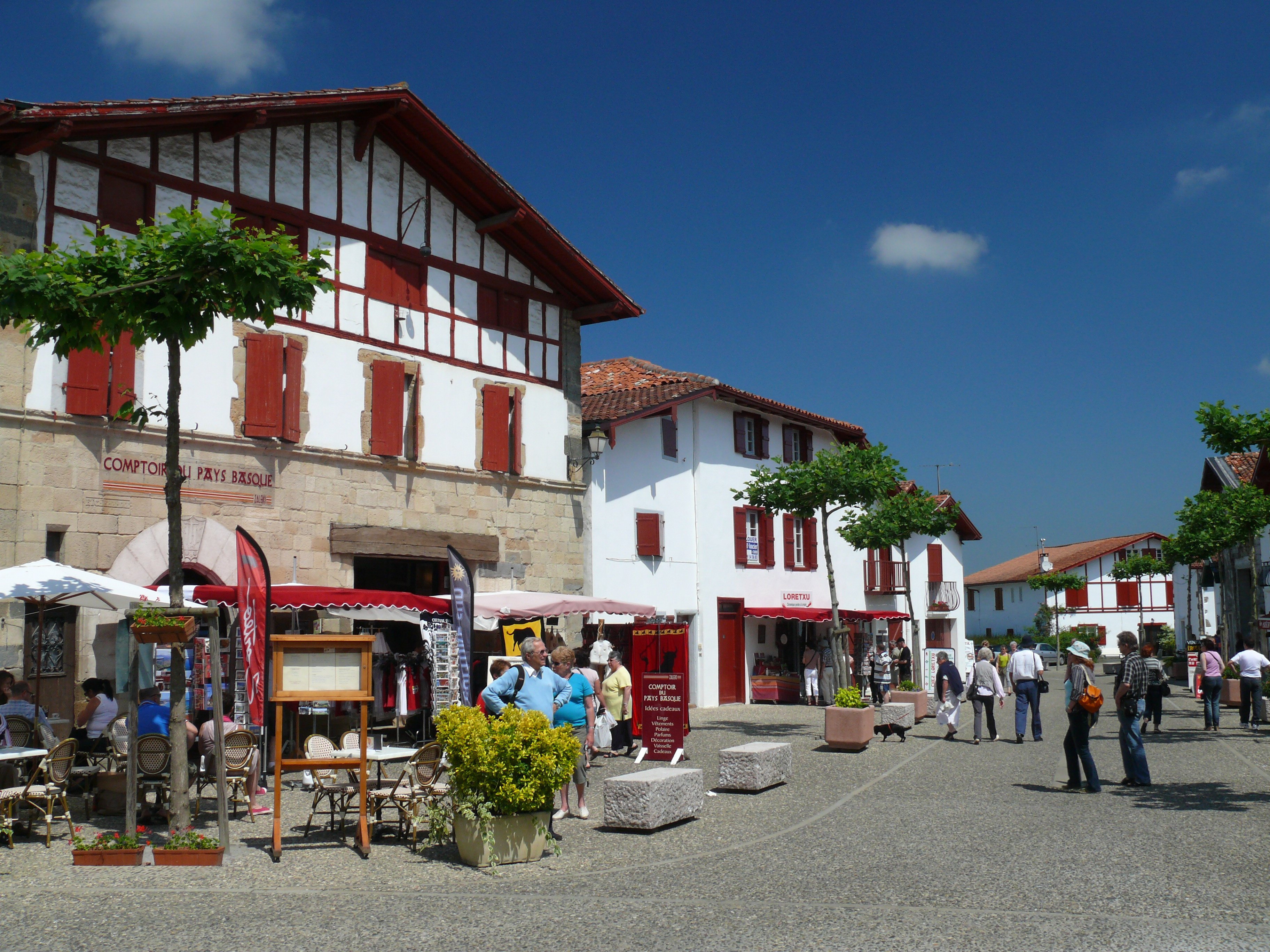
A market makes language practical. Someone greets a customer, names a product, explains a quantity and answers a question. Written labels and spoken exchanges occupy the same small space, but they do not necessarily tell the same story. In Espelette, looking closely at that difference is a better introduction to Basque identity than treating every red-and-white shopfront as a cultural explanation.
The village also appears as Ezpeleta in local institutional material. The coexistence of names is visible before any conversation begins. Yet a bilingual heading cannot tell you which language a particular trader prefers, how confidently a customer speaks it, or what happens when a visitor joins the exchange. Those are questions about use, not decoration.
This article offers a way to read the market and its surrounding institutions without pretending to have surveyed the people at the stalls. The evidence comes from published local records and organisations. Where it stops, the interpretation should stop too.
Begin with a real market, not an imagined linguistic scene
The Pays Basque tourism office identifies the Wednesday market as a recurring village event. Its market listings locate local-product trading at the covered market and describe food producers alongside other exhibitors. These records establish a setting for exchange; they do not record the language of transactions. Exact hours should be checked against the current listing rather than assumed from an older event page. Village overview; tourism-office market record.
That is a useful evidentiary boundary. It would be easy to write a colourful scene in which every seller switches effortlessly between Basque and French. Without observation or testimony, it would also be invented. The more honest starting point is a market where several kinds of language evidence may be present and can be distinguished.
A product label is one kind. A business sign is another. A greeting chosen for a visitor is a third. None should automatically be substituted for the others. Reading them separately makes a short visit more informative, not less vivid.
Commercial signs in central Espelette, photographed in 2009. This is a streetscape, not the covered market or evidence of the language spoken by any person shown. The photographer’s description says June, while the page’s capture field says November; the month is unresolved. Photo: dynamosquito, original photograph and description, CC BY-SA 2.0. Unchanged full frame; historical businesses and signs are not a current directory or evidence of eusko membership.
Names can locate you without defining everyone you meet
The town's bilingual local charter, published through the Council of Europe, includes traditional and correct place-name forms among its commitments. The document defines the regional language to include dialectal and standard Basque. It is a statement of intended public action, not evidence that every resident uses the same variety or that every commitment has been fully implemented. Espelette local charter.
A visitor can use this distinction practically. Keep the spelling printed in the relevant address rather than replacing it with an approximate phonetic version. Compare the name on a map with the name on a building or municipal page. Different language forms can help identify the same place; they need not be competing destinations.
Do not infer a person's politics, ancestry or proficiency from the sign above a stall. A language belongs to speakers and learners with varied histories. The visible public landscape is part of that history, but it is not a reliable biography of the individual serving you.
The market is connected to places where language is learned
The municipality describes Basque–French bilingual provision at its public school, and an immersion-then-bilingual pathway at Saint-Étienne. It also points to nearby ikastola provision in Itxassou and Cambo-les-Bains. These are distinct educational arrangements and locations, not one undifferentiated “Basque school” system inside Espelette. Municipal school information.
Why bring schools into an article about a market? Because treating language as a naturally replenished inheritance misses the institutions through which people acquire it. A market conversation may depend on years of learning that the passer-by cannot see. The existence of teaching routes does not prove what proportion of traders or customers speak Basque, but it does show that transmission has an organised local dimension.
The published school page is not a promise of current places, staffing or admissions. Nor are schools visitor attractions for listening to children. The point is interpretive: the market is one potential place of use within a much wider daily geography.
Adults are learners too
A municipal-hosted AEK brochure for the 2022–23 training cycle lists Espelette town hall among its training locations. It links intensive Basque learning to employment in reception, childhood services, social activity and other fields. Its dated course information must not be presented as an open 2026 enrolment offer. AEK training document hosted by the municipality.
The historical record nevertheless changes the picture. Language learning is not confined to childhood or family inheritance. Adults can acquire it for ordinary working relationships: receiving someone, explaining a service, answering a request. The market is a useful place to understand why even a limited repertoire can matter, although the brochure does not establish that a particular vendor took the course.
A beginner's hesitation should therefore not be read as proof of cultural inauthenticity. Nor should fluent speech be demanded as the price of belonging. When language is being sustained through learning, uneven confidence is part of the process rather than a reason to dismiss it.
A local-currency project links commerce and language explicitly
Euskal Moneta, the organisation behind the eusko, describes a language challenge for participating businesses: bilingual customer-facing material or a basic spoken Basque welcome, with learning support where needed. The account connects commercial participation with the visibility and use of the language. It describes the organisation's programme, not an independently measured result for every member. Euskal Moneta's project explanation.
That distinction helps when reading a window sticker. Network membership, bilingual written material and the ability to sustain a long conversation are different things. A sticker can indicate a form of participation; it does not guarantee that the person on duty speaks Basque fluently or that every stall nearby participates.
The operator's visitor information includes Espelette within its network geography and directs people to participating professionals. Check the current directory and ask the business before assuming acceptance. This article is not a recommendation to exchange money, open an account or infer financial benefits from the cultural programme. Operator's visitor information.
The covered market can be more than a trading hall
For Eusko Eguna on 18 April 2026, the organiser advertised a farm and craft market around Espelette's covered market, alongside Basque initiation, storytelling and other explicitly identified Basque or bilingual activities. The programme is dated evidence of how an organisation intended to bring trade, association life and language together. It is not a record of every activity's actual delivery. Eusko Eguna 2026 programme.
The building's meaning changes with its use. On an ordinary market morning, a transaction may take a few minutes. During a programmed event, the same general setting can host learning, performance and discussion. Neither use cancels the other. Together they show how a commercial place can become a meeting place for several kinds of local participation.
It would still be wrong to describe an event programme as the village's unanimous opinion. Organisations make choices about themes, languages and audiences. Their activity is an important part of Espelette's public life, but no single organisation represents every resident's experience.
A small greeting is enough to begin respectfully
For a visitor who wants a modest entry point, Euskal Moneta's illustrated French–Basque vocabulary leaflet gives Egun on for a daytime greeting and Milesker for thanks. These are starting points, not a performance of fluency. The leaflet was produced with language-support institutions and can be consulted for a fuller set of expressions. French–Basque leaflet.
Use a greeting, then follow the other person's response. If either of you needs to change language, do so without turning the exchange into a test. A busy trader is not obliged to provide a lesson, and a customer should not be made to feel that purchasing correctly requires cultural credentials.
Questions about the product are often the most natural way forward. Ask where it was made or how it is used, in a language both people can manage. The goal is communication. Correcting a stranger's wording, requesting a lengthy explanation during a queue, or recording conversation without permission works against that goal.
Read three layers, and keep your conclusions proportionate
A useful market visit separates three layers. First, the built and written setting: place-names, notices, labels and public information. Second, the organised opportunities: teaching, cultural events and business programmes. Third, the actual exchange: what two people choose and are able to say to each other at a particular moment.
The first two can often be researched in published sources. The third cannot be inferred reliably from them. Hearing French at one stall does not show that Basque has disappeared; hearing Basque at another does not establish universal fluency. A short encounter is an encounter, not a representative survey.
This approach leaves room for complexity without making the village abstract. The sign, the school, the training course, the association and the market hall are all concrete. What joins them is the effort required to make a language usable in ordinary life. Identity is not only what a place displays. It is also what people have opportunities to learn, use and pass on.
Locate the market and plan without assumptions
The official tourism record locates the activity at Marché couvert, 64250 Espelette. Find the covered market in Google Maps. This is a named-place search, not a fabricated street number or a verified accessible route. Consult the current tourism-office calendar for the intended date and confirm practical access separately.
Do not expect a scheduled language workshop on a normal market day merely because one appears in an April festival programme. The best preparation is simpler: know where you are going, leave space for the seller's working rhythm, and arrive ready to notice more than the colour of a façade.
Source register and limits
Sources checked 27 October 2026: municipal education information; the local charter hosted by the Council of Europe; AEK's dated 2022–23 training brochure; Euskal Moneta's project, visitor and April 2026 event pages; its bilingual vocabulary leaflet, visually read on both PDF pages; and Pays Basque tourism's village and market records. The charter was downloaded and its text read after the web reader returned a cache miss. These sources support institutional intentions, published provision and dated programmes, not a present-day census of market language use.
No local fluency percentage, dialect prevalence, interview, observed conversation, legal-language-status change or all-trader participation claim is asserted. The charter is not treated as proof of completed implementation. Old course dates and event details are explicitly historical. No personal speech or identifiable customer was recorded.