Free · France
Sarlat-la-Canéda: Market stalls and Périgord rural produce
A bag of walnuts on a Sarlat stall connects the town with more than a nearby orchard. Someone has grown the crop; someone has sorted, stored, transported or shelled it; and someone is now selling it. Those roles may belong to one business or several. Understanding the distinction makes the market a window onto the rural economy rather than simply a picturesque place to shop.
Sarlat's market streets concentrate that relationship between town and countryside. The useful question is not whether a product looks suitably rustic. It is which place, season and form of work the particular item actually represents.
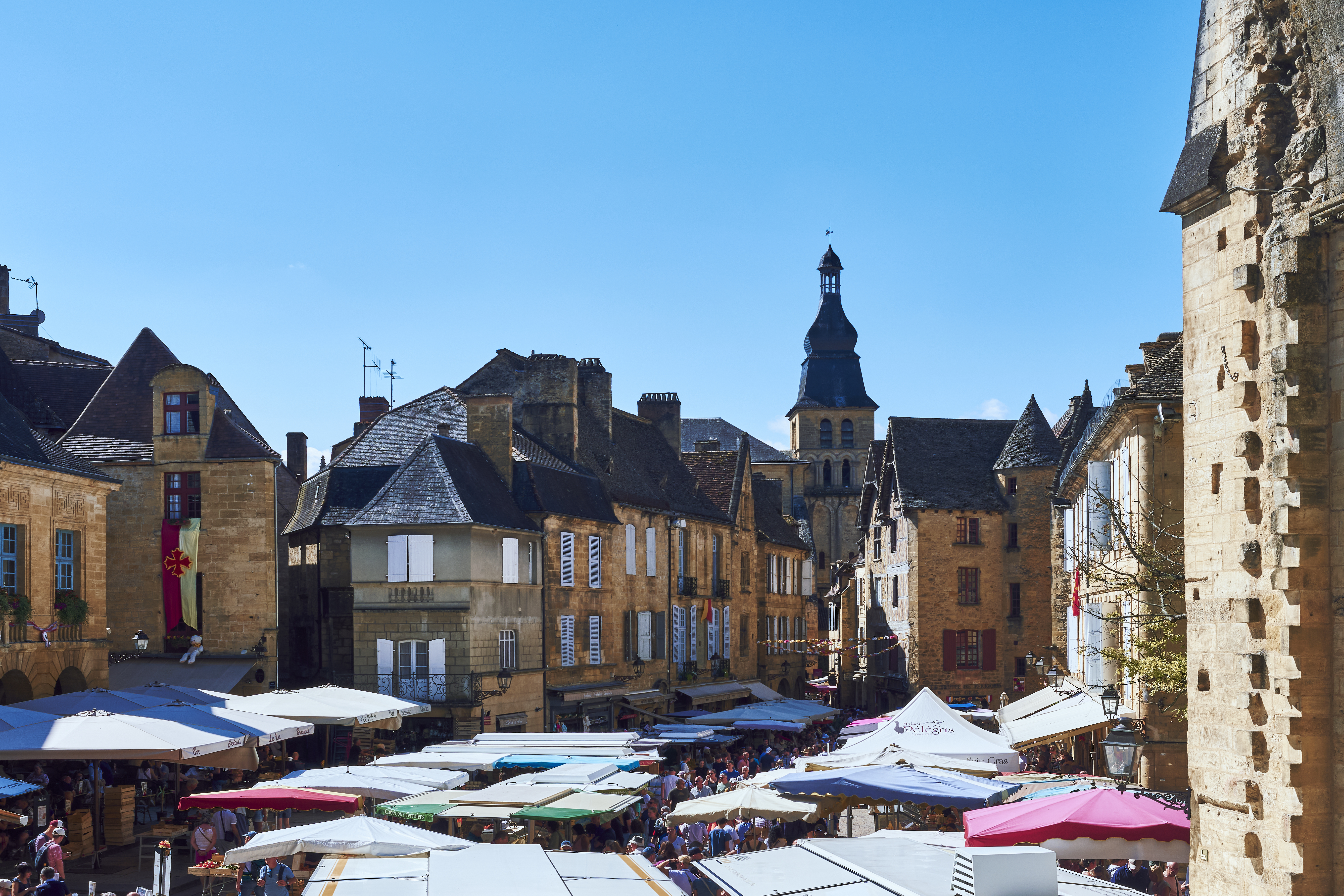
The Saturday market at Sarlat on 2 August 2025. The awnings show how trading occupies the square, not where any particular product was grown or whether its seller was its producer. Photo: Øyvind Holmstad, Wikimedia Commons; CC BY-SA 4.0. Unmodified.

First distinguish the markets
The municipality lists the open-air food market on Wednesday and Saturday mornings, advertised from 08:00 to 13:00. Saturday also includes non-food trading. The covered Sainte-Marie market has a separate, seasonally changing timetable, while winter truffle trading is separately organised. These are different selling arrangements, not interchangeable names for one event. Municipal market information.
The tourism office's traditional-market page also separates the morning food trade from Saturday's wider offer, which includes clothing, souvenirs and leather goods. Its advertised Saturday closing time differs from the municipal page's non-food closing time. The shared morning food window is therefore more dependable for general orientation than a promise that every stall remains until a particular late-afternoon hour. Check the organiser's latest notice before a time-sensitive visit. Tourism office: traditional market.
This distinction also changes what to expect. A general market can bring different kinds of seller together. Its location in a celebrated food town does not, by itself, establish that every item was grown nearby or that every vendor is its producer.
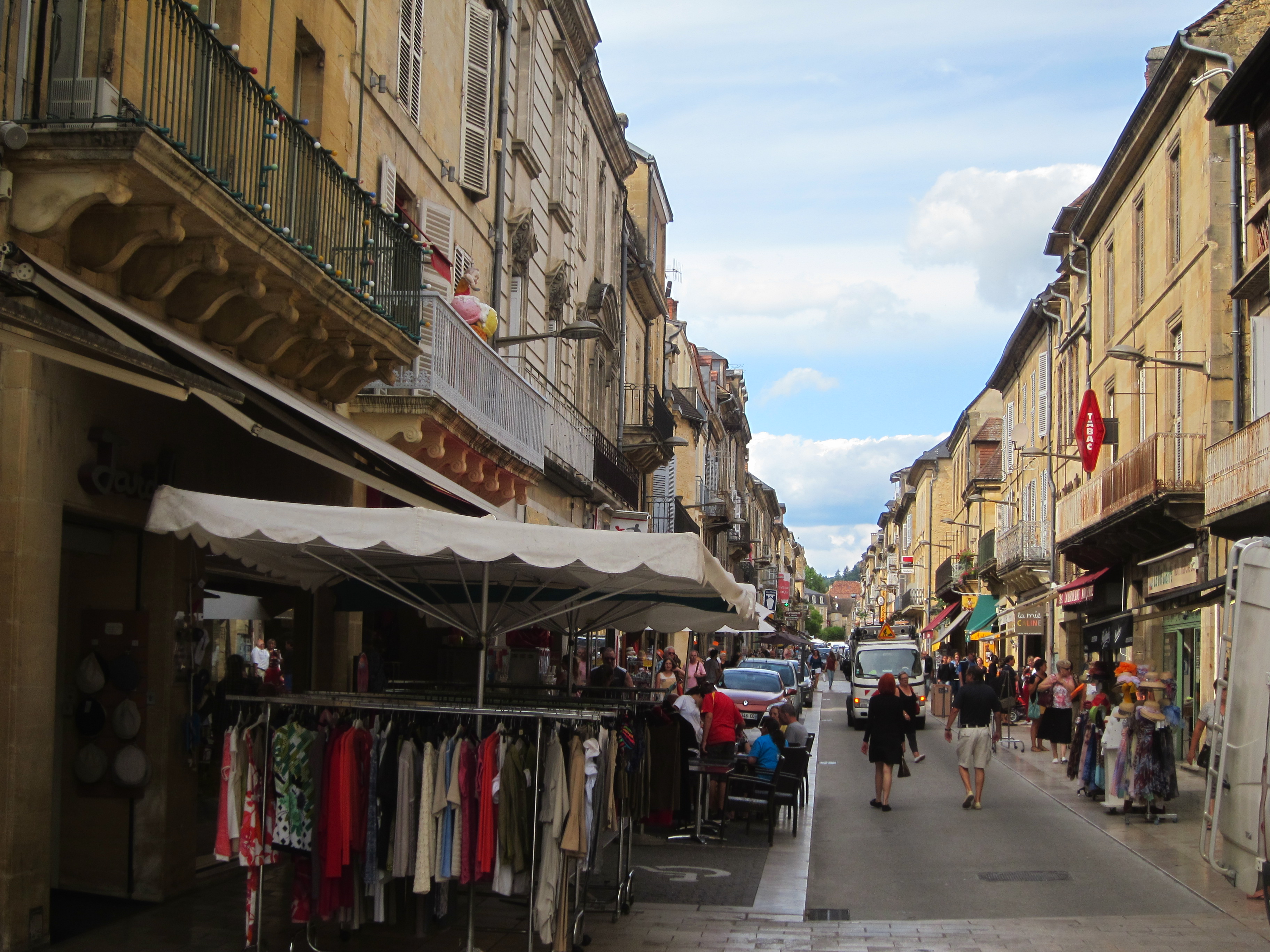
Sarlat’s commercial street photographed on 2 September 2015. Visible clothing displays help distinguish general urban retail from a verified food-producer market; the photograph is not presented as a contemporary stallholder list. Photo: Henk Monster, Wikimedia Commons; CC BY 3.0. Unmodified.

A regional product is not necessarily a direct farm sale
The tourism office describes Marchés des Producteurs de Pays as a specific Chambers of Agriculture brand, with participating local producers following a charter. It presents these producer markets separately from Sarlat's traditional market and lists examples in surrounding communities. That distinction should not be erased by calling every regional market a farmers' market. Tourism office: producer-market scheme.
At a stall, ask a narrow question rather than testing the seller against a vague ideal of authenticity: “Do you grow these walnuts yourselves?” A perfectly useful answer may be that the business buys from named growers, shells the nuts or specialises in bringing them to market. A reseller is not automatically a poor seller; a producer is not automatically the producer of everything on display. What matters is clarity about the actual product and role.
Walnuts reveal the chain particularly well
INAO's product information distinguishes three forms of Noix du Périgord AOP: fresh nuts, dried nuts and kernels. It identifies the authorised varieties as Marbot, Corne, Grandjean and Franquette, and describes a production area extending across parts of several departments. The protected name therefore identifies a defined production framework, not a guarantee that the tree stood within Sarlat's municipal boundary. INAO: Noix du Périgord.
Fresh nuts in their season, dried nuts in shell and prepared kernels are different purchases. Comparing only the price of a bag can hide differences in form and weight. Compare like with like, read the product's identification and ask about the variety, harvest and place of production when those matter to you. A regional name on a shopfront does not answer all of those questions for every product it sells.
The walnut interprofessional body's operator directory makes the distribution chain visible. It lists producer organisations, traders and producer-shippers, including a trader in Sarlat and a producer organisation in Cénac. These are examples of different commercial roles within the same regional product system—not a verified list of today's Sarlat market stallholders. Walnut-sector operator directory.
The distinction helps explain how an urban market can represent its countryside without every transaction being a direct meeting between the shopper and the grower. Preparing and moving produce are also work. Asking who performed each stage gives a more informative answer than treating the whole chain as either “local” or “not local.”
Old market geography was divided by product
Sarlat's municipal memory publication, covering 1875–1975, describes a more specialised arrangement of trading spaces. Eggs and poultry were sold in front of the town hall, with women prominent among the sellers. Walnut trading occupied the places du 14 Juillet and de la Grande Rigaudie before moving in the 1970s. The publication also records livestock fairs and the different ways animals reached the town. These are historical descriptions, not directions to present-day stalls. Sarlat se souvient!, section “Sarlat fait son marché”.
That historical geography gives today's names and squares a different significance. A market was not only a gathering of colourful goods; it had to arrange bodies, animals, loads, buyers and sellers in usable space. The location suitable for one kind of trade might not suit another.
Do not infer an unbroken activity from a surviving place name. A name can outlast the business that gave rise to it. Conversely, the same product can remain important while its handling moves elsewhere. The town's agricultural connections need not disappear merely because a former trading square changes use.
The museum keeps evidence of work behind the display
The Ministry of Culture's record for the musée de Sarlat et du Périgord noir describes agricultural tools from the late nineteenth and early twentieth centuries alongside everyday objects and local craft-workshop collections. This broadens the story beyond the food visible on a stall: rural production belongs to a material world of tools, skills and labour. The record also lists photographic and documentary holdings useful for further historical enquiry. National museum record M0060.
The directory currently marks the museum as not open. Its collection description is a research lead, not a recommendation to arrive expecting an exhibition. Nor does the broad description establish that a particular tool came from a particular farm supplying the market. Object-level provenance would need to be checked separately.
To connect a market photograph with such evidence, begin with what the image actually shows: containers, signs, quantities or the arrangement of sellers. Then ask what a collection object or written record can add. Do not turn a photographed basket into proof of a product's origin merely because the scene is recognisably Sarlat.
Truffles show why the sales channel matters
The tourism office distinguishes a controlled Saturday truffle market on rue Fénelon from Wednesday wholesale trading at Place de la Liberté. Its seasonal dates do not exactly match the municipality's general market page. Those differences are a reason to verify the current winter programme with the organiser, not to combine several listings into a supposedly precise schedule. Tourism office: truffle markets.
The underlying distinction is durable: a specialised sale and a general food market can serve different customers and operate differently. Before planning a purchase, establish which event you mean and whether it is intended for your kind of transaction. This article does not claim a verified 2026–27 opening date or access to a particular wholesale sale.
Four questions that make a market visit more useful
Use one product as a manageable enquiry rather than trying to judge the entire market at once:
- Where was this particular item produced? Seek a place associated with the item, not just the seller's business address.
- Who did what? Distinguish growing, processing, packing and selling. For a prepared product, ingredients and preparation may have different origins.
- Which form am I buying? Fresh, dried, shelled and preserved products should not be treated as identical simply because they share a familiar name.
- What is the evidence? A label, a producer's explanation, an official product specification and an old photograph answer different questions. Keep those answers separate.
Ask courteously when the seller is free, and do not obstruct customers or photograph people closely without permission. A working market is not an exhibition staged for an investigation.
For orientation, open an address search for Place de la Liberté, Sarlat-la-Canéda, the town-hall address identified by the municipality. This is a location-search link, not a verified map of stall positions or a guarantee of pedestrian accessibility.
What emerges from these questions is a more substantial sense of place. Sarlat's stalls connect urban selling space with orchards, farms, preparation work and distribution. The countryside is present not just in a list of celebrated flavours but in the relationships that bring a particular product to the buyer.
Source register and limits
Checked remotely on 27 October 2026 against municipal market information and historical publication, official local tourism explanations, INAO, the walnut interprofessional directory and the national museum record. Historical evidence is distinguished from current arrangements. No seller interview, farm visit, transaction or individual museum-object inspection is claimed.