Free · France
Périgueux: Markets in the Dordogne agricultural basin
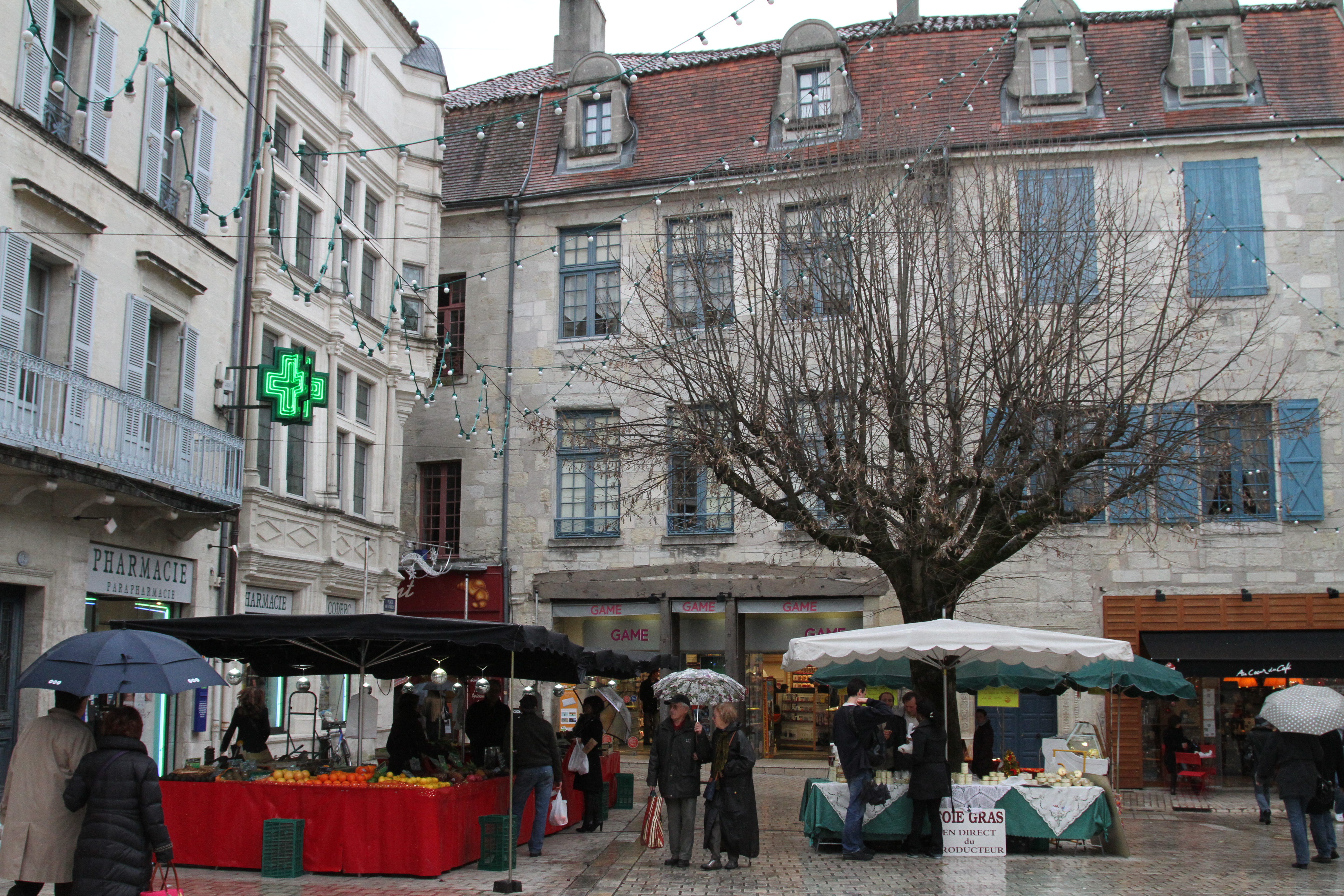
A market stall has two addresses: the place where you buy something and the place where it was grown, raised or made. In Périgueux, keeping those addresses separate is the key to understanding the relationship between an urban market and its agricultural surroundings. A stall beneath a historic façade can sell produce from a nearby farm, goods purchased from a wholesaler, or both. The setting does not settle the origin.
Here, “agricultural basin” means the city's wider food-producing hinterland, not a claim that every supplier farms within a single river catchment. The most useful way to read the market is to follow three connections: the weekly use of public space, the movement of food from identifiable places, and the evidence that allows a buyer to distinguish local production from regional imagery.
One city, several shopping rhythms
The municipal market page, checked again on 28 October 2026, distinguishes the covered Coderc hall from the larger outdoor markets. It lists the hall from Tuesday to Sunday mornings; on Wednesdays and Saturdays, outdoor stalls also occupy the Clautre, Ancien-Hôtel-de-Ville and Saint-Silain/Coderc areas. A smaller Friday market serves place de Verdun in the Toulon neighbourhood. Winter brings the marché au gras at place Saint-Louis, generally November to March, and a shorter truffle season, December to February. These are standing descriptions, not confirmation of a particular seller's attendance. City of Périgueux: market arrangements.
The distinction matters to an ordinary shopping trip. Someone looking for a broad weekly selection has a different task from someone buying a few ingredients near home. Treating all these occasions as one picturesque “market day” hides their practical roles. Before leaving, identify the place and type of market you need, then check the current municipal notice rather than assuming that a remembered holiday opening applies all year.
A setting is not a supply-chain certificate. Kimon Berlin’s 31 December 2009 photograph shows stalls and shoppers on place du Coderc. It records a particular winter scene, not current attendance or proof of where every displayed item was produced. A seller’s sign is a claim to check, not independent certification. Photo: Kimon Berlin, Flickr original, CC BY-SA 2.0. Original photograph unchanged; adaptations must retain applicable share-alike terms.
A producer and a reseller are not the same thing
The Grand Périgueux tourist office explicitly describes local growers alongside fruit-and-vegetable resellers at the central market. That is an important corrective to the assumption that every open-air stall represents a farm selling its own harvest. It also identifies neighbouring markets, including Vergt and Sorges-et-Ligueux-en-Périgord, as part of the area's broader pattern of food shopping. Grand Périgueux tourist office: the Périgueux market.
Neither selling role automatically establishes quality, environmental performance or value. A reseller can supply useful variety; a grower can explain a particular crop in detail. The meaningful question is what relationship the seller has to the item in front of you. Ask about that item, not merely the stall as a whole. A person who grows one product may obtain another elsewhere.
Useful, courteous questions include: “Did you grow these?” “In which commune?” and “Are these your own processed products?” If an answer is unavailable, keep the origin unconfirmed. You do not need to turn a shopping conversation into an inspection, and a busy seller should not be pressed for personal information. The aim is to buy with clearer expectations, not to classify people by appearance or accent.
The hinterland is more varied than its celebrated specialities
The Pays de l'Isle en Périgord's territorial food project covers both urban and rural communities across several intermunicipal areas. Its account highlights varied local crops, including walnuts, strawberries, chickpeas, potatoes and cabbages. Launched in 2018, the project links agricultural land, producers, distribution and access to food. Its priorities include local supply for households and collective catering. This is a development programme, not proof that every ambition has already been achieved. Pays de l'Isle: territorial food project.
This changes the way to read a shopping basket. Regional identity need not be restricted to an expensive speciality bought for a celebration. Everyday vegetables and pulses can also connect a household with nearby production. Conversely, a famous regional dish may contain ingredients sourced elsewhere. Keep the identity of the recipe, the location of processing and the origin of its ingredients in separate mental boxes.
The project's directory of local food actors includes farms, markets and associations in different communes. It is a starting point for identifying a business or alternative purchase channel, not a live inventory of what is available today. Check the individual producer's current arrangements before making a special journey. A listing alone does not establish attendance at Périgueux's next market.
Follow one crop: strawberries and the limits of a regional name
INAO's product description connects the development of commercial strawberry growing after the Second World War with the sandy, acidic slopes around Vergt. It describes Fraise du Périgord as a protected geographical indication, recognised in 2004, and explains that the fruit is grown in soil and packed at harvest into its consumer sales unit because repeated handling damages it. This is a specific product description, not a blanket description of every strawberry sold in Dordogne. INAO: Fraise du Périgord.
For the buyer, the lesson is to look for the actual product identification rather than relying on a regional-looking sign. “Bought in Périgueux,” “grown near Vergt,” and “sold under the Fraise du Périgord IGP” are different statements. Record the one the evidence supports. Do not infer certification from a farm's location alone.
Season also changes the question. A strawberry purchase and a winter truffle purchase belong to different production cycles; neither defines the market throughout the year. This article does not promise stock on a particular date or reproduce a future season's opening calendar from an unofficial listing.
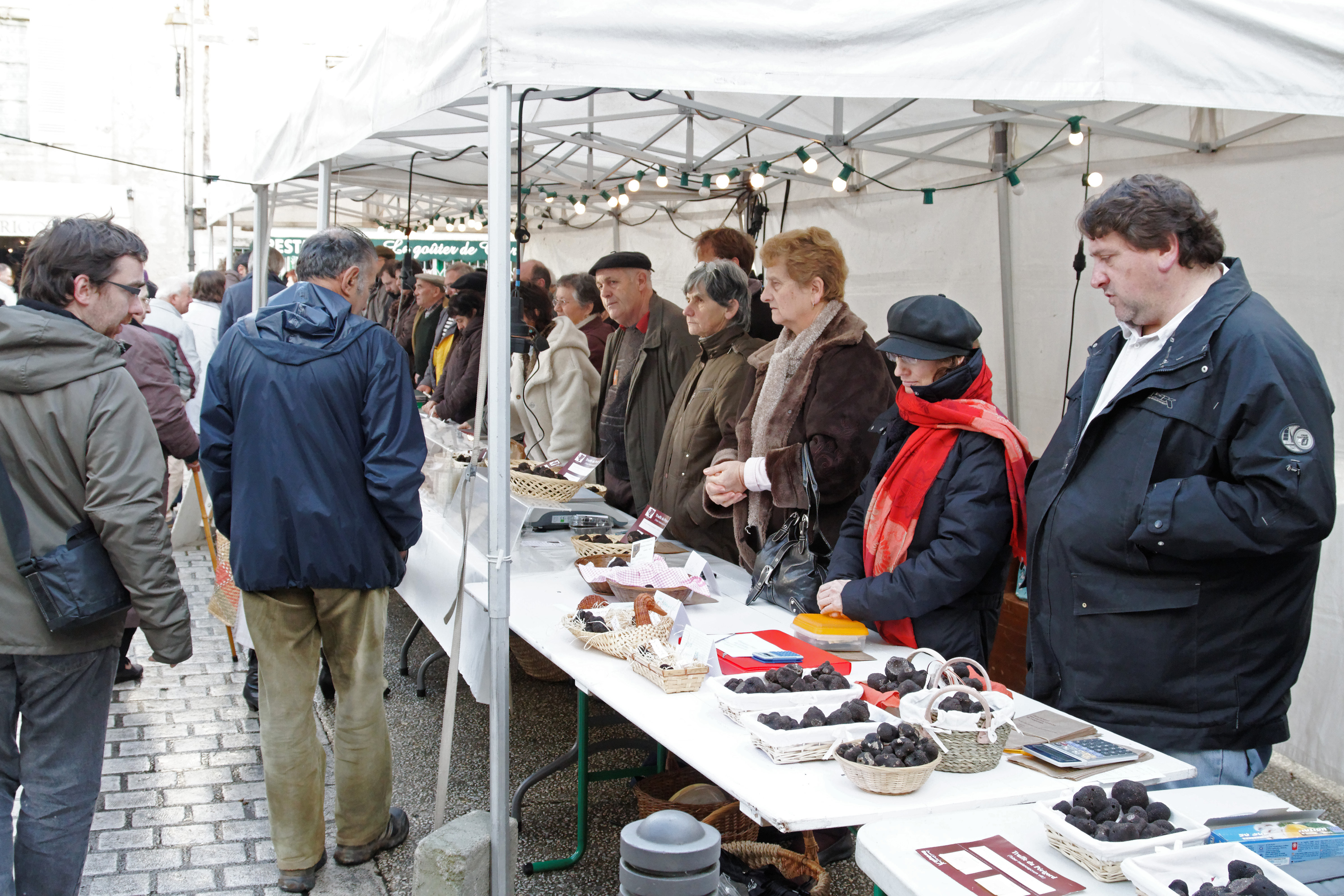
The transaction has a practical shape. This Périgueux truffle-market scene, photographed on 30 December 2009, shows baskets beside weighing scales: useful prompts to ask about the quantity and price basis, not evidence of a particular truffle's origin, species or certification. It illustrates winter specialisation rather than year-round stock. No seller is identified or presented as endorsing this article. Photograph: Kimon Berlin (KimonBerlin), original provenance and licence review, CC BY-SA 2.0, unaltered.

A market is also work in a constrained space
The Pays de l'Isle's 2024 study of markets and halls discusses transport, installation, weather, changing attendance and competition among sellers. Its geographic comparisons require care: one table describing markets across Grand Périgueux explicitly excludes the markets of Périgueux itself. Those figures cannot be quoted as the city's stall count. The study also treats communication and equipment as practical issues rather than assuming that heritage surroundings alone sustain trade. Pays de l'Isle: 2024 market and hall study.
The city's own commerce page provides a market-placement application and market rules. That administrative layer reminds the reader that selling space is organised, not simply occupied at will. This is not advice about obtaining a permit; prospective vendors should consult the municipality's current requirements. City of Périgueux: market documents.
As a customer, allow room for queues and deliveries, avoid blocking a stall while taking photographs, and ask before photographing people closely. A useful observation is how space changes between a working market and the same square after trading, not an assumption that every obstacle or crowd is a permanent feature of the neighbourhood.
What archives and museum collections can—and cannot—prove
The departmental archives' Collection Périgord index includes a reference to a charter concerning a measure of wheat sold to Pierre de Petit, described as a bourgeois of Puy-Saint-Front: 1 MI 290, folio 10, corresponding to volume 81. This is an archival research lead about a transaction. The index does not, by itself, locate that transaction in today's market square, establish modern unit equivalents or demonstrate uninterrupted trading practice. The original document was not consulted for this article. Archives départementales de la Dordogne: Collection Périgord index, PDF page 145.
A different kind of evidence is preserved at the Musée d'Art et d'Archéologie du Périgord. Its account of the Maranne collection describes a substantial herbarium and the work of identifying, documenting and conserving specimens. This records natural-history collecting, not the contents of contemporary market stalls. A plant specimen becomes evidence for a particular place and date only when its documentation supports that attribution. MAAP: collection research and the Maranne herbarium.
These sources are valuable precisely because they answer different questions. A civic page tells you where a market operates; a transaction record may illuminate a historical exchange; a labelled specimen can document a collected plant. None should be asked to certify a present-day stall's supply chain. That distinction prevents a story about regional abundance from becoming an invented claim of timeless continuity.
A simple three-item provenance comparison
Choose three purchases that you actually need, rather than buying extra goods for the exercise. For each, note:
- Item and form: fresh, dried, preserved or prepared. Avoid treating unlike forms as a direct price comparison.
- Seller's stated role: grower, processor, reseller, mixed or unconfirmed.
- Origin evidence: the named farm or commune, a product label, or an answer given for that item. Keep “unknown” available.
- Purchase conditions: the quantity, displayed price basis and the date. A price without its unit is not a useful comparison.
- Your reason for choosing: flavour, convenience, origin, budget, intended recipe or another explicit priority.
At home, write one sentence about what the basket establishes and one about what remains uncertain. For example: you may have confirmed a named production commune without knowing the journey taken to market. That is a valid partial answer. Do not turn three purchases into a statistical claim about all sellers or the whole department.
For orientation, use this map search for place du Coderc, Périgueux, then consult the municipal market page for the relevant trading area. The link is a place search, not a checked accessible route or a guarantee that a particular stall will be there.
Source register and limits
Remote research only. Municipal, territorial food-project, official tourism, departmental archive and museum material consulted. INAO’s indexed official product description was available; direct site retrieval was restricted. No certification audit, farm visit, price survey, vendor interview or live-stock check is claimed. The archival index entry was read, not its underlying charter. The museum section distinguishes herbarium documentation from food-supply evidence. The 2024 study excludes city markets from the cited regional comparison.