Free · France
Aubusson: How a small town's museum preserves weaving skills
Keeping a tapestry safe and keeping tapestry-making alive are related tasks, but they are not the same task. An institution can conserve an object without ensuring that someone will be able to make another. In Aubusson, the Cité internationale de la tapisserie addresses that distinction through collections, documentation, professional training and new artistic work.
The result is more than a display of a town's former speciality. It is an attempt to connect things that can be stored—textiles, drawings, books and records—with judgement that has to be practised. For a visitor, that connection offers a useful way to understand what a museum can contribute to a living craft, and what it cannot accomplish alone.
A museum housed in a former school
The Ministry of Culture's 2026 anniversary account identifies the Cité's home, occupied since 2016, as Aubusson's former École nationale d'art décoratif. It describes an institution combining a reference collection with contemporary commissions and training partnerships. The building's earlier educational use is therefore a particularly apt setting, although a former school building does not by itself guarantee the survival of a craft. Ministry of Culture: the Cité's tenth anniversary.
A workshop lesson and a gallery visit ask different things of their participants. The visitor may learn to notice an interpretation; the trainee must learn to make and evaluate one. Bringing those activities into the same institution makes their relationship visible without making them interchangeable.
Institutional survival has not been automatic
The national museum directory traces a longer and less seamless history. An early museum opened in 1885 alongside the educational project associated with the decorative-arts school. Its building deteriorated, the collections were moved to the town hall, and the structure was demolished around 1935. A later museum opened in 1982; management of its collections was delegated to the Cité's joint public body in 2011. National museum record M0502.
This history matters because “six centuries of tradition” can sound as if institutions simply continued by themselves. Buildings, collections and teaching arrangements have required decisions, resources and reorganisation. Recognising interruption and change is not an argument against the craft's importance. It explains why preservation is an active responsibility rather than a natural consequence of fame.
The national record is used here for institutional history. For present-day visiting arrangements, the Cité's own current information is the appropriate starting point; older directory addresses and contact details should not be treated as a current route plan.
Keep the work around the finished work
The Cité's collection catalogue includes preparatory designs, tools and woven learning samples alongside finished textiles. Those less spectacular holdings help preserve evidence of how work was developed and taught. They make it possible to investigate process, rather than presenting tapestry only as an image with an artist's name beneath it. Cité museum collection overview.
A sample can prompt questions a large wall-hanging does not: what was being tested, what was varied and what was judged successful? The answer may require its catalogue description or associated teaching material. An unlabeled fragment does not explain itself, however evocative it looks.
This is the museum's first contribution to skill preservation: retaining material that gives future learners and researchers something specific to question. It is not the same as extracting a complete recipe from every object. The maker's decisions may be only partly recoverable.
Documentation lets someone return to the question
The Cité's Resource Centre–Bibliothèque des Arts André Chandernagor brings together documentary holdings from the former departmental museum and the decorative-arts school's library. Its collection description includes technical files, images, periodicals and archives from the school, workshops, artists and researchers. The centre offers catalogue searching and on-site consultation under stated conditions. Resource centre and documentary collections.
Those resources connect a visible textile with evidence that may not fit on a gallery label. A dated image can clarify a stage of production; a technical file can explain a method; a workshop document can establish a commission's context. Each record still needs to be interpreted according to what it actually contains.
The centre's public access and professional appointment arrangements differ. Consult its current conditions before planning a research visit. A catalogue entry does not imply that the document is digitised, freely downloadable or available to borrow, and this article does not claim to have inspected a particular archival file in person.
Teaching requires practice, not only reference material
The Cité's professional-training page describes a two-year pathway involving CAP and BMA qualifications, delivered through GRETA Limousin with public and professional partners. Its account of the lissier's work includes preparing the design, choosing threads and colours, setting up the warp, weaving and finishing. Cité: transmission and training.
That description suggests a useful distinction between knowing the vocabulary and acquiring the skill. A visitor can learn what a cartoon or a warp is in an afternoon. Becoming able to judge a colour relationship in woven material requires repeated work and feedback. Training gives knowledge a setting in which it can be attempted, assessed and improved.
The published programme is evidence of an organised teaching pathway, not confirmation that applications are open today or that a place is available. Prospective trainees need the provider's current requirements and intake information. A museum visit should not be mistaken for a professional qualification.
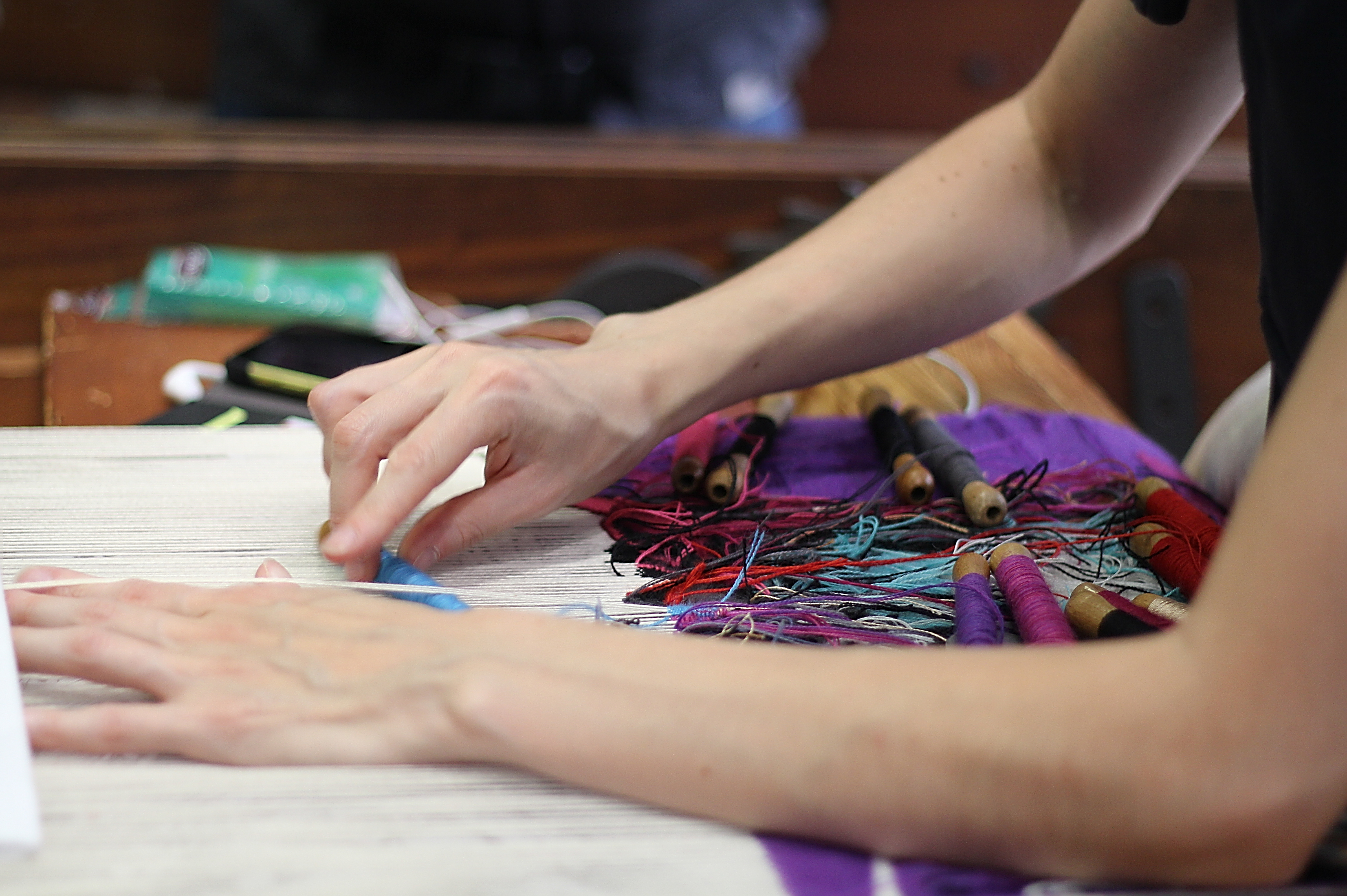
Practice is a physical activity: hands, warp threads and coloured bobbins photographed at the Maison de la Tapisserie in Aubusson on 12 August 2020. This is not identified as a Cité training class, nor as evidence of present-day enrolment or workshop access. Notice the contrast with the finished historic object shown below: an object photograph records a result; this close view records one moment of work. Photograph by Nicolas Fressengeas, original file and provenance, CC BY-SA 4.0, unaltered.

New commissions give inherited methods new problems
The Cité describes its contemporary-creation policy as support extending from an initial concept to the realised work, encouraging dialogue between artists and workshops. Its contemporary collection has developed through several mechanisms, including calls for projects and supported commissions. Cité: contemporary creation.
This adds a second kind of learning opportunity. An unfamiliar design asks practitioners to consider how their methods can serve an intention that is not already solved by an old model. Tradition is then a body of usable judgement, not a requirement that every new piece repeat a historical image.
There is an important limit to the claim. A commission can create work and experimentation; it does not, on its own, prove that every workshop is economically secure or that enough people are entering the profession. Those outcomes need their own evidence. The institution's stated mission and the health of an entire local sector should not be reported as the same thing.
The city contributes through a separate workshop
Aubusson's municipal website describes its own weaving workshop at the Maison du Tapissier and its collection of contemporary tapestries. The workshop produces unique pieces from designs by living creators while allowing the public to discover the technique. This is a municipal initiative, not simply another name for the Cité's museum or training programme. Municipal workshop and collection.
The distinction is useful. A living craft can be supported by several institutions with different jobs: a collection conserves evidence, a workshop makes work, a training provider develops practitioners and an archive preserves records. Recognising those separate roles gives a more accurate picture than crediting every activity to one museum.
The departmental archives provide a further counterpart. Their guide to manufacture registers identifies records of production, sale and maintenance, offering routes into the business history behind the objects. Creuse tapestry-manufacture archives. The catalogue is a research route, not evidence that every individual commission can be fully reconstructed.
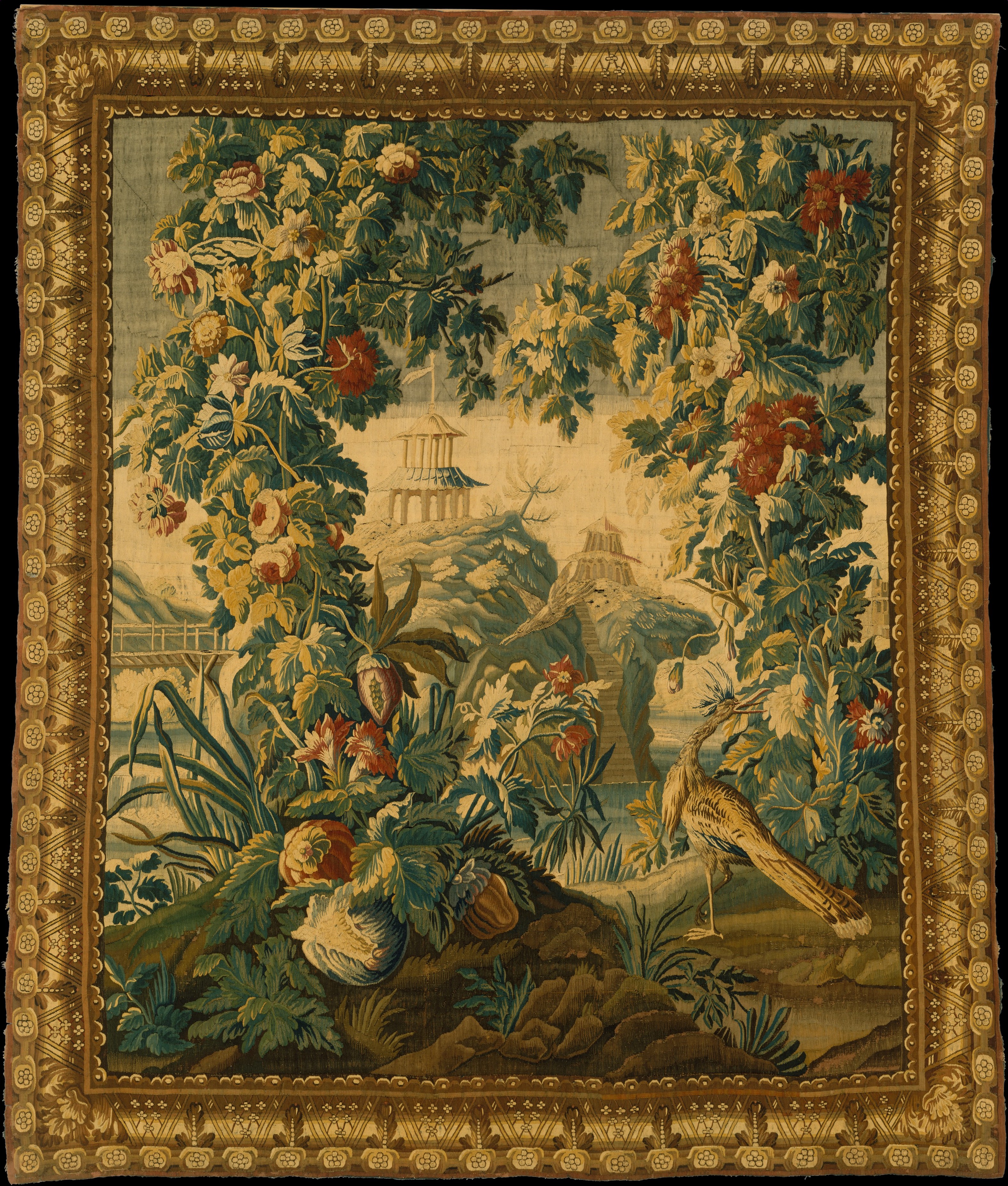
Try the questions below with a documented comparison, not a claimed object in the Cité's display: Fantastic Landscape, Aubusson, about 1725, wool and silk, probably woven under Jacques Dorliac's direction. It belongs to The Metropolitan Museum of Art, New York (Gift of Alexander Smith Cochran, 1911; 11.175.17). Collection record and image, public domain / CC0 Open Access, original image unchanged. The record supplies materials, date and a cautious maker attribution; this photograph does not supply a teaching history, preparatory cartoon or record of the maker's decisions. Notice what more a researcher would need.
Make a visit about one decision
To avoid being overwhelmed by an entire history, choose one documented work and look for a decision that someone had to make. A useful sequence is:
- Find the credited makers and date. Distinguish the design's author from its textile interpretation.
- Look for a preparatory drawing, sample or explanation associated with the work. Do not assume two nearby objects are related unless the display says so.
- Ask what the documentation establishes and what remains unknown. An attractive comparison is not necessarily a documented one.
- Consider how the knowledge might be taught: what could a learner discover from looking, and what would require practice with a skilled teacher?
This approach connects appreciation with the institution's underlying work. It also respects the limits of a public display: not every stored item is on view, and a visitor should not expect access to private workshops or reserved collections without arrangements.
The Cité identifies its address as Rue des Arts, Aubusson, and provides an official map/directions link. This article reproduces that institutional link but does not claim a visually checked map or an accessibility survey. Check current opening and research-access information before travel.
Aubusson's example is strongest when preservation is understood as a relationship between evidence and practice. The museum keeps objects and records available for questioning; teachers and makers turn questions into work. Neither side replaces the other. Together, they make it more plausible that the next generation will inherit not just remarkable tapestries, but the ability to think through making them.
Source register and limits
Primary sources checked remotely on 27 October 2026: national museum directory and Ministry of Culture anniversary account; Cité collection, resource-centre, training and commissioning pages; Aubusson municipal workshop information; Creuse departmental archive guide. No classroom observation, graduate-outcome study, collections-store visit or on-site research is claimed. Institutional claims are distinguished from proven sector-wide outcomes.