Free · France
Aubusson: Tapestry workshops and the textile craft chain
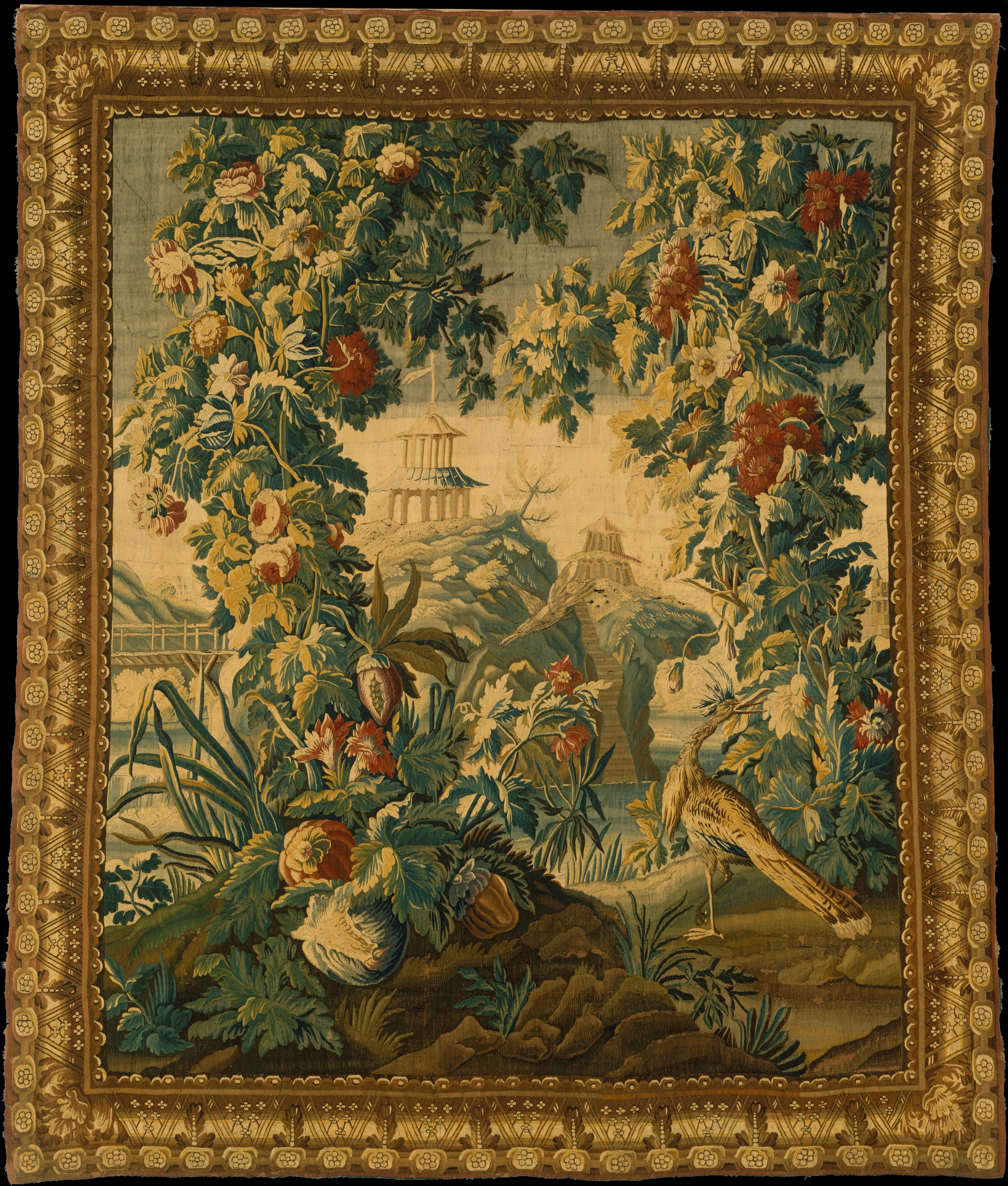
A tapestry on a wall presents a finished surface. Its making involves a much less visible sequence of decisions: which fibre to use, how to turn it into yarn, how to obtain a colour, how to translate a drawn shape into weaving and how to finish the textile after it leaves the loom.
In Aubusson, following those decisions is a better introduction to the craft than imagining a solitary artisan copying a painting. The finished object is the meeting point of artistic intention, material preparation, workshop judgement and commercial organisation. Different people may take responsibility for different stages; a skilled practitioner may also combine several roles.
Start with a network, not an origin legend
The municipality acknowledges that the origins of tapestry-making in the Aubusson–Felletin area remain uncertain. It discusses several historical theories without establishing one as a settled founding story, and points to written mentions at Felletin from 1457. Its account also stresses that artisanal weaving remains a contemporary means of expression. Aubusson municipal craft introduction.
There is no need to solve that uncertain origin before taking the present craft seriously. A workshop's current methods, its records and the objects it produces offer more concrete starting points than a colourful migration legend repeated as fact.
The Cité internationale de la tapisserie's overview describes the craft as a chain connecting wool preparation, spinning, dyeing, weaving and restoration in the southern Creuse area. Aubusson is an important centre within that wider working territory, not the address of every activity involved. Cité: overview of the craft network.
Fibre preparation is already a design decision
The Cité's explanation of materials follows wool through sorting, washing, carding and spinning. It describes twisting strands to strengthen and regularise the yarn, then identifies the Fonty spinning mill at Rougnat and Terrade at Felletin as regional participants. Its account also makes clear that tapestry is not restricted to a single fibre: wool and silk are important, but other materials can be used according to the artistic project. Materials and spinning.
For the observer, this means that “made of wool” is only the beginning of an explanation. Ask what sort of thread was needed and why. The answer connects the apparently modest material in a sample to the eventual surface. Do not assume that a regional weaving tradition proves the geographical origin of every raw fibre in an individual work; that requires project-specific information.
The cartoon translates an image into textile instructions
The carton is a working design used beneath the warp threads. According to the Cité, the cartonnier-colourist can select a palette, plan transitions between colours and consider the nature and thickness of threads. The same technical account describes the dyer's skilled adjustment of shades for the weaving process. These are related but distinct contributions: deciding what a colour should do in the design and producing the yarn that can achieve it. Cartoons and dyeing.
This is why a tapestry should not be judged simply as a more laborious photographic reproduction. A mark that works in paint must be made legible in a different material. When a preparatory drawing or sample is available, compare one boundary or transition rather than expecting a one-to-one match across the whole image. The difference may reveal an interpretation rather than an error.
One documented finished work: Fantastic Landscape, woven at Aubusson, about 1725; the Met cautiously attributes its direction to Jacques Dorliac. Wool and silk. This is an object in New York, not a photograph of a present-day Aubusson workshop. The Metropolitan Museum of Art, Gift of Alexander Smith Cochran, 1911, 11.175.17. Object and image, public domain / CC0 Open Access; original image unaltered. Compare the changing colour boundaries with the article's questions about translation into textile; the photograph alone does not establish the precise decisions of its makers.
The loom changes what the maker can see
Aubusson's low-warp weaving uses a horizontal loom. The Cité explains that the weaver works on the reverse, with the developing textile progressively rolled up; a mirror permits partial checks. Cutting the warp to release the completed work—the tombée de métier—allows the whole front to be seen. Finishing includes sewing edges and openings associated with changes of colour. Weaving and finishing.
The practical consequence is striking: the person making the image does not continuously see it as a gallery visitor will. Judgement operates through local passages, accumulated experience and checks along the way. A loom demonstration can therefore explain more than speed or dexterity. It can show how a maker navigates between a small area of work and an intended whole.
Museum collections preserve intermediate work too
The Cité's collection description includes not only tapestries and carpets but cartoons, designs, weaving tools and thousands of woven samples deposited by the former national decorative-arts school. That range matters because a finished textile alone cannot reveal every experiment or teaching exercise behind the craft. Cité museum collections.
A sample is not merely a miniature masterpiece. It may help investigate a material, a colour relationship or a technique. Its purpose should be read from the collection record rather than guessed from its appearance. Likewise, the presence of an item in the collection does not establish that it is currently on display.
When comparing a design with a woven object, keep the credits separate. Identify the artist, the workshop or weaver, the date and any documented preparatory role. An artist's name alone is not a complete production history.
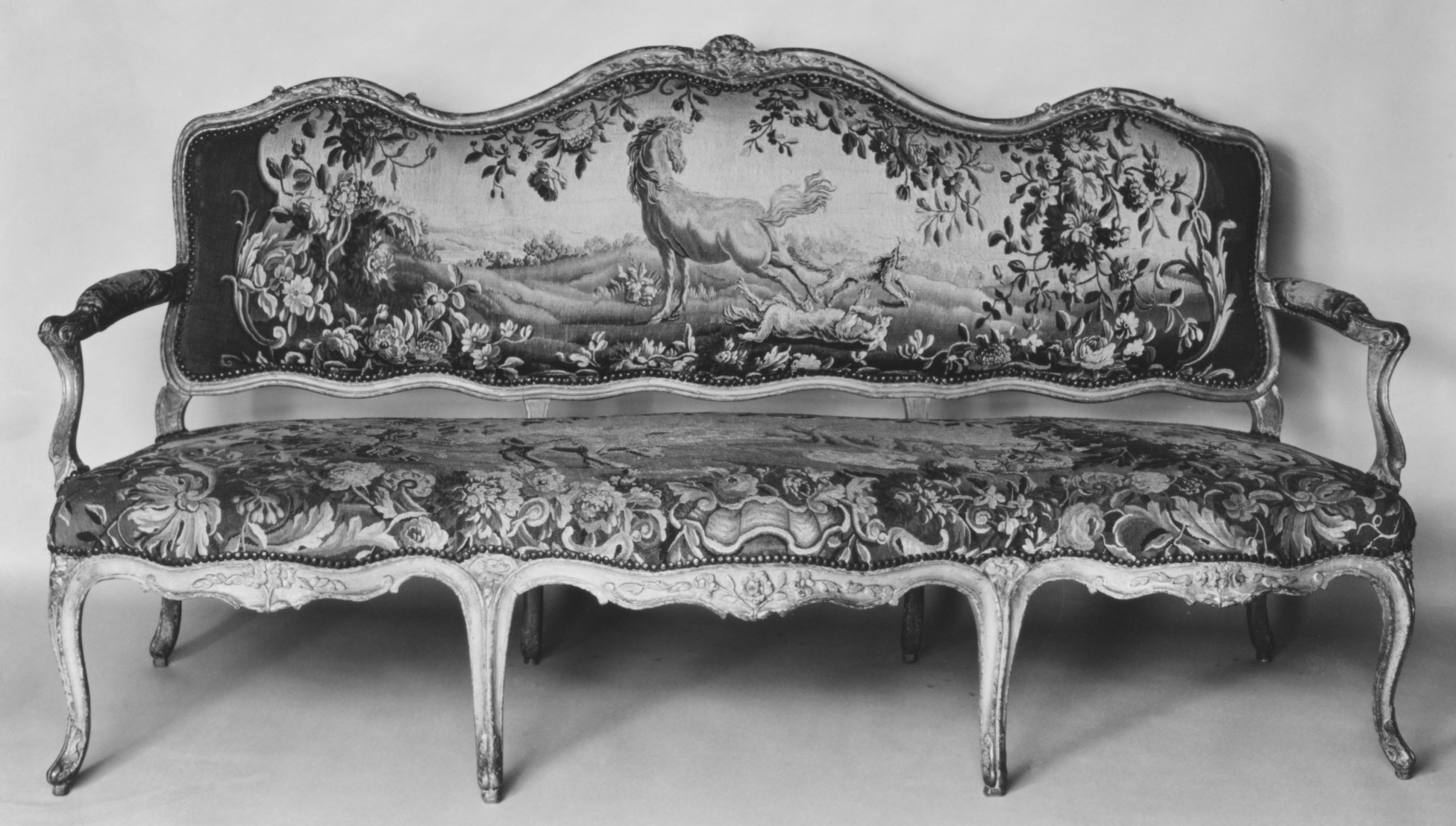
Another use for the woven surface: a mid-eighteenth-century sofa with Aubusson wool-and-silk tapestry over carved and painted walnut. It illustrates a documented furnishing, not a workshop demonstration or an object currently displayed in Aubusson. The Metropolitan Museum of Art, Bequest of Catherine D. Wentworth, 1948, 48.187.711. Object and image, public domain / CC0 Open Access; original monochrome image unaltered. The shaped seat and back invite comparison with a wall hanging without proving that the same workshop made both.
Workshop archives show orders as well as artistry
The Creuse departmental archives provide digitised registers relating to the Braquenié, Hamot and Tabard manufactures, within a collection spanning 1855–1987. Their guide distinguishes records of cartoons and weavings, entry books for the Braquenié shop on rue Vivienne in Paris and maintenance records. The entry books can contain order identification, coded prices and customer names; the maintenance books record cleaning and repair. Creuse archives: tapestry-manufacture registers.
These descriptions complicate the image of a craft confined to the workshop. Orders, distribution and aftercare were also part of its organisation. A register can answer a different question from a tapestry label: not just what the object depicts, but how it moved through a business.
The digitised selection is not a complete account of every manufacture or worker. This article has checked the archival guide, not traced an individual commission through a ledger. A serious object enquiry would retain the register reference, page and date, then compare those with the object's documentation.
Skills cross the boundaries between jobs
The Cité's training description presents the lissier as a practitioner able to work across design preparation, thread choices, colour, warp setup, weaving and finishing. It distinguishes employment in a workshop or manufacture from independent practice. These are descriptions of skills and possible professional roles, not a guarantee of current vacancies or training admission. Transmission and professional training.
A useful way to understand collaboration is therefore to ask who did what on a particular project. Do not turn a general list of occupations into a rigid rule that each stage must always have a different person. Nor should the fame of a designer erase the decisions of the people translating the design into textile.
A practical way to read one tapestry
Choose a single documented work rather than attempting to summarise the whole tradition. Build a small chain of questions:
- Intention: Who supplied the design, and what is known about the intended work?
- Translation: Is there a cartoon, sample or explanation showing a decision made for weaving?
- Execution: Which workshop and practitioners are credited? Which materials and technique are actually documented?
- Movement: Does a collection record, commission history or archive establish where the work went?
- Later life: Is repair or conservation documented, or merely assumed from the object's age?
An unanswered question is useful: it marks where the label, catalogue or archive stops. Keep observation separate from inference. A visible texture may suggest a technical question, but it does not disclose the workshop's exact method without supporting evidence.
For an orientation point, the Cité gives its address as Rue des Arts, Aubusson, and supplies this map/directions link. The link is reproduced from the institution's own website; its map display has not been visually verified here. Consult the institution's current visitor information before travel, and do not assume that nearby private workshops accept unarranged visits.
The craft chain is the central lesson. A tapestry carries more than an image: it carries coordinated decisions about materials, colour, technique and use. Recognising those decisions lets Aubusson's workshops appear as places of continuing thought and work, not simply as survivals of an old decorative art.
Source register and limits
Remote primary-source check: 27 October 2026. Civic evidence: Aubusson municipality. Museum and technical evidence: Cité internationale de la tapisserie. Archival evidence: Creuse departmental archives' manufacture-register guide. No workshop interview, on-site demonstration or individual ledger inspection is claimed.