Free · France
Espelette: Pepper drying, farmhouses and the village calendar
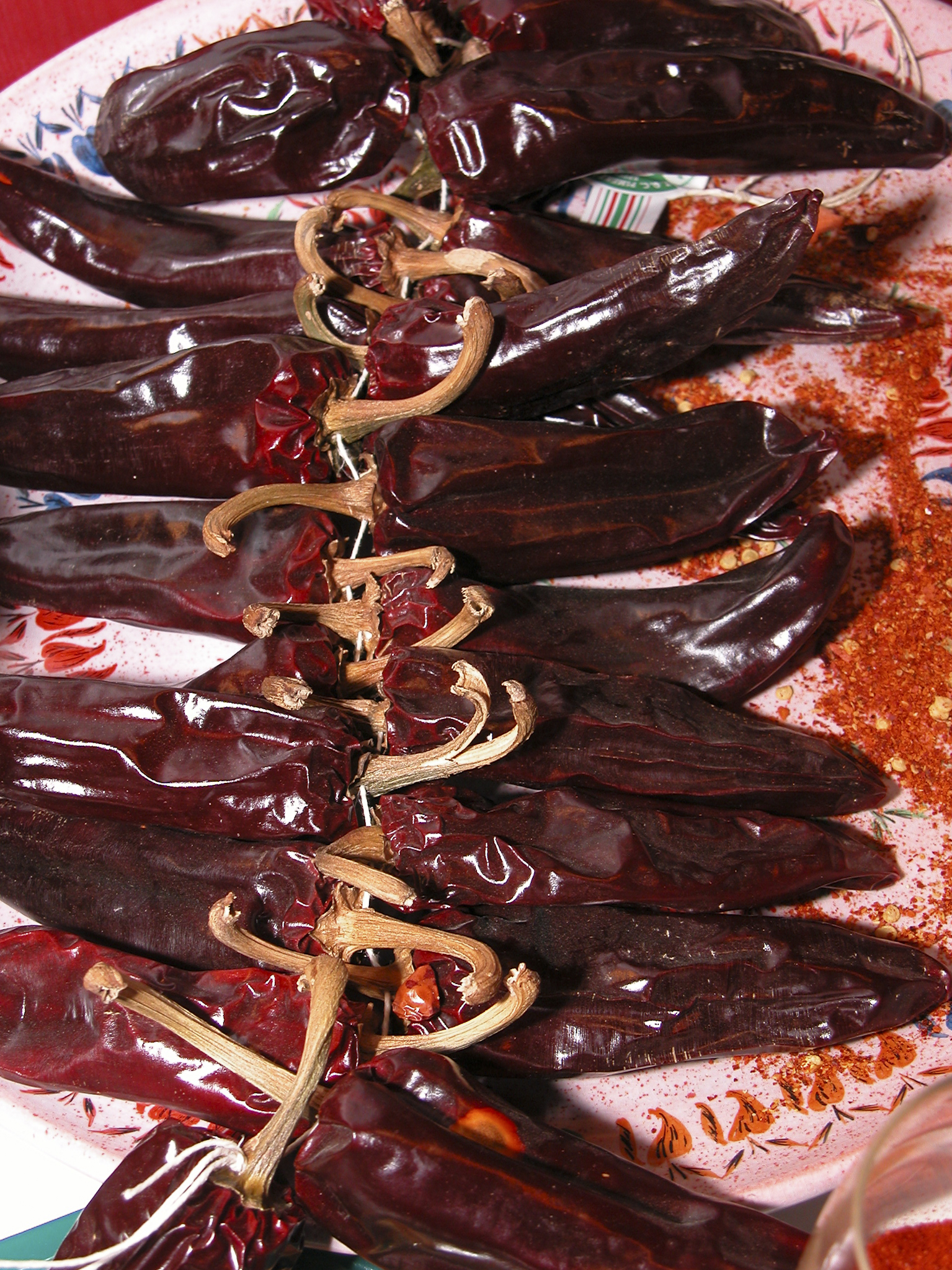
A red string of peppers against a pale wall is an unusually efficient picture of a place. It identifies Espelette before the caption does. Yet the photograph leaves some important things outside its frame: the plot where the fruit grew, the person who selected it, the sheltered space where another batch is maturing, and the work that continues after the festival crowd has gone.
Understanding the village means putting those missing elements back. A house façade can be a working surface, a display or both. A public celebration can honour farming without marking the end of every farm's harvest. And the name of a village can identify a product made across a wider territory. These distinctions do not diminish Espelette's identity. They make it more interesting than its most repeated image.
Start with the difference between a wall and a production process
The Pays Basque tourism office describes an older sequence: peppers were strung and exposed on house façades, then finished in a bread oven and pounded. Crucially, its present-day account adds that relatively few producers still use façades for drying. That qualification is as important as the picturesque description. A street view is not a census of contemporary processing methods. Local tourism account.
Look at a hanging string without deciding immediately what it proves. Is it a recent agricultural batch, merchandise, a demonstration or a decorative reference to the crop? Unless the owner explains, the answer may remain unknown. The same visual arrangement can serve different purposes at different times.
This is a useful way of reading rural heritage more generally. A practice can remain meaningful when its working location changes. Moving part of a process into a suitable shelter does not, by itself, erase inherited knowledge. Conversely, keeping the outward appearance does not prove that every old operation still happens behind the wall.
Peppers identified as Espelette peppers in Jean Weber's photograph, dated 4 March 2005 in both Flickr capture metadata and the original EXIF. The visible string is useful for comparing product forms; it does not establish a batch's maturation stage, drying method, food safety or present certification. Photo: Jean Weber / INRA, AOC piments d'espelette, CC BY 2.0. Original photograph unmodified.
Maturation and final drying are not interchangeable
The official specification approved on 28 November 2024 distinguishes several stages. Peppers intended for powder normally mature for at least fifteen days in a ventilated place, which may be a shelter or façade; fruit harvested from 2 to 15 December has a twenty-five-day minimum. Oven drying comes afterwards, following removal of the stalk and collar, before grinding. These are not instructions to leave every batch outside until it becomes powder-ready. Ministry of Agriculture specification, section 5.
The distinction changes the questions worth asking at a farm. “Do you dry peppers on the house?” is less informative than “Which stage happens here, and what happens next?” It also prevents a false opposition between an authentic wall and an inauthentic oven. The two can belong to successive parts of a documented process.
This article is an interpretation of local production, not a home-preservation recipe or a certification manual. A photograph cannot establish compliance, food safety or the condition of an individual batch. Those questions require the relevant producer and control information, not visual resemblance alone.
Farmhouses belong to mixed working landscapes
The municipality's agriculture page describes sheep dairying, beef cattle and mixed farming, with maize commonly associated with livestock systems. It distinguishes farms that have specialised in pepper growing, processing and sales from others for which pepper is an additional activity and income source. The municipal picture is therefore more varied than a village surrounded by pepper-only farms. Espelette municipality: agriculture.
That variety matters when looking beyond the main street. A field without peppers is not an absence of local identity. Nor should a farmhouse be reduced to the red fruit hung on one elevation. Its buildings and land may support several activities whose working calendars overlap.
From public space, notice the relationship between a residence, access lane, agricultural buildings and fields. Do not enter yards or assume that an open gate announces a visitor attraction. The appropriate question is not whether a farm looks sufficiently traditional, but how a particular household or enterprise combines growing, handling, selling and other work. Only its own account can establish the details.
The village name is not the whole growing area
The producers' technical sheet explains that the appellation territory covers parts of eight communes and the whole of two others. It also identifies Espelette's historical role as a commercial crossroads in the product's naming. The town centre and the production area are connected, but they are not geographically identical. Syndicat du Piment d'Espelette, technical sheet updated April 2025.
This distinction helps when buying. The seller's stall, the farm's address and the place-name on the protected product need not all be the same location. Ask who grew the peppers and who transformed them. An informative answer supplies a relationship between people and places rather than relying only on the familiarity of the name.
It also changes the view from the street. The village functions as a point of interpretation and exchange for a larger agricultural geography. A central shop window cannot show that entire geography, however many jars it contains. The label is a starting point for inquiry, not a substitute for it.
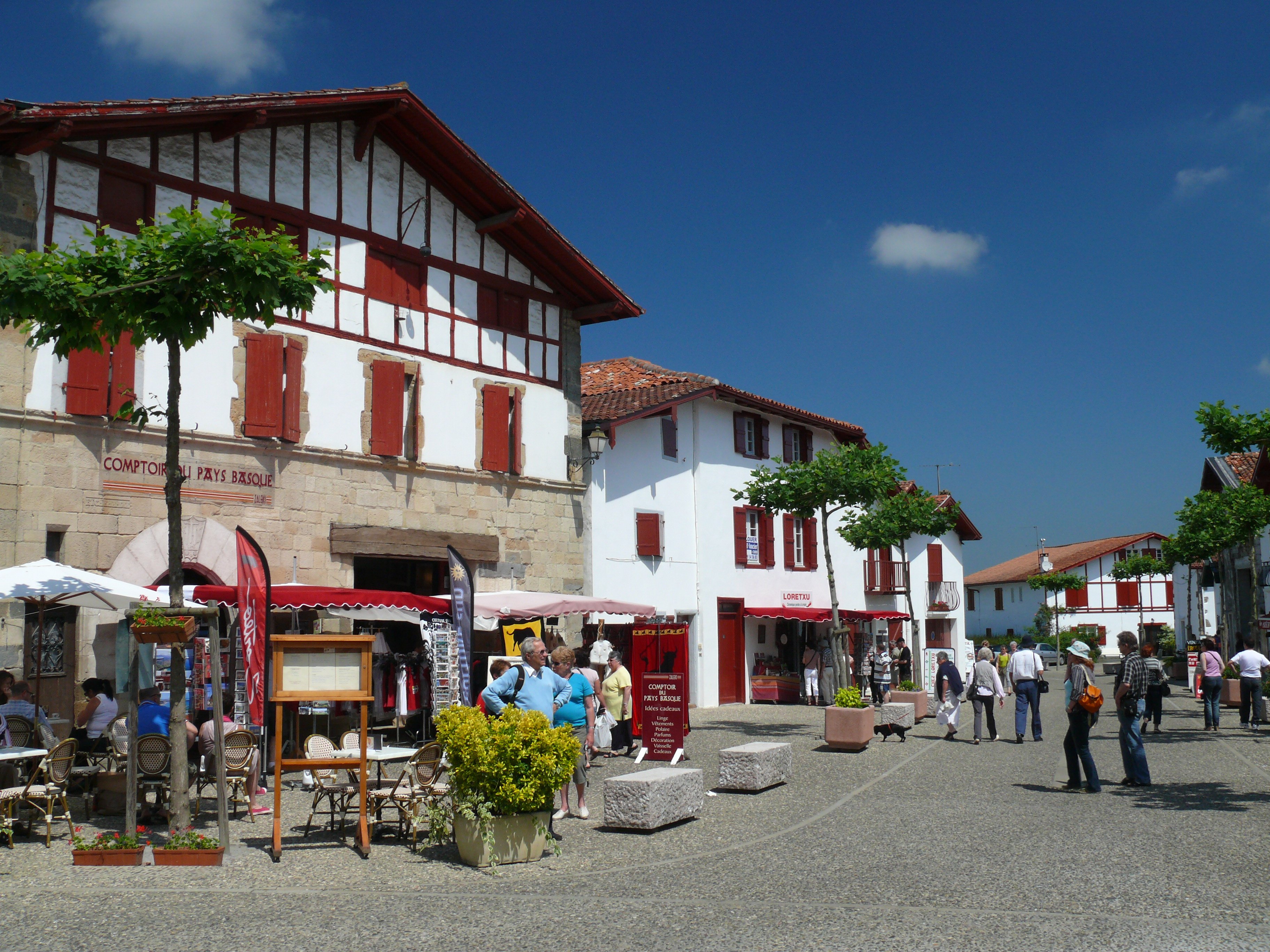
Central Espelette in 2009: shops, outdoor tables and circulation share the public space. This town-centre view complements the product close-up without identifying a farm, proving where a displayed product was grown, or documenting the pepper festival. The photographer's description gives June; the capture-date field gives 21 November, so the month is unresolved. No present-day trading arrangements or identities of passers-by are inferred. Photo: dynamosquito, Espelette, CC BY-SA 2.0. Original photograph unaltered; no endorsement implied.
Harvest time does not end when the music stops
Under the 2024 specification, picking is manual and staggered, ending with frost and in any case no later than 15 December. The autumn festival should therefore not be treated as a universal last-harvest day. A celebration and a crop respond to different kinds of timing. Official production specification, section 5.
Consider three calendars side by side. The biological calendar follows plant development and weather. The working calendar includes picking, sorting, maturation and transformation. The public calendar offers dates when a village gathers or receives visitors. They overlap without becoming one schedule.
For a visitor, this means that arriving during a festival does not guarantee seeing every agricultural operation. Arriving afterwards does not mean that production has finished. A farm demonstration may make a process intelligible without presenting that day's full workload. Ask whether an activity is being explained, demonstrated or carried out as part of a current batch; each can be valuable, but they are different experiences.
The festival has a history, not just an atmosphere
The Ministry of Culture's intangible-heritage inventory, based on fieldwork in 2012 and 2013, dates the first celebration to 1967 and the organising confraternity's creation to 1969. It records the municipality's allocation of stalls, volunteer involvement, religious observance and public ceremonies. This is evidence of an organised social event, not an unchanged ritual emerging automatically from the harvest. Inventory record, dated 24 January 2014.
Those organisational details are worth retaining. Stalls need places; visitors need circulation; performances need preparation; traders and residents have different uses for the same streets. The festival temporarily rearranges an ordinary settlement. Its cultural meaning lies partly in that work of coordination, not only in costumes or food.
The 2026 event was advertised for 24–25 October. The Ossau-Iraty producers' organisation published a programme while explicitly warning that it was provisional. As this source was checked on 27 October, those dates are past; the announcement is not eyewitness confirmation that every advertised activity occurred, and it does not establish next year's dates. Dated 2026 announcement.
An ordinary market day asks a different question
The tourism office lists a Wednesday market throughout the year. That recurring rhythm offers a useful contrast with the exceptional festival weekend. The contrast is not between an authentic weekday and a false celebration. It is between two ways of arranging exchange, sociability and visitors within the same place. Check the current calendar before travelling, especially around holidays. Village information.
On either occasion, make the crop less anonymous. Ask one specific question about an operation rather than requesting the entire history of the village. Where does maturation take place? Is the string being sold as a product? Which farm supplied the powder? A focused question respects the seller's time and can yield a more precise answer than a broad request for “tradition.”
Do not turn observations into population-wide claims. One producer's system, one stall's language or one house's display cannot stand for every resident. A place can have a strong shared image while containing substantial differences in work and everyday life.
Use the interpretation centre to connect what the street separates
Etxea, the pepper interpretation centre, is listed at 25 place du Marché / Merkatu Plaza, 64250 Espelette. The tourism office describes displays about the product, its territory and the people who make it, together with a production film. It is a useful context for comparing a façade, a farm account and a finished spice. Centre information and address.
Locate Etxea in Google Maps. This is an address search, not a verified accessible route. The tourism listing contains inconsistent weekend-opening fields, so confirm the intended date directly rather than relying on a copied timetable.
Leave with a small, connected explanation: peppers grow within a wider farming landscape; handling involves distinct stages; the village gives the product a public identity; and the calendar brings different parts of that system into view. The red façade remains memorable. It becomes more valuable when it is the beginning of understanding rather than its endpoint.
Source register and limits
Primary and institutional sources checked 27 October 2026: the ministry's 2024 product specification; the producers' April 2025 technical sheet; municipal agriculture pages; the Ministry of Culture's 2014 inventory based on named local interviews; Pays Basque tourism's village and Etxea records; the Ossau-Iraty organisation's dated 2026 event announcement. No household archive, original farm ledger or in-person interview was inspected. The heritage inventory is a published fieldwork record, not this article's own oral-history research.
Conflicting or unreliable details were excluded: introductory crop-arrival stories, inconsistent AOC/AOP dates on promotional pages, suspect municipal historical tonnage, and an exact universal end-of-harvest date inferred from the festival. Production-method claims follow the ministry's detailed 2024 text rather than abbreviated older summaries. No claim is made that every local farm uses one method, that the 2026 programme occurred exactly as advertised, or that historic visitor totals describe current attendance.