Free · France
Limoges: Porcelain factories and regional clay
A white porcelain plate makes its raw materials difficult to imagine. The finished surface conceals extraction, grinding, shaping and firing. In Limoges, following those operations changes the familiar story of beautiful objects into a regional industrial history: a city connected to mineral deposits, fuel, machinery, skilled work and distant customers.
Kaolin is central to that history, but a useful explanation must go beyond the discovery of a white clay. A deposit is not a factory, and a factory is not a finished product. The connections between those stages are where much of Limoges's porcelain story becomes visible.
The important clay was not simply beneath the city
Nouvelle-Aquitaine's regional account places the decisive eighteenth-century kaolin discoveries in the Saint-Yrieix-la-Perche area, identifying 1768 as the landmark year. It describes the later growth of manufactures following the first Limoges establishment in 1771. The geography matters: the production city's name and the location of the raw material are related, but they are not identical. Region Nouvelle-Aquitaine: porcelain of Limoges.
Think of the region as a connected working landscape. Material had to reach places where it could be prepared and used; the people making and selling porcelain needed more than proximity to a deposit. This is a stronger starting point than imagining that a complete industry sprang up wherever someone found a promising piece of clay.
Nor does that historical connection prove the present origin of every mineral in a modern object. An eighteenth-century quarry story cannot substitute for a manufacturer's current sourcing information.
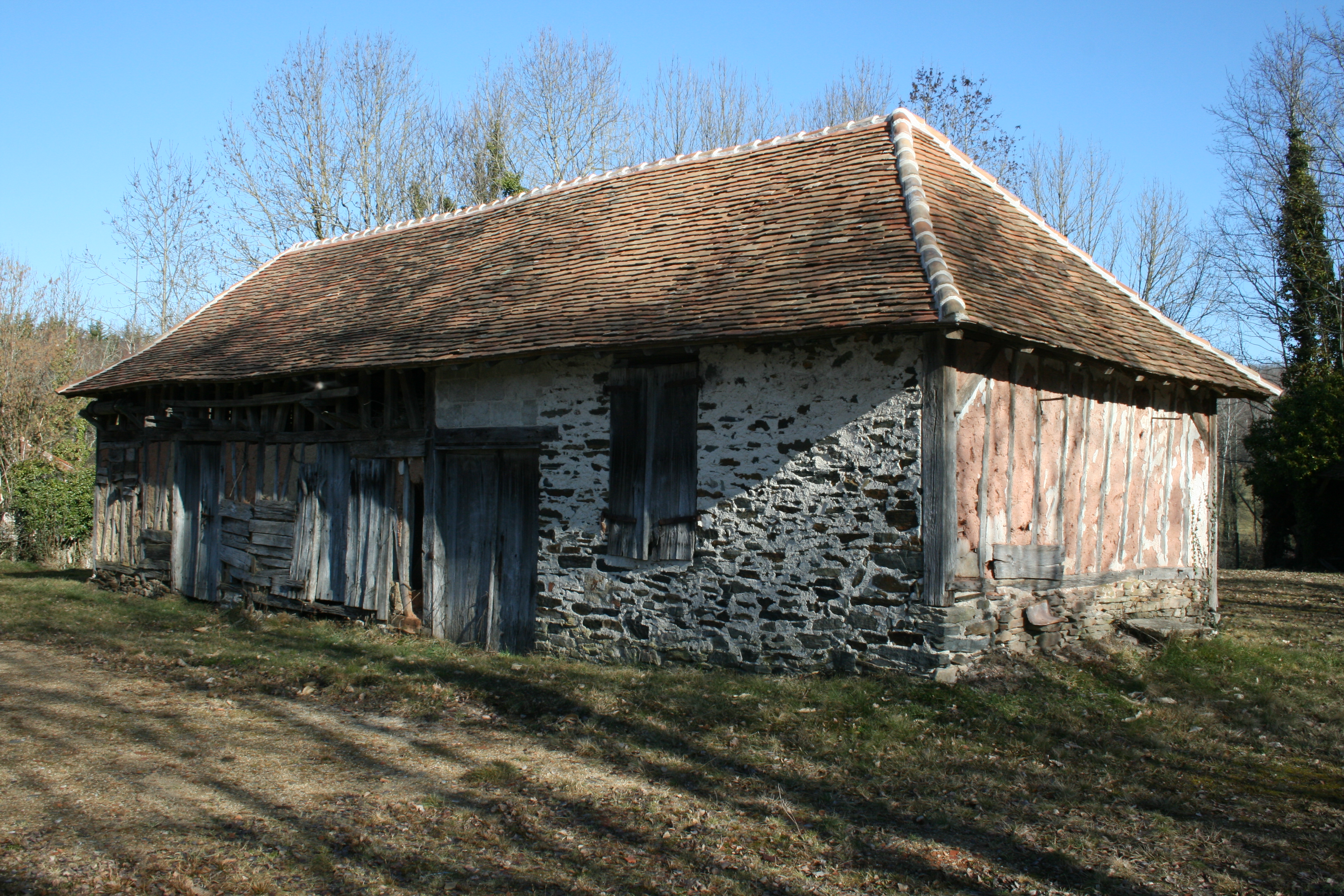
The material landscape has its own buildings. Marcognac, in the commune of Saint-Yrieix-la-Perche, is recorded as a former kaolin quarry by the national heritage inventory, PA87000022. This photograph records a building at the site, not exposed kaolin or an operating extraction process; its particular former function is not established here. It helps separate the regional supply landscape from the finished Haviland plate below, without asserting a supply link between them. Photograph by MairieSY, 1 March 2012, original and provenance, CC BY-SA 3.0, unaltered.

Porcelain is a prepared material, not untouched clay
Université Paris-Saclay's mineral-heritage account explains porcelain through a finely ground mixture including kaolinite-bearing clay, feldspar and quartz. This makes an important distinction for the non-specialist: kaolin is a key constituent, not the whole finished body. Paris-Saclay: minerals and porcelain.
A useful comparison is between the raw ingredient, the prepared body and the fired object. Each belongs to a different stage. A lump of extracted material is not ready-made porcelain, and a white unfired shape does not yet have all the characteristics of the finished piece.
Avoid treating a simplified recipe as a universal specification for every ceramic. This article concerns the material story of Limoges porcelain, not instructions for mixing or firing an unknown body. Particular products and processes require their own technical information.
Resources needed an industrial organisation
The city of Limoges connects the early industry with water, minerals, kaolin and wood fuel, as well as the role of the intendant Turgot. Its account places the major industrial and artistic expansion in the nineteenth century. Municipal introduction to the arts of fire.
A separate municipal history is less triumphal about the beginning: despite nearby kaolin, it describes a difficult start and a small manufacture on the Paris road before the Revolution. Limoges: the first manufacture.
Read together, these accounts guard against a deterministic explanation. Natural resources helped make production possible; they did not remove the need to organise knowledge, labour, equipment and sales. The later reputation of an industry can make its early uncertainty easy to overlook.
For a reader trying to understand a factory site, this suggests a set of practical questions. Where did material enter? Where was it prepared? What supplied heat? How did a finished piece leave? A building's attractive façade may answer none of them without a plan, inventory or explanation of its former use.
The museum makes preparation visible
At the Musée national Adrien Dubouché, the technical mezzanine explicitly addresses extraction and treatment of raw materials, including the Saint-Yrieix quarries. Its account identifies machines and models used to explain body preparation, such as grinding equipment and a filter press. It also presents the later stages of manufacture and tools donated by Limousin factories. Museum: technical mezzanine.
Those objects offer an antidote to looking only at decorated surfaces. They direct attention to repetitive operations and the means of controlling material before an object becomes presentable. A tool can be important precisely because it is ordinary in production rather than spectacular in a display case.
The museum describes preserved signs of use on its equipment. Those traces should be read alongside the label: wear may invite a question, but it does not by itself establish who used a machine or on which order. This is a remote account of the museum's interpretation, not a claim to have inspected the equipment in person.
A factory could change its place in the chain
The national heritage inventory's record for Haviland's avenue Garibaldi site provides a concrete example. It describes decoration workshops established in 1853, followed by the company's move into making white porcelain in 1864; previously it bought that ware from other Limoges manufacturers. New buildings and kilns followed. The record also documents the firm's strong American commercial connection. POP industrial-heritage record IA87000178.
This sequence shows why “porcelain factory” should not be treated as a timeless description of one fixed set of activities. A business could decorate and distribute goods before bringing more stages of production onto its own site. The same name can cover changing arrangements over time.
When researching a particular object, keep the maker, decorator, business and date distinct. A mark or catalogue attribution is a starting point, not permission to assume that all the work occurred under one roof. The historical site record likewise does not establish that its buildings now contain an operating porcelain factory or admit visitors.
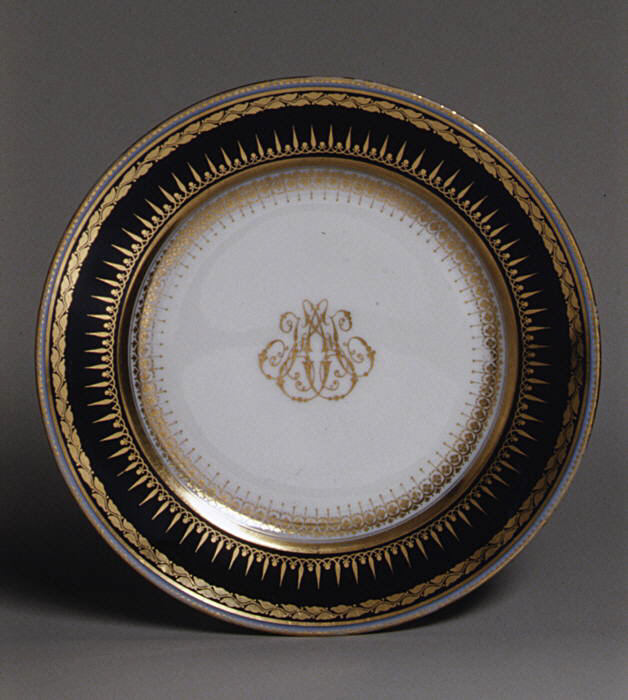
Manufacture and decoration need not share an address. The Met records this Haviland & Co. hard-paste porcelain plate, 1876–88, as Limoges with Paris decoration. The Metropolitan Museum of Art, Purchase, Anonymous Gift, by exchange, 1988; 1988.84.47. Object record and image, public domain / CC0 Open Access, original photograph unchanged. It provides a documented example of the distinction discussed here, not proof of the minerals' origin or of manufacture at the particular Garibaldi site.
A kiln belongs to social history as well as technology
The municipal museum network describes the Four des Casseaux as a nineteenth-century industrial site interpreting porcelain through technical, artistic and social history. Limoges museum network: Four des Casseaux.
That combination is useful. Heat is not just an abstract stage in a diagram: a kiln had to be loaded, managed and incorporated into a working establishment. To understand it, ask how the interpretation connects the equipment with the people and organisation around it. Do not infer a particular firing temperature, cycle or operating procedure from the kiln's appearance alone.
An industrial monument and a collection of finished ceramics supply complementary evidence. One helps establish the scale and setting of production; the other can show its outcomes. Neither, by itself, supplies the whole regional story.
Archives connect mineral suppliers with manufacturers
A CNRS industrial-history source guide hosted by the government's archive service lists several relevant Haute-Vienne holdings: porcelain-manufacture catalogues in series 18 J, Haviland records in 23 J and the records of KPCL—Kaolins et Pâtes Céramiques du Limousin—in 32 J. The guide identifies KPCL as succeeding the Maison Alluaud in 1907. Frédéric Ogé, industrial-history source guide, 2013, printed page 72.
These are research leads from a dated guide, not claims that individual files have been read here or that every reference remains unchanged. Confirm current descriptions and consultation conditions with the holding archive before ordering material.
The distinction between supplier records and manufacturer records is nevertheless instructive. To investigate a material connection, one might need evidence from both sides of a transaction. A factory's publicity could explain what it sold; a supplier's records could address a different part of how production was sustained. Neither should be used to invent a supply relationship that has not actually been documented.
Read one object across three scales
A manageable enquiry starts with one labeled piece rather than the entire city's output:
- Object: record the attributed maker, date, material and decoration. Note what the label does not say.
- Factory: look for evidence of the establishment's operations at that date. Was the relevant activity manufacture, decoration or both?
- Region: identify any documented material or transport connection. Do not fill a gap by assuming every input came from the nearest historic quarry.
Keep an evidence trail between those scales. A general history can explain the context of a piece without proving its individual provenance. A catalogue may identify an offered model without proving that a particular surviving example was sold in a particular year.
For a public orientation point, the Adrien Dubouché museum gives its address as 8 bis Place Winston Churchill, Limoges. Museum visitor information and address search in Google Maps. The latter is a search link, not a visually verified map, factory-access route or accessibility assessment. Check current visitor arrangements before travel.
Limoges's porcelain becomes more impressive, not less, when its raw-material story is made complicated. The white surface is the outcome of a chain of transformations and decisions. Understanding that chain connects an object on a table with the regional work that made it possible.
Source register and limits
Primary institutional sources checked remotely on 27 October 2026: Limoges civic history; Nouvelle-Aquitaine regional history; Paris-Saclay mineral interpretation; Adrien Dubouché museum technical interpretation; national industrial-heritage inventory; municipal Casseaux museum listing; 2013 CNRS archival source guide hosted by the government archive service. The archive guide was read; individual manufacturing or supplier files were not. Historical mineral sources are not represented as verified modern supply chains. No site visit or industrial-process inspection is claimed.