Free · France
Holidays, Paid Leave and RTT Are Not the Same
Three kinds of time away from work—and three different questions
A date marked on a national calendar, a balance in a leave portal and a colleague’s mention of “taking an RTT” may all suggest a day away from work. They are not interchangeable. Confusing them can lead to a booking made before permission, the wrong leave category selected or an assumption that someone else’s working arrangement applies to you.
This guide concerns ordinary private-sector employment in France. It is not an individual entitlement calculation, and it does not cover every public-service, sectoral or territorial rule. Its purpose is to help you name the question before asking your employer or adviser for the answer.
A public holiday is a calendar category
A jour férié is a recognised public holiday. Service Public’s private-sector guidance explains that public holidays can be worked or not worked, depending on the applicable rules. May Day has a particular compulsory-rest rule, with exceptions for activities that cannot stop. Other public holidays should not automatically be read as days off for every employee. Territorial and local distinctions also matter.
The calendar tells you which date is a holiday; it does not by itself tell you your rota, the employer’s arrangements or every pay consequence. A friend who does not work that day may have a different agreement or activity from yours.
A pont—the intervening day used to create a longer break—is another question. The same official guidance describes it as an arrangement rather than an automatic right. Do not convert a Thursday holiday into a guaranteed Friday absence simply because the weekend makes the combination attractive.
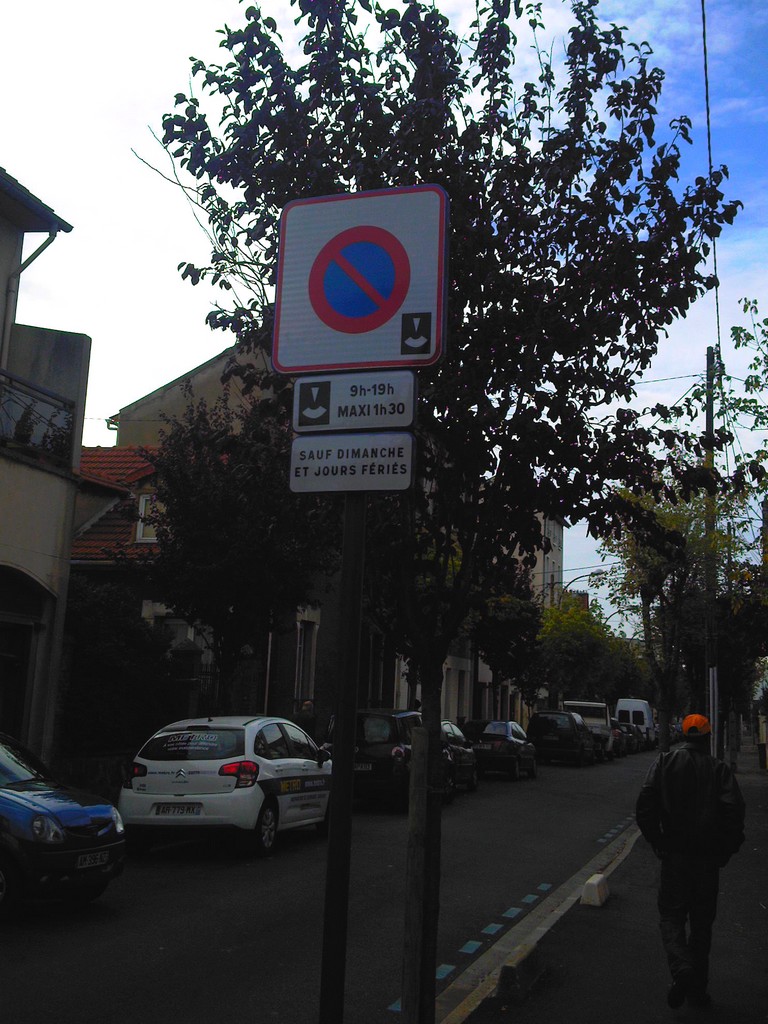
A historical Drancy sign uses jours fériés as a calendar category. That wording does not establish whether a particular employee is off work, on paid leave or using RTT. This dated image is not current parking guidance. Photograph: Ykmyks, uploaded 7 October 2010, exact capture date unverified; original photograph, CC BY-SA 3.0, unaltered.

Paid leave is an individual entitlement with a counting method
Congés payés are paid leave. The official paid-leave guidance says employees have rights whether they work full-time or part-time and whether their contract is indefinite or fixed-term. In the general case, acquisition is 2.5 jours ouvrables per month of actual work, corresponding to thirty such days over a complete year. Special cases, including certain absences, affect the calculation. An employer may use jours ouvrés provided the method gives at least equivalent rights.
Those French counting terms matter. Do not compare two portal balances just by looking at the numbers, or silently translate thirty jours ouvrables into thirty days on a Monday-to-Friday rota. Ask which unit and reference period your employer uses. Also distinguish leave acquired, leave already used and leave requested but not yet confirmed.
The practical lesson is not to calculate your entitlement from this paragraph. It is to know which information you need before checking a balance.
RTT belongs to a working-time arrangement
Réduction du temps de travail refers to a working-time reduction arrangement. Service Public’s RTT page, updated in September 2026, explains that the applicable agreement determines which employees are covered and the rules for taking days or half-days. Part-time employees are generally outside the arrangement unless a particular agreement provides otherwise. It is not a universal extra leave balance attached to every French job.
Do not treat “I worked late” as proof that a particular number of RTT days has appeared. The applicable working-time system and agreement matter. Likewise, do not assume that every rest-day label in a portal is legally identical to RTT. If your arrangement uses a different label, ask what it means rather than renaming it for convenience.
For planning, record the category exactly as the employer uses it, the applicable rule and the actual status of the request. A colleague’s experience can suggest a useful question, but it cannot supply your answer.
A small classification card
This original aid is for organising questions, not determining legal rights.
| What you have seen | What it establishes | What still needs checking | |---|---|---| | A public holiday printed on a calendar | A calendar designation | Whether you work and which rules apply | | A paid-leave balance in a portal | A recorded balance under that system | Unit, period, adjustments and request status | | An RTT balance or reference | A named working-time-related category | Applicable agreement and how it may be used | | A proposed long weekend | A personal plan | Every relevant day’s work or absence status |
A blank in the final column is not a confirmation. Write the actual question and keep the response with the relevant request or policy reference.
Three fictional situations
A holiday next to a weekend. Léa sees a holiday on a Thursday and wants to travel until Sunday. Before buying a non-changeable ticket, she checks whether Thursday is non-working for her and how Friday would be treated. She does not assume the calendar has approved a four-day break.
Two colleagues with different balances. Omar sees a lower number in his portal than a colleague sees in hers. They first compare the labels, units and periods rather than concluding that one has lost leave. Even within a workplace, a raw total without its context is a poor basis for comparison.
A late finish and a day off. Elise works beyond her usual finishing time and plans to select RTT the following week. Her first task is to clarify how that work is recorded under her arrangement and what request process applies. This article does not decide whether the hours create overtime, rest or another treatment.
Each example separates a fact from an assumption. None tells the reader to forgo a right; it helps the reader ask for the right information.
Before you commit to a date
Use four short prompts:
- Category: What is the exact name of the day or absence?
- Rule: Which employer policy, agreement or official provision is relevant?
- Record: What balance or schedule applies to me, in which unit and period?
- Status: Is this only an idea, a submitted request or a confirmed arrangement?
Keep the categories separate when talking to colleagues. “I have submitted a paid-leave request” is clearer than “Friday is a holiday” when Friday is not a public holiday. “I need to check my RTT rules” is more accurate than “Everyone gets those days.”
If the answer affects pay, an unusual absence or a disagreement, use the actual documents and obtain appropriate advice. Do not solve a dispute by copying a general online example into a leave portal.
The distinction that makes planning easier
Public holidays begin with the calendar. Paid leave begins with an employee’s entitlement and its counting rules. RTT begins with an applicable working-time arrangement. All can affect a plan, but they do not become the same thing merely because the result may be a day away from work.
Read the label, confirm the applicable rule, and distinguish a request from its outcome. That simple discipline makes conversations about time off more accurate—and avoids building a trip around an assumption.
Sources and scope
Service Public pages F2405, F2258 and F34151 checked remotely on 29 October 2026. Each official-page summary is deliberately limited; the classification card and fictional scenarios are original explanatory aids. No individual entitlement, date-counting exercise, overtime calculation or leave approval is supplied. Recheck current rules and your own arrangement before acting.