Free · France
What Assurance Habitation Usually Refers To

The label is a starting point, not a complete promise
When someone asks for your assurance habitation, they usually mean home insurance. But the label alone does not tell you which people, property or events are covered. A certificate, a quotation and the full contract also serve different purposes.
The useful first step is to separate damage to the rented home, damage to your belongings, and liability for harm to other people. They may appear within one package, but they are not the same question. This article explains the vocabulary and a way to read a proposal; it does not certify that a particular loss will be paid.
The tenant’s minimum is not a promise about all possessions
Service Public’s rental-risk guidance, verified in April 2025, says a tenant under a residential lease, including a mobility lease, must have cover for rental risks such as fire, explosion and water damage. It distinguishes that protection of the rented property from cover for personal belongings and damage to neighbours. It also warns that tourist furnished lets follow different rules.
The page requires the insurance certificate when keys are handed over and subsequently when the landlord requests it each year. That helps explain why a letting agent asks for an attestation d’assurance. The request does not mean that the certificate is a complete inventory of every protection you have bought.
Ask the insurer to identify the exact cover that meets your rental situation. Do not treat a holiday stay, an ordinary residential tenancy and ownership as interchangeable simply because each involves a place to sleep.
Building frontage at Place Carnot, Figeac, photographed on 20 March 2018. Insuring a building and insuring possessions inside it are separate questions; this exterior establishes neither the occupants’ insurance nor the contents or policy terms. Photo: Krzysztof Golik, original and rights record, CC BY-SA 4.0, full frame unchanged.

What a multirisques package adds—and what to check
A multirisques habitation policy is a package of protections rather than an assurance that every possible risk is insured. The DGCCRF’s August 2026 rental-insurance explanation describes core event cover and common additional protections, including belongings, glass and liability towards neighbours or other people.
The practical reading task is to identify the actual guarantees in your proposal, not to infer them from the word multirisques. For a valuable item, an outbuilding or a particular use of the home, find the relevant provision and ask about any separate limit or condition.
The same official guidance says a landlord cannot force a tenant to choose a particular insurer. That is different from saying the landlord has no legitimate need for proof of the required insurance.
Liability and possessions answer different questions
Service Public’s civil-liability page, verified in December 2025, explains liability protection in terms of damage caused to third parties by you, your home or people under your responsibility. It also points to exclusions and differences according to the person’s occupancy situation.
A useful question is therefore: “Whose loss are we talking about?” Replacing your own damaged laptop is not automatically the same guarantee as compensating someone else for damage for which you are liable. Avoid the shortcut “I have liability cover, so everything in my flat is covered.”
Fictional reading exercise: A water leak affects a rented room, a neighbour’s ceiling and the tenant’s own computer. This is not one automatic payout promise. The useful next step is to identify the relevant cover and conditions for each interest affected and follow the insurer’s actual claims instructions. The scenario does not establish responsibility, coverage or compensation.
Four contract words that change the practical meaning
- Garantie: the protection described, with its scope and conditions.
- Exclusion: a situation outside that protection.
- Plafond: a limit to the amount covered under the applicable provision.
- Franchise: the part that may remain at your expense when the claim is handled.
Assurance Banque Épargne Info Service’s pre-contract guide stresses reading both guarantees and exclusions. It notes that definitions of matters such as outbuildings and valuable items differ between insurers, and that compensation may use replacement value or account for wear. It also explains why accurate declarations and the contract’s particular conditions matter.
Those differences can be more important than the first premium shown. If an answer is unclear, ask the professional to point to the relevant contractual text. Do not translate an unfamiliar term into the most generous interpretation and then budget on that assumption.
A deductible is not always one universal subtraction
Service Public’s deductible explanation, verified in October 2025, distinguishes absolute, relative and proportional deductibles and notes separate treatment for natural disasters. The applicable guarantee and contract matter.
Original arithmetic-only illustration: If a fictional covered amount is €900 and the exercise expressly assumes a €180 absolute deductible, subtracting that deductible gives €720. This is not an estimate for an actual claim: coverage, valuation, limits and other applicable conditions must already have been resolved for the example to mean anything. Do not use the subtraction as a formula for a different deductible type.
A lower premium paired with a larger possible personal share may suit one person and not another. This article does not recommend a policy or determine that trade-off for you.
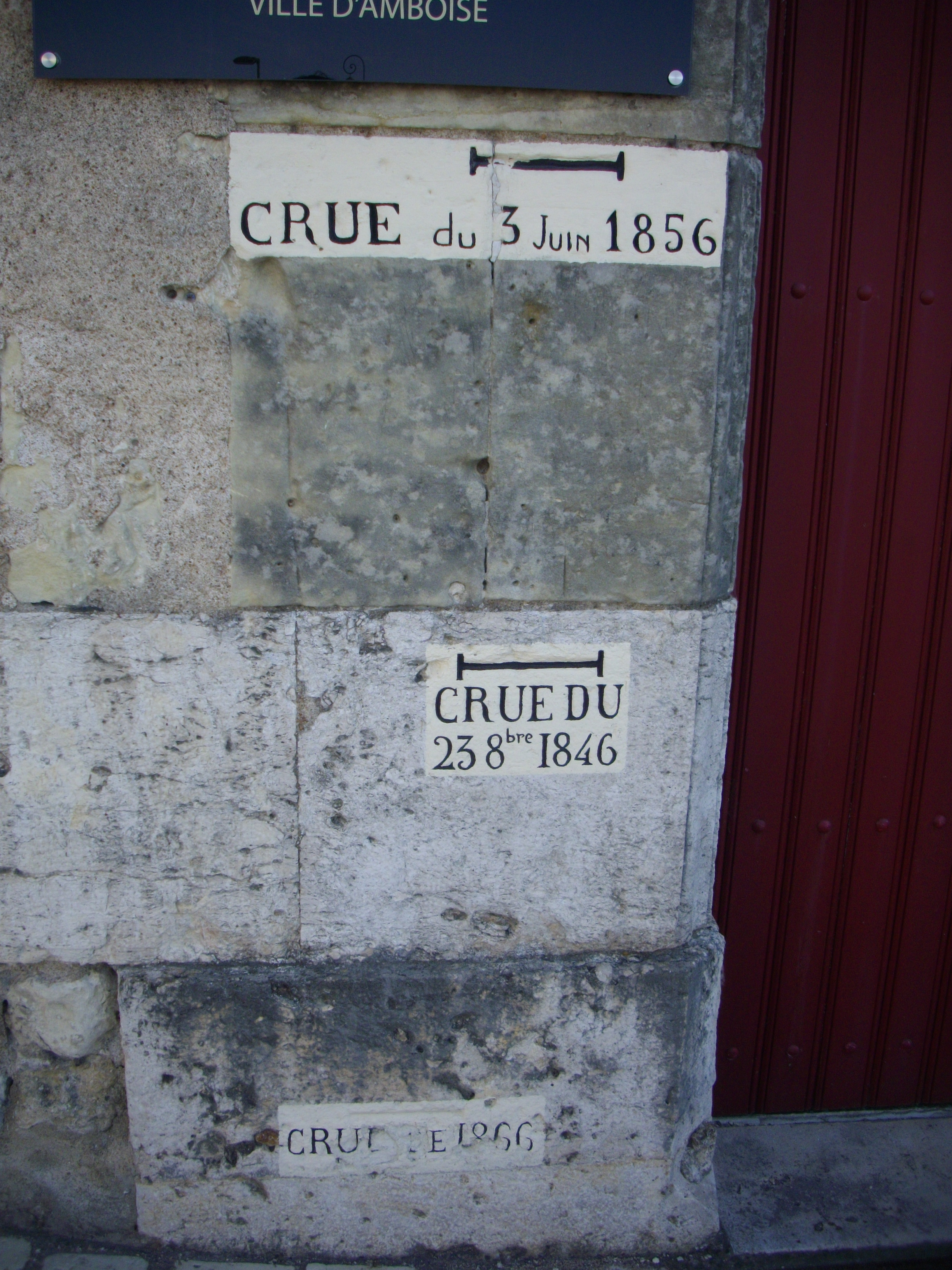
Historical flood marks at Notre-Dame-du-Bout-des-Ponts, Amboise, photographed on 21 May 2017. River flooding is not interchangeable with an ordinary household leak: the cause, policy terms and applicable regime must be checked. These marks establish neither current property risk nor an insured claim. Photo: Fab5669, original and rights record, CC BY-SA 4.0, full frame unchanged.

Read a proposal with this six-question card
Use this original tool alongside the actual documents. It is not an insurance certificate or a substitute for professional advice.
| Question | Evidence or clarification to obtain | |---|---| | Who and where? | Correct insured people, address, occupancy and declared use. | | Which interests? | Separate the rented building, belongings and liability to others. | | Which events? | Named guarantees and any relevant optional protection. | | Which limits? | Exclusions, ceilings, deductibles and conditions for the specific concern. | | When does cover begin? | The actual effective date, not merely the quotation or payment date. | | What record will I keep? | Contract and particular conditions, certificate, answers and claims contact route. |
For example, “Are my belongings insured?” is a useful opening but not a complete enquiry. Follow it with: “Which guarantee, what valuation basis, what limit, what deductible, and which exclusions apply to the items I described?” Give accurate facts rather than selecting convenient answers to obtain a lower quote.
Keep proof separate from certainty
Store the certificate where you can retrieve it for the landlord, and keep the contract where you can read its terms. Record the date of any clarification and the document or message that supports it. If the home, occupants or use changes, ask what must be updated rather than assuming the old description still fits.
If a loss has already happened, do not use a general article to decide that it is covered or to delay contacting the insurer. Follow the actual contract and current official guidance for notification and evidence. This introduction does not give a universal claims deadline.
The most useful understanding of assurance habitation is therefore not “the piece of paper the landlord wants.” It is a set of defined protections whose value depends on what is insured, under which conditions, for whom and from when.
Sources and scope
Read remotely on 29 October 2026: Service Public on rental risks, civil liability and deductibles; DGCCRF rental-insurance guidance; and ABE Infoservice’s pre-contract guide. The card and fictional examples are original. No actual policy, claim, insurer quote or private household record was inspected.