Free · France
Pharmacies, Tabacs and Press Shops: Who Does What?
You need to ask about a medicine, find a magazine and buy an electronic fiscal stamp for an administrative procedure. Three small errands—but not three interchangeable counters.
French shopfronts can make this confusing. One business may advertise several activities, while another has a single strong symbol. A useful distinction is the outlet's main role, the extra services this particular outlet offers, and the task you actually need done. Those three things do not always line up automatically.
This introduction focuses on metropolitan France. It explains how to identify the right kind of place and ask a precise question, rather than giving individual medical, legal or financial advice. The photographed businesses are examples of signage, not recommendations or verified current service listings.
Pharmacie: a healthcare role behind a retail frontage
A community pharmacy, also called an officine, is run under a pharmacist's responsibility. Its core work includes dispensing medicines and providing the accompanying advice. Medicines with and without a prescription belong to this pharmacy setting; “without a prescription” does not mean “without professional advice.” Assurance Maladie, pharmacists' roles.
So a question about how to understand a medicine's instructions is not the same kind of request as asking whether a magazine is in stock. You are seeking a healthcare professional's explanation, not simply locating merchandise. A useful opening is « Bonjour, je voudrais parler au pharmacien ou à la pharmacienne. » — “Hello, I'd like to speak to the pharmacist.” You can ask to discuss something discreetly rather than explaining it to everyone waiting nearby.
Pharmacists' work also includes prevention and follow-up services. Some pharmacies provide services such as vaccination, subject to the relevant conditions. Do not assume that every pharmacy offers every service or that a particular service is suitable for you: ask the pharmacy what it provides and what arrangements apply. Assurance Maladie, prevention and care services.
Read the word and the symbol together
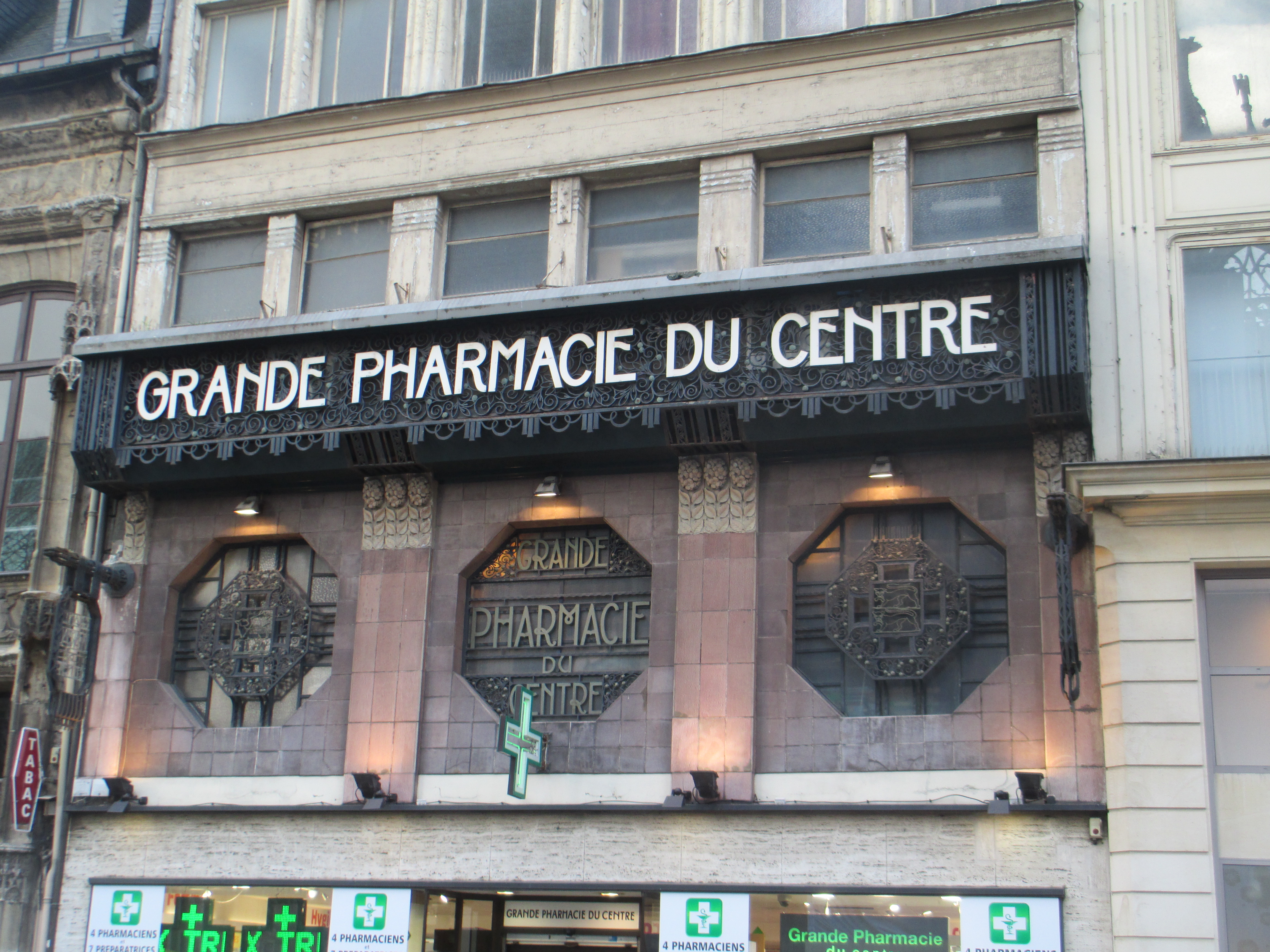
Rouen, photographed on 28 February 2014. The word PHARMACIE and the green cross provide two visible identification clues. The old photograph does not establish today's opening hours, staffing or services. Photo: topol6, “rouen_pharmacie,” CC BY 2.0. Unmodified photograph; display size only changed.
The green cross and pharmaceutical emblem are protected symbols associated with the profession, not generic decoration for any shop selling health-related products. Ordre national des pharmaciens, pharmacy symbols.
Use the photograph as a reading exercise: identify the pharmacy wording first, then the symbol. Do not turn a window display, an architectural style or a sign's brightness into a judgment about the quality of care. For a medicine or treatment question, speak to the professional; this article cannot assess what you should take.
Tabac: a specific activity, sometimes with other services
A bureau de tabac, often shortened to tabac, is a tobacco outlet; buraliste is the usual word for its operator. In metropolitan France, tobacco retail operates within a state-controlled system administered by Customs. That explains why tabac is a particular category, not simply another word for a convenience store. French Customs, tobacco retail framework.
Customs describes the distinctive projecting sign as a carotte, in red or blue-white-red. It identifies the tobacco activity. It does not, by itself, tell you whether the premises also sell newspapers or provide an administrative payment service. French Customs, shop signage.
You do not need to buy tobacco to use an unrelated service that a participating shop offers. Two examples help explain why someone might be sent to a tabac for an errand that has nothing to do with smoking:
- An electronic fiscal stamp. Service Public explains that a suitably equipped tabac can issue a timbre fiscal électronique. Equipment matters: the category of shop alone is not enough. Check the official instructions for your procedure before buying anything; a fiscal stamp is not ordinary postage. Service Public, electronic fiscal stamps.
- Certain public-bill payments. The DGFiP's paiement de proximité service operates through approved participating outlets. Eligibility depends on the bill or notice and the service's conditions, not just on seeing TABAC above a door. The official locator distinguishes participating points. DGFiP, local payment points and conditions.
For a fiscal stamp, a precise question is « Est-ce que vous délivrez des timbres fiscaux électroniques ? » — “Do you issue electronic fiscal stamps?” For another service, name it explicitly. “Can I do my paperwork here?” is too broad to establish what the shop can actually do.
Presse: publications, not a promise of every title
A marchand de presse sells newspapers and magazines. The Ministry of Culture distinguishes buying individual issues at retail points—vente au numéro—from receiving a subscription by post or delivery. It also describes the chain that brings publications from publishers through distribution businesses to retailers. The person at the counter is the final retail contact, not the publisher of every title on the shelves. Ministry of Culture, press distribution.
A press outlet need not look like a full-sized shop. Paris's official kiosk inventory describes a street kiosk as a small pavement-side outlet principally selling newspapers and magazines. That is one format, not the definition of all press retail across France. Ville de Paris, press kiosks.
If you want a particular publication, give its title and, when relevant, the issue or date. « Vous avez le dernier numéro de ce magazine ? » means “Do you have the latest issue of this magazine?” Showing the title can avoid a misunderstanding. If it is unavailable, ask whether the shop expects another delivery; do not assume the retailer can immediately produce any past or current edition.
France Messagerie also provides the Trouver la Presse service for locating retailers and checking listed title availability and opening hours. It is a useful starting point; confirm with the shop if a particular issue is important to your trip. France Messagerie, reader search service.
One frontage can describe more than one role
Two activities in two words
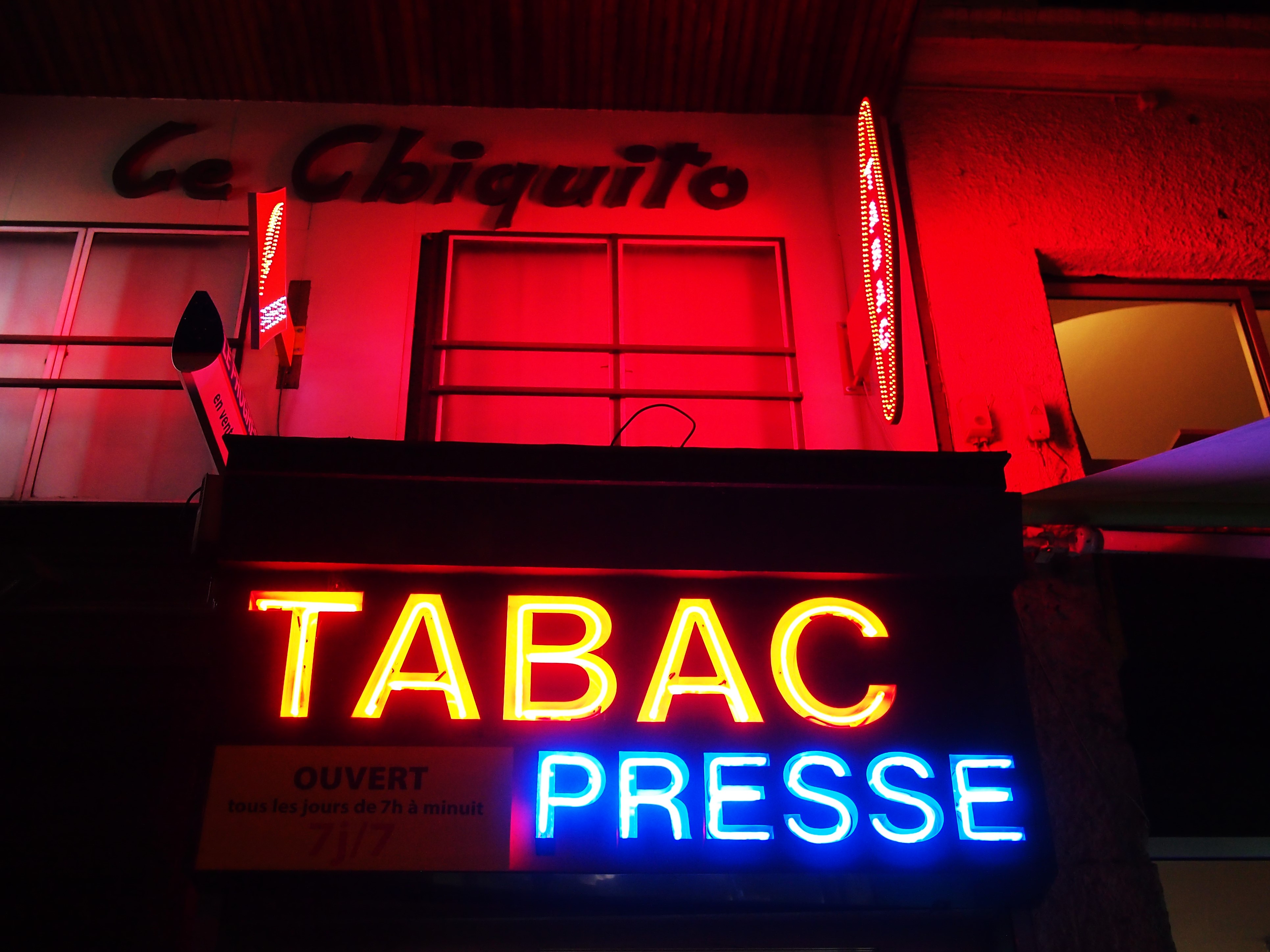
Lyon, photographed on 6 December 2014. TABAC and PRESSE appear together on this frontage: the words identify different activities within one business. The opening-hours notice visible in the photograph is historical, not current guidance. Photo: Francisco Gonzalez, “Tabac Presse le Chiquito,” CC BY 2.0. Unmodified photograph; display size only changed.
The point is not that every tabac is a press shop. It is that a combined sign tells you more than either word on its own. In this photograph, you can read two advertised activities. You cannot establish whether this business currently issues fiscal stamps, participates in a payment network or has the magazine you want.
Read a shopfront in layers:
- Category: which activity is named—pharmacy, tobacco or press?
- Combination: are several activities advertised together?
- Specific service: is the service you need actually listed or confirmed?
- Today's availability: is it offered here now, and is an appointment, document or particular item required?
That method avoids two opposite mistakes: overlooking a useful combined business, and assuming that every business in a category offers the same extras.
Try three errands before you leave
These situations are fictional; they test how to choose a question, not how to make a medical or administrative decision.
“I want an explanation of the instructions on my medicine.” Start by asking to speak to a pharmacist. Do not substitute a shop's general health-product display for that professional conversation.
“I want this month's issue of a magazine.” Look for a press retailer, including a business explicitly advertising PRESSE. Give the title and issue; the sign identifies the activity, while the question establishes stock.
“I have been told to pay a public bill at a participating tabac, but I also want more time to pay.” Separate the tasks. The DGFiP states that a local payment point cannot accept a request for a payment extension. Consult the contact or instructions on the bill for that request; a place that processes payment is not automatically the office that decides changes to it. DGFiP, scope of local payment points.
The same habit works across all three: name the task, identify the relevant role, then confirm the particular outlet's service. A familiar sign can help you choose a door. It cannot answer every question about what happens behind it.
Sources checked on 28 October 2026. Roles, participation, opening hours and service conditions can change. Check current official information and the outlet itself before relying on a specific service. Neither photograph is a current directory entry or an endorsement.