Free · France
What a French Apéro Is—and Isn't
An invitation to an apéro tells you something about the occasion, but not everything about the evening. There may be a meal afterward; the gathering may itself be the whole plan. A glass and a few things to eat do not resolve that distinction.
The useful starting point is to separate the drink, the shared moment and the arrangement. They can overlap without being interchangeable. Understanding this makes the word less mysterious—and leaves room for people whose preferences, schedules or ways of socialising differ.
A drink and the moment around it
Apéro is the familiar shortened form of apéritif. Larousse labels the short form informal; the word itself does not specify a private home, a dress code or how close the participants are. Larousse, apéro.
The fuller word has two closely connected noun meanings: a drink before a meal, most often alcoholic, and the moment when it is taken. That second meaning explains why translating apéro simply as the name of a beverage can miss the point. Larousse, apéritif.
Compare these original, illustrative lines—not recorded conversations:
- « Vous prenez un apéritif ? » — “Would you like an apéritif?” In a restaurant conversation, this can be a question about ordering a drink, not a new invitation to a social event.
- « On se retrouve pour l'apéro ? » — “Shall we meet for an apéro?” Here the proposed meeting matters. Choosing a beverage would not answer where or when to meet.
Neither sentence tells you how long to stay. In the second, the question mark also matters: a suggestion is not yet a settled arrangement.
Why the social moment matters
An apéro can give a gathering an opening: something shared is available while conversation begins, without everyone immediately taking their place for a succession of courses. This is a way to understand the format, not a rule that participants must stand, circulate or talk continuously.
The Académie française's 2019 language column describes the modern apéro as a festive, convivial moment and comments on the tension between simplicity and elaborate presentation. It is a cultural commentary, not a survey proving how French households behave. Académie française, C'est l'apéro, 10 March 2019.
For a visitor, the important distinction is between an opportunity to spend time together and a performance you must reproduce. You do not need to recognise every snack, provide an entertaining story or accept another drink to demonstrate that you understand the occasion. Nor does an invitation prove instant intimacy: being included in one gathering is not permission to assume access to someone's home or time afterward.
Before dinner is not the same as invited to dinner
The before-meal meaning supplies a sequence, not a guest list for the next stage. People can share an apéro and then go their separate ways to eat. They can also continue into a meal that was explicitly part of the plan.
The extra word dînatoire changes the interpretation: it means that the food serves as dinner, rather than merely preceding it. An apéro dînatoire places that shared food in the role of the evening meal. It does not specify the dishes, seating or serving arrangement. Larousse, dînatoire.
Read the rest of the message rather than judging by the number of bowls on a table. If food arrangements matter to you, ask about the actual provision; a generous-looking spread is not evidence about its ingredients or suitability.
Three messages with different plans
The following messages are invented teaching examples, not quotations from real invitations or universal customs.
1. « On prend l'apéro après la répétition ? Ensuite, chacun a son programme. »
“Shall we have an apéro after the rehearsal? Afterward, everyone has their own plans.”
The second sentence limits the shared plan. It would be a mistake to assume a group dinner merely because the gathering is called an apéro. If the proposal suits you, settle the missing time and place—not an imagined later meal.
2. « Je propose un apéro dînatoire. Je prépare de quoi manger ; pas besoin de prévoir un autre dîner. »
“I suggest an apéro dînatoire. I'll prepare food; there's no need to plan another dinner.”
Here the explanation confirms the intended meal. It still says nothing about a mandatory contribution, particular ingredients or a formal seated service. Those details do not follow from the label alone.
3. « On commence par un apéritif, puis on passe à table ensemble. »
“We'll start with an apéritif, then sit down to eat together.”
This message explicitly includes the next stage. The word puis—“then”—does useful work: there is a sequence involving the same group, not just an isolated offer of a drink.
The lesson is not that every invitation needs a lengthy exchange. A short « C'est prévu comme un repas ? »—“Is this intended as a meal?”—can settle the one uncertainty that affects your plans.
A real example beyond the home
A past Biennale de Lyon visite apéro page describes a guided exhibition visit followed by conversation with the group and mediator. Its offer includes a drink, with a nonalcoholic option, and vegetarian platters to share. The opened page lists past 2024 dates: this is an archived example of a format, not a current event recommendation or availability check. Biennale de Lyon, Visite apéro.
What matters here is the connection between activities. The shared refreshment creates space to continue a discussion begun during a visit. This particular organiser spells out the provision; another event using apéro would need its own explanation. The label does not by itself promise free entry, unlimited drinks, an open invitation or a meal.
What the photograph can and cannot tell you
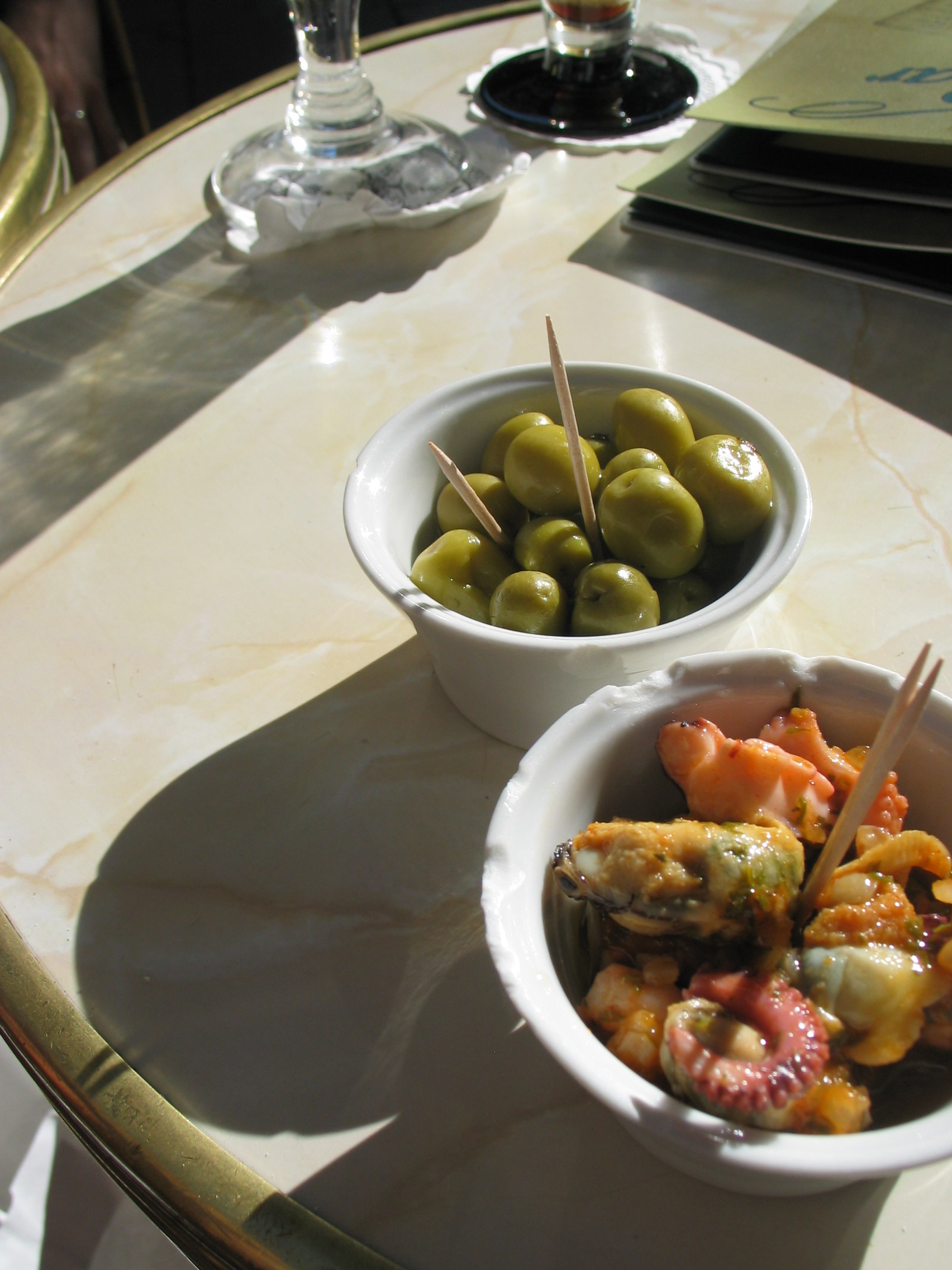
“Apéritif olives vertes et petits poulpes” — DocteurCosmos, 2008. Photograph source · CC BY-SA 3.0. Supplied original unchanged; precise location not established. This contextual photograph does not depict the invented messages above.

The food is visible; the social arrangement is not. You can identify small portions set out in bowls, but you cannot establish who was invited, what the glasses contained or whether another meal followed. Nor does one image make olives and seafood a required French menu.
That distinction is useful in person, too. Visible objects help you notice what is available. They cannot replace the information people give about what the gathering is for.
Participation is not an alcohol test
Treat the occasion and your drink choice as separate questions. « Je prendrai quelque chose sans alcool, merci. » means “I'll have something without alcohol, thank you.” This is an original practical phrase, not a promise that a particular venue has a particular option.
You can make that choice without explaining personal reasons. If you are arranging the gathering, ask what people would like rather than assuming that a refusal requires persuasion. Someone declining food, a drink or the invitation itself is not supplying reliable evidence about their affection for the group.
There is no need to turn participation into a test of national authenticity. The useful questions are smaller: What is being proposed? Is food intended as the meal? What do I want to accept? Once those are clear, the conversation—not a supposed compulsory menu or drinking ritual—can be the point.