Free · France
From Cheese Counter to Table: How Buying Customs Work
You do not need to recognise every cheese before approaching a specialist counter. A more useful starting point is knowing what you want the purchase to do: accompany a meal, provide a small taste, or supply an ingredient for cooking.
The exchange can then move from purpose to product, and from product to amount. That is a practical way to understand cheese buying without turning it into a test of French manners. Shops, staff and customers differ; there is no single conversation everyone must perform.
Give the seller something useful to work with
Onisep's description of the profession places customer advice alongside sourcing, display and selling. It also describes different settings, from specialist shops to market stalls and supermarket counters. This is a professional role, not a guarantee that every counter offers the same services. Onisep, Fromager / Fromagère.
For your own purchase, prepare a short brief:
- Use: part of a meal, a tasting, or a named recipe?
- Timing: eating it today, or buying ahead?
- Preference: what have you enjoyed or disliked before?
- Limit: a particular amount, or a maximum spend for the whole purchase?
These are useful inputs, not information you owe a stranger. You can keep the request simple. The French seller-adviser competency framework explicitly includes discovering customers' tastes and budgets; it is not a survey showing how every sale unfolds. France compétences, RNCP39989, customer-relations block BC03.
“For four people” leaves an important gap. Is cheese the main feature, one item among several, or an ingredient? Explain that before asking for an amount. No fixed number of grams can answer all three situations.
Ask about the cheese you are actually buying
Affinage means maturing in the cheese context. Larousse, French–English entry. Rather than treating the word as a ranking of good and bad cheese, connect it to your plan: “Which of these would you suggest for Saturday?” That asks about the selection in front of you, not an abstract ideal.
Likewise, a recognised label answers a particular question. INAO explains that an AOP protects a product name linked to recognised know-how and a defined production area, under a specification and controls. It does not tell you which flavour you will prefer. INAO, AOP explanation.
Keep preference and requirements separate. “I prefer a less pronounced flavour” is not the same request as “I need to check the ingredients.” Do not treat a regional name, attractive rind or seller's enthusiasm as an answer to a specific dietary question. Ask for the information about the actual product; this article does not assess personal dietary suitability.
Agree on what the amount means
Pointing to a wheel identifies a product, but it does not necessarily specify how much you want. Distinguish a whole item, a cut piece and a weight request. Un morceau means a piece; by itself, it leaves its size open.
Cutting is product-specific. Onisep notes that techniques vary with cheese shape and texture. The Fourme de Montbrison syndicate, for example, describes halves, quarters and eighths for that cheese. Those fractions are not a universal ordering system or a fixed gram weight. Fourme de Montbrison, La découpe.
Before cutting, you can ask: « Vous pouvez me montrer la taille du morceau ? » — “Could you show me how big the piece would be?” If it is more than you intended, clarify then. A budget limit should also be stated before the cut, not assumed from “a small piece.”
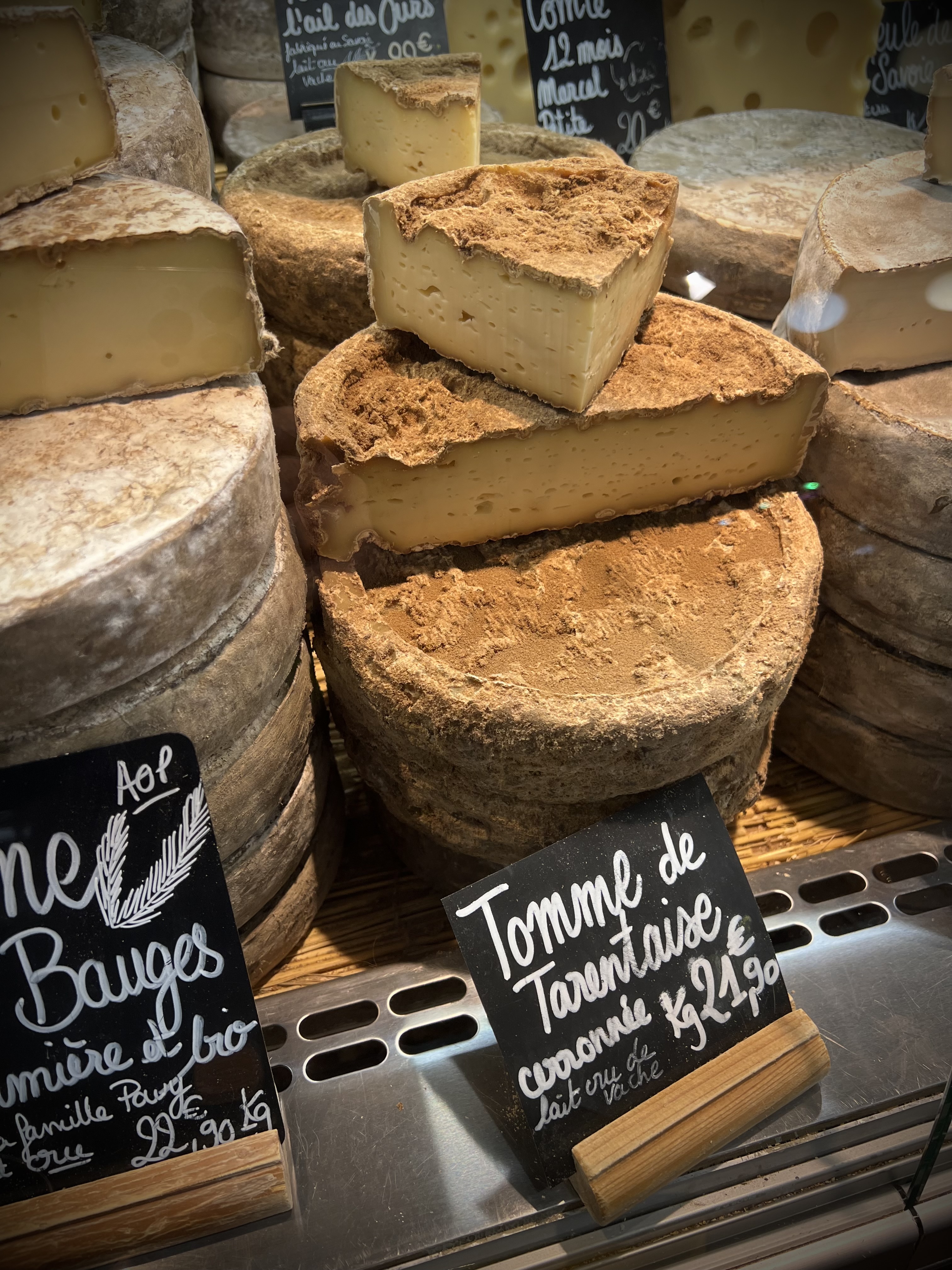
A counter identified by the photographer as Halles de Chambéry, photographed on 2 May 2024. The visible sections are display pieces, not evidence of a customer's requested quantity. Historical view, not today's stock or prices.
Credit: “Chambéry, Savoie department, Auvergne-Rhône-Alpes region, France 🇫🇷” — Sharon Hahn Darlin, CC BY 2.0. Supplied original unchanged.
Look, then separate the unknowns. The photograph shows whole wheels, cut sections and a foreground label marked in kilograms. You cannot see an order, a weighing result or a final bill. A wedge's appearance therefore cannot establish what you should buy or what your purchase would cost.
Read the unit as carefully as the number
French price guidance requires information before the sale is concluded; where the price cannot be determined in advance, the calculation method must be explained. That makes the basis of a price worth checking, not just the large number on a sign. Bercy, price-display guidance, 20 January 2026.
« C'est le prix à la pièce ou au kilo ? » asks, “Is that the price per item or per kilogram?” When sold by weight, the amount payable depends on the actual weight, not merely the piece you pointed towards. A requested approximate weight and a weighed result are different things.
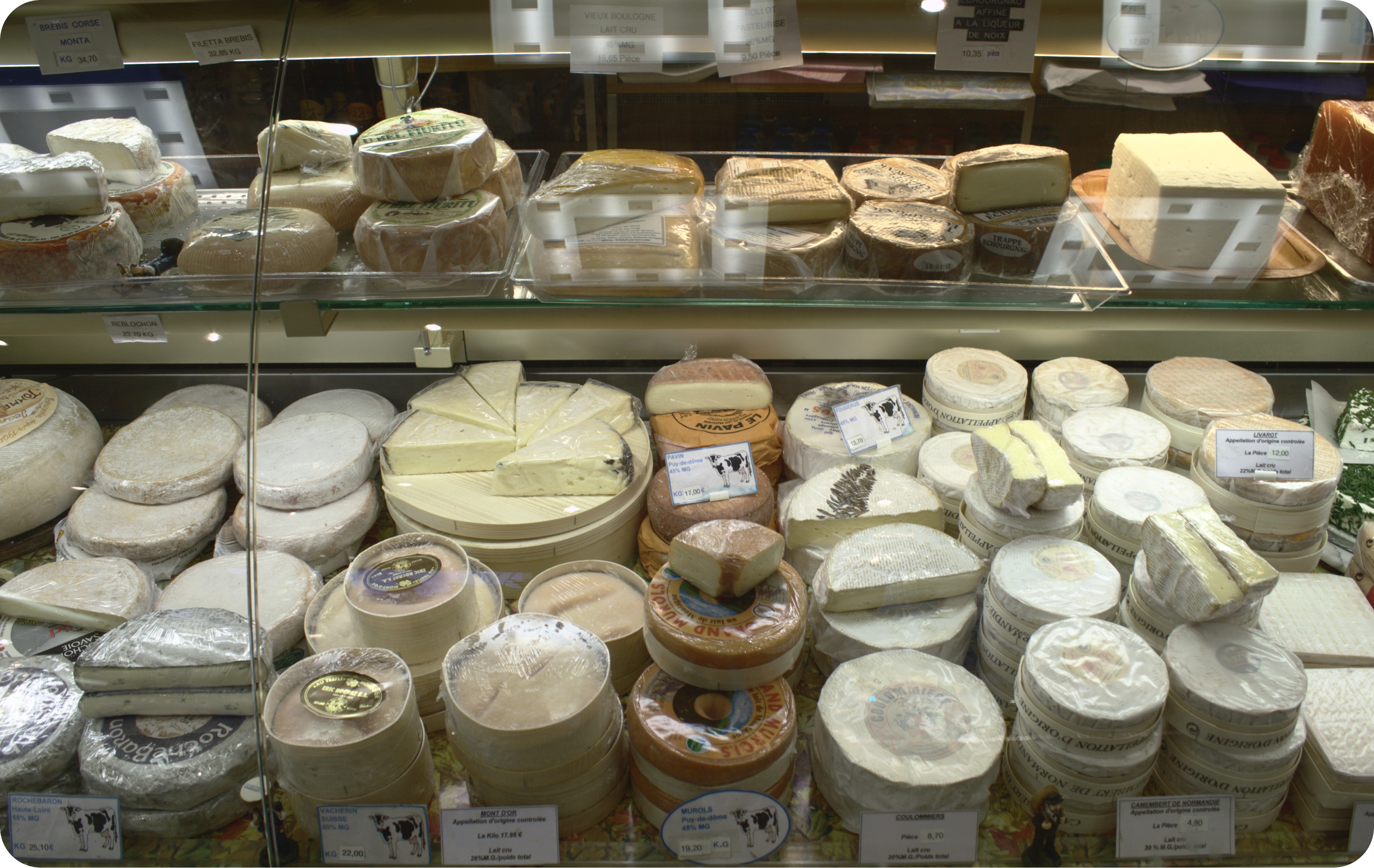
Photographed on 25 September 2009; the photographer identifies the shop as Maison du Fromage in Neuilly-sur-Seine. Labels include “Pièce” or “La Pièce” and “KG” or “Le Kilo.” These are different sale units, not comparable price totals. No current offer is implied.
Credit: “Fromages à pâte molle” — Marc Kjerland, CC BY-SA 2.0. Supplied original unchanged; its rounded white corners are preserved.
In this second photograph, compare the unit words rather than the historical prices. The labels are small: use the original-resolution view if needed; the exercise does not require deciphering every label. A per-item amount cannot be compared directly with a per-kilogram amount without knowing the item's weight.
A short exchange with a clear stopping point
This dialogue is invented for learning. It did not take place at either photographed counter. The quantity is an example, not a portion recommendation.
Customer: « Bonjour. Je voudrais un morceau de ce fromage, pour samedi. »
Hello. I'd like a piece of this cheese, for Saturday.
Seller: « Quelle quantité souhaitez-vous ? »
How much would you like?
Customer: « Environ deux cents grammes. Vous pouvez me montrer avant de couper ? »
About two hundred grams. Could you show me before cutting?
Seller: « Un morceau comme celui-ci ? »
A piece like this one?
Customer: « Un peu plus petit, s'il vous plaît. »
A little smaller, please.
The useful result is a clarified request, not an obligation to accept the first suggestion. The conversation still needs the actual weight and price. If choosing several cheeses, also distinguish the limit for each item from the limit for everything together.
You need not accept a tasting, buy an assortment or know specialist vocabulary to make a clear purchase. If speaking is difficult, a written request with the product, intended day and limit can carry the same information.
Carry the information home as well
Before leaving, ask about the particular cheese and your journey: how to keep it, what instructions to follow before serving, and how to cut the purchased piece. Avoid replacing those answers with a universal rule for every rind, texture or package. Product-specific keeping and consumption advice is also part of the professional competency framework cited above.
If several packages look alike, ask which is which. Keeping the names lets you distinguish “I liked this cheese” from “I liked everything that looked like it.” On a later visit, that is more useful feedback than feeling you must sound knowledgeable.
The aim is not to buy in a supposedly perfect French way. It is to leave knowing what you chose, how much you agreed to buy, what the price refers to, and which product-specific instructions still need an answer.