Free · France
What “C'est compliqué” Can Really Mean
“It's complicated” is a translation, not yet an answer to your practical question. If you have asked whether a friend can come, whether a room is available or how something works, c'est compliqué leaves different things unresolved.
The useful response is not to memorise “French people say this when they mean no.” It is to identify what is being described as complicated, what the speaker adds, and whether you need a decision or simply need to leave the subject alone. Sometimes the difficulty is literal. Sometimes the phrase helps someone avoid committing or explaining. The words alone do not tell you which.
Start with the meaning, then look for the function
The Académie's entry for compliqué covers arrangements whose parts are difficult to understand or use, and matters that are difficult to untangle or explain. That gives a sensible starting point: something is being presented as not straightforward. It does not give you the speaker's private reason. Académie française: compliqué, senses 1–2.
Nor is compliqué simply another spelling of impossible. In its basic sense, impossible concerns what cannot happen or be done. A difficulty and an impossibility are different claims. Recognising that difference is not a reason to press someone to try harder or accept your proposal. Académie française: impossible, sense I.1.
Language research also distinguishes a sentence's wording from what it does in an interaction. A 2025 study by Francesco Faresin and Alexis Ladreyt examines three other French expressions used in refusals and their interpretation in context. Its learning study involved 22 Italian-speaking university students; it is not a survey of French people's behaviour, and it does not establish a fixed meaning for c'est compliqué. Faresin and Ladreyt, Lexique: abstract and sections 2.3, 2.3.2.1 and 3.1.
The examples below are original illustrative conversations, not transcripts or reports of how particular people behaved. Their continuations supply information that the short phrase alone does not.
A practical obstacle can be exactly that
Imagine two people considering where to put a large piece of furniture.
A: On peut mettre le meuble dans cette pièce ?
Can we put the furniture in this room?B: C'est compliqué. Il faut vérifier s'il passe par la porte.
It's complicated. We need to check whether it will fit through the doorway.
B has identified a question about dimensions. There is no need to translate the answer into “I don't like your idea.” Equally, B has not confirmed that the move is feasible.
A useful reply keeps the uncertainty specific: D'accord. Quelles dimensions faut-il vérifier ?—“All right. Which measurements do we need to check?” The conversation can progress because both people now know what remains unknown. Whether the object can actually be moved requires its own assessment, not a language exercise.
This is a good habit whenever the phrase is followed by a concrete explanation. Attend to that explanation before constructing a story about reluctance, incompetence or hostility.
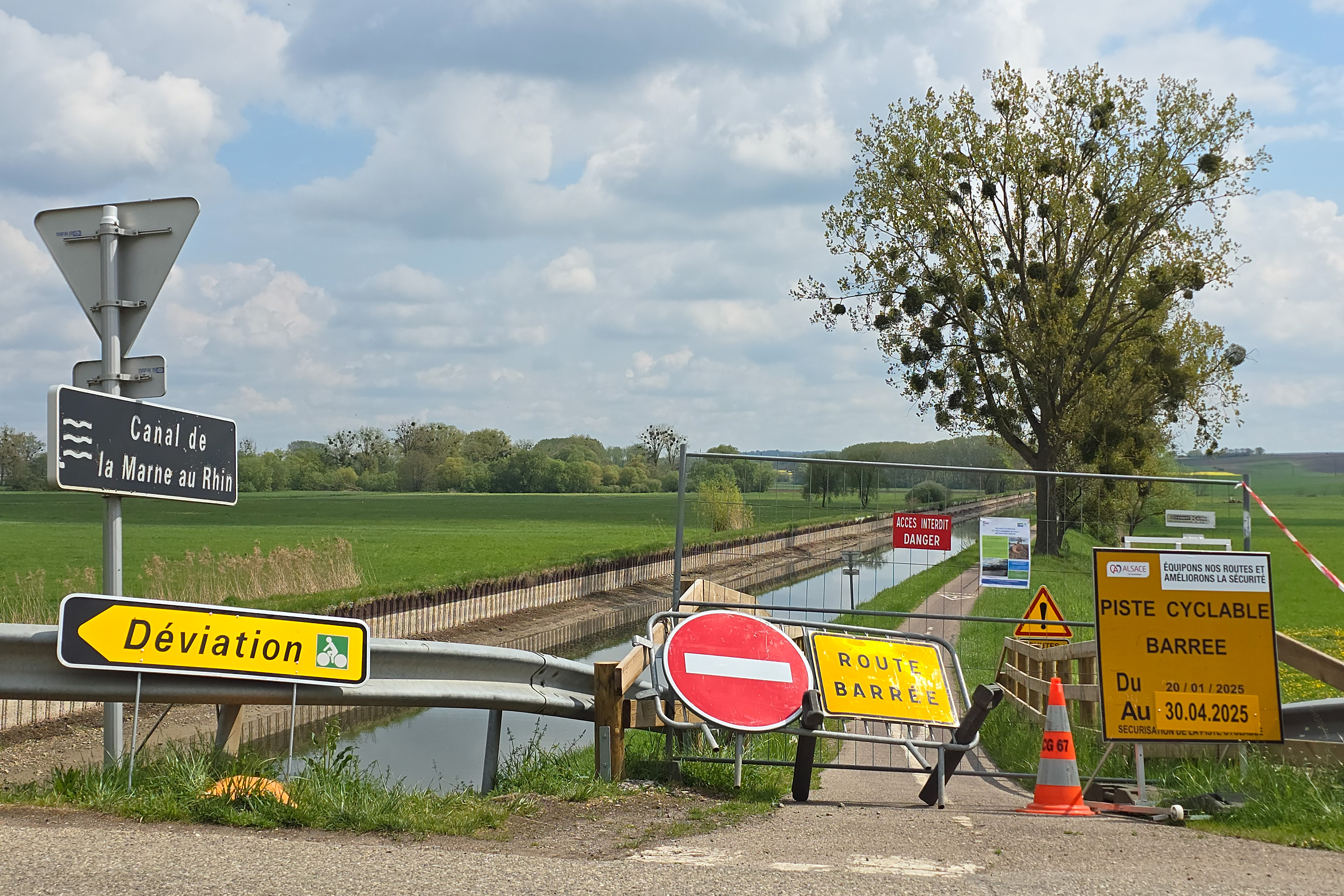
A cycle-path barrier near Ingenheim, photographed on 22 April 2025. Historical image, not current access information.
Observation exercise: This is not the furniture scene above. You can see an obstruction. You cannot learn why a hypothetical speaker says c'est compliqué from that sight alone. A visible obstacle supplies context, not their answer.
Photo: “Dead end for cyclists” — Tristan Schmurr (kewl; CC-BY kewl.lu, Some rights reserved), CC BY 2.0. Photographer's original-size file supplied unchanged.
An unresolved request is not an approval
Now imagine asking a volunteer organiser about using a shared room.
A: Est-ce qu'on peut utiliser la salle vendredi ?
Can we use the room on Friday?B: C'est compliqué. Je dois d'abord vérifier avec la personne qui gère les réservations.
It's complicated. I first need to check with the person who manages bookings.
Here the next step involves another person. The exchange does not establish that the room is unavailable, nor that it has been reserved for you. There may be a workable arrangement, but you do not have it yet.
Ask about the decision you need: Quand pourrai-je avoir une réponse ?—“When will I be able to get an answer?” If necessary, add your real planning constraint: J'ai besoin de confirmer le lieu demain—“I need to confirm the venue tomorrow.”
Keep “someone will check” separate from “someone has confirmed.” This fictional example is about interpreting a response, not a rule governing all French associations or booking systems.
An invitation may remain unaccepted
A: Tu viens dimanche ?
Are you coming on Sunday?B: C'est compliqué en ce moment.
It's complicated at the moment.
You still do not have an acceptance. B could be facing a scheduling problem, declining without detail or remaining uncertain. Choosing one of those explanations as fact would go beyond the exchange.
If no decision is urgent, you can leave space: D'accord, on laisse ça de côté pour le moment—“All right, let's leave it for now.” If you need numbers, clarify that practical point without demanding a personal explanation: Pour m'organiser, est-ce que je dois prévoir sans toi cette fois ?—“For planning, should I make arrangements without you this time?”
An offered alternative would add information. Dimanche, c'est compliqué, mais mardi je suis disponible proposes a different time. A bare c'est compliqué does not contain that proposal. Do not invent a future invitation on the speaker's behalf, or keep suggesting solutions after they have declined.
Sometimes the explanation is not yours to obtain
A: Tu es toujours en contact avec cette personne ?
Are you still in touch with that person?B: C'est compliqué. Je préfère ne pas en parler.
It's complicated. I'd rather not talk about it.
The second sentence makes the boundary explicit. You do not need to decide whether the underlying situation is sad, awkward, ordinary or serious. D'accord, on change de sujet—“All right, let's change the subject”—responds to what was actually said.
Without the second sentence, there would be more uncertainty. You could offer an opening rather than an interrogation: Tu veux en parler, ou on passe à autre chose ?—“Would you like to talk about it, or shall we move on?” Moving on is a complete option. Closeness does not create an obligation to explain.
Notice what has been added to the phrase
TV5MONDE explains that adverbs can qualify an adjective. Other additions can name the task, time or next step. Read those words rather than treating every version as the same answer. TV5MONDE: qualifying what you say.
| Illustrative wording | Information worth keeping | What it does not establish | |---|---|---| | C'est compliqué à expliquer. | Explaining is difficult. | The thing itself is impossible. | | C'est compliqué pour demain. | Tomorrow is specified. | Another date is agreed. | | C'est un peu compliqué. | The wording softens the difficulty. | The actual obstacle is minor. | | C'est compliqué, mais on peut essayer. | Trying is proposed. | Success is promised. |
These invented examples do not form a scale from weak to strong. Soft wording does not measure the actual amount of work, worry or inconvenience involved.
Clarify the consequence, not the hidden motive
Before replying, identify the smallest question you genuinely need answered:
- Understanding: “Which part is difficult?”
- Planning: “Should I wait for confirmation or make another arrangement?”
- Participation: “Are you joining us this time?”
- Privacy: “Would you prefer to leave it there?”
Use tu or vous as appropriate to the relationship. If you did not understand the French, you can say so and ask for a simpler explanation. There is no need to pretend you detected a subtle message.
Avoid turning punctuation, a pause or a facial expression into proof of intent. You can notice them without deciding that they reveal a refusal, a lie or a personal judgement. When a consequential arrangement depends on the answer, seek an explicit confirmation through the appropriate channel. When the person has set a personal boundary, stop rather than seeking a more satisfying explanation.
Try one final distinction. After c'est compliqué, you may know that the speaker has raised a difficulty. You may still not know its cause, whether it can be resolved, or whether they want to continue. Understanding the phrase well means keeping those unknowns separate—not filling them with a supposedly universal French subtext.