Free · France
Betschdorf: Village potteries and the history of everyday storage
Before the pot reached the cupboard
A history of storage can begin with a jar, but Betschdorf offers another starting point: the premises that made containers possible. At 39 rue des Potiers, the protected Wingerter-Ruhlmann pottery includes a dwelling, workshops, shop, storage pit, wood-fired kiln, barn and courtyard. The official designation treats them as one production unit. Architectural heritage record PA67000108.
That ensemble shifts attention from what a pot held to the work behind it. Containers had to be produced and offered for sale before entering domestic use. Their history therefore belongs partly to the village's buildings and commercial organisation, not only to the kitchen. The surviving workshop, a recent inventory of its contents and the local museum provide different ways of recovering that relationship.
A craft took its place in the village
The national heritage inventory places the nineteenth-century growth of pottery within the settlement. Its village record associates potters' houses with Oberbetschdorf's southern edge and the concentration of workshops around the industry's peak with the western side. This is a useful correction to the idea of pottery as an activity spread evenly behind every timber-framed façade. Village inventory IA00118793.
The record also requires a historical reading. Its field survey took place in 1991, with the notice written in 1992. Its statement about the potters remaining “currently” belongs to that investigation, not to a count made in 2026. A database's later modification date does not turn an old survey into a new census. The inventory's survey and drafting dates.
Read at the right scale, the inventory supplies a geography of work rather than an employment total for today. It helps locate the craft within a changing village while leaving open questions about individual properties, their occupants and the amount each workshop produced.
Working downstairs and living above
The Wingerter-Ruhlmann record brings that geography down to one address. It dates the house to 1843 and describes professional activity on the ground floor, with domestic life upstairs. The barn combines timber framing and earthen infill with brick walls. These details identify a working household, not merely a detached industrial building decorated in a regional style. PA67000108, history and description.
An upstairs dwelling does not tell us who performed each task below. Nor does the presence of a shop establish how much business was conducted over its counter. The building records relationships between activities more securely than it records hours, wages or sales. Its value lies in keeping those relationships available for investigation.
The storage pit introduces a further distinction. The Fondation du patrimoine's restoration account identifies it as a clay pit. Storage here concerns the pottery's material, not a household's provisions. Its programme also includes the kiln's wood shelter and drainage in the courtyard. Such apparently secondary features belong to the physical setting that supported production. Fondation du patrimoine project account.
What remained on the premises
An original administrative record makes the connection with domestic containers unusually precise. Order 2025/401, dated 1 September 2025, lists objects preserved at Wingerter-Ruhlmann. Among them are undecorated pots à conserve: a four-litre example, inventory 2023-285, and a two-litre example, 2023-286. These are recorded capacities, not estimates from photographs. Grand Est administrative register: order identity on PDF page 57, storage pots on page 58, signed date and preservation location on page 75.
The list also identifies mid-twentieth-century pitchers by Victor and Emilie Wingerter in one-litre, half-litre and quarter-litre sizes. Different capacities belonged to the workshop's surviving repertoire, alongside the storage pots. The same register, PDF page 63.
This is a heritage inventory, not a stockbook from an ordinary trading day. Objects retained across generations cannot reveal the proportions once sold. The document also distinguishes named makers from unattributed pieces: presence in the workshop does not automatically prove manufacture there. Its strength is more modest and more tangible. Containers survive within a documented place of production.
Selling pots when household needs changed
The historical section of the potters' specification hosted by INPI describes the Poteries réunies de Betschdorf, established in 1922 to facilitate joint sales and operating until 1969. It also connects the gradual retreat of ordinary food-related pottery with competition from glass and enamelled products, and the development of more elaborately decorated art pottery. Potters' specification, page 13.
That account adds a commercial organisation to the physical workshops. Making a useful vessel and finding a market for it were separate problems; collective selling was one response. The cited history does not supply customer lists, delivery routes or the proportion sold directly from each pottery.
It would also be too simple to divide the story into an age of useful pots followed by an age of useless ornaments. The historical account describes a change in the balance of production. It does not establish that every practical form disappeared on a particular date, or that decoration and household use excluded one another.
Keeping equipment with its setting
La Manufacture du Patrimoine describes a 2023 inventory mission at Wingerter-Ruhlmann that covered ceramics, production tools and machines. It was undertaken while the state studied keeping the movable collection within the already protected premises. This is the inventory team's account of its assignment, rather than a claim here to have examined its full report. La Manufacture du Patrimoine, collections-management projects.
The scope matters. A finished pot can be compared with other vessels after removal to a display case. Equipment raises a different set of questions: what was made here, which operations the premises accommodated, and how the surviving objects relate to those operations. Preserving the association makes such questions easier to pursue. It does not, by itself, reconstruct a complete working day.
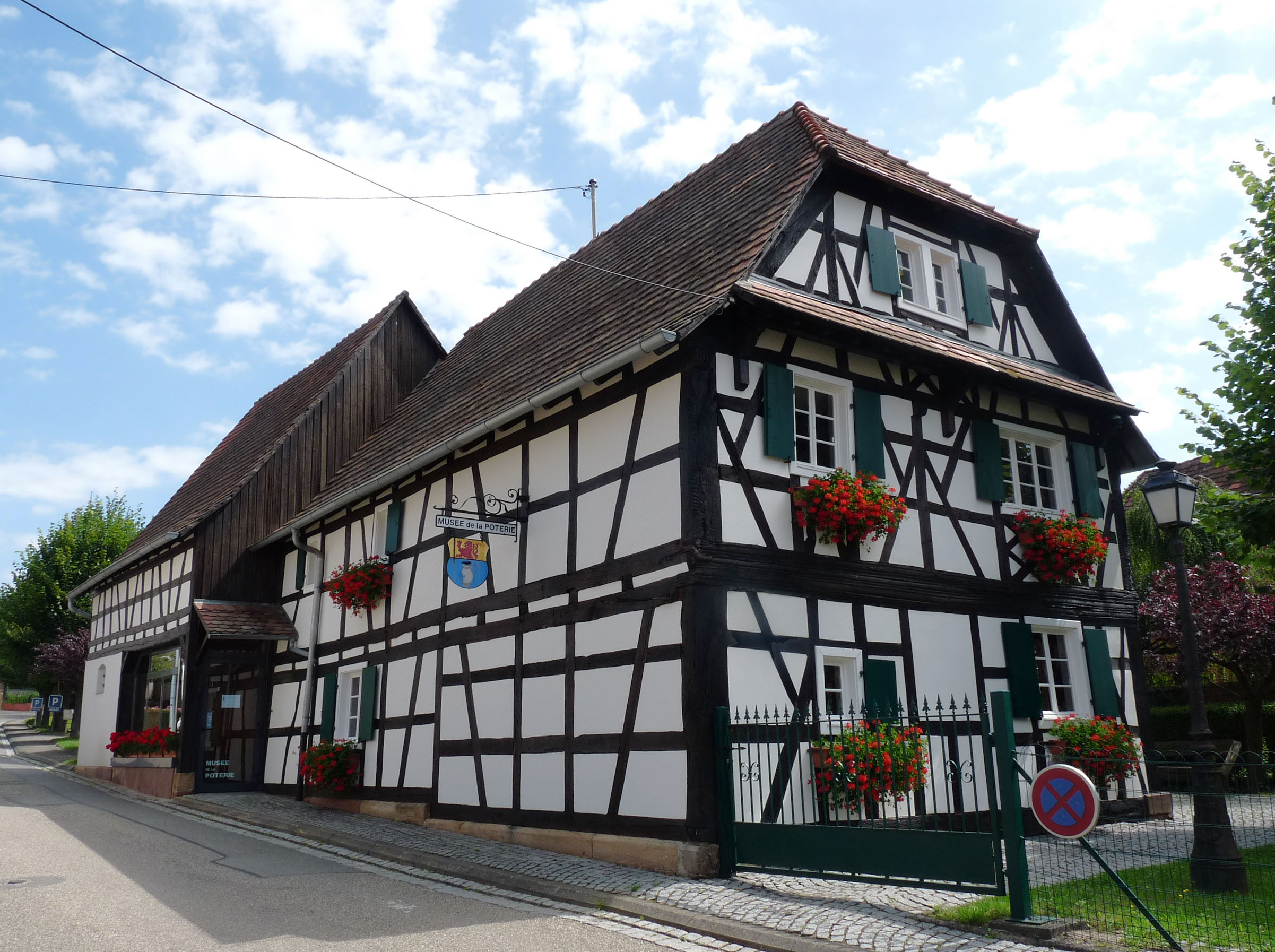
Betschdorf’s Musée de la Poterie photographed on 16 July 2009. The building is a museum setting, not the Wingerter-Ruhlmann production premises or a view of its reconstructed workshop. Photo: Ji-Elle, Wikimedia Commons; CC BY-SA 3.0. Unmodified.

A museum is a different kind of place
Betschdorf's municipal presentation describes the Musée de la Poterie as occupying an early-eighteenth-century timber-framed former farm with its dependencies. Its displays include a reconstructed potter's workshop. That reconstruction should not be confused with the production premises at rue des Potiers. One is an interpretive arrangement in a museum; the other is a historically documented workshop ensemble. Municipal museum presentation.
The distinction is useful rather than competitive. Reconstruction can explain a sequence of tasks to someone unfamiliar with pottery. A surviving workplace preserves constraints and adjacencies that a demonstration may simplify. Neither should be asked to do the other's job. The museum's own account connects the diversity of objects with changing needs and tastes, making adaptation part of the story rather than a departure from it. The museum's account of its displays.
The national museum directory adds another layer: the collection includes deposits from Strasbourg's Musée alsacien and Musée de l'Œuvre Notre-Dame, as well as pottery from several regional centres. A museum located in Betschdorf is consequently not a single workshop's accumulated stock. Muséofile record M0002.
This gives the museum a comparative role. It can put local production beside related objects from elsewhere. The preserved workshop answers a more spatial question: how a particular place brought domestic life, making and selling together. Reading the two separately avoids turning the museum into an imagined intact nineteenth-century pottery.
Beyond a picturesque façade
Protection also operates at the street level. DREAL's Betschdorf site sheet records a 1973 site designation covering façades and roofs along rue des Potiers, rue du Docteur Deutsch and Grand-Rue, with portions of other streets included. That streetscape protection is different in scope from the later protection of the Wingerter-Ruhlmann production unit. DREAL Grand Est site sheet, page 1.
The distinction prevents the village's appearance from standing in for its working history. A roofline can preserve the scale of a street without showing what happened inside a house. Conversely, a kiln without its surrounding premises would tell only part of the story. The two scales of evidence belong together, but they are not interchangeable.
Nor is conservation a finished chapter. The Fondation du patrimoine's project page, updated on 1 October 2026, gives spring 2027 as the projected end of restoration. It describes planned repairs to buildings and production-related structures; the timetable is not proof that those works are complete. Fondation du patrimoine, restoration schedule.
Meanwhile, Fortuné Schmitter's own website identifies a workshop and shop at 47 rue des Potiers, describing its production as both utilitarian and decorative. That present-day self-description is narrower, and more defensible, than claiming the village now makes only ornaments. It does not tell us the share represented by either category. Poterie Fortuné Schmitter.
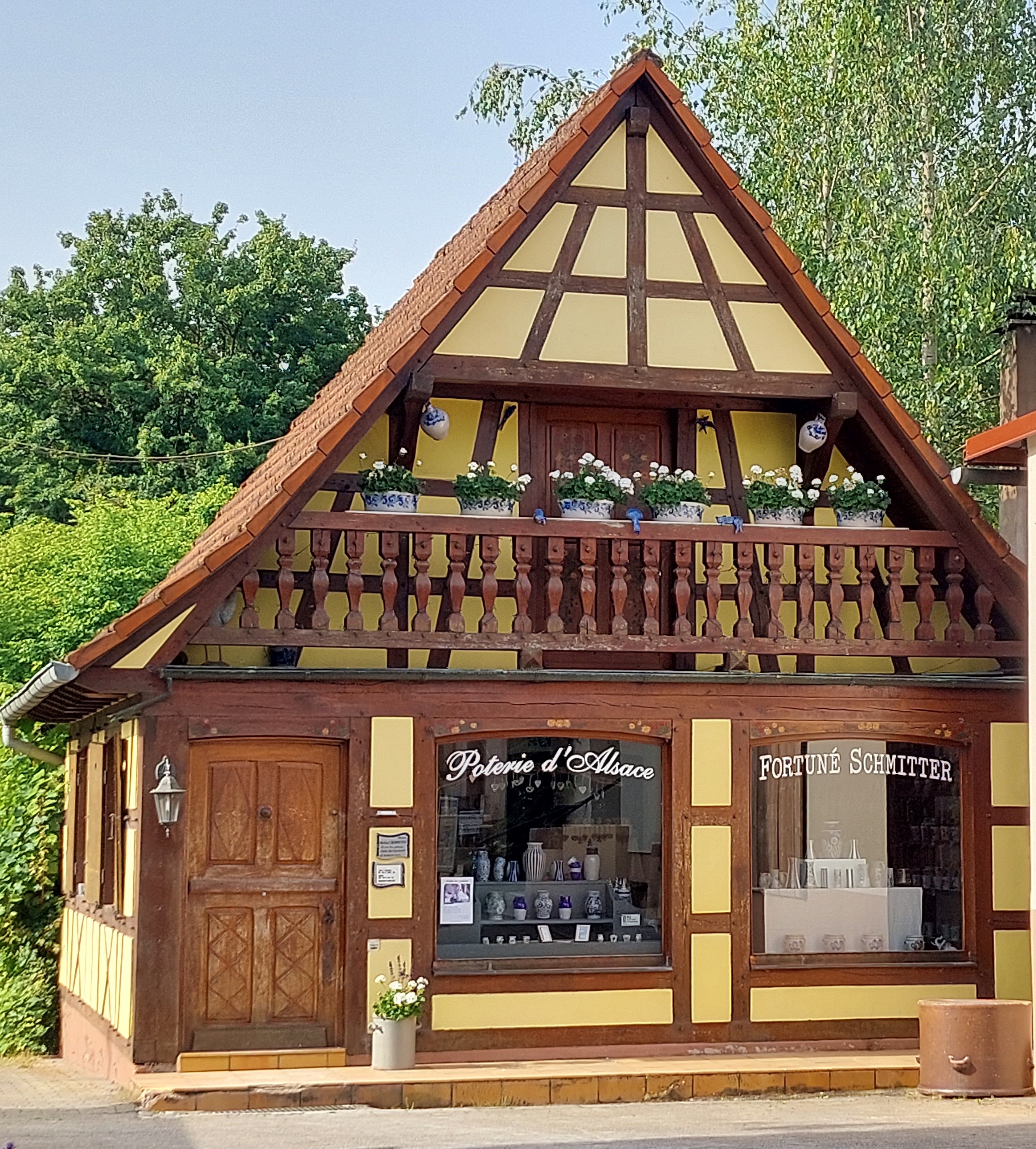
Poterie Fortuné Schmitter on rue des Potiers, photographed on 29 June 2024. This is the separately identified shop, not the protected Wingerter-Ruhlmann ensemble at number 39; the image makes no claim about present opening or restoration status. Photo: Didivo67, Wikimedia Commons; CC0 1.0. Unmodified.

Betschdorf's history of everyday storage thus extends beyond the preserved jar. It includes the spaces and commercial arrangements through which containers were made available, and the decisions that now keep evidence of that work together. The strongest account does not freeze the village at the moment when storage pottery was most prominent. It follows the relationship between a changing product and the places that made it possible.
Locate the town
For regional orientation, open a Google Maps search for Betschdorf. This community-level search is not an exact building entrance, a verified walking route or permission to enter a workshop, museum or private property. Check the institution’s own current access information separately.