Free · France
Pont-Aven: The mill town that became an artists’ centre
A mill can enter the history of painting without ceasing to be a workplace. At Pont-Aven, the building known as the Moulin David makes that distinction especially important. Its recorded industrial life extended well beyond the nineteenth-century artistic encounters for which the town is famous. The story is not simply that painters arrived, the wheels stopped, and practical buildings became picturesque remains.
This article follows one feature: the changing identity of the Kermentec mill, later called the Moulin David, as a manufacturing site and a repeated artistic subject. Regional heritage research, an archival finding aid, municipal planning documents and museum collections ask different questions of it. Read together, they reveal overlapping histories rather than a clean succession from industry to art. The key is to keep three things separate: what the mill produced, what artists made of its appearance, and what later institutions chose to preserve.
A mill with more than one working life
The regional heritage inventory assigns Kermentec's construction to 1828 and identifies its first use as papermaking. It records a judicial sale in 1840, followed by resale to Amédée David and conversion into a flour mill around that time. Flour production continued into the 1960s. The familiar name therefore belongs to a change of ownership and production, not to an unchanging medieval relic. Région Bretagne, inventory IA29131291, history and description.
The same record, based on a 2015 survey and updated in 2023, describes residential use, a missing vertical wheel, a surviving millrace and a stone trough associated with papermaking. These are recorded conditions, not a fresh inspection in 2026. Nor does a recorded object in a courtyard establish public access.
That sequence changes the questions worth asking of a painted mill. Its exterior cannot tell us which product was being made inside. A surviving water channel does not establish that machinery still operates. Even the name most familiar to art lovers covers only part of the site's working history.
The river in an administrative archive
The Finistère departmental archives' finding aid for collection 29 S supplies a less picturesque vocabulary. Article 16 lists an usine de Kermentec at Nizon with dates 1893–1896, and a moulin de Kéramentec at Nizon dated 1846. The spelling and municipal labels are worth retaining when identifying the files; a search confined to “Moulin David, Pont-Aven” would miss these entries. Archives départementales du Finistère, DDE transfer inventory 29 S, article 16, PDF p. 6.
This is a finding aid, not the contents of the files. Its dates do not establish uninterrupted operation, output, employment or the outcome of a dispute. They identify material requiring further examination. The underlying papers were not consulted for this article.
Nevertheless, the administrative record provides an important counterweight to a landscape title. It directs attention towards installations and named establishments within a river basin. Where a painter offers one selected view, an archive groups a mill with other uses of water. Neither source substitutes for the other: an attractive image cannot supply an operating account, while a file heading cannot explain a colour choice.
A working town could also accommodate painters
The Musée de Pont-Aven's guide does not explain the artistic colony through scenery alone. It points to the port's activity, transport connections through Quimperlé and the availability of accommodation. Its discussion of the port as a possible attraction is explicitly tentative. These are complementary conditions, not a demonstrated single cause. Musée de Pont-Aven, Guide du musée, p. 7.
This helps place the Moulin David within the town without making it responsible for the whole artistic colony. A place could offer painters a compelling subject while also providing the ordinary arrangements needed for a stay. Hospitality, circulation and work need not disappear from the story merely because an artist preferred to paint water and trees.
The distinction also guards against an empty-town narrative. “Discovered by artists” describes a change in outsiders' attention, not the beginning of a place's history. Here, the question is how a functioning environment became a subject of sustained looking. The evidence does not show that this particular mill caused painters to settle, or that its workers understood their surroundings in the same terms as visiting artists.
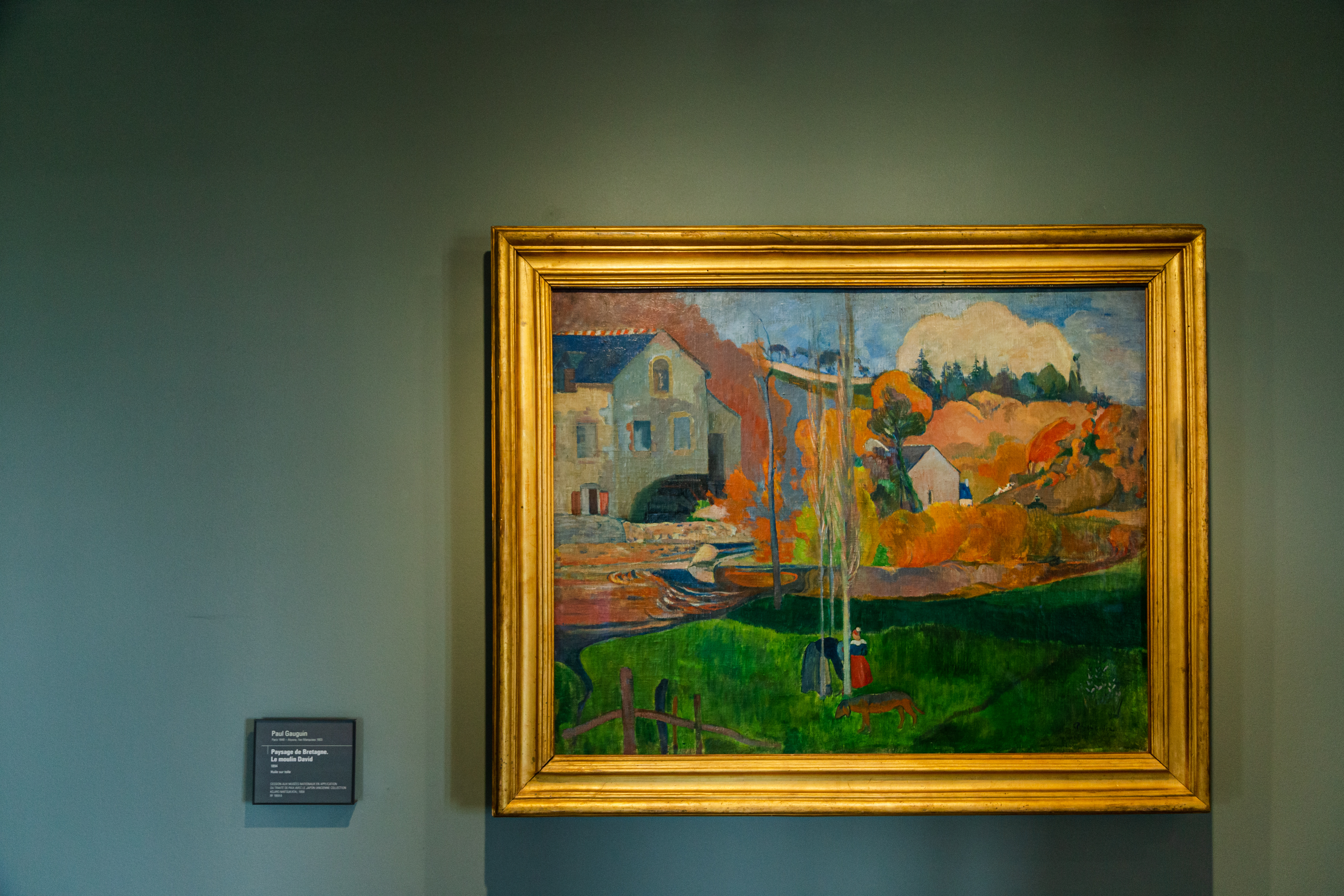
Gauguin’s 1894 Paysage de Bretagne. Le moulin David, photographed in the Musée d’Orsay in June 2022. This is a photograph of the painting, not of the working mill. Its dated museum setting does not establish present display. Photo: Adrian Scottow, Wikimedia Commons; CC BY-SA 2.0. Unmodified by publisher.

A factory made into a composed landscape
Gauguin's Paysage de Bretagne. Le moulin David is dated 1894 in the Musée d'Orsay catalogue. The museum interprets its simplified forms and deliberately non-naturalistic colours as part of the artist's search for something beyond immediate visual impressions. This is an account of pictorial decisions, not a technical assessment of the mill. Musée d'Orsay, Paysage de Bretagne. Le moulin David, inventory RF 1959 6.
In the museum's reproduction, the large building and dark wheel occupy the left side. Slender trunks cross the foreground, while the water and banks create curving bands through the scene. Green and orange areas organise attention more insistently than any account of production. These observations concern the reproduced image, not an independently reconstructed view from the riverbank.
The wheel makes the industrial subject recognisable, but recognition is not documentation of a working day. Nothing in the painting establishes how many people were employed or how much flour passed through the building. Its value here lies in showing that a mill could be retained as a motif while its surroundings were reshaped into a highly deliberate composition.
The same subject could be painted again
A later work prevents the story from ending with a single famous canvas. The local museum's educational booklet reproduces Fernand Dauchot's Le Moulin David à Pont-Aven, an oil painting dated 1943 and identified as part of its collection. The image places the buildings on the right, with water opening across the left and trees dividing the scene. Strong outlines and angular roofs give the mill a different pictorial presence from Gauguin's. Musée de Pont-Aven, Parcours in situ, PDF p. 16; museum collection caption, inventory 1985.11.1.
The interval between the two paintings matters more than a claim that they reproduce an identical viewpoint. A local subject remained available for reinterpretation across decades. Its artistic history was not finished by one encounter or one style.
Nor should the later image be treated as an architectural condition report. Comparing painted façades can suggest questions, but it cannot date every alteration without other records. The museum's reproduction documents a second representation of the mill; it does not prove that every visible element was transcribed literally. The booklet also warns that not all the works it presents are displayed in the museum.
An artists’ centre is not a single artistic movement
The museum describes the “École de Pont-Aven” as a label applied retrospectively to different artists who repeatedly worked in the town. It notes varied styles rather than one uniform manner. That explanation is useful when placing the Moulin David paintings within local heritage: a shared subject does not automatically make two painters members of the same group. Musée de Pont-Aven, section Découvrez l’école de Pont-Aven.
There is a difference between the history of a particular artistic movement and the longer history of a town attracting artists. Keeping that difference visible allows a twentieth-century painting to matter without presenting it as merely an after-echo of Gauguin. It also leaves room for the mill's practical history to continue alongside successive ways of seeing it.
Preserving more than the view
The commune's AVAP heritage-planning dossier identifies the Aven's hydraulic structures as a connected heritage concern. Its synthesis calls for attention to wheels, sluices, millraces, supply and discharge channels, and associated masonry. Elsewhere it distinguishes natural river islands from those created for mill operation. Commune de Pont-Aven, AVAP document de synthèse, printed pp. 76 and 88, PDF pp. 78 and 90.
This civic perspective shifts attention from a picturesque building towards the arrangements that made water useful. It is a planning document's account of heritage priorities, not proof that all proposed work has happened or that every structure remains intact. Its reproduced approval fields are incomplete, so it is not used here to determine present legal obligations.
The distinction matters to interpretation as well as conservation. Protecting a view and explaining a working system are different tasks. A roofline may remain recognisable while the wheel disappears; a channel may retain evidence of use that a famous painting barely explains. Reading the mill only through art would leave that practical relationship with the river insufficiently understood.
There was no single handover from mills to painters
Even the official tourism account illustrates the danger of assigning the town one closing date. Its introductory text says the last mill closed in 1925, but its own individual entries include later activity and give 2022 as the final closure of the Pénanros milling business. The page is useful as a public presentation of mill heritage, but those statements cannot form a consistent chronology without qualification. Office de tourisme De Concarneau à Pont-Aven, Les 14 moulins de Pont-Aven.
The Moulin David offers a more precise approach: follow one establishment, date each use, and distinguish a surviving building from continuing production. A painted wheel, a documented conversion, an archival file and a preservation objective each answer a different question.
Pont-Aven became an artists’ centre in a landscape already shaped by work. At this mill, artistic attention and practical use overlapped rather than occupying neatly separate eras. What survives is not a complete industrial scene waiting to be recognised from a canvas. It is a site with successive functions, images with their own purposes, and institutions that preserve different parts of the story. Its interest lies in reading those parts together without forcing them to say the same thing.
Locate the town
For regional orientation, open a Google Maps search for Pont-Aven. This community-level search is not an exact building entrance, a verified walking route or permission to enter a workshop, museum or private property. Check the institution’s own current access information separately.