Free · France
Concarneau: How fish markets and marinas change town livelihoods
A fish auction and a marina are not simply opposing scenes of work and leisure. Both depend on work ashore, although they organise it around different customers and different demands. In Concarneau, the useful place to examine that relationship is the auction and marina edge around the Quai Carnot and Quai du Lin. The question is not whether pleasure boats have replaced fishermen in a photograph. It is how market buildings, serviced moorings and their management distribute work. Here, “fish market” means the professional auction and associated handling of the catch, rather than a retail stall.
A working waterfront was also a town frontage
The regional heritage inventory identifies a longstanding tension in this small area. In March 1937, while discussing the proposed fish auction, Concarneau’s municipal council sought to protect fishermen’s interests while retaining the town’s visual appeal, which it also considered economically important. The inventory traces these positions to council deliberations of 6 and 15 March. Concern about the waterfront’s appearance therefore accompanied construction of fishing facilities; it was not invented after a later turn towards leisure boating. Région Bretagne, Quai Carnot et quai du Lin, IA29133732.
These are the council’s priorities as transmitted through an official researched inventory, not evidence that every worker agreed with the design. They nevertheless complicate a simple sequence of fishing first, tourism afterwards. The waterfront was already being judged both as a workplace and as part of the town presented to outsiders.
The separate inventory of the auction building records a more recent change inside it. The present building dates from 1952–57; an enlargement followed in 1990. In 2024, partitions dividing its upper-floor corridors and offices were removed to create rentable spaces suited to newer forms of office work. The same account records the loss of decorative floor mosaics. This is a concrete example of diversification within a fishing building, rather than wholesale conversion of the harbour to leisure. It also shows that adaptation can remove heritage fabric while retaining a building’s use. Région Bretagne, Halle à marée et criée, IA29133710, pp. 1–2.
A catch becomes a livelihood through work ashore
The Musée de la Pêche’s 2018 educational dossier on tuna fishing makes the connection between a catch and a sale unusually tangible. It describes women buyers employed by canneries, known as senteuses, who assessed fish by smell when boats returned. Delayed arrivals could mean spoiled cargo. The dossier also explains the importance of onboard preservation to the price obtainable in port. Fishing skill alone did not determine the commercial outcome: the condition of the fish and its acceptance by a buyer intervened between catching and payment. Musée de la Pêche, L’aventure thonière des marins de Concarneau, pp. 4–6.
The significance of these buyers is occupational, not picturesque. They exercised judgement at the junction between vessels and factories. A history concentrating only on boats would miss that work, even though it helped determine what could enter the processing chain. Their example also cautions against treating all shore employment as an activity that arrived with tourism.
The Finistère departmental archives supply another part of that chain. An exhibition panel reproduces photographs catalogued as the Amieux-Frères cannery in Concarneau around 1910. Their captions identify workers making sardine tins, women putting sardines into tins, and women preparing and drying fish on racks. These are separate stages, not a single undifferentiated “fishing” occupation. The archival references make the local identification explicit: 21 Fi 284, 285 and 286. Archives départementales du Finistère, Les conserveries, PDF p. 2.
For the auction itself, the museum’s published description of a behind-the-scenes activity follows fish from landing through preparation and sale, including the work of mareyeurs, the fish merchants who handle the onward trade. It also describes a working environment below 5°C and warns of slippery floors. This is evidence of the museum’s interpretation of the workplace, not a report of an activity attended for this article. It directs attention away from a colourful auction scene towards handling, conditions and the division of labour. Musée de la Pêche, La criée en coulisses.
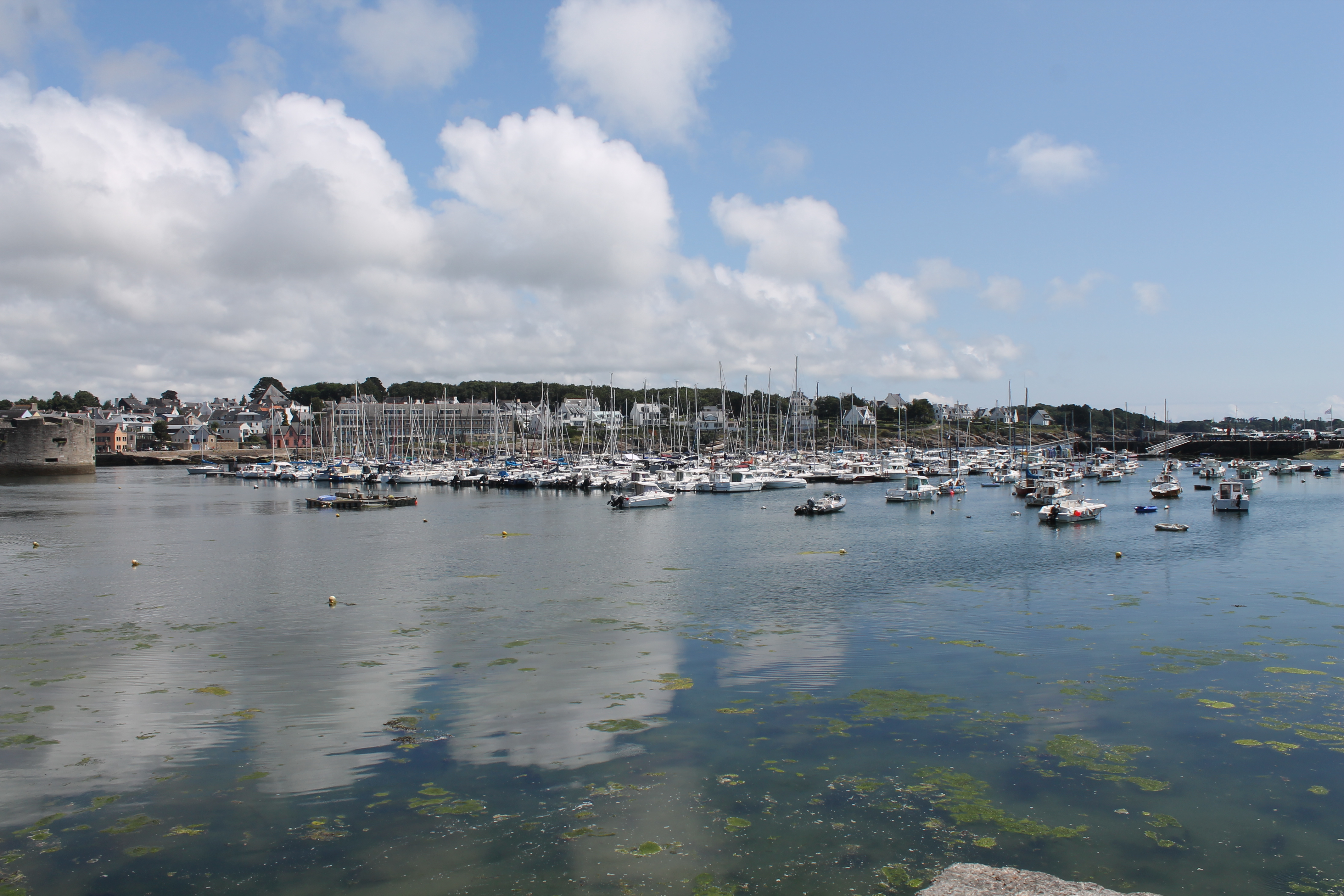
Concarneau’s marina in August 2024. Moorings and shore connections show the physical setting for the services discussed here; a photograph cannot establish staffing, annual occupancy or displacement of fishing jobs. Photo: Kev22, Wikimedia Commons; CC BY-SA 4.0. Unmodified by publisher.

Leisure boating has a work schedule
The marina’s recruitment documents offer a different kind of evidence: an employer specifying the labour it wanted. A notice dated 10 January 2025 advertised one pre-season post for weekends and public holidays from April to June, and ten seasonal posts spread between June and September. The summer posts were advertised at 35 hours a week, including weekends and holidays. These were recruitment intentions for that season, not a verified count of people eventually employed. Port de plaisance de Concarneau, seasonal recruitment notice, 10 January 2025.
The linked employer specification describes what Concarneau’s seasonal agents were expected to do: inform users and visitors, arrange boat placement and mooring, monitor the port, and maintain its installations. A boat licence was required. This is more revealing about livelihoods than a total number of berths. It identifies practical maritime skills and responsibilities within an activity commonly described as leisure. It also shows why “seasonal” does not mean casual attendance whenever the weather is pleasant: the advertised service included the days when other people were free to use their boats. Pêche et Plaisance de Cornouaille, January 2025 recruitment specification, p. 1.
The port’s services page makes the operating rhythm visible. Its published office schedule extends to every day in July and August, with a shorter weekday schedule in the October-to-March period. Water and electricity on pontoons, sanitary facilities and collection points for used oil and filters form part of the advertised provision. These facilities require management even though they are not the principal attraction of arriving by boat. The economic product is therefore not merely a rectangle of water: it is an organised stay with support ashore. The page describes services offered; it does not measure how much individual boat owners spend in town. Port de plaisance de Concarneau, Services.
Access to a berth is managed rather than automatic
The marina’s published waiting-list procedure adds an administrative dimension. Applications are ordered by registration date, but an allocation also depends on matching a boat’s dimensions to an available place. Applicants must identify the actual vessel before receiving an allocation. The document thus distinguishes a person waiting from a boat that can fit a particular berth. Port de plaisance de Concarneau, waiting-list procedures, file dated 1 January 2024.
For an account of livelihoods, this matters because marina activity depends on repeated administrative decisions as well as maintenance and boat handling. A berth count describes capacity; it does not establish occupancy, employment or household income. Nor can an increase in pleasure-boat capacity, on its own, demonstrate that a particular fishing job disappeared. The people doing the work, their contracts and their trajectories would have to be investigated separately.
The institutional arrangements also distinguish the activities. In December 2025, the Département du Finistère announced that the Société des pêches de Cornouaille would take over the CCI’s fishing-port responsibilities from January 2026. It assigned marketing of fish and operation of port equipment to the new company, while identifying marina management and infrastructure development as responsibilities of the port syndicate. A March 2026 civic notice subsequently described the company as operating the fishing ports from that January. Fishing and leisure boating belong to a connected port economy, but they are not one interchangeable service. Département du Finistère, 23 December 2025; Douarnenez Communauté, 18 March 2026.
Changes in space are not yet changes in household income
A convention text published with the agglomeration’s 2026 civic records sets out a project for reorganising leisure boating in Concarneau’s outer and rear harbour. It places improved fishing installations alongside a maritime-events role for Quai Carnot and reorganisation of marina space. Its proposed timetable runs through studies and later works; its financial clauses require further decisions after design studies. The document is evidence of an intended combination of activities, not proof that all the proposed facilities exist. Concarneau Cornouaille Agglomération, convention for reorganisation of leisure boating, pp. 4–7.
The distinction between an objective and an outcome is important here. The convention seeks economic activity and employment. Establishing what it actually delivers would require evidence from subsequent operations and employers. Its useful contribution now is to show what public bodies are trying to keep together: fish handling, maritime events and services to boats in a constrained town-centre waterfront.
The museum offers a complementary question: whose work receives attention? Its 2024 programme, La mer au féminin, included a scheduled encounter about the auction and fish-merchant workshops with the auction manager and a representative of the fish-buyers’ association. It also proposed encounters with women employed by a Concarneau fishing company. Rather than limiting women’s maritime history to historic cannery work, the programme placed them within contemporary professional organisations. This records a curatorial choice and an announced programme, not a workforce survey. Musée de la Pêche, La mer au féminin, 2024 programme, pp. 2–4.
Taken together, these sources support a more precise account than “fishing gives way to tourism”. Markets shape livelihoods through purchasing, preparation and the spaces needed to handle fish. Marinas organise another set of tasks around boats, users and seasonal demand. Concarneau’s changes can be traced in an office partition removed, a mooring assignment checked or a seasonal post advertised. None is a complete measure of prosperity. Each makes a particular form of work visible, and keeps the town’s working life from disappearing behind either a nostalgic fishing image or a leisure-waterfront view.
Locate the town
For regional orientation, open a Google Maps search for Concarneau. This community-level search is not an exact building entrance, a verified walking route or permission to enter a workshop, museum or private property. Check the institution’s own current access information separately.
Image note: One verified contextual photograph is included; no second image is represented as cleared.