Free · France
Salins-les-Bains: How brine technology shaped the town
Follow the water beyond the machinery
Salins-les-Bains is not simply a town with an old saltworks in its centre. Its history includes several different uses of water: saline water as raw material, river water as a source of power, water associated with bathing, and water supplied for everyday consumption. Calling all of them “the waters of Salins” obscures the distinctions that made each system work.
The Grande Saline's municipal presentation places salt production at the centre of the town's historical prosperity and identifies 1962 as its endpoint. But the end of production is not the end of the relationship between the town and saline water. The question is how resources, technology and uses were reorganised—not whether one unchanged system continued indefinitely. Municipality, Grande Saline.
A productive way to read Salins is to draw connections rather than collect isolated sights. Which water was wanted? Which had to be kept out? What supplied the motive force? Where did the usable material go? Answers to those questions lead from the underground works into streets, employment, other settlements and public services.
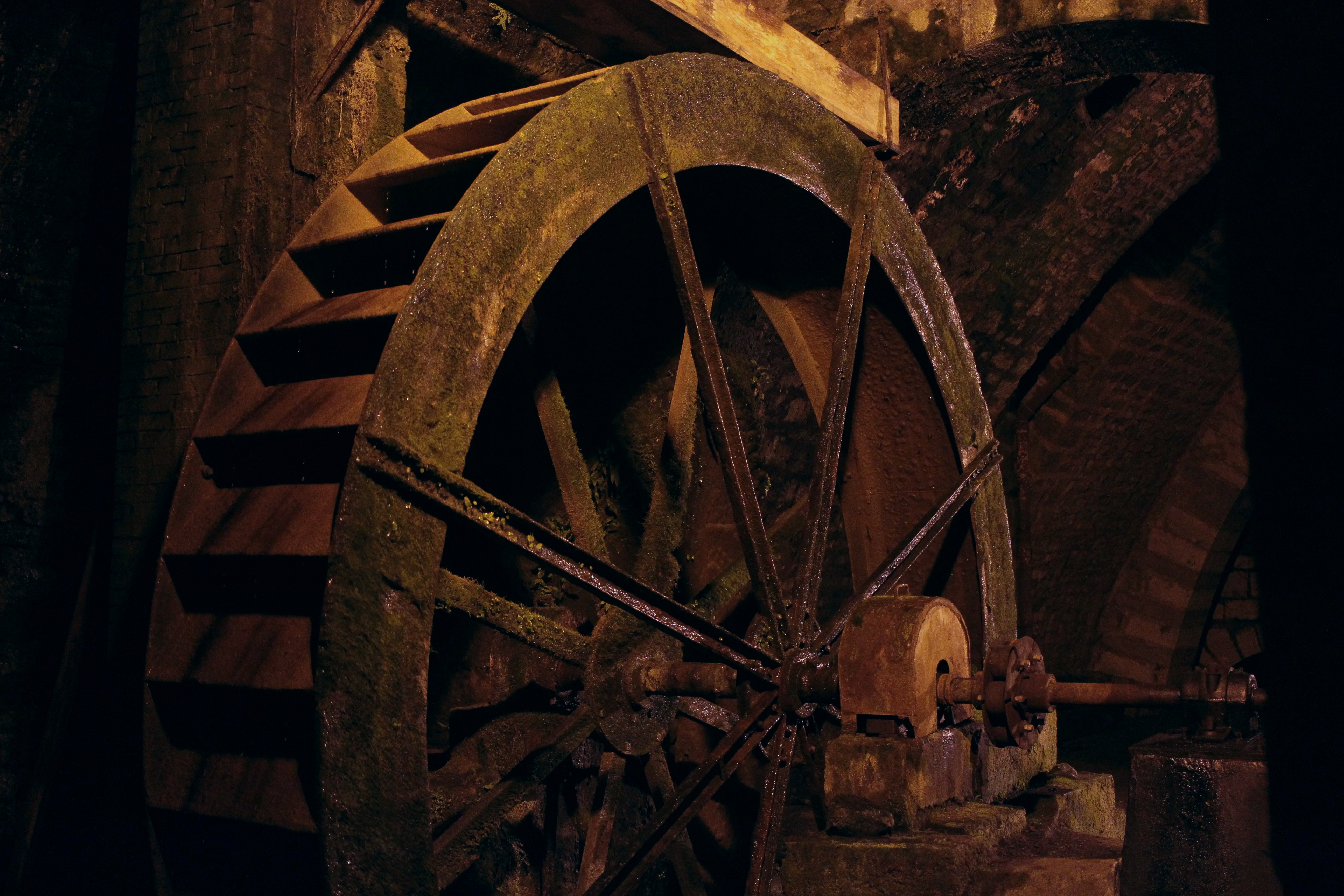
The saltworks water wheel on 18 May 2023. This surviving mechanism illustrates the use of water as motive power; the photograph does not verify its current operation or the routing of any present-day water service.
Photo: Anne Daemon, Roue de la saline de Salins-les-Bains.jpg, CC0 1.0. Original photograph reproduced without cropping or other alteration.

One resource could depend on separating another
The academy's account of the hydraulic pump explains a historical transition from human and animal power to river-driven machinery. In the eighteenth century, water diverted from the Furieuse turned wheels; a mechanism transmitted their motion to pumps. Fresh water also had to be removed so that it did not dilute the saline water. The account identifies the Cicon channel as part of this freshwater drainage arrangement. Académie de Besançon, hydraulic pump.
This is a striking inversion of the usual assumption that more water automatically helps a water-dependent industry. What mattered was not just quantity but function and composition. Water could be a source of power, a useful solution or an unwanted dilution, depending on where it entered the process.
That distinction helps explain why a technical site cannot be understood solely by looking at its central machine. Channels, controls and drainage formed part of the system. They connected the works to the river and surrounding ground. An apparently peripheral conduit might be essential to the quality of what the pumps supplied.
Going deeper did not mean building an underground salt mine
The monument record describes the introduction of drilling from 1832 as a way to obtain more concentrated saline water. The later installations retained important elements of hydraulic lifting and evaporation, rather than replacing the whole works with a completely different kind of industry. Ministry of Culture, saltworks notice PA00102032.
The distinction between drilling for brine and excavating solid salt matters. A visitor entering a gallery should not imagine that its accessible walls were the face from which every tonne of salt was cut. The gallery, borehole and production pan occupy different positions in the process. Their relation is technical, not just spatial.
The wider lesson is that innovation can reuse existing infrastructure. A new way of reaching a resource does not necessarily erase the established workplace, transport arrangements or skills around it. For Salins, “old” and “modern” are therefore less useful labels than a dated account of which component changed and what remained connected to it.
Technology also organised work
The academy's resource on women at the Grande Saline describes specialised roles in handling braises, forming salt loaves and drying them. It also identifies women acting as supervisors responsible for the work and quality associated with a pan. This was not an undifferentiated workforce standing beside machines: production depended on a division of tasks and judgement. Académie de Besançon, women's work at the Grande Saline.
That account changes the way to think about a “salt town.” Technology did not shape it only through buildings and pipelines. It created specific relationships between work stages and people with different responsibilities. A finished product embodied a sequence of decisions about heat, handling and form as well as the availability of brine.
It would nevertheless be wrong to assign one account of labour to every century of the works' existence. Roles, equipment and forms of payment changed. The source is used here to establish the importance of specialised labour and women's responsibility, not a timeless employment system or a modern claim about equal pay.
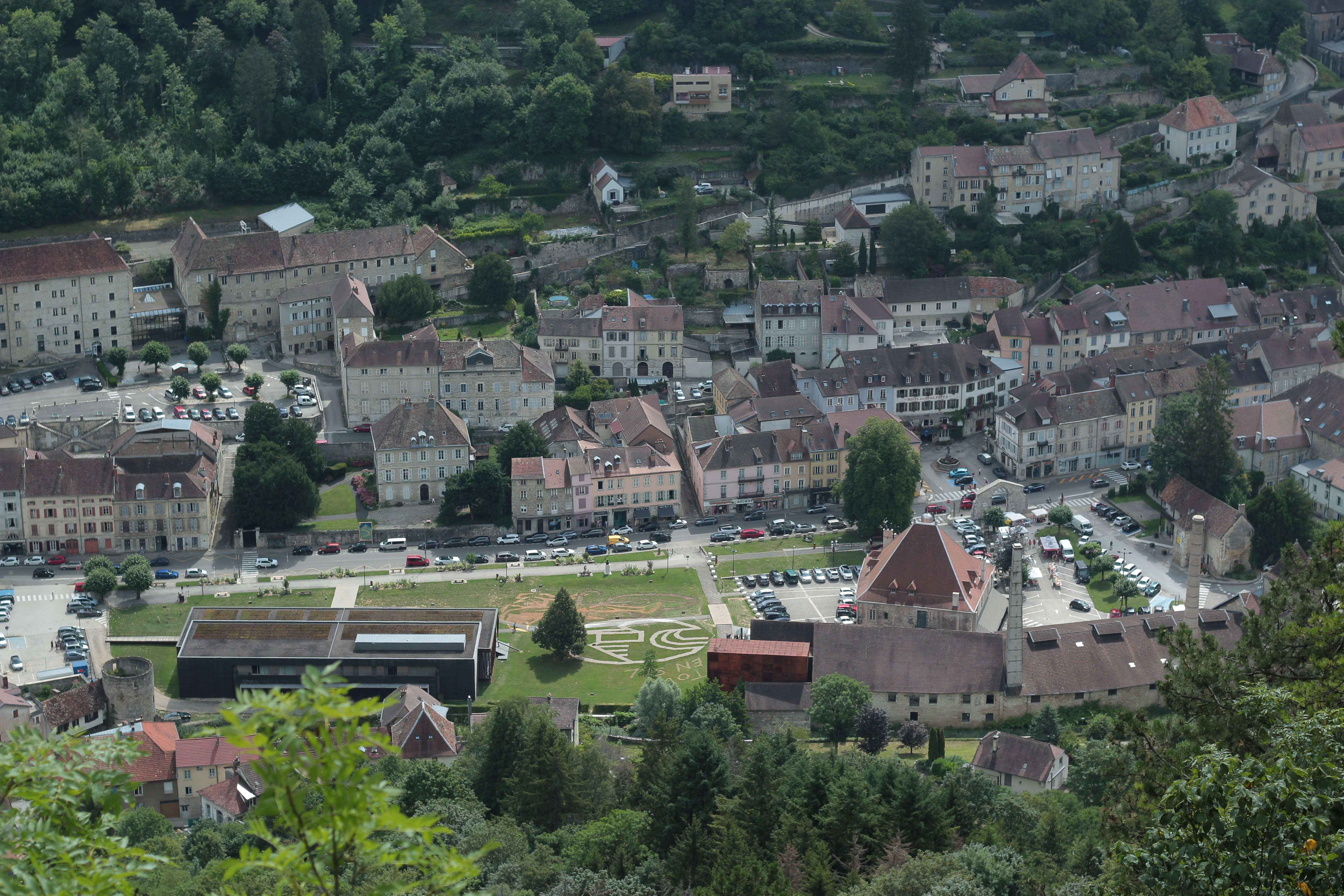
Salins-les-Bains and the Grande Saline seen from Fort Saint-André on 29 July 2023. The view locates the former works within the town, but cannot reveal the underground supply networks discussed here.
Photo: Anne Daemon, Salins-les-Bains et sa saline.jpg, CC0 1.0. Original photograph reproduced without cropping or other alteration.

Moving brine changed the scale of the system
UNESCO describes the connection between Salins and Arc-et-Senans: from 1780 to 1895, saline water travelled through a pipeline over 21 kilometres to the royal saltworks near the Chaux forest. The latter location offered access to fuel. This was a production relationship between two sites, not simply two museums later joined by a heritage label. UNESCO, World Heritage property 203.
The practical question is revealing: should fuel move towards saline water, or should saline water move towards fuel? The historical pipeline represents one response. Its significance lies in separating the location of the resource from the location of part of its processing.
This is a network view of Salins. The town's industrial importance cannot be bounded by the walls of one building, because its operation involved places beyond them. At the same time, a historical pipeline is not a current walking route, and the evidence does not establish that it remains navigable, accessible or operational. Its past function should not be converted into a present-day itinerary without another investigation.
Bathing was a new use, not an unchanged continuation
The Grande Saline's press dossier dates the establishment of the baths to 1854 on the Petite Saline site. It explains the historical use of eaux-mères, residual liquid from the evaporation process, and distinguishes later supply arrangements for bathing and treatment. The same account identifies a new ThermaSalina establishment in 2017. Grande Saline, press dossier, section on the baths.
A change of use is more than a change of sign above the door. Material formerly associated with making a product acquired a place in another service, with different premises, users and operating requirements. Continuity of a local resource did not make the purpose of the buildings identical.
The press dossier describes the Puits à Muyre in relation to the relaxation pool and a separate Cordeliers borehole for the treatment supply. This is its published account, not a current engineering verification. It is sufficient to caution against saying that every pool in today's establishment is directly supplied by the old museum pump. It is not a basis for drawing a definitive 2026 pipe diagram.
The operator's current presentation offers thermal treatments and relaxation facilities at Place Barbarine. It is used here to confirm the contemporary institution and its stated activities, not to endorse claims of medical effectiveness or advise on treatment. ThermaSalina, presentation.
Drinking-water infrastructure is another story
The municipal water-service page identifies Veley and Fonteny as sources supplying the treatment plant on the route de Cernans. Its public-service account concerns distribution and network management for residents. That is different evidence from the saltworks' historical brine story. Municipality, water and sanitation.
The distinction is important for everyday understanding. A town's fame for saline water does not mean that the water at a household tap is drawn from its industrial brine well. Names and reputation can join things in a visitor's mind that the service documents keep separate.
Nor should heritage interpretation be used as a water-quality assessment. This article makes no claim about the potability of a spring, fountain or historic basin. The practical reader should use current service and health information for that purpose, not the historical importance of the location.
An abundant history does not guarantee an abundant supply
The municipality publishes the operator's 2023 drinking-water report. It recounts a marked reduction in Veley and Fonteny resources during the summer of 2022, when plant flow had to be reduced. It says the same scenario did not recur in 2023, and discusses improved measurement, leakage reduction and possible additional resilience measures. Those are dated operational findings and proposals, not a description of a current emergency. Salins-les-Bains, 2023 water-service report, pp. 25–26.
The report provides a valuable counterpoint to the language of natural bounty often used in heritage promotion. A resource becomes a dependable service through monitoring, maintenance and choices about infrastructure. Its existence below or near a town is not the same as assured delivery whenever it is required.
This does not imply that the modern distribution service is merely a continuation of the saline system. The comparison is analytical: both histories become clearer when water is treated as something managed for a particular use rather than a single, undifferentiated gift of nature.
Keep the documentary layers visible
For the older works, the CCFr manuscript catalogue lists reports on the state of the Salins saltworks, including a 1669 examination in manuscript Chiflet 204. That listing offers a route towards original assessments of the installations, but the manuscripts themselves were not read here. BnF, CCFr catalogue entry.
The catalogue, a museum explanation and a modern service report answer different questions. One identifies historical records, another interprets a process, and the third documents an operating service in a particular year. Combining them is valuable only if those distinctions survive in the resulting story.
For a personal reading of Salins, use four headings: resource, energy, destination and date. A fifth—evidence—keeps the diagram honest. If the destination is unknown, leave it unknown. If a source is an old report, write its year. This simple discipline prevents a famous working mechanism from becoming an explanation for every use of water in the town.
Salins is most interesting not as a place where nothing changed, but as one where a powerful local resource was repeatedly captured, moved, separated and reassigned. Brine technology shaped the town through those relationships, while the town's later needs created new systems that should not be mistaken for the old ones.
Source register and limits
Sources read on 27 October 2026: municipal Grande Saline and water-service pages; academy resources on hydraulic pumping and women's work; monument notice PA00102032; UNESCO's property account; the downloaded Grande Saline press dossier; ThermaSalina's presentation; the downloaded 2023 water-service report; and the CCFr catalogue hierarchy. Links accompany the claims.
No site inspection, current hydraulic audit, original manuscript reading or clinical assessment was undertaken. The 2023 report's account of 2022 drought conditions is not presented as 2026 conditions. Published descriptions of the heritage mechanism do not guarantee that it will be running on a visit. Exact contemporary salinity, borehole depth, treatment efficacy and network configuration are not asserted.
For broad orientation only, this Salins-les-Bains place-name map search is not a verified entrance pin or an assessment of visitor access.