Free · France
Albi: Toulouse-Lautrec museum and city heritage
Why does a medieval episcopal palace in Albi contain images associated with modern Paris? The answer is not that the building was Toulouse-Lautrec's studio, nor that everything in the collection depicts his birthplace. The museum brings together three histories: a palace whose use changed, an artist whose career extended far beyond Albi, and a public collection shaped by gifts, decisions and conservation work.
Reading those histories separately before joining them makes a visit more rewarding. A wall belongs to the building's life; a depicted scene belongs to an artwork's subject; a donation entry explains how that object entered the collection. The date beside one is not automatically the date of the others.
A birthplace is a connection, not the boundary of a career
Henri de Toulouse-Lautrec was born in Albi in 1864. The museum's biography describes his artistic training in Paris from 1882 and the importance of Montmartre's performers, theatre and everyday social worlds to his work. His practice included painting, drawing, prints and posters rather than one uniform type of image. Musée Toulouse-Lautrec: artist biography.
This distinction guards against a common misunderstanding. A museum dedicated to a city's native artist need not be a collection of local topographical views. The link can be biographical and institutional rather than the subject of every work. When a picture refers to a Parisian venue, do not relocate it imaginatively to the palace around you.
Nor is the artist's biography a complete explanation of every formal choice. Start with the work's medium, purpose and date before turning a personal episode into an explanation. A commissioned advertisement asks something different of its audience from a portrait, even if both share the same maker.
Two dates that should not be collapsed
The museum identifies the major 1922 donation to the City of Albi as foundational to its Toulouse-Lautrec collection. Its history also describes the restructuring carried out between 2001 and 2012 to improve the visitor route while revealing important architectural features, including medieval glazed floor tiles and a late-fifteenth-century painted ceiling. The institution has continued to reinterpret both collection and building. Musée Toulouse-Lautrec: institutional history.
A municipal council record from March 2022 makes a useful distinction: the Toulouse-Lautrec gallery was inaugurated in 1922, while a decree of 31 July 1923 gave the museum civil legal personality. The document discusses a proposed evolution of its governance at that later 2022 meeting. It is evidence of the recorded discussion and historical dates, not sufficient by itself to establish the outcome of every subsequent administrative step. City of Albi: council record, 21 March 2022, culture item 5.
The broader lesson is that an institution can have several legitimate milestones: a gift, an opening, a legal foundation and a new display. Asking which milestone a date describes is more productive than deciding that every different date must be an error.
Follow one poster from public advertisement to collection object
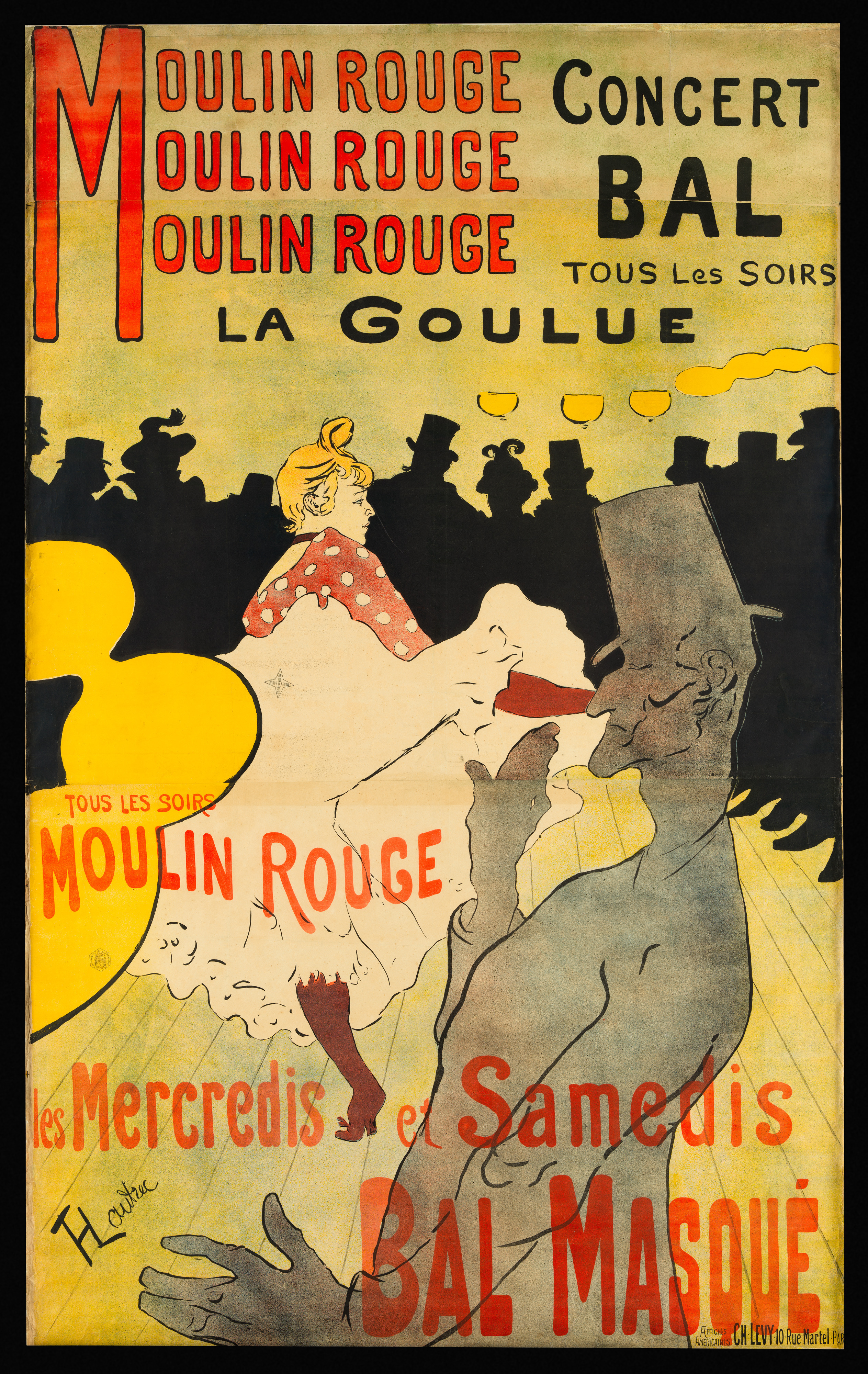
The museum's record for Moulin-Rouge. La Goulue identifies a colour lithograph of 1891, acquired through Adèle de Toulouse-Lautrec's 1922 gift. It explains that the director of the Moulin-Rouge commissioned the poster for the season's opening. Its recorded size—1.70 by 1.30 metres—also reminds a reader that the familiar image was not designed merely as a small illustration on a screen. Collection record: Moulin-Rouge. La Goulue.
Use that information to ask a practical visual question: what has to be understood quickly? An advertisement must identify or promote something in a setting where attention is limited. In a gallery, viewers can approach more slowly, compare details and read a label. The change in viewing conditions is part of the object's later history; it does not erase its original function.
A second museum document, prepared for its 2025 poster exhibition, explicitly addresses this move from street publicity to collected art and the conservation, restoration and display issues it creates. It is a record of that exhibition's argument, not a claim that the same temporary exhibition remains open in October 2026. Museum: 2025 poster-exhibition statement.
Same design, different collection object. This reproduction shows the Metropolitan Museum of Art’s impression of Moulin Rouge: La Goulue (1891), accession 32.88.12, Harris Brisbane Dick Fund, 1932. It is not a photograph of Albi’s sheet or its current display. The Met records its three-sheet impression as 190 × 116.5 cm; those dimensions and acquisition history must not replace the Albi catalogue entry discussed above. Notice how repeated lettering and silhouettes organise attention before you examine smaller details. Image: The Met, Open Access / CC0, public-domain artwork by Henri de Toulouse-Lautrec. Original museum image unchanged.
Compare a portrait without turning it into an advertisement
The museum identifies Gabriel Tapié de Céleyran as an oil painting on canvas dated 1894, donated by the sitter in 1922. The record places the portrayed figure in the corridors of the Comédie-Française and explains the cousin's relationship with the artist. This is a different acquisition entry and medium from the poster, even though both entered the collection in the same year. Collection record: Gabriel Tapié de Céleyran.
A useful comparison therefore begins with two labels, not a generalisation about “Lautrec's style.” Record what each object was made to do, who or what it represents, and how it reached Albi. Then look for similarities in composition or differences in the kind of attention each asks from the viewer. Your visual interpretation can be exploratory; the object identification should remain anchored to the catalogue.
Online collection entries establish that works belong to the collection. They do not guarantee that every object is on display on a particular day. Check the actual room labels and current information rather than expecting the website's selection to function as a live hanging plan.
The museum has a history beyond its famous name
The museum's Quelle histoire! 200 ans de collections exhibition, held from October 2023 to January 2024, examined the development from an early natural-history cabinet and encyclopaedic collection toward the Toulouse-Lautrec identity. Its statement describes archaeological, natural-history and other holdings, as well as later art acquisitions. It also explained a reconstruction of the 1922 hanging based on historical photographs. Museum: 2023–24 collection-history exhibition statement.
The Tarn departmental archives add another angle through their study of teacher and amateur archaeologist Julien Rigaud. The account follows his collecting and references material deposited at the Albi museum, while also discussing incomplete documentation and later efforts to examine the archaeological holdings. This is evidence of a collecting history with gaps, not permission to fill those gaps with confident object provenances. Archives départementales du Tarn: Julien Rigaud.
Together, the sources complicate the idea that a museum simply arrives fully formed around one celebrated artist. Collections accumulate unevenly. Records, conservation and changing research interests influence what can be understood and shown. A reserve collection is not necessarily unimportant, and an object absent from a visitor route has not necessarily disappeared.
A palace inside a larger city
The Berbie was an episcopal residence before its museum use. The museum's architectural account describes a medieval fortified complex progressively transformed into a residence of greater comfort and display, followed by a new public museum function. The building's different uses are part of the experience, not a neutral backdrop to it. Museum: palace and gardens.
UNESCO's Albi entry situates the palace within the Episcopal City, alongside the cathedral and surrounding historic urban fabric. The 2010 inscription concerns that ensemble. It is not a separate certification of every object inside the museum. UNESCO: Episcopal City of Albi.
That distinction also suggests how to reconnect the museum visit with the city outside. Notice changes in scale and use between a ceremonial room, a garden and a public street. Ask what kind of access each allows today and what its documented former role was. Do not assume that a currently open route reproduces how a medieval visitor moved through the palace.
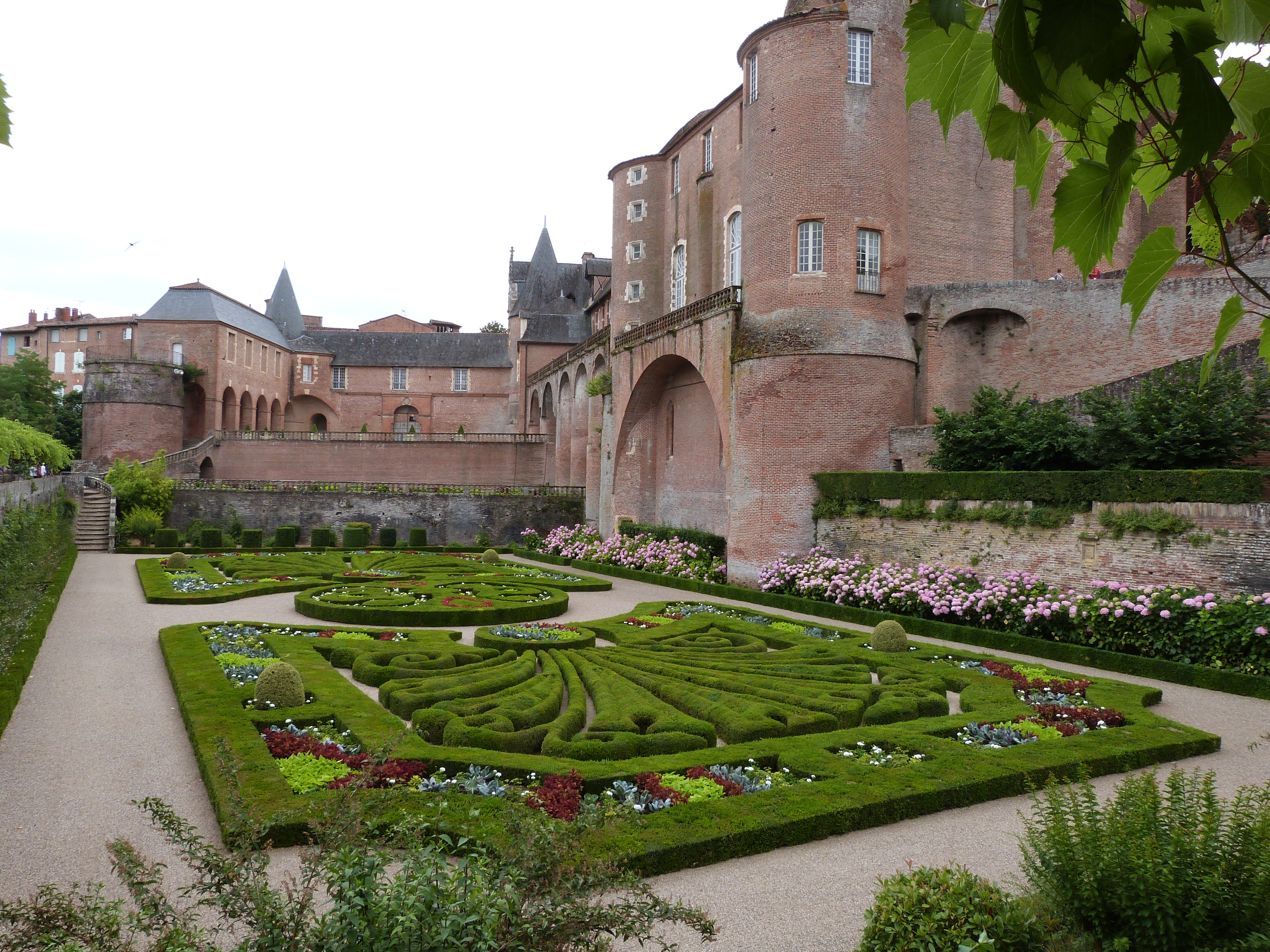
An exterior is a different kind of evidence from an artwork label. The Palais de la Berbie and its garden, photographed on 24 June 2017, show a relationship of walls, terraces and planted space. The museum’s architectural history traces changes from medieval fortification to residential and garden uses; the photograph alone cannot date every visible element. It does not show Toulouse-Lautrec’s studio, certify today’s access, or document the current gallery hanging. Photograph: Thérèse Gaigé, original and provenance, CC BY-SA 4.0, unaltered.

A three-label method for a focused visit
Choose a manageable set rather than trying to absorb every room:
- One architectural label: identify a dated element of the palace. Write down its material and recorded function, without treating all surrounding fabric as contemporary with it.
- One artwork label: record maker, title, date and medium. Separate what the work depicts from where it is now kept.
- One acquisition or exhibition-history note: identify a gift, purchase, deposit or display decision. If the information is absent, leave the question open rather than inventing an acquisition story.
End by writing the relationship among the three in plain language. For example, a modern work can be conserved in an older building because a later public institution brought them together. That is a specific heritage process, not a contradiction. It gives the city a role as a keeper and interpreter of works whose subjects may lie far beyond its streets.
Practical distinction: gardens, galleries and current display
The museum is at the Palais de la Berbie, place Sainte-Cécile. Its practical page, checked again on 28 October 2026, distinguishes free garden access from the museum's own opening arrangements and lists seasonal hours, weekly and holiday closures. It also describes lifts and other access provisions; readers with particular requirements should confirm their intended route with the institution. No individual accessibility assessment is implied here. Museum: practical information.
Use this map search for the Musée Toulouse-Lautrec, Albi for broad location only. It is not a verified entrance pin or surveyed route. Consult the current programme for temporary displays; past exhibition documents in this article are historical evidence, not event recommendations.
Source register and limits
Remote research compared museum history, catalogue records, practical information, institutional exhibition statements, the municipal council record, UNESCO and Tarn archives. No archival original, physical artwork or room hanging was inspected in person. The 2023–24 exhibition statement was available through indexed institutional text; direct PDF retrieval was unavailable. Past exhibition documents are historical evidence, not present event recommendations. The 2022 council proposal is not proof of completed reform.