Free · France
Saumur: Loire river trade and the cavalry school
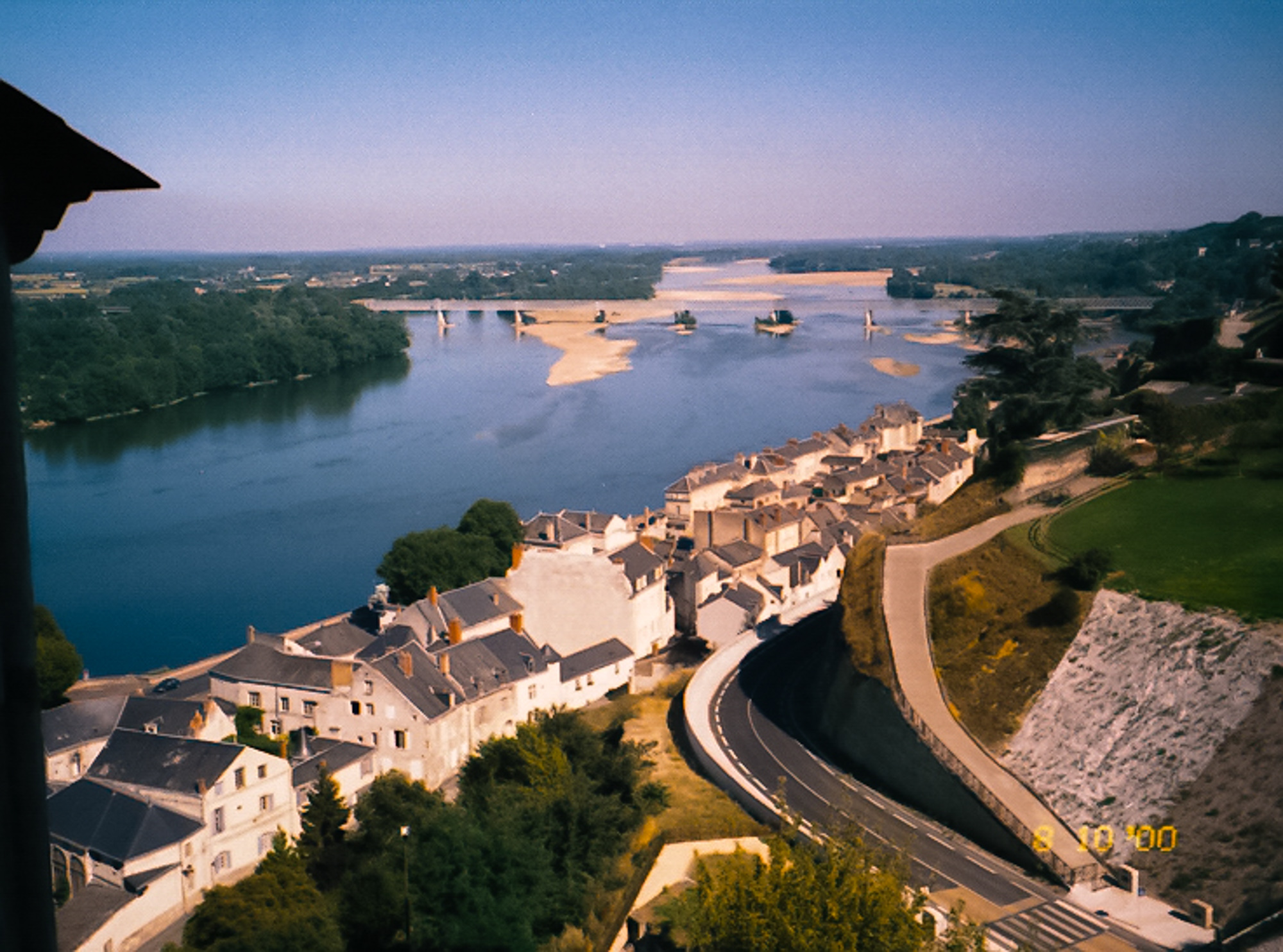
Saumur's river and horses are often presented as two separate attractions. In the Saint-Nicolas quarter, they become a question about urban space: how did a neighbourhood organised around markets and a port also become a place of riding instruction, barracks and large training buildings?
The answer is not that every boat served the cavalry school or that the military simply replaced commerce overnight. The more useful story concerns changing uses of land, buildings and expertise. It can be followed through the streets around Saint-Nicolas and Chardonnet without pretending that a modern river view explains every historical connection.
A commercial triangle before the military ensemble
The municipal heritage service describes the medieval Saint-Nicolas suburb through three connections: the market at Place de la Bilange, Rue Saint-Nicolas towards the Chardonnet meadows and Rue de la Petite Bilange towards the port. Its account places mariners and artisans within this commercial neighbourhood. It also describes later riding instruction and the conversion of the former Chardonnet halls into a riding hall under the Protestant government of Philippe Duplessis-Mornay. City of Saumur: Saint-Nicolas quarter.
That account supplies a concrete link between commercial and equestrian space: a change in the use of a building. It does not establish that the entire quarter changed function at one moment. A market, a riding hall and a residential street can coexist, and each can have a different institutional history.
For a simple sketch, place the market, port connection and Chardonnet area at three points. Then add the different activities rather than colouring the whole district “commercial” or “military.” The exercise helps reveal what broad labels conceal: movement between places, reused space and functions that overlap.
A river route was also a problem of reliability
River trade needs more than water on a map. A cargo must arrive, and someone must explain what happened if it does not. Historian Emmanuel Brouard's study of more than two hundred notarial damage reports from Anjou, dated between 1689 and 1791, examines navigation through the accounts of carriers dealing with accidents and losses. These are regional records, not a complete ledger of Saumur's port. Brouard, published research and abstract.
That distinction is useful. A report created after damage can illuminate responsibility and risk, but a collection of such reports overrepresents occasions when something went wrong. It cannot directly tell us the proportion of all voyages that failed unless the total number of voyages is also known. Nor can evidence from elsewhere in Anjou automatically be assigned to a Saumur quay.
The practical comparison with military instruction is not that the two activities were identical. Rather, both depended on learned skills and organisation. Knowing a river and training a horse each involve work that a picturesque image can hide. This is an interpretive comparison, not proof of a documented exchange of personnel between the port and the school.
Water is not a delivery record. This dated river view makes the contrast between waterway and built town visible. It is not a view of the cavalry school, a documented military landing or evidence of current navigation conditions. Andy Hay, View from the chateau at Saumur, 10 August 2000, CC BY 2.0. Original photograph unchanged, including its date imprint.
Barracks gave the quarter a new scale
The Ministry of Culture's record for the Chardonnet ensemble places the arrival of the carabiniers in 1763 and dates the H-plan barracks to 1768–1769. It describes the axis towards the Loire and the subsequent development of riding halls, stables and fodder stores around the training ground during the nineteenth century. Ministry of Culture: Chardonnet ensemble, PA00109304.
The presence of a fodder store is especially instructive. A school for mounted troops needed more than a prestigious façade and a place to ride. Its built environment had to accommodate animals, equipment, instruction and supplies. The architectural record makes those functions visible even where the original activity is no longer taking place.
It would be tempting to complete the picture with a claim that grain or hay arrived directly from a particular river landing. That may be a research question, but it is not established by the building's orientation towards the Loire. A supply contract, delivery account or dated plan of a landing would be needed to identify that connection. Proximity is not a receipt.
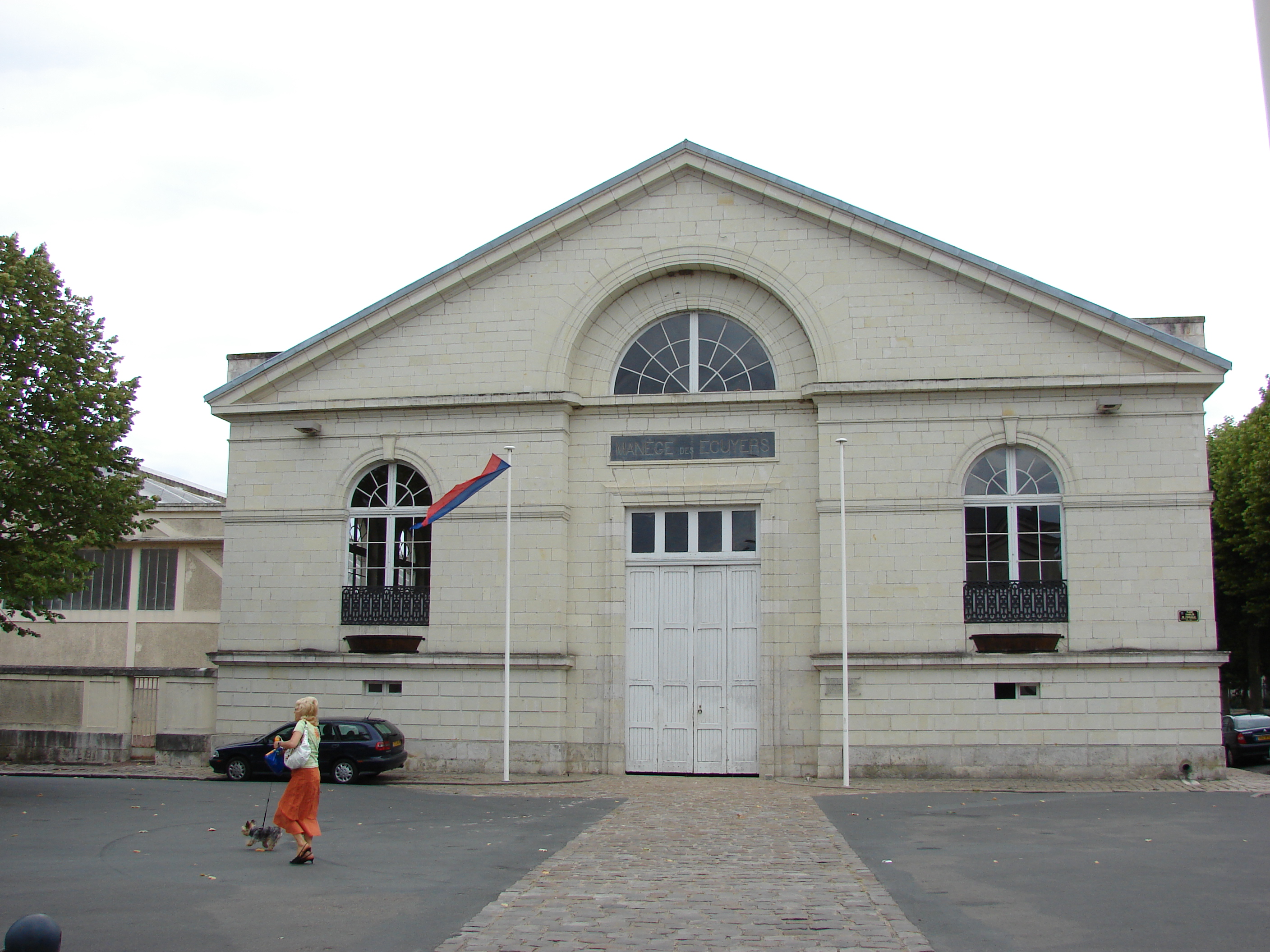
A specialised building, not just a town-wide label. The inscription identifies this riding hall as the Manège des Écuyers. Its exterior offers a concrete comparison with the riverfront view above, but does not show the interior, establish a cargo-supply link or identify today's performance venue. M.Strīķis, Manege des Ecuyers, Saumur, 11 August 2006, CC BY-SA 3.0. Original photograph unchanged; historical image, not a current access guarantee.

Why several foundation dates appear
Saumur's military and riding history has several institutional beginnings, rather than one date that explains everything. The army's account describes an eighteenth-century school, a new school established at the end of 1814 and reorganisation in 1825. The IFCE's history associates 1825 with the formation of the equestrian doctrine that became central to the Cadre noir. French Army: schools at Saumur; IFCE: history of the Cadre noir.
These dates need not describe the same event. The arrival of troops, construction of barracks, creation of a training institution and consolidation of a teaching tradition are different milestones. A short caption saying only “founded in 1825” would be too broad if it were meant to date the whole Chardonnet complex.
A useful reading rule is to attach a noun to every date: barracks, school, reorganisation, doctrine. If the noun is missing, ask what the date actually refers to. This prevents an attractive chronology from becoming a misleading one.
The modern Cadre noir is not simply an unchanged military school
The IFCE explains that the Cadre noir developed from military teaching and now carries its instructional role within the civilian equestrian institution. Its specialist historical account distinguishes the École nationale d'équitation and its later place within the IFCE from the older military setting. IFCE Equipedia: history of the Cadre noir.
For a reader, the essential point is to distinguish a tradition, an institution and a site. A teaching tradition can continue while its institutional organisation and location change. A historic building can retain associations with that tradition without being the place where every present-day activity happens.
Do not therefore use an image of the old barracks to imply that a current public Cadre noir performance takes place there. Equally, a visit to the cavalry museum is not the same thing as attending an equestrian presentation. Check the relevant operator for the activity intended.
What the cavalry museum adds—and what it cannot answer alone
The Musée de la Cavalerie identifies its setting as the former Cadre noir stables and describes collections of uniforms, weapons, insignia, art and everyday military objects. Its scope extends from mounted troops to later armoured cavalry. The building and the collections therefore offer two kinds of evidence: a former working space and a curated account of military change. Musée de la Cavalerie, official site.
An object label may explain use, date or provenance more precisely than a town-wide heritage summary. But an object in a museum does not necessarily come from the street outside. Ask whether a uniform, weapon or painting is being used to illustrate national military history or a specifically documented Saumur episode.
The distinction matters for the river connection too. Unless a label or record establishes it, an item should not be turned into evidence of local boat transport, local manufacture or a particular school supplier. The museum can prompt those questions without already answering all of them.
A small research plan that avoids invented links
| Starting point | A focused question | Evidence that would strengthen the answer | |---|---|---| | Port and market connections in the municipal account | Which route connected a named activity to a named place? | A dated plan, street record or property document | | A fodder store in the protected ensemble | Who supplied it during a specified year? | A supply contract or account, not merely a nearby quay | | A museum object | Is its connection to Saumur local or illustrative? | Provenance and collection documentation | | A foundation date | Which institution or building does it date? | The relevant order, building record or institutional history | | A river accident report | What happened on that voyage? | The complete report and related transaction evidence |
Saumur's municipal archives provide a route into further investigation. Their online inventory structure distinguishes older and modern records; the Series F page identifies commerce and industry among the economic subjects but marks parts of that series as still being classified. This is a finding-aid lead, not confirmation that a specific shipping ledger is digitised and immediately available. Municipal archives: Series F.
Choose one year, one building or one supplier before widening the enquiry. A narrow question is more likely to yield a verifiable connection than the general assertion that “the Loire supplied the cavalry.” No original supply accounts or cargo registers have been inspected for this article.
Read the neighbourhood from public space
For orientation, use Place du Chardonnet, Saumur on Google Maps. This is an address-search link, not a verified museum entrance or permission to enter military buildings. Follow current signs and operator access instructions; protected status does not create public access to every part of an ensemble.
An exterior comparison can be worthwhile without entering every building. Contrast the scale of the training ground with the street connections described in the municipal history. Ask how open space and specialised buildings differ from a commercial street. Do not label a particular doorway as a stable or store merely because it looks suitable: use a verified plan or building description.
Saumur's river trade and cavalry school meet most convincingly in this history of changing urban use. The Loire helped organise a commercial neighbourhood; riding instruction and military investment introduced new demands and new buildings. The evidence is strongest when it explains those specific changes—and when it leaves unsupported stories about individual boats, cargoes and suppliers unwritten.
Source register and limits
Municipal heritage, Ministry monument, IFCE, museum and archive-finding-aid sources were read remotely. The Army’s direct page timed out; its official indexed account supported the chronology. Brouard’s regional study was consulted through published research/abstract and indexed publisher material; a later bot check was not bypassed. No original notarial register, supply contract, cargo ledger or museum field visit is claimed. Troop arrival, barracks, school, reorganisation and doctrine remain separate milestones. Finding aids do not establish digitised ledger availability. The two dated photographs preserve original bytes and credits, including the river image’s date imprint; neither proves a supply connection, modern performance venue or present access.