Free · France
Saint-Antoine-l'Abbaye: Why an Alpine foothill village preserves hospital heritage
Hospital heritage is not always a preserved ward. At Saint-Antoine-l'Abbaye, in the Dauphiné foothill landscape near the Vercors, it is also a church façade needing skilled repair, former conventual buildings used by a museum, documents held in an archive and a continuing public discussion about what deserves care. The question is not only why the Hospitaliers of Saint Anthony mattered in the Middle Ages. It is why a village and institutions beyond it keep investing in the traces of their world.
A short answer is that these traces connect several kinds of value: local identity, historical knowledge, worship, craft skill and public access. A better answer looks at actual decisions. Completed restoration, an approved funding framework and a fundraising appeal are different stages of preservation—not interchangeable evidence that a monument has been “saved.”
First identify what is being preserved
The departmental museum describes Saint-Antoine as the mother house of an order with a European network. Its account links the development of the town to pilgrimage and the reception of sick people. That explains why a relatively small settlement contains an architectural ensemble whose historical connections extend far beyond its immediate landscape. Source: departmental museum, historical site.
But the museum's 2018 research publication states that the historic hospitals at Saint-Antoine itself disappeared, including the Grand Hôpital demolished in 1655. Preserving hospital heritage here therefore cannot mean maintaining an intact collection of medieval wards. It means preserving surviving associated buildings and objects, researching lost elements and explaining the distinction to the public. Source: museum's 2018 hospitality exhibition publication.
That distinction is useful well beyond this village. A historic institution leaves different kinds of remains. Some survive in place; some enter collections; some exist only in records. The strongest interpretation makes those differences visible rather than allowing the largest surviving building to stand for everything that once happened nearby.
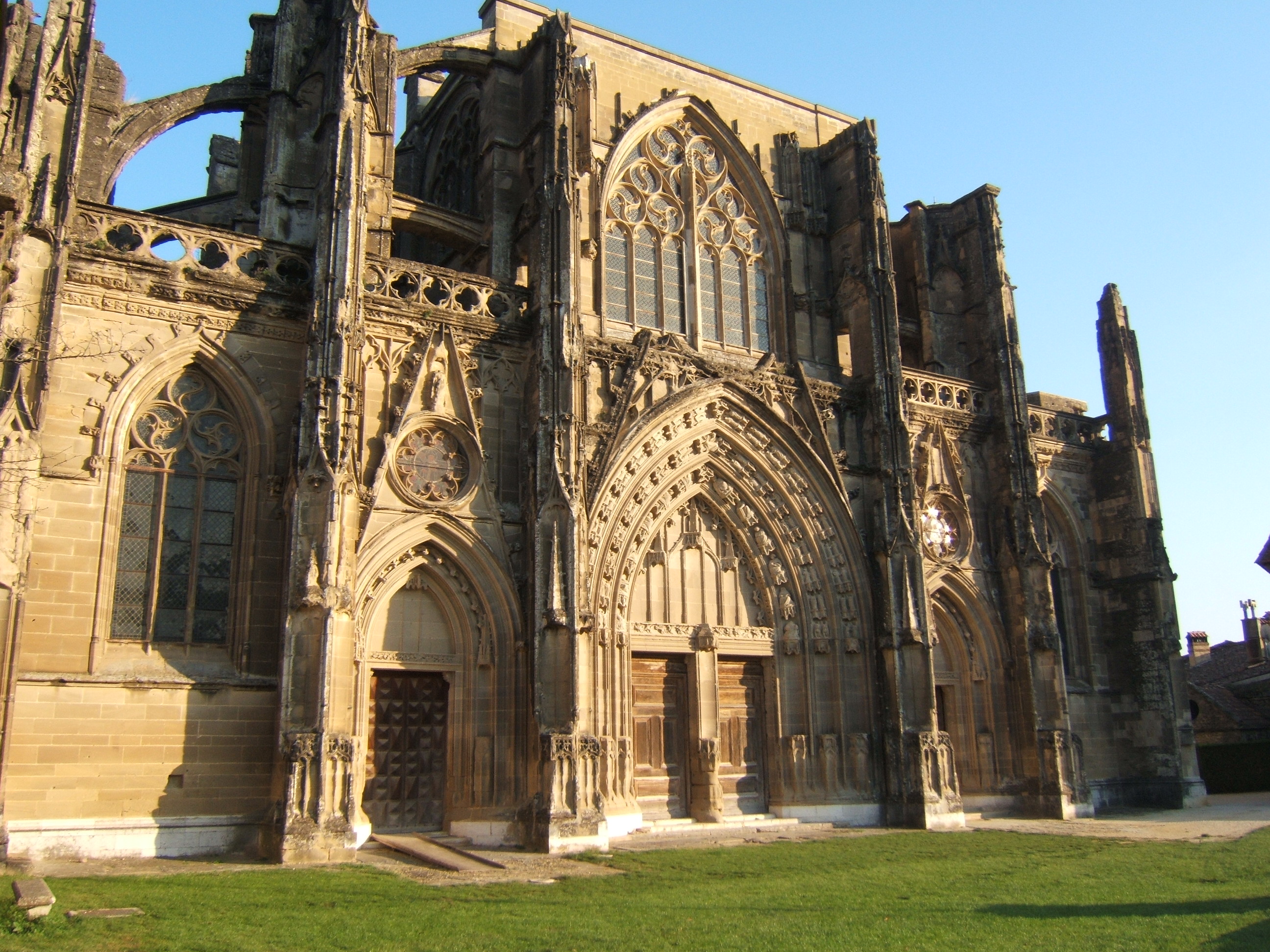
A dated baseline, not a completion photograph. This November 2005 view precedes the restoration phases discussed below. It identifies the façade's setting but cannot measure later structural work or establish which spaces are open today. Denis Gounele (Groumfy69), Portail Eglise Abbatiale, photographer's public-domain dedication. Original photograph unchanged; reused from the existing verified asset, not a newly commissioned view.

Preservation is work on particular material
A joint public-authority statement dated 27 April 2023 records completion of the first restoration phase on the abbey church's west façade. Work ran from June 2020 to February 2023 and concerned the central bay and part of a buttress, not the entire abbey. The statement explains that detailed inspection revealed more serious deterioration inside some stones than their surfaces suggested, requiring structural priorities and a revised approach. Source: Isère, completed first-phase statement.
This is a better starting point than the phrase “restored to its former glory.” It names a boundary: which part, which work and which period. It also shows why conservation cannot be judged solely from a photograph. A façade may appear broadly unchanged while the work needed to keep it secure has been substantial.
For the observer, a useful question is not whether a replacement stone looks old enough. Ask what evidence guided the intervention and what problem it addressed. Appearance, structural stability and the survival of original material are related but distinct concerns. The public statement offers a documented case of professionals adapting work after closer investigation; it is not an instruction for visitors to test or touch the stone themselves.
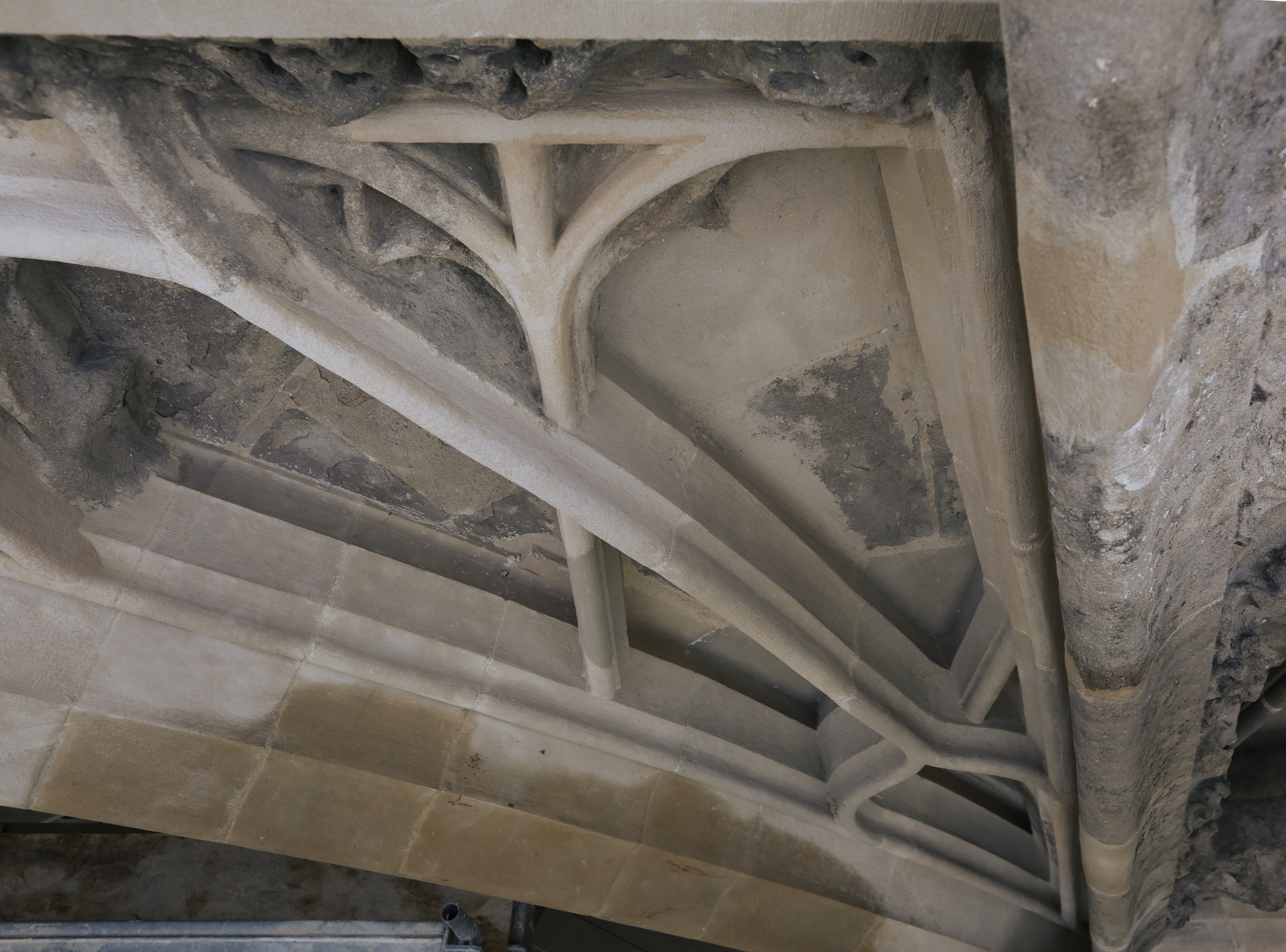
Look at the material scale. Stonework photographed during the abbey restoration on 16 June 2022 contrasts with the broad façade view. Visible changes of tone alone cannot identify every intervention, diagnose damage or certify completion. © Yann Forget / Wikimedia Commons / CC BY-SA 4.0, Restauration de l'abbatiale de Saint-Antoine l'Abbaye, 2022-06, 9283. Published photograph unchanged; the photographer's existing crop and colour correction are retained. Not a current site-condition report.

Read the municipal decision as a dated decision
The council minutes of 2 September 2024 provide another layer. They record a financial framework with the Département for a second west-façade phase, under a 2024–2031 program. The account identifies the church as municipally owned and describes coordinated work with the Département and state heritage services. It projected a 2026 start. Source: municipal minutes, item 8, page 4.
A reader should preserve the verb “projected.” An approved program tells us what public bodies intended and authorized at that moment. It is not proof that every operation subsequently happened on that timetable. That is particularly important when old web pages remain easy to find beside newer ones.
This is also where local history becomes everyday governance. The abbey is not maintained by historical importance alone. Decisions have to be made about responsibilities, sequence and resources. The record makes those arrangements inspectable. It does not tell us that all residents share one opinion, and no such consensus should be invented from a formal decision.
A new appeal is not the same project completed twice
The Fondation du patrimoine's project page, updated in October 2026, focuses on the abbey's beffroi, or belfry structure. It identifies water-related and structural deterioration and describes a restoration appeal opened in May 2026. Its timeline separately lists work on the main façade beginning in 2025. These are the Foundation's dated project statements; the page does not establish completion of the belfry work. Source: Fondation du patrimoine, Saint-Antoine project.
This is precisely why preservation needs a small vocabulary of status. “Completed phase,” “planned phase,” “appeal launched” and “work reported as begun” should not be compressed into “restoration finished.” The difference is not bureaucratic pedantry. It changes what a visitor can reasonably expect and what a reader thinks public or donated money has already achieved.
The newer timeline and the older municipal forecast should also not be forced into artificial agreement. They concern evolving programs and reporting dates. For a live construction schedule or access restriction, consult the current site information. For historical analysis, retain each statement's date and scope.
Objects need care as well as walls
Preservation reaches inside the church. The museum records a municipal restoration campaign for six paintings by Marc Chabry, initiated in 2017 and completed in 2022, returning the works to their setting in the choir. The story is one of material conservation and skilled intervention, not merely a new display label. Source: departmental museum, Chabry restoration account.
A church painting can be read as an artwork, a devotional object and part of an architectural ensemble. Those readings need not compete. They do, however, require more care than treating every surviving object as a direct illustration of medieval hospital practice. Date the object before using it to explain the institution.
The Ministry of Culture's object portal lists protected objects associated with the village's buildings. It offers a way to identify particular works rather than relying on an unsourced photograph caption. An entry is a research aid, not evidence that every listed object is currently on display or that its photograph can be freely republished. Source: Ministry's Saint-Antoine object inventory.
A museum turns survival into public knowledge
The Département's museum occupies former conventual premises and presents the order's history through Chroniques d'une abbaye. Its separate perfume-history exhibition occupies the Grandes Écuries; some other rooms are opened only for specified events. This is active reuse with interpretation, not an institution frozen at the moment its hospital order flourished. Source: museum's institutional and visitor overview.
Reuse matters because keeping a building standing and making its history intelligible are different tasks. A roof protects fabric; a carefully explained collection helps visitors distinguish periods, people and functions. Neither achievement substitutes for the other. Nor does a contemporary event in a historic room prove continuity of the room's medieval use.
For a hospital-history visit, ask how the display handles absence. Does it identify a lost building? Does a reconstruction distinguish certainty from interpretation? Does a treatment description describe past belief without endorsing it as present medical advice? Good preservation protects the evidence and the reader's ability to understand its limits.
Documents are part of the inheritance
The Isère archives' Chaper inventory identifies records concerning the abbey and the Antonine order, including a register begun in 1660 under J 577* and a group of acts and correspondence under J 578. The published finding aid is accessible; the original records were not examined for this article. Source: departmental archives, Chaper inventory, PDF page 26.
This gives the visitor a useful counterweight to the façade. The public image of a place favors what can be seen in a wide photograph. Administrative and institutional history often depends on less visible records. An account book or letter may answer a question that no surviving stone can, but only after it has actually been read and interpreted.
Do not let the existence of an archive become a decorative guarantee of truth. A citation should say whether it points to a catalogue, an original document or a modern study. Here the finding aid demonstrates a research route, not a newly discovered patient's story.
Four checks for any preservation claim
| Claim encountered | What to check | Saint-Antoine example | |---|---|---| | “The abbey has been restored” | Exact area and completion date | First west-façade phase completed in 2023 | | “A restoration is approved” | Decision date and projected scope | Municipal second-phase framework of 2024 | | “The public can help preserve it” | Which object or structure the appeal concerns | Belfry appeal described in 2026 | | “The hospital survives” | Whether the term means fabric, associated heritage or documentation | Lost hospitals interpreted through other remains and records |
These checks are not an audit of a contractor or a funding body. They are a way for a reader to avoid confusing an aspiration with an accomplished result. They also make a visit more rewarding: you can ask about a specific intervention instead of admiring an undifferentiated “old abbey.”
For orientation, the map search for the museum at Le Noviciat, Saint-Antoine-l'Abbaye uses the official museum location. It is not a verified entrance pin or an accessible-route assessment. Check current departmental visitor information before planning entry; restoration reporting alone cannot establish which spaces are open.
The village preserves hospital heritage not by pretending the whole medieval institution remains intact, but by caring for several different inheritances at once. Stone, paintings, records and interpretation require different kinds of work. Seeing those efforts separately makes their collective value clearer—and makes it harder to mistake a handsome view for a finished preservation story.
Source register and limits
The 2023 completion statement, September 2024 council minutes and October 2026 Foundation page are dated evidence for distinct phases, forecasts and appeals; they do not certify whole-site completion or current access. The Chaper finding aid was read, not original manuscripts or patient accounts. The 2005 portal photograph and 2022 restoration-detail photograph retain attribution and original bytes; neither diagnoses stonework or establishes later work status. No resident interview, site inspection or funding audit is claimed.