Free · France
Corte: University town within Corsican mountains
Corte is not simply a mountain town with a university added to its list of attractions. Its teaching spaces, cultural activities, collections and research infrastructure offer a different way of understanding the town: as a place where knowledge is produced, preserved and exchanged.
The mountain setting is real. The university's own introduction places Corte at the meeting of the Restonica and Tavignanu. But the surrounding landscape should not lead to the assumption that intellectual life here is inward-looking or isolated. Source: Università di Corsica, discovering Corte.
To see the distinction, follow a narrow thread through the town: the relationship between the contemporary campuses, the historical memory of education, and the museum's interpretation of rural Corsica. These are connected subjects, but they are not interchangeable institutions or evidence of an unchanged way of life.
A revival, not an uninterrupted institution
The university gives 3 January 1765 as the opening of Pasquale Paoli's university at Corte. Its historical account describes a short first existence and a reopening in 1981 after a long interruption and popular mobilization. The two dates are anchors for a story of revival, not proof of continuous teaching across more than two centuries. Source: Università di Corsica, institutional history.
Even the end of the first university needs care. The current institutional account describes four years of operation, while an archival exhibition produced by the university uses 1765–1768 in its title and description. This article does not resolve that difference by selecting whichever date makes the neatest timeline. The secure point for this reading of the town is the substantial break before the modern reopening.
The distinction matters when looking at buildings. A historical name, a remembered founding and a current campus do not automatically establish that lessons continued on the same site. Nor does a present-day room become an eighteenth-century classroom merely because it belongs to the same named university.
What an archive changes in the story
The university's 2011 exhibition, Documents inédits sur l'Université de Pasquale Paoli, approached education through records of teaching, books, expenditure, student support and village communities. Its catalogue explains that Jean-André Cancellieri translated archival texts from Tuscan into French, retaining the alternative spellings Corte and Corti found in the originals. Source: Médiathèque Culturelle de la Corse, exhibition record.
That structure is significant. It shifts the question from “who founded the university?” to “what made education possible?” A founding story foregrounds a person and a date; the listed records direct attention to resources, institutions and people supporting study. The original panels and documents were not independently inspected for this article, so this is a reading of the exhibition's documented scope, not a claim about an individual payment or student.
A research paper by historian Erick Miceli provides a complementary perspective. Drawing on diplomatic and other archival materials, it examines the educational project through relations among Corsican actors, Genoa and Rome. The point relevant here is not a dramatic tale of intrigue but the outward reach of the project: the history of learning in an inland Corsican town cannot be contained within the town's physical boundaries. Source: Erick Miceli, study of the university project and Genoese intelligence, introduction and conclusion.
These sources do different jobs. The exhibition catalogue identifies an archival programme; the historian interprets records; the institutional history presents the university's own chronology. None should be silently substituted for the others.
The present university is distributed through the town
The university's campus description identifies Mariani and Grimaldi as its two Corte campuses. Its current campus plan associates Mariani with teaching and the Natale Luciani performance space, and Grimaldi's Desanti building with the library and most administrative services. The presidency is listed separately at the Palazzu Naziunale. It also identifies the Edmond Simeoni building near Mariani with humanities and social-science research and language facilities. Source: Università di Corsica, campus geography.
This is more useful than imagining a single enclosed campus that can be understood from one gate. A student going to a class, someone attending a performance and a researcher consulting material may need different destinations. “The university” is not a sufficiently precise address.
For a reader trying to understand daily life, make a simple distinction between a building's role and access to it. A library contributes to the town's knowledge infrastructure; that does not mean every visitor has the same borrowing rights as a student. A research building may host a public event without being freely accessible at other times. Confirm the particular venue and conditions rather than assuming institutional presence guarantees entry.
The mairie's university page describes the institution's research partnerships and international exchanges. Its cultural-centre page also describes activities for audiences beyond the campus. These are civic statements about a relationship, not a complete measurement of the university's economic effects. Sources: mairie de Corte, university; mairie, university cultural centre.
The mountains are also a research environment
A small piece of infrastructure makes the connection particularly concrete. The SNO RENOIR observation network describes a rain collector on the roof of the Pozzo di Borgo building at campus Grimaldi. Its account explains how precipitation samples support research into water systems and the origins of rainfall. Source: SNO RENOIR, Corte station.
The mountain landscape is therefore not only something seen from a classroom window. It helps generate scientific questions and observations. An ordinary-looking university building can participate in a wider research network without resembling a visitor attraction.
That example does not make the station a public rooftop destination or a source of immediate personal weather advice. It illustrates the difference between enjoying a landscape and systematically studying it. No approach to equipment or restricted space is suggested.
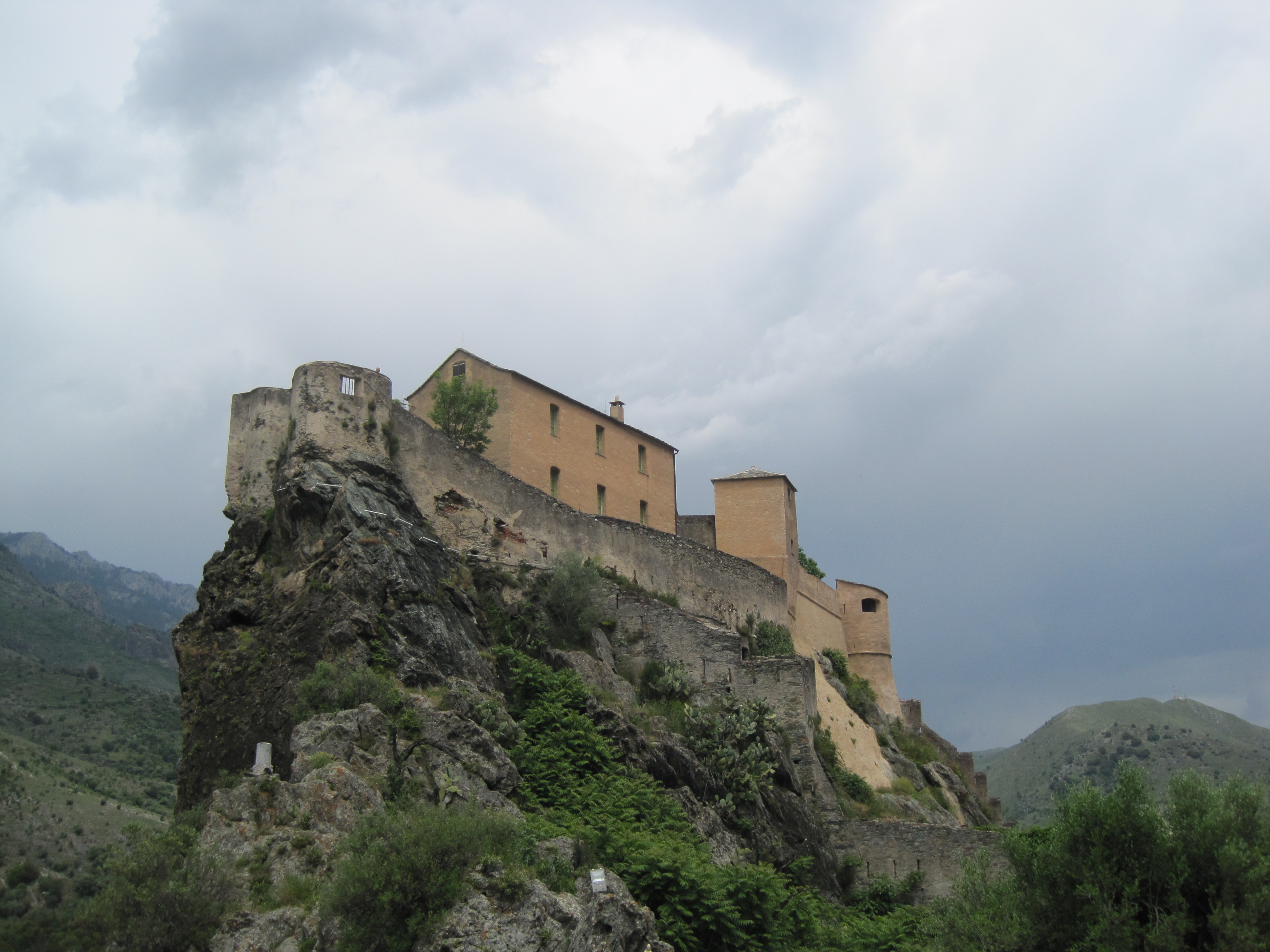
Corte’s citadel, photographed on 28 May 2010: historical context for the museum setting discussed here, not a university-campus view, a particular gallery or a current access guide. Photograph: Bj.schoenmakers, original and attribution, CC0 1.0. Original image unchanged.

A museum can unsettle the idea of a timeless mountain culture
At the Musée de la Corse in Corte's citadel, the Doazan gallery presents a particular ethnographic view of rural Corsica, based on work undertaken during the twentieth century. Its account of pastoral life emphasizes movement across territories and adaptation, not self-contained communities frozen outside history. The gallery also considers the collection and interpretation of cultural heritage. Source: Musée de la Corse, Doazan gallery.
Read that beside the university's research and teaching role. The museum preserves and interprets material evidence; the university trains students and generates new knowledge. Their presence in the same town offers opportunities for comparison, but it does not make the museum a university department or turn every ethnographic object into evidence about contemporary student life.
There is a third, distinct form of cultural access on campus. The university's Micro-Folie is described as a digital museum and immersive facility within the LISA laboratory's Edmond Simeoni building at Mariani. It brings digital material from partner collections into a local setting. Digital access to an artwork is not the same as custody of its original. Source: Università di Corsica, Micro-Folie.
Together, these places complicate a familiar contrast between an ancient rural island and a modern institution. Collection, translation, teaching, observation and digital interpretation are all ways in which knowledge is selected and circulated. The interesting question is how they work, not which one embodies a single authentic Corsica.
A reading guide for a university town
Use four questions to keep an exploration focused. This is an interpretive framework, not a timed walking itinerary or an offer of access to buildings.
| Setting | Look for | Ask | Avoid assuming | |---|---|---|---| | Campus information | Named buildings and their functions | Where does this particular activity happen? | Every service is in one complex | | Historical interpretation | Dates, sources and stated interruptions | Is this continuity, revival or commemoration? | The modern university operated continuously from 1765 | | Museum interpretation | Collection period and curator's viewpoint | Whose evidence and whose account am I seeing? | A collection represents all Corsicans at all times | | Research or cultural programme | The actual project, event and access conditions | How is knowledge shared beyond enrolled students? | Every facility is a public attraction |
For a cultural visit, consult the current programme rather than treating an old brochure or calendar link as a present schedule. For study or relocation, this article is not an assessment of admissions, accommodation availability, fees or accessibility: those require current information for the particular course and circumstances.
Corte's university character is best understood through these everyday distinctions. The town is neither simply a backdrop for the institution nor a museum of its founding. It is a place where historical memory, present services and the work of learning occupy different spaces—and keep producing new relationships.
Location and source-use note
Find Corte, Corsica on OpenStreetMap. This is a community search link, not an exact campus entrance, accessible itinerary or verified museum route.
Sources and institutional locations rechecked 29 October 2026. Confirm current programme and venue conditions before a visit.