Free · France
When rural doctors use a 'maison de santé pluriprofessionnelle'
A maison de santé pluriprofessionnelle, or MSP, is a way for different health professionals to organise coordinated care. It is not simply a new medical building, and its name does not guarantee an available appointment. In a rural area, understanding that distinction helps you ask the right questions before travelling.
This guide is for residents, newcomers and people helping a relative navigate local services. It explains organisation and access checks, not diagnosis, treatment or urgent-care triage. Sources were checked on 28 October 2026. No practice was contacted and no appointment availability was tested.
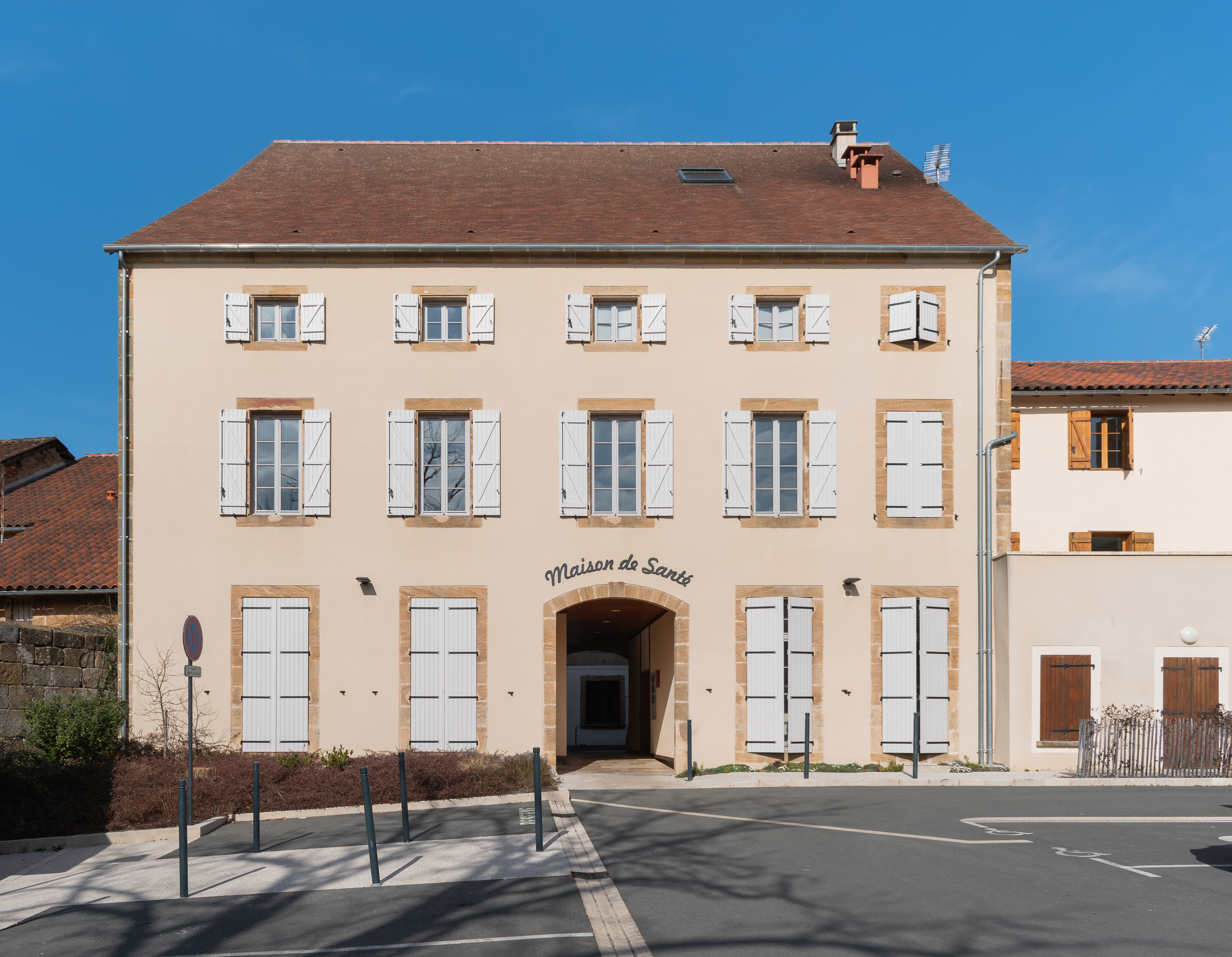
A sign identifies a place, not its whole care arrangement. The Maison de Santé in Lacapelle-Marival, Lot, photographed on 13 February 2022. The visible name is a useful starting point for an enquiry; this exterior does not establish current staffing, appointment availability, opening hours or how the team coordinates care. It is a separate location from the examples below. Krzysztof Golik, original photograph, CC BY-SA 4.0. Original unchanged, proportional full-frame display.

Why a rural doctor may join one
Assurance Maladie's guide for professionals describes coordinated patient care, easier exchanges between professions, organisational flexibility and shared running costs among the advantages of an MSP. For patients, it identifies proximity and continuity as intended benefits.
The important word is coordinated. A doctor may want to work alongside nurses or other professionals, organise follow-up more effectively and avoid running an isolated practice. That does not mean every discipline is present in every MSP, or that every professional works the same hours.
The Occitanie regional support page places these projects in the context of access to care and uneven medical provision, with particular attention to mountain constraints. It refers to a health project prepared by professionals. This explains why a local authority may support premises while the care organisation depends on the professional team. The page also announces changes to its support scheme from October 2026: it should not be used here as a current grant calculator.
A useful distinction follows: a building project, an operating care team and a bookable service are three different things. Evidence of the first does not establish the other two.
“Maison” does not always mean one address
The MSP Santé Trégunc team's own explanation says an MSP may operate on one site or across several. Trégunc describes itself as multi-site, allowing professionals to retain their own consulting premises while working within a shared project.
For a patient, this has an immediate practical consequence: do not travel to an address labelled “MSP” without checking the address of the professional or activity you booked. The coordinating organisation, a doctor's consulting room and a group session may not use the same entrance—or even the same building.
Write the site beside the appointment, not just the organisation's name. If you have two appointments, confirm both locations independently before assuming that walking from one room to another is all that is required.
A real rural example, read carefully
The public territorial body Hautes Terres d'Oc describes a rural, middle-mountain health initiative developed with elected representatives and professionals. Its account records MSP creation at Brassac in 2009, Lacaune in 2014, Labastide-Rouairoux in 2015 and Vabre in 2017, followed by the multi-site Sidobre structure, covering Roquecourbe and Lacrouzette, in 2019.
These are dated examples of how a network developed, not a verified October 2026 appointment directory. The same page contains information from different periods, including a local health contract signed in December 2024 and an older workforce figure. Do not turn that older figure into today's staffing count.
What the example demonstrates is the territorial scale of the question. A rural health service can involve several communes and sites rather than a single village facility. It does not demonstrate that every resident can immediately register with a doctor or obtain every service locally.
Five checks before relying on an MSP listing
Use the current practice or organisation contact details, cross-checked against an official local listing where possible. Ask about the service you actually need rather than requesting a general promise of “access to care.”
| Check | A precise question | What not to assume | |---|---|---| | Team | Which professional provides this service now? | Every profession listed historically is still present | | Appointment | What is the booking route and are new patients accepted for this request? | The MSP name guarantees a place | | Site | Which address, entrance and floor apply? | All team members occupy one building | | Practical access | What accessibility and transport arrangements can be confirmed? | A nearby map pin means an accessible journey | | Payment | What fees and payment arrangements apply to this appointment? | Shared premises mean identical charges or free care |
These are original preparation questions, not statements that a particular MSP offers the arrangements listed. If an answer is unavailable, keep it marked unconfirmed. Do not fill the gap using another town's practice policy.
For urgent needs, do not treat an ordinary MSP webpage or unanswered booking message as an emergency assessment. Use the appropriate urgent-care or emergency channel for your situation rather than waiting on a routine administrative enquiry.
A fictional newcomer avoids the wrong journey
Émilie is fictional. She has moved to a rural commune and finds a page naming an MSP that serves several places. She wants a routine appointment and initially assumes that the address at the bottom of the website is where all consultations take place.
Before travelling, she asks which professional handles her request and how appointments are arranged. The fictional receptionist confirms a different consulting site from the organisation's correspondence address. Émilie records that site and checks the journey separately.
She also asks whether the practice is accepting new patients for the relevant service. If the answer is no, she does not reinterpret the existence of an MSP as a guarantee that registration must be available. She asks what legitimate local route can help her find appropriate care, without claiming a referral or an appointment that has not been offered.
Finally, she asks about payment and any documents the practice requests. She sends personal health information only through the practice's established secure route when needed—not through a public comment under the municipal announcement.
The example is not an account of Trégunc, Brassac or any other real reception desk. It illustrates how to turn a general listing into a confirmed practical plan.
Ask how coordination works for you
A shared project is useful only if patients can understand the parts that affect them. During an appropriate routine contact, you can ask who coordinates a particular follow-up, how to contact the right professional and what happens when that person is absent. Do not assume that every team member has unrestricted access to all your information or that a website listing settles the arrangements for your case.
The Haute Autorité de Santé's guidance on user involvement describes ways patients and citizens can contribute to these structures, including work on local needs and service improvement. You can ask whether your local team has a patient-feedback or participation route. That is different from requesting an individual consultation or making a clinical complaint through a general workshop.
For a useful first visit, aim to confirm four things: the right professional, the right site, the actual booking arrangement and the practical conditions. An MSP can help professionals organise rural care, but a careful local check is what turns that organisational model into a service you can actually use.
Place searches for orientation
These links open locality searches, not verified boarding stops, entrances, appointment sites or routes. Confirm the exact location and current arrangements separately; a search result does not verify access or availability.