Free · France
Reading French Signs Without Knowing Every Word
You can understand a notice's practical message before you can translate every word. But the words you skip must not be the ones that change the message. Recognising ouvert—open—is useful. Missing sauf, a date or an appointment condition may lead you to the wrong conclusion.
Start with four questions: what does this notice concern, what action or status does it describe, what limits that statement, and does it apply here and now? This is a reading method for everyday entrances, counters and public-facing notices, not a substitute for traffic rules, emergency instructions or professional interpretation of a binding document.
First identify what the notice is doing
A sign may name a place, direct a movement, describe availability or restrict an activity. You do not need to translate each kind in the same way.
| Illustrative wording | Its practical function | The detail to find next | |---|---|---| | Accueil | Labels a reception or information point. | Which service is handled there? | | Poussez / Tirez | Tells you to push / pull. | Which door or handle does it concern? | | Fermeture exceptionnelle | Announces an exceptional closure. | What place, date or period is affected? | | Accès réservé au personnel | Limits access to staff. | Where does that restricted area begin? | | Merci de refermer la porte | Asks you to close the door again. | Which door is meant? |
These are language examples, not notices at a location you are being directed to visit. The courteous merci in the final example does not remove the request to close the door.
Watch for familiar-looking words with an unfamiliar function. In a notice, défense de can introduce a prohibition: it is not necessarily about defending something. The Académie lists this prohibitive sense of défense. Likewise, réservé can mean allocated to particular people or uses, not merely booked by a customer. Académie française: défense, sense 5; réservé, sense 1.
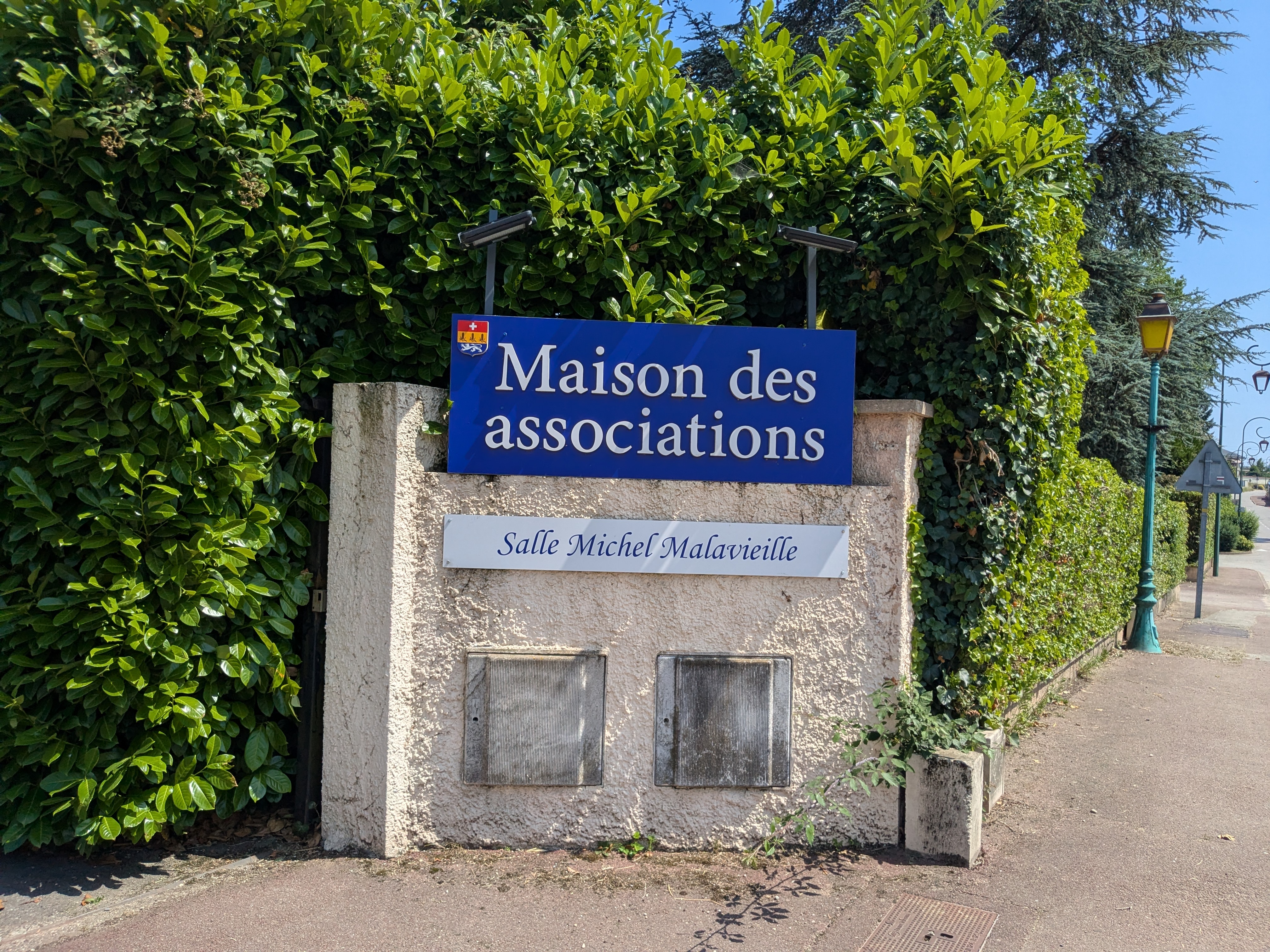
Jons, 22 June 2025. “Maison des associations” identifies the community-associations building; “Salle Michel Malavieille” names a room. These labels identify a place, not its opening hours or a booking entitlement. Photograph: Sebleouf, Commons original, CC BY-SA 4.0, unchanged.

Give the small words a second look
After the headline, look for the word that narrows it.
Sauf means “except” in the relevant everyday construction. In the invented example Ouvert tous les jours sauf le mercredi, Wednesday is excluded from the stated opening pattern. Recognising tous les jours but stopping before sauf reverses the useful message. This is one meaning of sauf, not a translation for every expression containing it. Académie française: sauf, sense 3.
Uniquement means “only.” In Retrait des commandes uniquement, the named service is order collection only. The notice does not promise that you can place a new order there. Follow the limiting word back to the service, person or time it modifies. Académie française: uniquement.
Sur rendez-vous means “by appointment.” An appointment involves an arrangement for a particular meeting, not merely turning up while a building is open. Look for how to arrange it and which service needs it. An appointment notice does not itself confirm that a place is available for you. Académie française: rendez-vous, sense 1.
Other useful things to locate include sans—without—à partir de—from or starting at—and the category after réservé à. You do not need a long vocabulary list if you can identify the part of the sentence that changes your intended action.
Free does not mean without conditions
In an admission context, gratuit concerns the absence of a charge. It does not, by itself, tell you whether booking, eligibility or a time slot is required. Académie française: gratuit, sense 1.
Real institutional wording shows why the rest of the sentence matters. The Lyon municipal library's Lacassagne page labels FabLab access accès libre, while attaching a condition: users must first have completed training, for which a reservation is required. Stopping at accès libre misses that condition. This is a reading example from the page checked on 28 October 2026, not confirmation of a currently available session. Bibliothèque municipale de Lyon: Lacassagne, FabLab section.
The noun matters too. BnF's research-library information mentions documents en libre accès while separately requiring a seat reservation at François-Mitterrand. Open-shelf documents and entry arrangements are different things. BnF: research library, François-Mitterrand section.
The practical question is therefore not just “Does it say free?” but “What exactly is free or freely accessible, and what else does this service require?”
Read the time attached to the action
Numbers are easier to recognise than unfamiliar words, but a time is useful only when you know what it governs. Ouverture concerns opening; fermeture concerns closing; dernière entrée concerns the last admission. Do not replace one with another.
Consider this invented notice:
Du mardi au samedi : 10 h–12 h et 14 h–18 h. Dernière entrée à 17 h 30.
It describes two opening periods, with a gap between noon and two, and a last-admission time before closing. On its own, it says nothing about a holiday exception, a temporary closure or a different service within the building. Those details need their own evidence.
Keep dates attached to their notices. A sheet announcing a closure on one specified day does not establish a permanent weekly closure. Equally, a regular timetable does not prove that no dated exception applies. Look at adjacent notices and the operator's current information rather than relying on an old photograph or a search-result extract.
A photograph can teach language without proving today's access
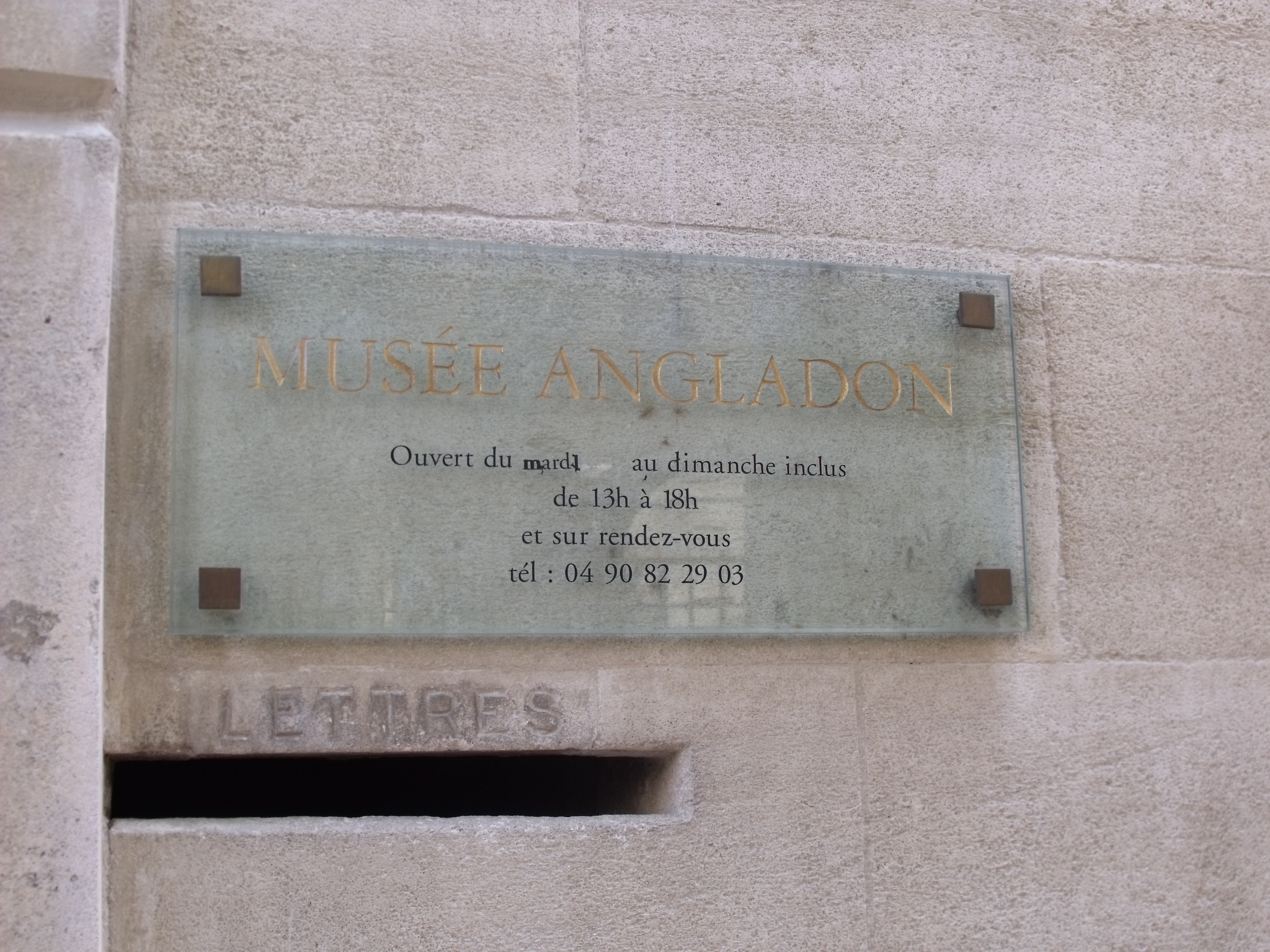
Musée Angladon, Avignon, 25 May 2011—not current opening or contact information. “Avignon - Square Pierre de Deimier - Musee Angladon - sign - opening hours,” Elliott Brown. Photograph source · CC BY 2.0. Unchanged.
The plaque adds et sur rendez-vous—“and by appointment”—to opening information; it does not say uniquement. Do not turn that addition into an appointment-only rule. The weekday lettering on the plaque appears altered; its original reading was not determined from the photograph. The photograph is evidence of text, not today's access.
When the missing word matters, ask about the decision
You do not have to request a translation of the entire notice. Ask about the point that affects you:
- Faut-il prendre rendez-vous pour ce service ? — “Do I need an appointment for this service?”
- Cette fermeture concerne aussi la bibliothèque ? — “Does this closure also affect the library?”
- Où est l'entrée pour le public ? — “Where is the public entrance?”
These are original illustrative questions, not quoted from a real notice or conversation. Pointing to the relevant line, using a written question or asking for a slower explanation can help. There is no need to pretend you have understood.
A translation or text-recognition tool can assist, but keep the whole relevant notice in view. A cropped image may omit an exception; damaged lettering may be misread. If the uncertainty concerns a prohibition, a restricted entrance or safety, do not experiment by entering or operating something. Seek clarification from the responsible staff or authority, and follow current on-site safety instructions.
Try the method on three short examples
The following notices are invented for practice, not operating information.
1. Entrée gratuite sur réservation. What are the two separate messages? Admission is without a charge, but a reservation is required. The phrase alone does not show whether a reservation remains available.
2. Service ouvert uniquement le matin. Which word limits the statement? Uniquement restricts the stated opening to the morning. You still need the actual hours and relevant days; it does not supply them.
3. Fermé le 12 novembre. Can you conclude that the place is always closed on that weekday? No. The wording names a date, not a weekly pattern. Without a year or surrounding context, even the intended occurrence may need clarification.
The aim is not a perfect sentence-by-sentence translation. It is a justified next step: you understand the action and its conditions, or you know exactly what still needs asking. A familiar word gives you a starting point. The complete relevant message determines what it means here.