Free · France
The Logic of the Neighborhood Boulangerie
A bakery purchase can be very small: one loaf, a few words, a payment. Yet a shop that someone returns to can become more than an interchangeable place to buy food. A returning customer learns its products and arrangements; the encounter may become familiar without becoming intimate.
That is the useful logic of the neighbourhood boulangerie: production, buying and repeated encounters meet in one place. It is not a promise that every shop is independent, every customer visits daily, or every person behind the counter knows the neighbourhood's secrets.
Understanding those three layers helps you see more than an attractive window—and ask better questions when the window cannot tell you enough.
The word describes more than a shopfront
Official guidance ties the use of boulanger and boulangerie to making bread from selected raw materials: kneading, fermentation, shaping and baking, ordinarily at the place of sale, without freezing the dough or bread. It also recognises provision for itinerant sales. These are conditions on the designation, not a quality score awarded by looking at a shop. Service Public Entreprendre, Boulanger-pâtissier, definition.
The important distinction is between making bread and merely displaying finished products. The sign is not, by itself, evidence about every cake or pastry on sale, a particular ingredient's origin, or the ownership of the business. Nor can a customer photograph establish that a business complies with all applicable rules.
This production layer also changes the questions worth asking. If the loaf you want is absent, “Will there be another batch today?” is more useful than assuming the display will be identical whenever you return. The answer belongs to that shop on that day; no national baking schedule follows from the word boulangerie.
The counter is a decision point
At the counter, several decisions can be compressed into a short exchange: which item, what quantity, which version, and what total price. You do not need to know the whole range before entering. You do need to identify the product you are choosing.
DGCCRF guidance says price information must be visible and understandable, expressed in euros with taxes included. It explains that a product's price can be marked on it or on a nearby notice that clearly identifies what the price refers to. DGCCRF, L'information sur les prix, 21 May 2026.
For the customer, this means that reading the display is part of the purchase, not an embarrassing interruption of it. If two loaves look similar, use the label or ask which one is being indicated. If you need a particular quantity, say it rather than relying on a familiar-looking shape. If an ingredient matters to you, appearance is not a recipe: ask about the actual product before choosing.
An original illustrative exchange—not a transcript—might be:
Customer: C'est lequel, le pain aux graines ? — “Which one is the seeded bread?”
Assistant: Celui-ci, à gauche. — “This one, on the left.”
Customer: D'accord. J'en voudrais un, s'il vous plaît. — “Right. I'd like one, please.”
The point of the exchange is simple: both people now mean the same item. Fluency is less important than removing the ambiguity.
Look at the display, not through it
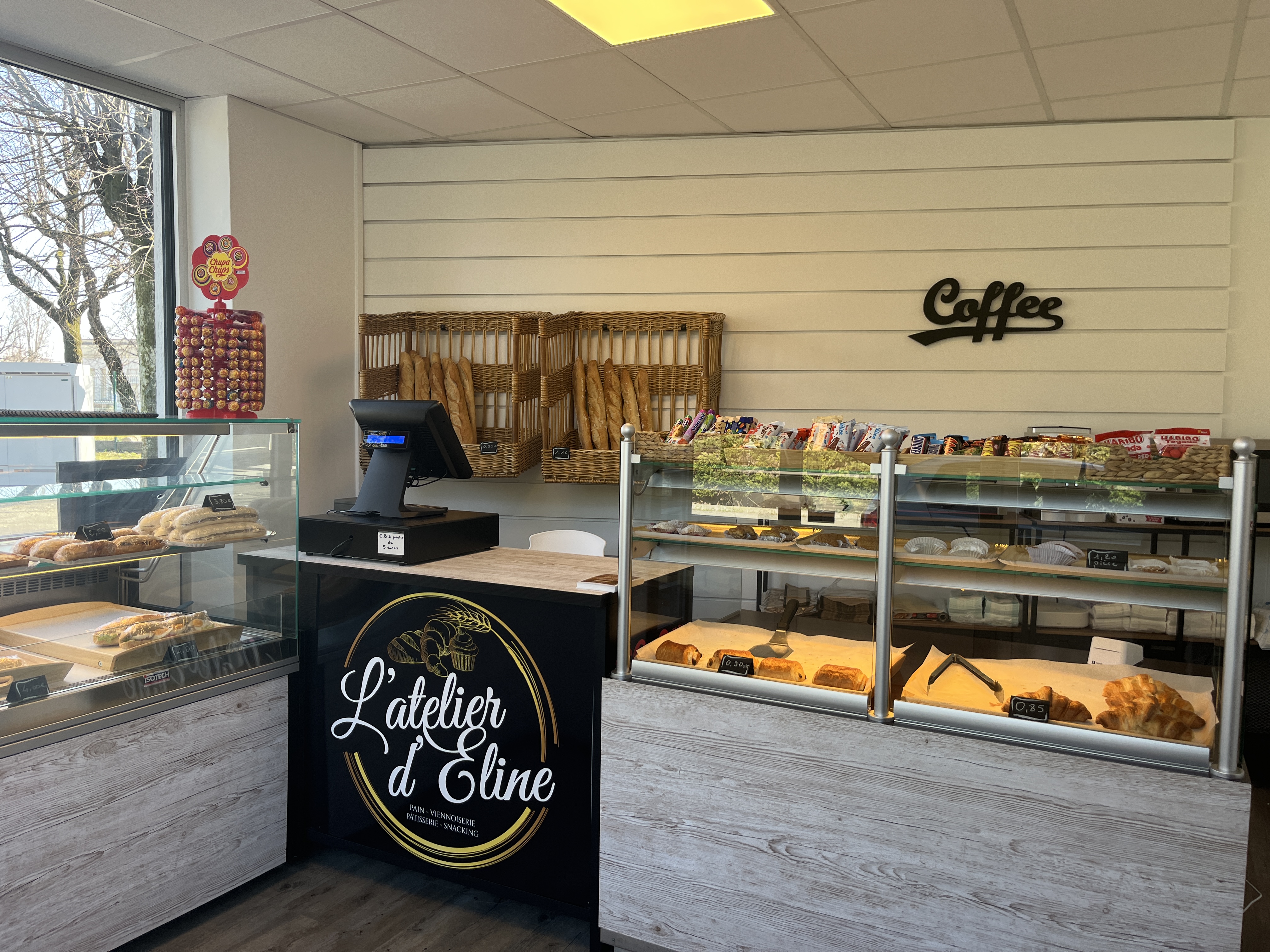
L'Atelier d'Éline, Saint-Maurice-de-Beynost, photographed on 5 March 2022. This historical retail scene is not today's stock or price list, a shop recommendation, or the setting of the invented exchange above.
Photo: Benoît Prieur, original file and attribution, CC0 1.0. Supplied original unchanged.

Find the upright bread racks, the glass cases and the positions of the small labels. You do not need to decipher the old amounts at page-preview size. These features help explain how a customer locates and identifies products. They do not show the dough-making process, confirm ingredients or establish relationships between staff and customers. The photograph illustrates a retail arrangement, not evidence of unseen production or compliance.
Repetition can create familiarity without creating an obligation
In the Culture Ministry’s 30 November 2022 press release announcing the UNESCO inscription of baguette-making know-how and culture, Culture Minister Rima Abdul Malak describes collecting bread as a cultural act with a social dimension. That is the institution's heritage framing, not a survey proving that every bakery visit creates a relationship. Culture Ministry, announcement of 30 November 2022.
To understand how familiarity might develop, imagine returning to the same counter over several weeks. You no longer need to ask which loaf is which. If the same employee serves you, they may recognise your usual choice. A brief exchange can acquire continuity because it has a previous encounter behind it.
But recognition is not the same as friendship, and friendliness does not guarantee recognition next time. Different staff, a busy shop or a changed order can make an apparently familiar situation new again. State what you want today rather than expecting someone to remember it.
There is no loyalty test to pass. You can buy elsewhere, change your order, keep a conversation short, or decline a personal question. Equally, a worker's attention is not an unlimited resource. The comfortable middle ground is a clear transaction with whatever additional conversation both people have room for.
A local shop is part of a route, not just a point on a map
INSEE's 2020 study of retail access, using 2017 spatial evidence for metropolitan France, explains that distance is only one part of shop choice. Product range, prices and the ability to travel also matter. A nearby point of sale does not capture all differences in access. INSEE, Des commerces moins accessibles dans les espaces périurbains, opening discussion and methods.
This is a reason to be cautious with the picturesque idea of everyone walking to “their” bakery. A shop may be convenient because it lies on a person's existing route, not because it is closest to home. For someone else, the journey, opening times, entrance or cost may make that same shop impractical.
You can therefore read “neighbourhood” as a relationship between a place and everyday movements, rather than as a guarantee of easy access. Before making a bakery part of your own routine, establish what the journey and purchase actually involve. A map symbol cannot answer whether a particular arrangement works for you.
What to notice—and what not to conclude
These are observation prompts, not a checklist for judging a business or its customers.
| What you can investigate | A useful question | An assumption to leave open | |---|---|---| | The range displayed | Which name belongs to the item I want? | Similar-looking products have the same ingredients or price | | Availability | Is this available now, or would I need to return or order? | An empty space proves neglect—or proves exceptional popularity | | An ordering arrangement | Is a particular collection time agreed? | Mentioning tomorrow automatically reserves something | | A familiar exchange | Does the other person have time to continue? | Recognition means friendship or permission to ask private questions | | The journey | Can I reach and use this shop in the way I need? | A nearby address means an easy walk or an accessible entrance |
The distinction between observation and inference is especially useful in a place that already carries strong cultural images. A queue cannot tell you whether the people are neighbours, visitors or regular customers. A quick exchange cannot tell you whether two people are unfriendly or simply understand each other efficiently.
Joining the routine without performing a stereotype
Consider a final fictional situation. You have bought the same bread twice and now want something different for a shared meal. The simplest approach is not to perform being a regular. Name what you need, ask about the available choices, and confirm the quantity and cost before deciding.
If you arrange collection for another day, make that agreement explicit. If nothing suitable is available, you can leave without buying. Neither outcome makes you less capable of participating in local life.
The neighbourhood boulangerie becomes intelligible when you hold its layers together: a place where work produces something, where money buys a particular product, and where repeated visits may build recognition. The cultural interest lies in that ordinary connection—not in requiring every bakery, customer or neighbourhood to tell the same story.