Free · France
Why Food Seasons Still Matter at French Markets
A market can offer a wide range of produce without everything on its stalls having been harvested nearby that week. The place of sale, the growing season and the journey to the stall are different parts of the story.
Seasons still matter because they give that story a timescale. They help explain why a variety is arriving, why another is disappearing, and why a familiar fruit might remain available after its harvest has finished. At a market, these can become questions you ask a seller—not just coloured squares on a calendar.
This article concentrates on fruit and vegetables. It is not a complete calendar for every French region or overseas territory, nor a claim that all French shoppers follow the same habits.
A calendar is an orientation tool
ADEME's September 2022 calendar lists, for example, squash, quince and pears in October. Those entries are useful starting points for recognising an autumn selection. They are not a live stock report or a promise about a particular farm. ADEME, À chaque mois ses fruits et légumes, October panel on PDF page 2.
Use a calendar to form a question: “What is happening with this crop here?” Do not turn it into a verdict: “This item appears in the October column, so anything sold under that name must have been picked locally today.”
There are several missing steps between those statements. You still need to identify the product's origin, the variety where relevant, and the actual supply. A calendar compiled for a broad area cannot settle the situation of every growing location within it.
Nor does crossing from one month to the next make a crop change overnight. The printed boundary helps organise information; it is not an appointment that every plant keeps.
Harvest time and selling time are different
Apples make this distinction particularly clear. CTIFL's technical information describes French harvest timing as varying with the variety and growing zone. It also explains that cold storage allows sales to extend across several months. Finding apples on a stall therefore does not establish that they have just been picked. CTIFL, Pomme, public “Pour en savoir plus” section, verified 13 February 2023.
That is not an accusation of poor quality. It is a distinction between stages: growing, harvesting, keeping and selling. If you want to understand a particular batch, ask about that batch rather than reading a harvest date into its appearance.
This also changes how to interpret absence. A missing item is not, on its own, proof that the regional season has ended. You have observed one seller's offering on one occasion. Whether the explanation is the crop, the supply or something else remains a question.
Read origin before imagining proximity
For loose fruit and vegetables, DGCCRF's current labelling guidance says the nearby sign should identify the country of origin, corresponding to the place of harvest; a more specific production area may accompany it. Country information and a seller's business address answer different questions. DGCCRF, non-prepacked food labelling, 23 July 2026.
An origine France label tells you the claimed country, not how close the field or orchard is to the market. Likewise, the name of the town where you are shopping is not a label for every product sold there.
Read the sign for the item you are considering. Do not transfer an origin displayed beside one crate to the neighbouring crate simply because they share a stall. If you cannot tell which sign belongs to which produce, that is a useful point to clarify.
The purpose is not to interrogate sellers or assume dishonesty. It is to replace a picturesque impression with a specific piece of information.
Read one sign, not the whole stall
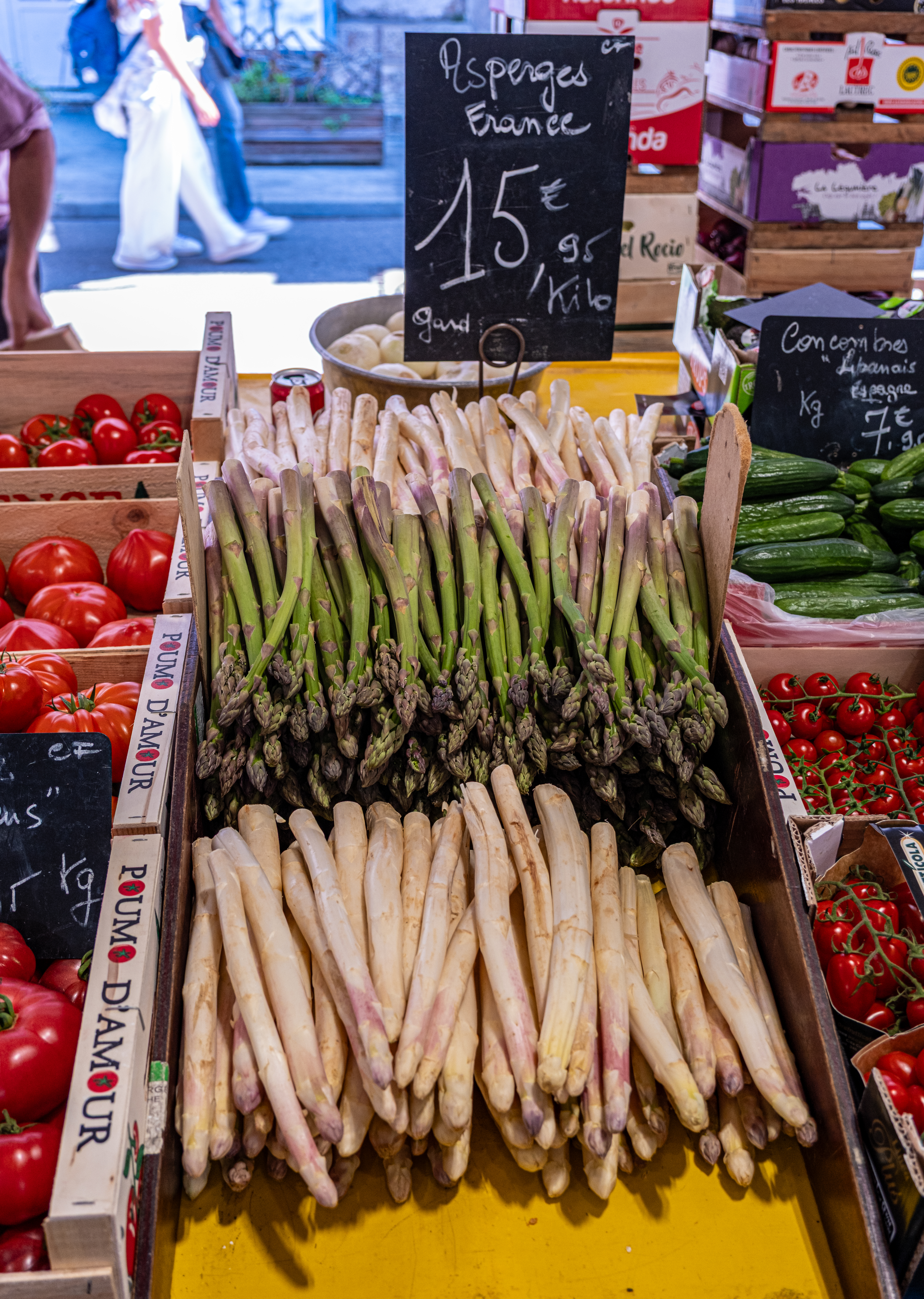
“Green and white asparagus on a market stall in France” — Winniepix, 26 April 2025 (photographer's recorded date). Photograph source · CC BY 2.0. Supplied original unchanged; precise town not established.
The asparagus sign says France; the neighbouring cucumber sign says Espagne. The frame makes the reading task concrete: connect each sign to the produce it describes rather than treating a market's location as every item's origin. These are displayed claims in a historical photograph, not independently audited supply records.
Neither sign gives you a harvest date, storage history or distance travelled. The photograph's recorded date is not a harvest date either. Prices visible here belong to this past scene, not a current shopping budget.
Local and direct are not synonyms
DGCCRF defines a circuit court by the number of intermediaries: direct sale or no more than one intermediary. The definition does not set a geographical distance. It distinguishes this from vente directe, where the product passes from producer to consumer without an intermediary. DGCCRF, products sold through short supply chains, 16 June 2025.
These distinctions let you ask more useful questions:
| What you want to understand | A question that addresses it | |---|---| | Where this produce was grown | Which growing area does this batch come from? | | Its timing | When was this batch harvested? | | The seller's role | Do you grow this produce yourself? | | How it reached the stall | Does it come straight from that grower or through another supplier? |
A helpful answer to one question does not automatically answer the other three. Knowing the grower's name does not supply the harvest date. Knowing the date does not establish the distance travelled.
Nor should the person behind a market table automatically be cast as the farmer who grew every item on it. Ask about the particular produce without treating one type of seller as a guarantee of every other quality you value.
The environmental question needs more than a postcode
ADEME identifies heated growing and long-distance supply as reasons to pay attention to seasonality. That gives a reason to ask about production, rather than assuming that a nearby origin alone settles environmental impact. ADEME, seasonal fruit and vegetables, 11 November 2025.
Transport organisation matters too. Cerema notes that numerous deliveries in small, poorly filled vehicles can, in some cases, compare unfavourably with consolidated transport. A shorter supply chain is therefore not an automatic environmental score. Cerema, organising sustainable short-chain logistics.
You do not need to calculate a complete footprint while buying vegetables. But avoid substituting a single attractive word—local, seasonal or direct—for information you do not have. None of those words alone promises a particular nutritional benefit, flavour, price or suitability for your needs.
Try reading a market note
Invented example—not a real stall, inspection or seller quotation.
Your note says: “Late October. Pears. Sign: origin France. Seller says they come from an orchard that supplies several stalls.”
What can you reasonably record?
- The displayed country claim is France.
- The seller has described a supply arrangement, not said that they personally grow the pears.
- You have not established the orchard's location, harvest date, growing method or storage history.
The calendar may have helped you notice pears, but it cannot fill in those blanks. “Autumn, French market, therefore picked nearby this morning” adds details that the note does not support.
A short follow-up might be enough. These are original practical phrases, not transcripts:
- « Elles viennent de quelle région ? » — “Which region do they come from?”
- « C'est quelle variété ? » — “What variety is it?”
- « Elles ont été récoltées quand ? » — “When were they harvested?”
Here elles refers to the pears. Ask whichever question matters to you; there is no requirement to conduct a full interview or buy something afterward. An answer you receive is still the seller's account, not an independent audit.
Notice change rather than demanding a fixed list
On a later visit, compare one thing: perhaps the varieties of the same fruit, or what the seller says is beginning or finishing. Record the date and the actual answer if you want to remember it. A repeated observation is more informative than assuming every stall represents the same local harvest.
This is where seasonality becomes culturally useful. It gives conversation a concrete subject and makes the market more than a backdrop to a shopping list. You can ask what has changed, discover a variety you did not know, or adapt an idea for a meal to what you learn.
You can also leave without adapting anything. Budget, access, time and personal requirements still matter. Understanding the seasons is not a test of whether you shop “properly” in France; it is a way to see the relationship between the food, its place of production and the moment you encounter it more clearly.