Free · France
Why French Opening Hours Can Surprise Visitors
You arrive at an office at 13:15, between two errands. Its door says 9h30–12h30 / 14h–17h30. The office has not closed early: you have arrived between its two opening periods. Later, another place stays open through lunch—but stops accepting visitors before the closing time you noted.
The useful question is not “What time does France close?” It is “Which timetable applies to this place, on this date, for what I want to do?” A shop's week, a restaurant's food service and a museum's entry deadline answer different questions. Geography and season matter, too, without making every business in a region identical.
This guide uses a few dated examples from metropolitan France to show how to read those differences. They are examples of timetables, not recommendations or promises of availability when you travel.
A break in the day is not a national rule
Read every time range, not just the first opening and final closing times. On the invented notice above, 12h30 to 14h is a closure, not a quieter period within continuous opening. In English clock notation, the afternoon session runs from 2:00 to 5:30 p.m.
There is a real contrast between two tourist-information services. The Île d'Yeu office's published 2026–2027 timetable lists October-to-March Tuesday hours as 9h30–12h30 and 14h–17h30. Its Monday afternoon is closed in that season. Bordeaux's tourism office contact page, by contrast, lists Monday-to-Saturday opening from 9h to 18h, without a midday break, and a separate Sunday/public-holiday schedule. Île d'Yeu tourism office; Bordeaux tourism office.
Neither example establishes how all island offices or all city businesses operate. It demonstrates why a timetable learned in one place is not a substitute for checking the next. A closure also does not tell you what the staff are doing behind the scenes; avoid turning an opening-hours notice into a story about national work habits.
Read a real notice in layers
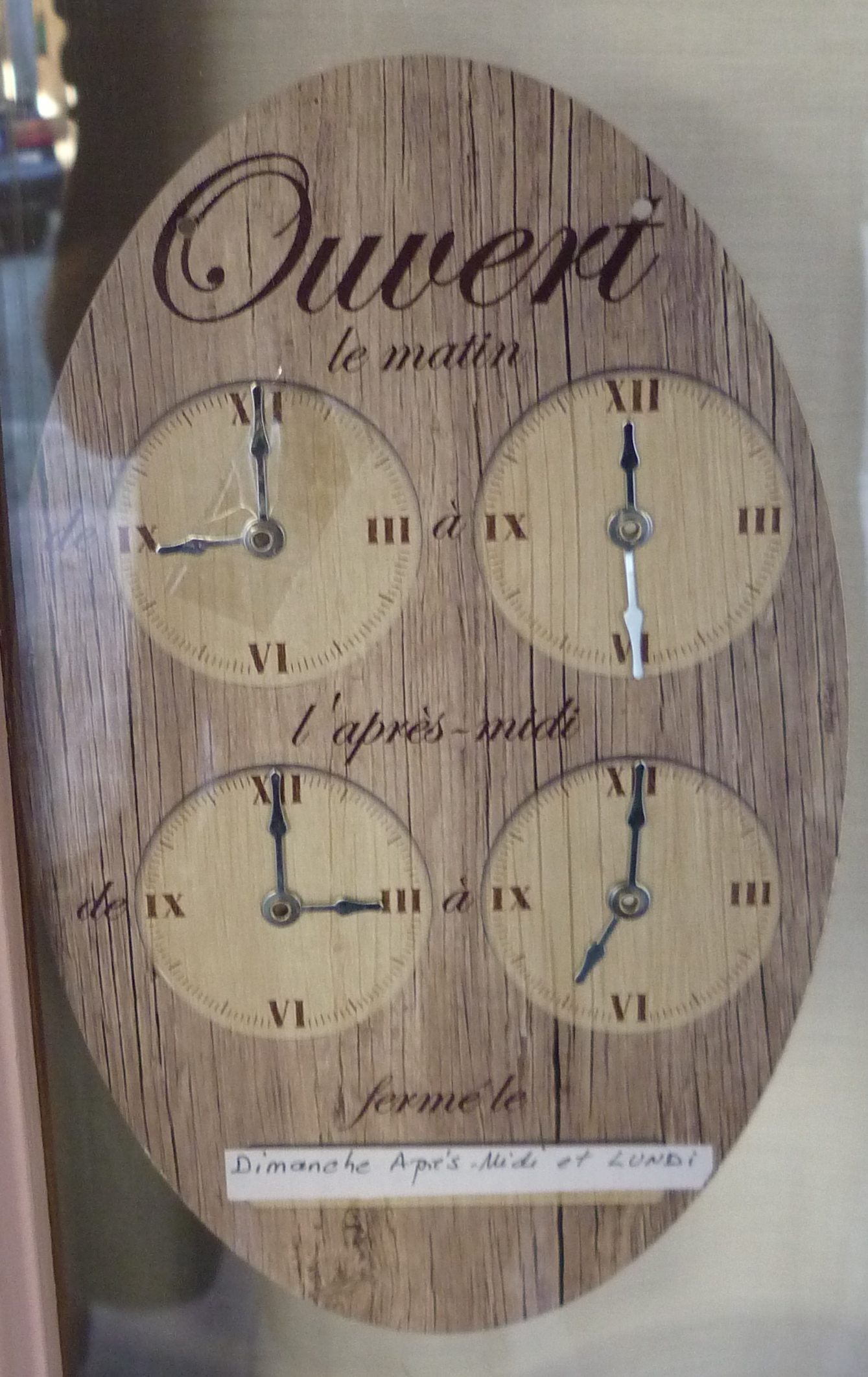
Photographed on 9 May 2011 and identified by the photographer as southwest France; the specific shop and town are not established here. Morning and afternoon clock pairs sit above a separate weekly-closure note. These historical hours are not current visitor guidance. Photo: Alistair Paterson (Alpat), “12.30 to 3.00 Lunch time closed South West France,” CC BY-SA 2.0. Unmodified photograph; display size only changed.
Start with the sessions, then look for the weekly exception. A notice may give morning and afternoon hours while a separate line removes a whole day—or just one afternoon—from that pattern. Do not stop reading as soon as you find a time that suits you.
The week changes with the activity
Sunday is not uniformly closed, and Monday is not uniformly open. Service Public explains that Sunday retail opening depends on factors including the activity, staffing arrangements and location. It also treats Bas-Rhin, Haut-Rhin and Moselle separately because their rules differ. Permission to open is not an obligation to open, nor proof that a particular shop will be staffed when you arrive. This is visitor orientation, not advice on an employer's legal obligations. Service Public, Sunday opening.
Even the label “museum” does not identify a single closing day. The Louvre's visitor page lists Tuesday as its weekly closure. Paris Musées describes Monday closure for the City of Paris museum network, while directing readers to the individual sites for certain exceptions and specific schedules. These are different institutions, not contradictory instructions for one museum. Louvre, visitor information; Paris Musées, opening days.
For an errand that matters, write down the establishment's actual name and address. “The post office,” “a bakery” or “the museum” is not enough to distinguish branches, outlets or institutions with different hours.
Open premises and available service are different things
A closing time is not always the last moment to begin your task. Three distinctions are worth checking:
- Museum entry versus museum closure. The Louvre says its last admission is one hour before closing and that clearing the rooms starts 30 minutes before closing. Arriving shortly before the headline closing time is therefore not a plan for a full visit. Check entry availability as well as the clock. Louvre, entry and closing times.
- A postal counter versus that day's dispatch. La Poste tells Colissimo senders to check the heure limite de dépôt if they want the parcel to leave that day. That dispatch cutoff is a separate piece of information to find, not something to infer from an open counter. Check the particular point and the relevant service conditions. La Poste, parcel deposit guidance.
- A restaurant's advertised service versus an assumed lunch window. Look for service continu if you need food between conventional meal periods, and confirm what is available. At the 28 October 2026 check, Chartier's official site advertised continuous service but also stated that its Gare de l'Est branch would open from 18h to midnight on 2 November 2026. A broad opening statement and a narrower exception can appear on the same page. Bouillon Chartier, official opening information.
That last example shows why the banner at the top of a page may matter more for your date than the familiar weekly schedule below. It does not guarantee a table or imply that other restaurants use the same hours.
The season belongs in the same sentence as the hours
A timetable headed juillet et août applies to July and August, not to an October visit. Basse saison means low season, but the months defining it come from that establishment's notice—not from a universal French calendar.
At the Île d'Yeu office, the published July-and-August table includes Sunday morning opening, whereas the October-to-March table lists Sunday as closed. The page also names specific holiday closures. A summer screenshot is therefore a poor basis for an autumn errand. Reopen the current official page and read the date range and exceptions. Île d'Yeu, seasonal timetable.
A seasonal heading can change the closing time
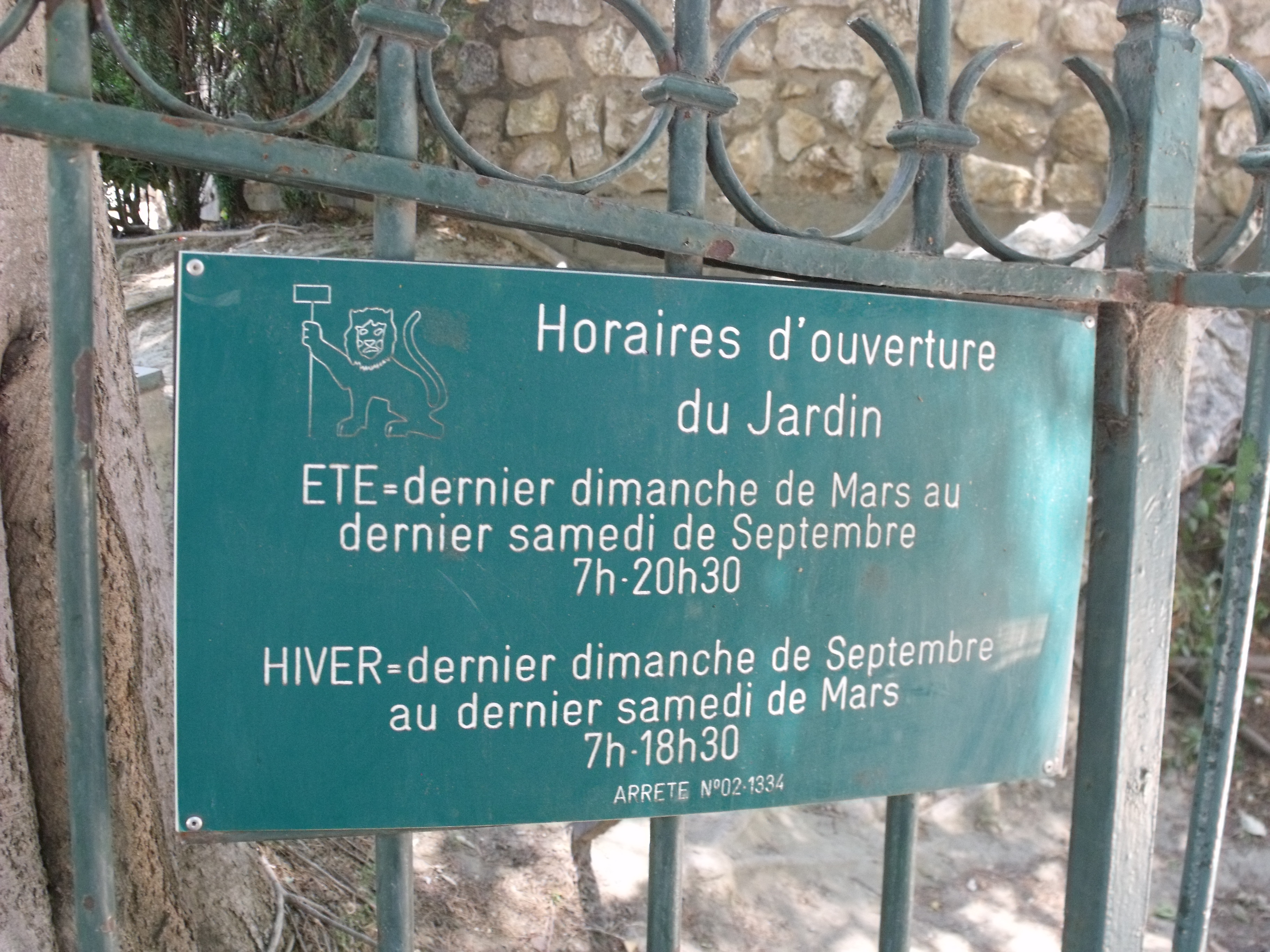
Jardin d'Été, Arles, photographed on 24 May 2011. This historical sign separates summer and winter schedules. It is a reading example, not today's garden timetable. Photo: Elliott Brown, “Jardin d'Ete, Arles - opening hours sign,” CC BY 2.0. Unmodified photograph; display size only changed.
Notice that the sign defines its seasons using particular Sundays and Saturdays, rather than simply giving whole months. The small date wording is part of the instruction. For a present-day visit, verify a current schedule instead of calculating your arrival from this old photograph.
Ask about the task and the date
These original phrases make the question more precise:
| What you need to establish | A question you can use | |---|---| | A midday interruption | « Vous fermez entre midi et deux ? » — Do you close between noon and two? | | The next session | « À quelle heure rouvrez-vous cet après-midi ? » — What time do you reopen this afternoon? | | A particular Sunday | « Vous êtes ouverts ce dimanche ? » — Are you open this Sunday? | | Food service now | « Est-ce qu'on peut encore déjeuner ? » — Can we still have lunch? | | A postal cutoff | « Quelle est l'heure limite de dépôt pour un départ aujourd'hui ? » — What is the cutoff for dropping off a parcel for dispatch today? |
The first question does not assert that noon-to-two is the actual break; it asks. Listen for a different time. If you mean another date, name it rather than saying “today” or “Sunday.” For a trip you cannot easily repeat, confirm directly when the official page is unclear or conflicts with a recent notice.
Practise with one fictional afternoon
Imagine that you need to collect a form, send a parcel and visit a small exhibition. The following times are invented, not real destination advice:
- The office lists 9h–12h / 14h–17h. At 13h, plan for its 14h reopening, not immediate access.
- The postal point closes at 18h but gives 16h as the relevant dispatch cutoff. If same-day departure matters, organize that errand around 16h, allowing time to be served and checking the sending conditions.
- The exhibition closes at 18h but stops admitting visitors at 17h15. An arrival at 17h30 is too late for entry, even though the building has not yet closed.
The improvement is not simply “start earlier.” It is to identify the limiting time for each task, then put the errands in an order that respects it. Check travel time between them; a timetable does not move you across town.
Before leaving, make a four-part note: exact place; date; opening session; task-specific cutoff or exception. That small habit is more useful than memorizing a supposed French closing hour—and leaves you better prepared when the next town, season or service works differently.
Official sources and image provenance checked on 28 October 2026. Recheck current hours and exceptional closures before travel. Historical photos are not live business listings or endorsements.