Free · France
Honfleur: Maritime museums and sailors' social history
For Pentecost 2025, Honfleur's festival programme announced an unusual museum exhibit: the restored banner of the Société des Marins de Honfleur et de Berville-sur-Mer. Its scheduled presentation on quai Saint-Étienne would place an association's emblem inside the town's maritime displays. A banner cannot explain how a vessel was rigged. It can raise another question: how did people connected with the sea recognise one another, commemorate losses and keep a collective identity alive? Honfleur, Fête des Marins programme 2025, PDF page 4.
That question gives a precise route through Honfleur's maritime museums. Rather than survey their attractions, this account follows the banner's relationship to museum care, public ceremony and the preservation of a named fishing boat. The thread is social belonging: who assembled the collections, whose memories they carry, and who undertakes the work of keeping them available. Ships remain central, but their people need not disappear behind them.
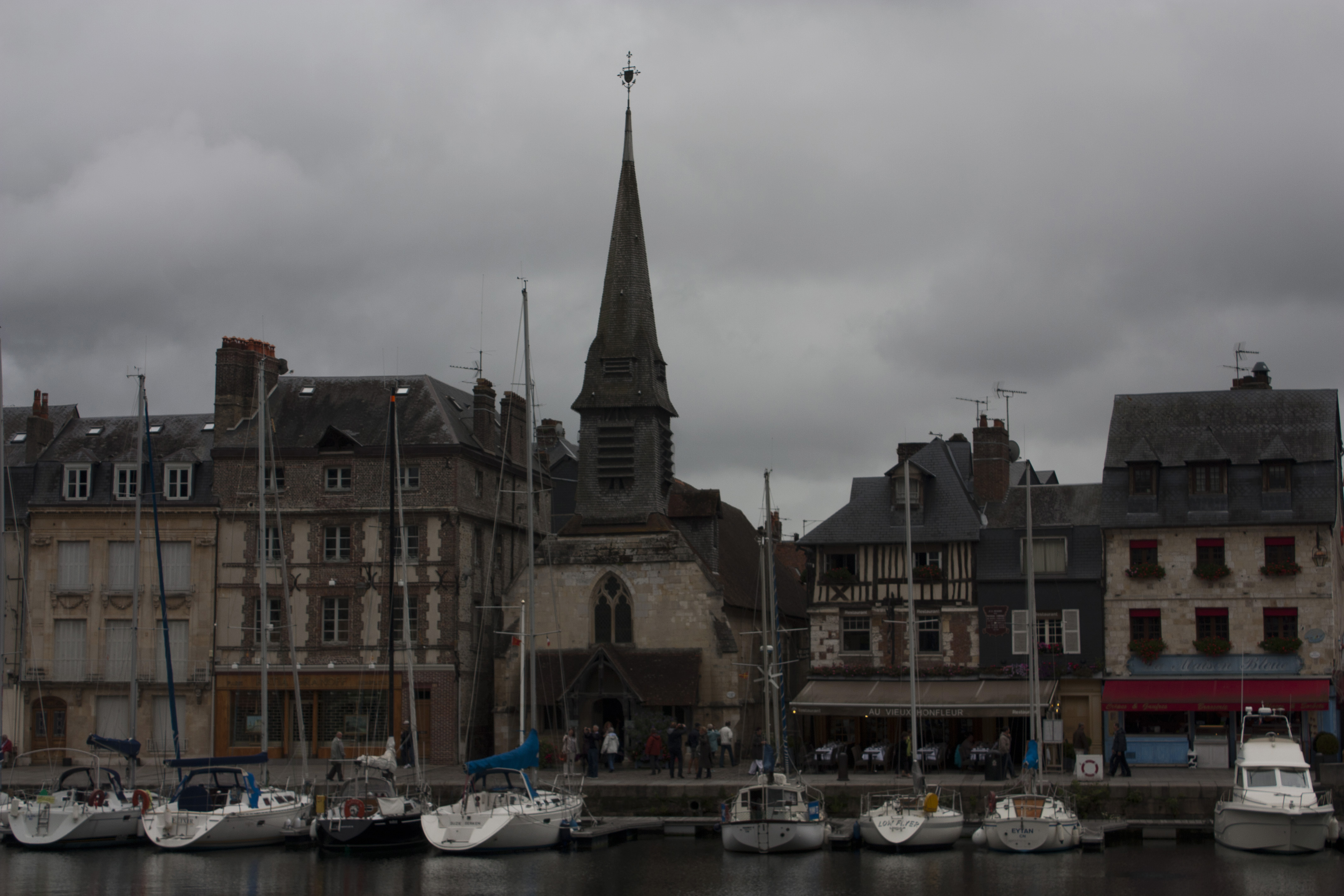
Saint-Étienne, housing the Musée de la Marine, photographed across the basin in September 2012. This locates the institutional setting; it does not show the society banner or verify its later display. Photo: Daniel VILLAFRUELA, Wikimedia Commons; CC BY-SA 3.0. Unmodified by publisher.

Collecting a community was itself a social project
The Musée de la Marine's presentation through the Réseau des musées de Normandie traces its historical and maritime collections to an exhibition organised by the Société du Vieux-Honfleur in 1899. Its later arrangement, developed in 1976 and reworked in 2002, brought objects together by historical themes. The account includes rescue at sea, the captain's role, popular craft and religious practice alongside fishing, trade and shipbuilding. This is an institutional description of the museum's scope, not a list of everything currently on display. Réseau des musées de Normandie, Musée de la Marine.
Those themes make different kinds of social relationship visible. A captain's authority is not the same thing as a crew's shared danger; rescue and pilgrimage answer different needs. The same collection description includes the slave trade and colonial activity. Sailors' social history cannot therefore mean only affectionate remembrance of a local occupational community. It must also leave room for unequal power and coercion within maritime commerce. A shared connection with the sea does not make everyone's position equivalent.
The collecting association's own history identifies Léon Leclerc's initiative in 1896 and a founding leadership drawn from local cultural and civic life, including a notary and a school principal. It also records an important practical undertaking: in 1900, the association founded the École des marins de la Basse Seine to train young people in navigation and fishing. Preserving maritime objects and preparing future maritime workers were, in this account, parts of the same institution's activity. Le Vieux Honfleur, association history.
This complicates the idea of a museum created only after a way of life had vanished. The collectors were concerned with continuity as well as memory. Their involvement in training suggests an interest in what young people would know and do, not merely in what their elders had left behind. Yet the founders' occupations also remind us that collecting was mediated. The resulting museum was not simply a sailors' autobiography written in objects. Choices were made by people with their own educational, artistic and civic purposes.
A banner could remain the society's property
The municipal record of the 16 December 2020 decisions, presented at the 10 March 2021 meeting, gives the banner a material and institutional history. Its textile and supporting structure were badly deteriorated. The proposed work separated textile treatment from wood and metal restoration, and included suitable storage in Honfleur's museums. The Société des Marins remained the owner. Periodic exhibitions were envisaged alongside that care. The record cautiously associates the banner with the joint Honfleur and Berville pilgrimage of 1873; it does not establish that origin conclusively. Honfleur, council record, printed pages 3–4, PDF pages 126–127.
Ownership, custody and visibility were therefore separate questions. An object could belong to an association while depending on a museum for preservation, and become publicly visible only at selected moments. The restoration discussion shows a relationship between a living organisation and professional conservation, rather than a simple transfer from everyday use into a permanently closed case.
The distinction is especially useful for a banner. Its significance lies partly in representing people collectively, but its continued use can expose fragile material to handling. Preservation cannot be reduced to making it look new. Decisions about when an emblem is shown, who cares for it and what story accompanies it are also decisions about how a community presents its past.
Ceremony gathers people as well as objects
Honfleur's civic account dates the Société des Marins and the official festival tradition to 1861. It describes remembrance of those lost at sea, religious observance and the procession of boat models towards Notre-Dame-de-Grâce. That founding date need not be confused with the tentative 1873 attribution attached to the particular banner. An association, a recurring celebration and one surviving object can have different chronologies. City of Honfleur, history of the Fête des Marins.
The 2025 programme makes the ceremony's social organisation more concrete. It scheduled a wreath-laying at the monument to mariners lost at sea and identified sailors' families among the limited participants boarding for the blessing of the sea. Models, officials, clergy and musicians were assigned places in the procession. This is evidence of the planned arrangement, not an eyewitness account of how every event unfolded. Honfleur, festival programme 2025, PDF pages 3–4.
The museum presentation belonged within that broader programme rather than standing apart from it. Public remembrance involved buildings, streets, an association and families, with objects moving into view at particular times. That makes the banner more than an illustration of an old custom. It marks the point where an organisation's continuing identity meets the practical limits of preserving its material inheritance.
The work behind that visibility also has names. In the autumn 2022 municipal bulletin, a tribute to Françoise Lecoq identifies her as the Société des Marins' secretary from 1996 to 2014 and its president from 2014, the first woman elected to that office. The mayor recalls advance planning, invitations, bands and the choice of the ceremonial lead boat. This is commemorative testimony, but its practical details matter: a maritime tradition depended on organisation ashore. Giving that work a place beside the banner avoids treating the ceremony as something that simply reproduced itself each year. Honfleur municipal bulletin 44, autumn 2022, pages 39–40.
A named crew gives devotional memory a different scale
A bounded comparison outside Honfleur's municipal museums shows what an individual object record can add. At Notre-Dame-de-Grâce, in the neighbouring commune of Équemauville, the protected painting of the Saint-André carries a vow associated with Captain Bellet and his crew, dated 11 April 1754. The national inventory describes sailors confronting ice and a representation of the Virgin and Child. Citing Jean Marin Le Roy's journal, it identifies Gabriel Bellet as a Honfleur captain and records seventeen people aboard, endangered in the ice for forty-eight hours. Ministry of Culture, Palissy PM14000311.
This is not a Honfleur museum accession, and the underlying journal has not been inspected here. Its relevance is the difference between a general maritime emblem and a named episode of collective danger. The inscription joins captain and crew in a vow, while the account preserves a number of people rather than treating the ship alone as the subject. It makes religious memory specific without allowing one experience to stand for every sailor's beliefs.
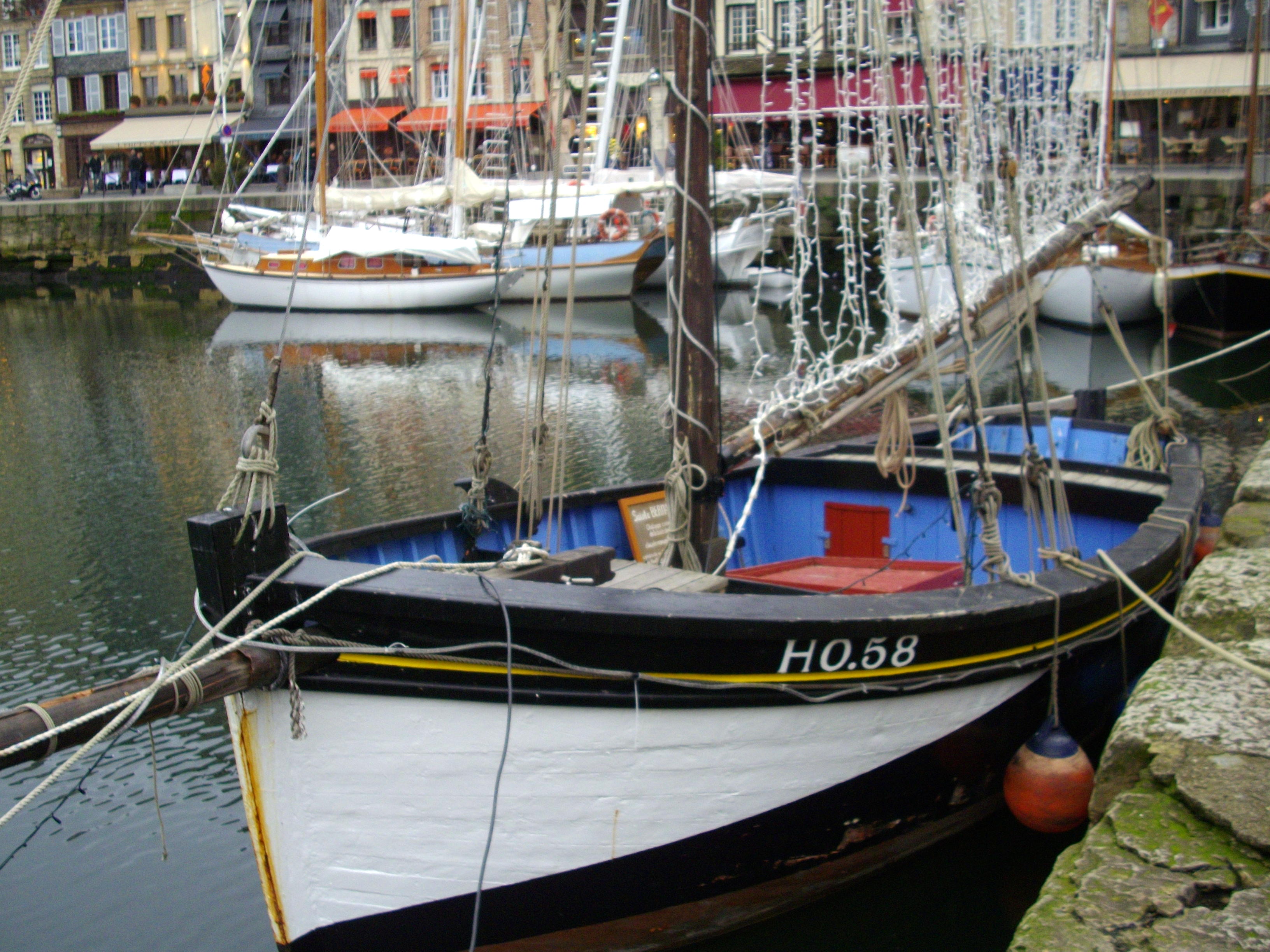
Sainte-Bernadette in December 2008, with HO.58 visible on the hull. The image records one preserved state, before the 2021 restoration announcement; it cannot establish current seaworthiness or identify which timbers are original. Photo: Raphodon, Wikimedia Commons; CC BY-SA 3.0. Unmodified by publisher.

A fishing boat carries family names into public memory
The Sainte-Bernadette, interpreted through Honfleur's Lieutenance heritage centre, offers another scale of belonging. The city's account identifies its construction at the Méterie yard in 1926 for Adrien Mérieult, under the name Serge-Olivier. It later passed to Jacques Cauchois and acquired the name Sainte-Bernadette, associated with his wife. The account follows subsequent ownership, rescue by an association and eventual inclusion in the heritage centre's project. Here, a boat's identity is attached to named households and custodians, not only to a technical category. City of Honfleur, Sainte-Bernadette history.
Names provide a small but tangible connection between paid work and family life. They do not disclose the whole household economy: they cannot tell us how money was divided, what work relatives performed ashore, or how a poor season affected a family. Nevertheless, they prevent the fishing boat from becoming an anonymous specimen. Someone commissioned it, worked it, renamed it and made decisions about its future.
The national protection record adds material specificity. It describes a fishing sailing vessel with auxiliary power, identifies the painted registration HO 58, and records an original keel within the restored boat. Its account is evidence of both survival and substantial rebuilding. A vessel can carry a continuous name and remembered biography without every timber being original. The physical object and its social identity require related but distinct histories. Ministry of Culture, Palissy PM14001116.
In September 2021, the city announced another restoration and a public subscription, following the association's decision to transfer the boat to municipal ownership. The notice described proposed work at a local boatyard and a partnership with the Fondation du patrimoine. It records a new distribution of responsibility, not merely an aesthetic improvement. Preserving the vessel had become a civic project supported by several participants. City of Honfleur, restoration announcement, 27 September 2021.
Objects do not replace the household record
The municipal archives' research guide points towards another kind of sailors' history by listing the estate papers of ship captain Pierre André Morin. The guide establishes that such material is held; it does not reveal the contents of the estate. A captain's succession is a promising route into property and family relationships, but not a ready-made portrait of all maritime households. The collection should be distinguished from an argument based on documents actually read. Honfleur municipal archives, research guide, page 1.
That gap is important when moving from museum objects to social history. A banner can identify an association, a vessel can preserve family names, and a devotional painting can recall danger shared by a crew. None alone establishes ordinary wages, domestic labour or the position of widows. Those questions need different evidence. Their absence should not be disguised by supplying an imagined household around a convincing object.
Honfleur's strongest maritime stories emerge when these sources remain distinct but connected. The museum explains and preserves; the civic record reveals decisions about care; an association maintains memory and participation; an archive offers access to less visible relationships. The sailors' world is not recovered simply by surrounding a visitor with boats. It becomes clearer when the objects retain the people, organisations and obligations that gave them meaning.
Locate the town
For regional orientation, open a Google Maps search for Honfleur. This community-level search is not an exact building entrance, a verified walking route or permission to enter a workshop, museum or private property. Check the institution’s own current access information separately.