Free · France
Bayeux: A medieval tapestry as a source for material history
Two kinds of making
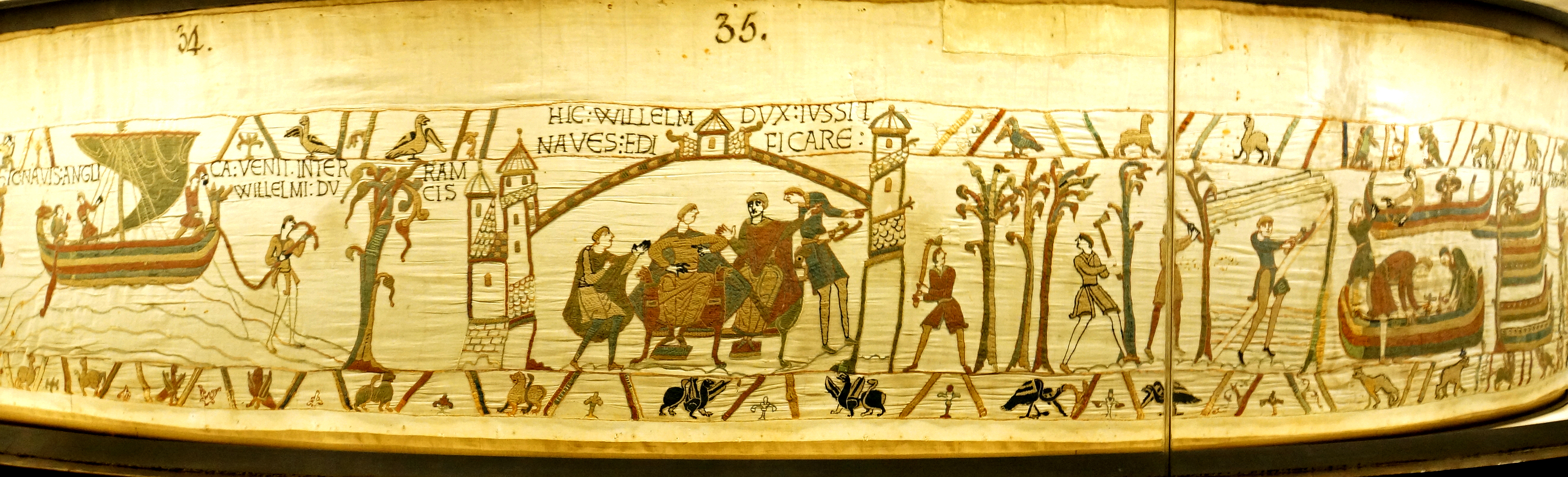
The most useful place to pause in the Bayeux Tapestry is not necessarily the battle. Its shipbuilding sequence brings two kinds of making together: the manufacture of the embroidered object and the work that object represents. Keeping them distinct allows a closer material history than treating every coloured shape as a transparent record of medieval life. Bayeux Museum's teacher guide identifies this passage as scenes 35–36. Bayeux Museum, teacher guide, p. 13
This is a deliberately small window onto the cloth. Instead of following rulers across the Channel, we can ask how an image makes manual work intelligible. Which details belong to a boatyard, which to an embroiderer's technique, and which to later care? Bayeux's documentation provides different answers according to the evidence being used: a technical description of the textile, a museum explanation of a tool, an old inventory recording use, or a civic account of conservation. None can simply stand in for the others.
Scenes 34–35 photographed in June 2014. The represented sequence moves towards ship construction; the numbered upper strip and display reflections belong to the object’s later presentation. This photograph does not identify original versus restored stitches. Photo: Dennis G. Jarvis, Wikimedia Commons; CC BY-SA 2.0. Unmodified by publisher.

A ship made from wool
The familiar name obscures a basic distinction. A woven tapestry produces its image as the textile is woven; embroidery adds needlework to an existing fabric. Bayeux's object belongs to the second category. GrandPalaisRMN's educational dossier distinguishes outlining stitches from the filling associated with the Bayeux stitch and also identifies chain and split stitches. The broad surface of a depicted object and its defining edge need not have been produced by the same movement of the needle. Recognising that difference changes the apparent simplicity of the pictures: a seemingly continuous ship is an arrangement of different operations. GrandPalaisRMN, MUSE — Tapisserie de Bayeux, p. 10
The Ministry of Culture's technical account describes nine sections of fairly regular, bleached linen joined with fine overcast seams. Embroidery subsequently covered those joins. Wool supplied most of the embroidered thread, with some linen thread also used. These are findings about the surviving object's construction, not deductions from what its pictures show. The hidden joins are particularly telling: the narrative's continuity was manufactured from separate pieces. A viewer following the action could pass over a join in the cloth without noticing the physical interruption beneath it. Ministry of Culture, June 2026 dossier, p. 18
There is a social history here before any pictured labourer appears. Cloth had to be prepared, pieces assembled and the surface worked. But the national Joconde catalogue, inventory Dd001, does not supply the makers' names. It records the designers, makers and commissioner as unknown; Odo's patronage and an origin around Canterbury remain hypotheses. Bayeux is thus a documented place in the object's later history, not proof of the location of its workshop. Joconde object record M0655000214
Nor does embroidery automatically identify an exclusively female workforce. GrandPalaisRMN places the popular image of Queen Matilda sewing the work within a romantic tradition, while noting that medieval workshops employed both male and female embroiderers. This contextual evidence does not reveal the personnel of this particular workshop. It does, however, remove an unsupported shortcut: the medium alone cannot tell us the makers' gender, status or working arrangements. Those questions remain different from the observable organisation of their stitches. GrandPalaisRMN, MUSE, p. 10
Colour is evidence, but evidence of what?
Bayeux Museum reports dye analysis identifying woad, madder and weld among the plants used to colour the wool. Here the image opens onto processing and plant materials, rather than simply providing a palette of medieval clothes and equipment. The museum also explains that some blue has faded because its colouring did not penetrate the fibres completely. It distinguishes this from the strong fading of some restoration wool, probably dating from the late nineteenth century. An apparently pale area can therefore belong to a later intervention rather than an original choice. Bayeux Museum, technical analysis
A coloured hull should consequently prompt two questions, not one. What does its colour contribute to the picture, and what does the surviving thread reveal about the embroidery? Evidence for a dye in the cloth is not, by itself, evidence that an actual ship was painted with the same substance. Equally, a digital reproduction cannot substitute for examining fibres. The distinction is practical rather than pedantic: it prevents a history of textile production from being mistaken for a specification for medieval ship paint.
Reading the boatyard
In the teacher guide's reproduction, bodies and tools divide the work into recognisable actions. Workers cut trees; another straddles a plank; others bend into hulls. The museum interprets particular implements as a broad axe, a spoon auger and an adze. These names supply an explanatory vocabulary, but the image itself does not label each tool. Its social force lies partly in the workers' postures: the construction requires exertion and coordinated tasks, not merely a command. The same guide describes a display of six woodworking tools. That is evidence of the museum's teaching method, not sufficient provenance to call the displayed pieces excavated eleventh-century originals. Bayeux Museum, teacher guide, pp. 13, 20
The Viking Ship Museum in Roskilde offers a useful specialist comparison. Its analysis finds correspondences between the depicted axes, broadaxes and spoonbits and archaeological discoveries. Yet it also notes that repeated representations of Harold's vessel vary in their hull strakes, colours and decoration. The same picture-source can therefore preserve convincing details while changing other features of a supposedly identical ship. Neither wholesale trust nor wholesale dismissal is a satisfactory response. The evidential value has to be tested detail by detail. Viking Ship Museum, “The Bayeux Tapestry”
That museum also cautions against reading the ships' proportions literally: prominent human figures and the limits of the medium help explain their shortened appearance. A technical reconstruction cannot simply enlarge an embroidered outline. For material history, the stronger question is how tool, hand and workpiece relate. A recognizable boring implement is more useful for investigating a craft operation than the overall outline is for calculating a vessel's capacity. Even then, recognising an operation does not establish its duration, the labourer's pay, the source of the timber or the completeness of the depicted workflow. Viking Ship Museum, analysis of proportions and tools
The two workshops remain connected without becoming interchangeable. The pictured carpenter transforms a rigid material; the embroiderer makes that transformation legible in a flexible one. The result can preserve a useful gesture without preserving the whole job. Reading it this way restores working people to the account without inventing biographies for figures whose names and circumstances the evidence does not supply.
It also suggests a disciplined way to use the scene. Separate an observed shape from a proposed tool identification, then separate that identification from a claim about working practice. Each step asks for different corroboration. A plausible tool name should open an investigation, not silently settle every question about the person holding it.
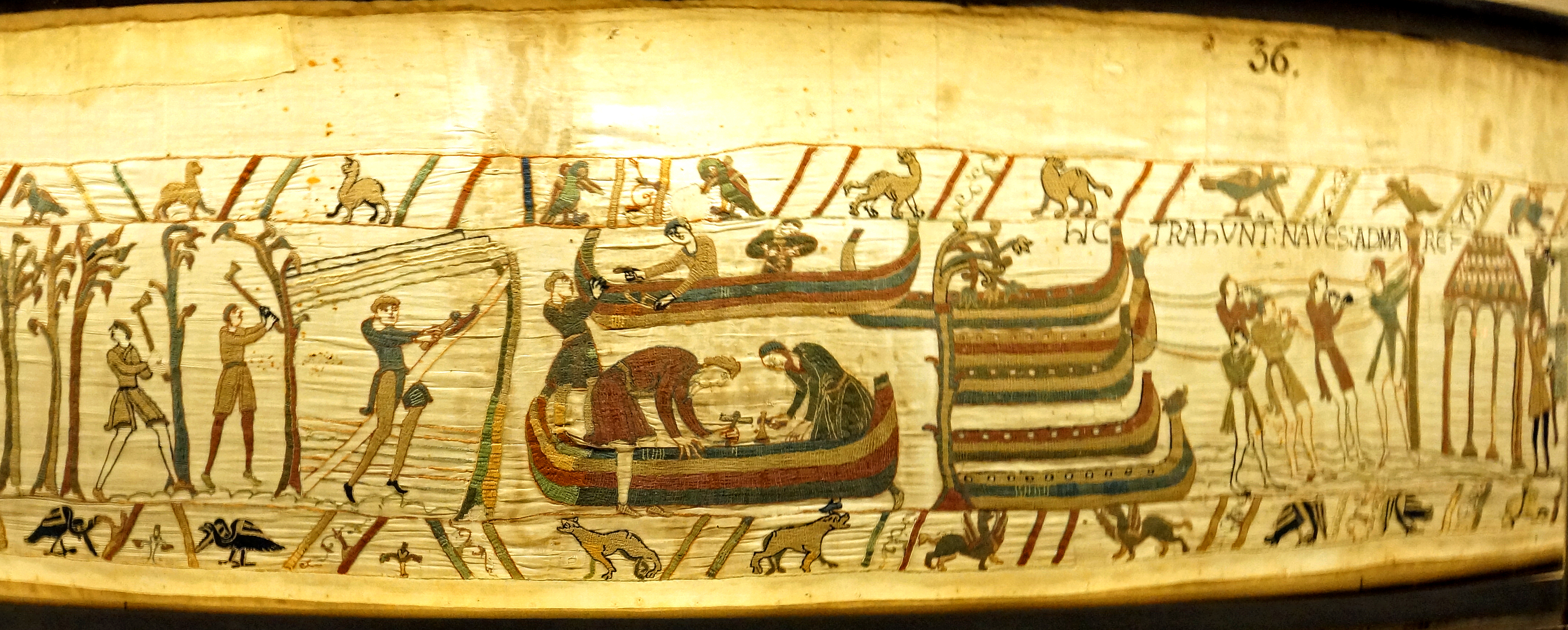
The boatyard and ship-hauling sequence around scene 36, photographed in June 2014. Distinct gestures can be compared with the article’s reading of tools and labour; photographic lighting is not a measurement of medieval dyes. Photo: Dennis G. Jarvis, Wikimedia Commons; CC BY-SA 2.0. Unmodified by publisher.

The cloth's own working life
Archival evidence changes the question again. Bayeux Museum's account of the cathedral inventory of 1476 records an embroidered conquest narrative used for an annual hanging in the nave. That is evidence of possession and use at that date, not a contemporary commission for its manufacture. The museum also publishes an excerpt from Vivant Denon's letter of 20 February 1804 returning the object after its Paris exhibition. Denon attributed it to Queen Matilda. The letter is valuable precisely because that attribution need not be accepted: it documents how an official described the object in 1804, rather than identifying who actually stitched it. Bayeux Museum, cathedral and Louvre history
The catalogue supplies another chronology within the textile itself. Its description separates the embroidered base from an upper numbered band, an eighteenth-century linen lining and a nineteenth-century lower band of linen and cotton supporting repairs. The numbered band's date is uncertain. These additions mean that neither the complete visible object nor every support around a scene belongs to one medieval moment. Even the convenient scene numbers are carried by a separate physical component. The catalogue also leaves the original destination—church or palace—unresolved, resisting a direct leap backwards from the cathedral's later ownership. Joconde object record, description and original destination
Care becomes part of the evidence
Modern civic records bring this material biography closer. Bayeux's September 2025 municipal magazine describes work on the backing and dust removal in January, followed by handling tests with a facsimile. The substitute mattered: logistical questions could be rehearsed without making every trial an intervention on the medieval textile. The account also identifies the city as the object's depositary and the state as its owner. Local attachment and legal ownership are not the same relationship. Bayeux à vivre 108, pp. 14–15
Public descriptions require comparison even here. The municipal account says the backing was removed, whereas the ministry's June 2026 dossier specifies partial removal. These summaries do not justify an assertion that every modern support disappeared. Municipal account, p. 15; ministry dossier, p. 16
Bayeux Museum's project history explains the competing demands behind the work: the padded backing protected the reverse but also added weight and stiffness. Conservation is therefore not merely the removal of something “inauthentic”. It requires judging how one layer affects another. Bayeux Museum, conservation project chronology
The shipbuilding passage ultimately rewards this layered reading. It records craft through an image that was itself crafted, subsequently handled, supported and interpreted. The stitches answer questions about making; the tools suggest questions about work; the inventory and municipal records explain different stages of use and care. Bayeux's material history emerges from their comparison, not from turning the embroidery into an illustrated inventory of everything medieval.
Locate the town
For regional orientation, open a Google Maps search for Bayeux. This community-level search is not an exact building entrance, a verified walking route or permission to enter a workshop, museum or private property. Check the institution’s own current access information separately.