Free · France
Fécamp: Cod-fishing history and port warehouses
A fishing history that stays ashore
At 3 quai Capitaine Jean Recher, Fécamp's fishing history has an unusually substantial container. The building occupied by Les Pêcheries museum was erected in 1950 as La Morue Normande, a cod-drying establishment belonging to the fishing company Les Pêcheries de Fécamp. It was not simply a warehouse waiting to be filled. It was a place where a catch became a different commercial product, through work performed after the fishing voyage. The national museum register identifies both its industrial origin and its later abandonment in 1996. Ministry of Culture, Muséofile M0715
Following this one building changes the scale of the story. A vessel's return was an arrival for its crew, but not necessarily the end of the fish's working journey. The distinction is essential: sailors, shore workers and company managers contributed to the same economy without doing the same jobs. The former drying plant makes it possible to ask where those jobs happened, how the building represented the business, and what a museum can preserve when production has stopped.
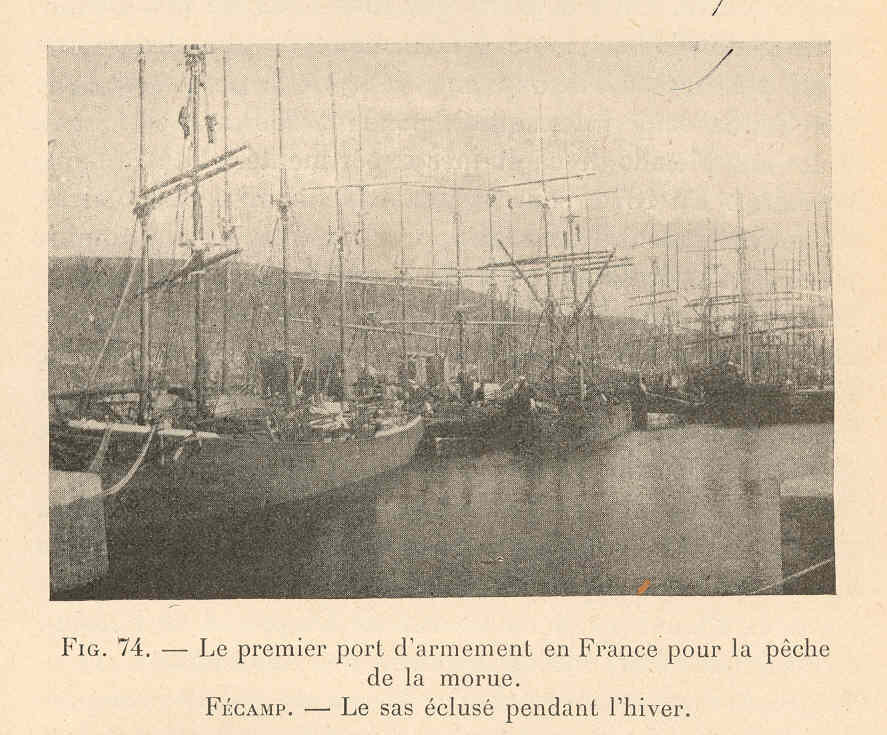
Fécamp’s lock basin in winter, as reproduced in Adolphe Bellet’s 1902 publication (FMIB 36594). This is the earlier sailing-port setting, not the 1950 La Morue Normande factory or a measure of its workforce. Photo: Photographer uncredited; reproduced in Adolphe Bellet (1902), University of Washington Freshwater and Marine Image Bank, Wikimedia Commons; Public domain — UW Freshwater and Marine Image Bank. Unmodified by publisher.

More than storage
Fécamp's civic heritage survey separates cod-drying establishments from shipowners' warehouses. The latter could combine merchandise storage with residential accommodation; some displayed their owners' prosperity through elaborate façades. Drying plants belonged to another functional category. The survey dates mechanical cod drying in Fécamp from 1904 and lists La Morue Normande among several enterprises. This is a useful correction to the idea that every large waterfront building performed an interchangeable storage function. Fécamp Site patrimonial remarquable, presentation report, pp. 58–59
The same report estimates that the town's drying factories employed between 1,200 and 1,300 people, depending on the season, excluding associated activities. These are sector-wide figures, not La Morue Normande's workforce. Nor does the passage supply a precise year for that employment estimate. Its value here is to establish scale: processing ashore was an industry in its own right, not a negligible appendix to the crews' work. Fécamp heritage survey, p. 58
“Warehouse” can therefore be a misleadingly quiet word. It encourages a picture of goods resting between journeys. A drying establishment instead demands attention to material change and repeated handling. The most revealing question is not merely how much the building could hold, but what had to happen to the fish before it left.
The site's previous use sharpens this distinction. The local Capitale des Terre-Neuvas heritage trail places the new factory on the site of a salt warehouse destroyed during the war. It also identifies the York and Duhamel families as owners controlling the chain from fishing to dispatch. The quay was therefore not just a convenient waterfront address: the trail connects its landing function with the organisation of the business. Fécamp heritage trail, panel 4, “L'usine des Pêcheries”
Seen this way, replacing a salt warehouse with a drying plant did not abandon the site's connection with preservation. It changed the building through which that connection operated. Storage of a processing material and treatment of the catch were related, but distinct, activities. The ownership link likewise connects ship and factory without erasing the boundary between their workforces. One business could coordinate several stages of production; the people carrying them out still occupied different places and had different responsibilities.
A public face for industrial recovery
The regional civic publication on Reconstruction dates La Morue Normande's inauguration to July 1950 and attributes its design to André Hamayon. It describes four levels, broad window bands and a concrete post-and-beam structure that allowed work areas to be rearranged. At the rounded corner, the employer's entrance and first-floor office balcony made management conspicuous. The building combined adaptable industrial space with a carefully presented public face. Normandy Villes et Pays d'art et d'histoire, La Reconstruction en Normandie, p. 15
A municipal archival photograph reproduced alongside that account, dated 1952–1955 and credited to the Bergoin collection, shows the rounded corner beneath its original roofline. Large lettering announces the drying business. Another reproduced photograph records a cod-shaped weather vane. The commercial identity reached from the façade to the roof: the fish was both the material being processed and an emblem visible outside. These images document appearance, not the day's production or the workers' experience. Fécamp municipal archives, Bergoin photographs reproduced in La Reconstruction, pp. 14–15
That difference between outward image and internal work is worth retaining. A successful-looking factory photograph is not a balance sheet, just as a prominent office is not a transcript of relations between employer and workforce. Architecture can organise and display authority without recording every way people responded to it.
An earlier record of handling fish
An ECPAD archival record provides a tightly bounded comparison. Albert Moreau photographed cod processing in Fécamp on 28 November 1916, decades before the present museum building existed. Record SPA 142 M 2909 preserves an original caption describing washed cod pressed between cloths. The associated report identifies the business as Société des morues du Nord, not La Morue Normande. Its catalogue describes women drying and salting fish before packing it into barrels. ECPAD, Albert Moreau, SPA 142 M 2909
The same opened record lists captions for unloading from a cart into a chute, washing, stacking fish with salt, packing for dispatch, and washing the drying cloths themselves. That last operation is particularly revealing: processing required care of the equipment and materials that touched the product. These captions establish a documented local sequence, but cannot be transplanted as a floor plan or machinery inventory for the 1950 factory. ECPAD, associated reportage and caption list
The comparison helps recover work without inventing continuity. Two establishments can belong to the same port economy while differing in layout, machinery and organisation. Keeping their identities separate is more informative than using any evocative fish-processing image as a generic illustration of “old Fécamp”.
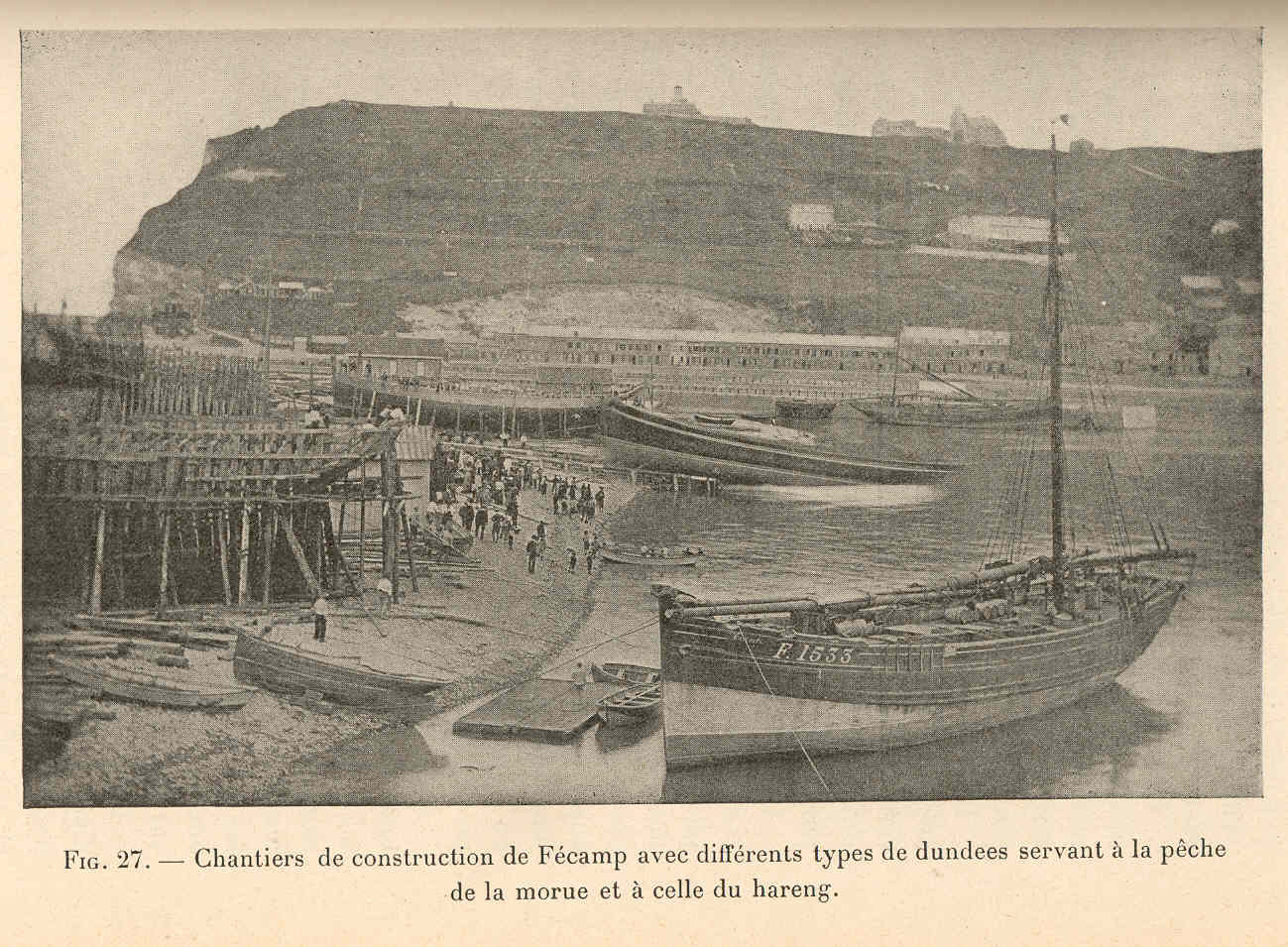
Fécamp shipbuilding yards in Bellet’s 1902 publication (FMIB 36553), whose caption identifies boats for cod and herring fishing. The view illustrates a distinct shore-based trade; it does not show fish drying or the later factory’s processing circuit. Photo: Photographer uncredited; reproduced in Adolphe Bellet (1902), University of Washington Freshwater and Marine Image Bank, Wikimedia Commons; Public domain — UW Freshwater and Marine Image Bank. Unmodified by publisher.

Sailors and factory workers
The local museum's Doris, Doris research gives the seagoing side a different vocabulary. Recollections from Michel Desjardins describe fishing in two-person doris teams and recording catches against each boat's number. The account also identifies separate roles aboard the sailing vessel Léopoldine, including captain, chief salter, cook, novices and ship's boys. This is evidence for an earlier fishing system, not a description of the trawler workforce supplying the post-war plant. It nevertheless shows why even “the sailors” should not be treated as one undifferentiated occupation. Fécamp museum research, Doris, Doris, hosted by the Ministry of Culture
For La Morue Normande, the museum project singled out a pointed spatial contrast: the employer's office and the women's changing and washing facilities. In 2005, chief curator Marie-Hélène Desjardins-Ménégalli proposed preserving this mezzanine ensemble as part of the future museum's industrial memory. Her text describes an intention before conversion, rather than a retrospective claim that everything proposed was subsequently achieved. Desjardins-Ménégalli, “Un musée, in situ, les Pêcheries de Fécamp”, p. 40
These are not neutral leftover rooms. One supported the direction of a business; the others accommodated workers' bodies around the working day. Read together, they place hierarchy, clothing and washing inside maritime history. They also resist reducing women to people who waited at home for men to return. The evidence here identifies industrial work and its spaces; it does not establish that every woman employed in the building was married to a fisherman.
A building with more than one fish
The curator's 2005 account also warns against freezing the establishment at its opening. It records herring processing from 1960 and subsequent salmon smoking. A building established for cod acquired other uses before its final closure. Calling it a cod-drying plant correctly identifies its origin, but does not describe every year of its working life. Desjardins-Ménégalli, p. 40
A later museum publication makes the need for precision equally clear. The press dossier for Jean Gaumy. Océaniques identifies a 1977 photograph of women preparing and boxing herring fillets at Établissements Leporc in Fécamp. Its location is another business, not La Morue Normande. The photograph's caption supports the wider importance of shore-based fish work while prohibiting an easy substitution of one workshop for another. Les Pêcheries, Jean Gaumy. Océaniques, press dossier, p. 8
Such distinctions are not obstacles to telling a connected history. They are what gives the connections substance. Cod drying, herring preparation and salmon smoking should not dissolve into a single picturesque activity called fishing. Naming the product and establishment makes change visible; naming a worker's task makes contribution visible.
What the museum changes
Les Pêcheries opened on 8 December 2017, bringing together Fécamp's municipal collections. Its exhibits therefore did not all originate inside this factory. The building and the objects have intersecting histories, not one shared provenance. Muséofile M0715, collection history
The Normandy museum network explicitly identifies the changing rooms of the former filetières, or female fish filleters, and the shipowner's office within the site's interpretation. A September 2026 heritage programme likewise paired these spaces in guided visits led by the municipal Archives-Patrimoine service. These notices confirm an active interpretive choice, rather than merely repeating the aspirations of the 2005 project. They are not evidence that every industrial fitting survives unchanged. Réseau des musées de Normandie; 2026 Journées européennes du patrimoine programme
La Morue Normande thus offers more than a backdrop for stories of distant fishing grounds. Its public façade, working spaces and conversion reveal successive decisions about what should be prominent and what should be remembered. Read beside archival captions and museum research, the former plant brings cod-fishing history back onto the quay. The catch mattered, but so did the people who handled it after landing—and the buildings that made their labour possible.
Locate the town
For regional orientation, open a Google Maps search for Fécamp. This community-level search is not an exact building entrance, a verified walking route or permission to enter a workshop, museum or private property. Check the institution’s own current access information separately.
Source register and evidence boundaries
All sources below were accessed on 2026-10-27. Citations above locate their substantive use. Institutional research images are not reproduced; two separately sourced public-domain photographs from 1902 are included with credits, not as views of the 1950 factory.
- Muséofile M0715, Ministry of Culture: opened national museum record, updated 26 January 2026. Used for the building's identity, closure and museum opening, not as a detailed factory inventory.
- Fécamp SPR presentation report, pp. 58–59, in the agglomeration's public planning annex: visually checked at PDF pages 125–126. The survey's industrial categories and aggregate figures are retrospective, not company payroll records.
- Capitale des Terre-Neuvas, panel 4, on the departmental tourism media platform: opened heritage-trail PDF; used only for predecessor storage and ownership, not its compressed closure chronology.
- La Reconstruction en Normandie (2024), pp. 14–15: Rendered pages read, including credited archival photographs; originals unexamined.
- ECPAD SPA 142 M 2909: opened catalogue metadata, original-caption transcription and associated caption list. The glass negative and photographic image were not inspected; the distinct 1916 company is retained throughout.
- Doris, Doris: museum-authored research, initially published online in 2003 and updated in 2022. The sailors' recollections are mediated through this publication; original recordings and catch registers were not consulted.
- Marie-Hélène Desjardins-Ménégalli, Études Normandes 54-3 (2005), pp. 39–40: museum chief curator's project account; page 40 consulted in its public HTML edition. Future-tense project proposals are not treated as completed works.
- Les Pêcheries, Jean Gaumy. Océaniques press dossier (2025), p. 8: museum-issued publication hosted by its press agency; text and photograph caption consulted. No claim is made to have viewed the exhibition or watched the related documentary.
- Réseau des musées de Normandie museum page and 2026 heritage programme: opened institutional descriptions of the preserved workplace spaces and their interpretation, not guarantees of unrestricted access.
Additional gaps: no La Morue Normande production logs, wage records, original equipment schedule or room-by-room conversion inventory was consulted. The precise factory processing circuit is therefore not reconstructed. The museum homepage and the relevant OpenEdition article were not used as fulfilled evidence.