Free · France
Bayeux: Town workshops and Norman craftsmanship
One manufacture, different kinds of usefulness
A porcelain street sign seems a modest starting point for Bayeux's craftsmanship. It has no elaborate scene to admire and no place in a ceremonial table setting. Yet the sign for the former Rue du Louvre, preserved at the Musée d'Art et d'Histoire Baron Gérard, makes the connection between workshop and town unusually clear. Bayeux's municipal magazine reproduces its pale oval surface and dark lettering, identifying the street as today's Rue Maréchal Foch. The object is both manufactured material and a surviving name: something made locally to help people read the town. City of Bayeux, Bayeux à vivre 99, p. 13
The workshop behind this wider porcelain tradition was not an anonymous collection of cottage crafts. Bayeux's civic heritage account locates the manufacture in a former Benedictine convent, converted to industrial use in 1812. It grew from roughly ten workers to about 140 around 1870, according to that account, and closed on 31 July 1951. These figures describe a changing enterprise, not a timeless artisan idyll. The physical setting also matters: an older religious complex acquired a new productive purpose rather than being replaced by an entirely new industrial quarter. City of Bayeux, heritage trail, “Un monastère manufacture de porcelaine”, p. 10
Three objects offer a manageable way into that manufacture: the street plaque, a perfume fountain and a chocolate pot. They are not a representative sample of everything the factory made. Instead, they expose different demands placed on the same craft—legibility, elaborate display and domestic handling. Reading them together shifts attention from the vague prestige of “old Bayeux” porcelain to the decisions that gave particular objects their form and surface.
A barrel that was not wood
The museum's self-guided publication identifies perfume fountain C1950 as an 1840s product made under Marie-Jeanne Le Cavelier, Joachim Langlois's widow. Its barrel-shaped body carries decoration in blue, red and gold, arranged in horizontal zones. The reproduced object shows how ornament follows the swelling sides rather than simply covering an interchangeable blank. The museum also records an ivory tap and two marks, BX and VL, the latter referring to the widow Langlois. This is therefore a composite object: describing it only as porcelain would leave out a significant component. MAHB, self-guided collection guide, p. 20
The same guide interprets its decoration as drawing on East Asian models. “Norman” here identifies a place of manufacture, not a sealed regional vocabulary. The fountain combines local production with an imagined visual world beyond Normandy. Its barrel form remakes a familiar container in another material. None of this identifies its first purchaser or proves how frequently it dispensed perfume. The museum's functional name and surviving fittings are evidence of intended use, not a diary of actual use. MAHB collection guide, C1950
The sequence behind a glossy surface
Bayeux Museum describes a paste made from kaolin, sands and chalk. The material could be shaped on a wheel; casting into plaster moulds developed at Bayeux only from 1898. Its account then distinguishes drying, an initial firing at about 800°C, glazing and a second firing at about 1,410°C. Cobalt blue and chromium green could be applied before glazing; other colours were added over the glaze after the high firing. This sequence makes colour a manufacturing question, not merely a matter of taste. Bayeux Museum, porcelain manufacture
It would be wrong, however, to turn that general explanation into an undocumented production record for C1950. The guide does not establish the exact forming method of each component, or identify the person who decorated it. The later date for plaster-mould casting is especially useful as a restraint: that later documented method cannot automatically explain an 1840s vessel. What the sources do establish is a sequence of transformations. The finished surface conceals drying, firing and decoration stages that were separate operations, with opportunities for skilled judgement between them.
A contemporary industrial assessment places a different emphasis on those skills. The report for the 1834 national exhibition credits the widow Langlois's manufacture with economical porcelain that was strong and stood up well to heat, confirming an earlier bronze medal. Elsewhere it describes Langlois's material as less brilliant in appearance but notably hard and heat-resistant, and names kaolin from Les Pieux near Cherbourg. This period judgement values performance as well as appearance. It does not make every surviving decorated object representative of the factory's everyday output. CNAM, digitized 1834 exhibition report, vol. I, p. 217; vol. III, pp. 385–386
Set beside the perfume fountain, the report complicates the usual opposition between luxury and utility. A factory could be praised for reliable material while also producing expensive-looking decorative work. Neither source cancels the other: the report evaluates industrial achievement, while the museum guide selects and explains a particular surviving object. Their different purposes account for much of the difference in emphasis. Craftsmanship included the less spectacular achievement of making material suitable for a job.
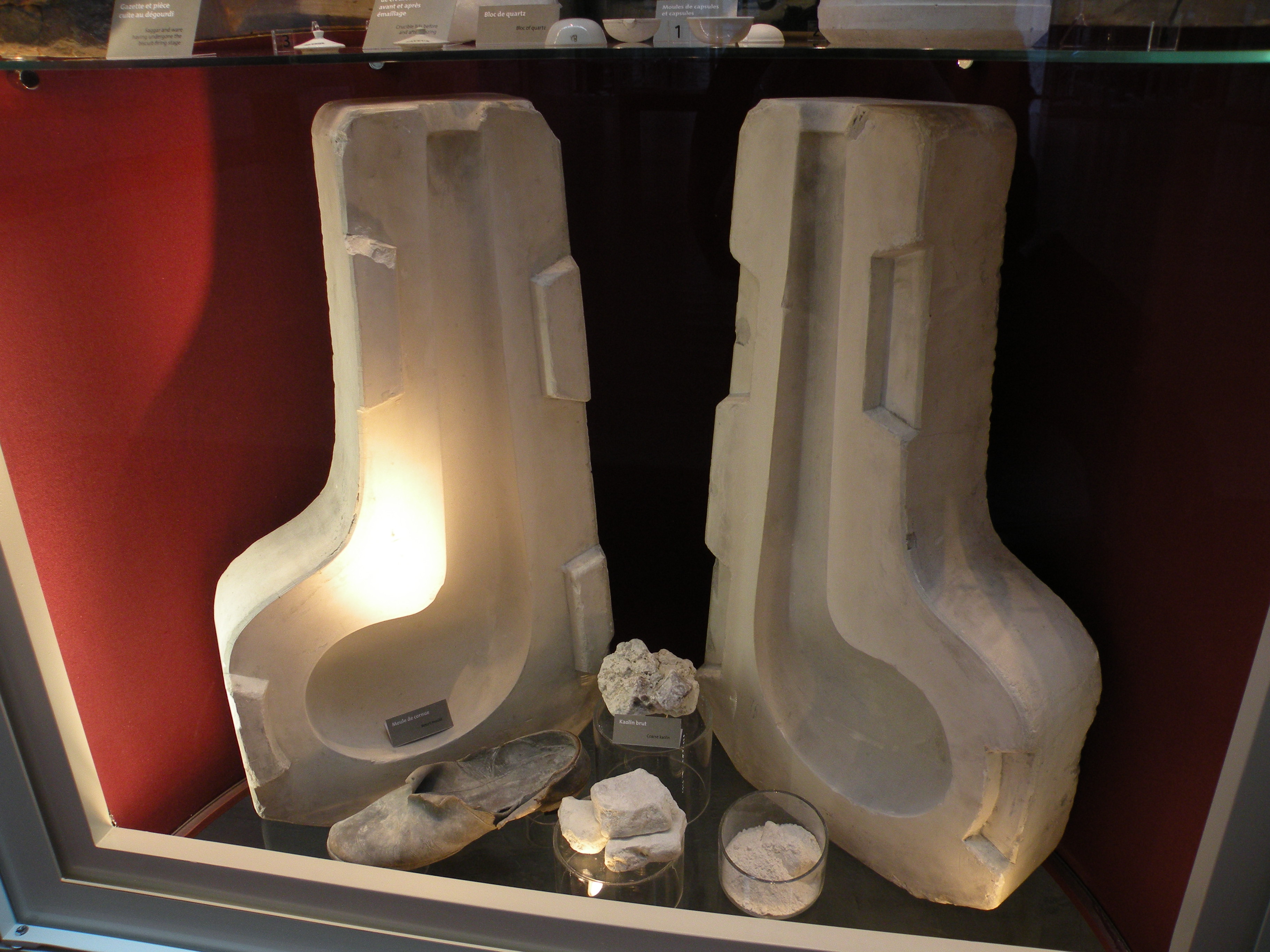
A retort mould in the MAHB display, photographed in August 2014. It makes the distinction between a forming tool and a finished vessel visible. It is not a mould documented as having made perfume fountain C1950; the date of Bayeux’s later casting process must not be projected onto that 1840s object. Photo: Chatsam, Wikimedia Commons; CC BY-SA 3.0. Unmodified by publisher.

A pot with a factory name
The MAHB chocolate pot C3280 gives that relationship another shape. Its Joconde record assigns it to the Bayeux manufacture under François Gosse and dates it to 1855–1870. The description specifies a rounded body, tapering neck, scrolling handle and spout with raised vegetal ornament. A circular lid has a graspable sculptural knob. These are not incidental embellishments: the vessel presents distinct places for holding, opening and pouring, although the catalogue does not document the gestures of a particular user. Joconde M0655000061, C3280
The catalogue transcribes a green, high-fired stencil mark reading “G / Bayeux / 4”. Unlike the street plaque's public lettering, this inscription identifies manufacture rather than location within the town. It names the business connection but not the individual who formed or decorated the pot. Its later history is clearer: the city acquired it at auction in 2019. That acquisition brought an object made in Bayeux into a civic collection; it does not establish an uninterrupted history of local ownership since manufacture. Joconde object record, inscriptions and acquisition
This distinction matters when craftsmanship is organised into family “periods”. A manufacturer's mark can help attribution while leaving the workforce largely anonymous. Owners, managers, decorators and other workers are not interchangeable historical actors. Naming Gosse or Langlois should not quietly transfer every operation to a single pair of hands. The surviving objects preserve products of organised work more readily than they preserve all the people who contributed to it.
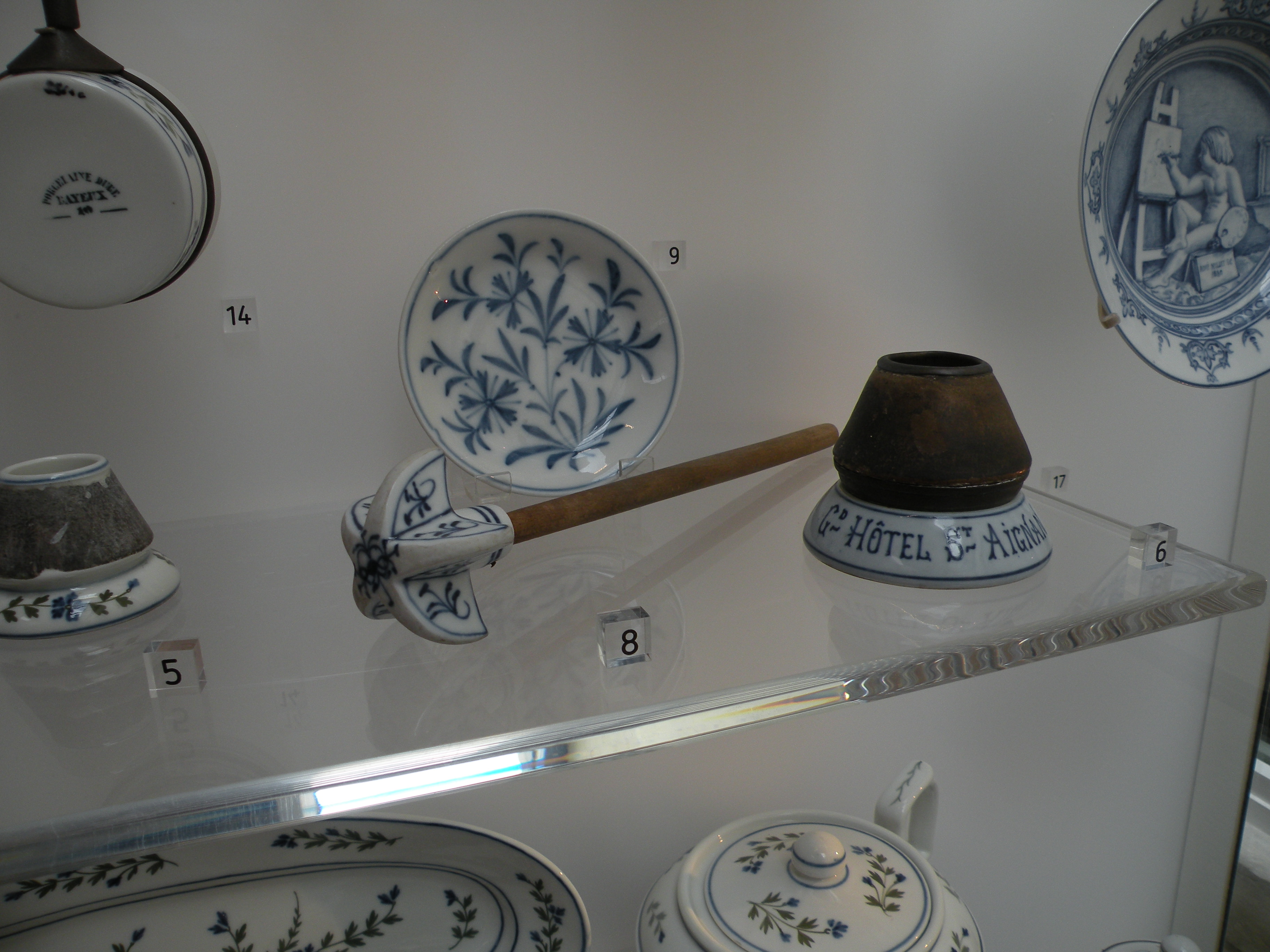
A chocolate-frothing implement in the MAHB collection, photographed in August 2014. This is a comparison object for the relationship between ceramic form and domestic handling, not the chocolate pot C3280 acquired in 2019. Photo: Chatsam, Wikimedia Commons; CC BY-SA 3.0. Unmodified by publisher.

Porcelain on the wall
The street plaque brings that organised work back into the built environment. The museum-held Rue du Louvre sign no longer performs its original navigational task: its street now bears another name. It has instead become evidence of an earlier urban vocabulary. The municipal magazine places it within an account of naming streets, explaining that museum documentation informs proposals considered by elected officials. A once-practical sign can therefore participate in two kinds of civic work, first identifying a street and later helping to interpret its history. Bayeux à vivre 99, pp. 12–13
There is a contemporary documentary trail for this product category. The Calvados archives catalogue lists, within reference 14T/1/1/1/1, Pattu's 1823 report on Langlois porcelain plaques intended for street names and house numbers. The finding aid establishes that such a report survives; it is not a substitute for reading its argument or checking its specifications. Nor does the report's date establish the Rue du Louvre plaque's age. The useful connection is narrower: street signage was already a subject of discussion around the manufacture in the early nineteenth century. Archives du Calvados, printed reports, 1805–1844
The plaque also changes what counts as ornament. Clear lettering can be the central achievement of a ceramic surface without imitating flowers, figures or precious materials. Its purpose depends on being understood, not on encouraging prolonged contemplation. The comparison with the fountain is therefore not a ranking of beautiful and ordinary objects. It shows the workshop adapting its output to different kinds of attention: close looking at a decorated vessel and quick recognition of a place name.
From production to collection
Later business documentation warns against imagining uninterrupted continuity behind the familiar factory name. The commercial-court finding aid identifies a file for Société Morlent et Saintville, manufacture de porcelaine, Bayeux, covering 1919–1934. It sits within company acts, not a workers' oral-history collection or a decorative-arts catalogue. Without the underlying papers, it cannot establish individual contracts, working conditions or reasons for later closure. It nevertheless makes visible a corporate history that the objects alone cannot explain. Archives du Calvados, 6U/1/71
The museum's presentation creates another transformation. Its 2022 press dossier explains that porcelain was sometimes arranged in apparently mixed groupings to evoke a manufacture, within a contemporary glass display. That is an interpretive setting, not a workshop preserved untouched. MAHB, 2022 press dossier, p. 3
The same dossier describes the presentation of a stock of 3,000 pieces made for chemical laboratories after the Second World War. This introduces quantity as part of the story. A mass of related products asks different questions from a single ornamented fountain: how were useful forms repeated, sorted and supplied? The stock makes production visible at another scale, while its post-war date prevents it from being treated as an illustration of the workshop a century earlier. MAHB press dossier, p. 5
The distinction leaves these objects more interesting, not less. A fountain, a chocolate pot and a street sign carry different relationships between material, labour and use. Their manufacture belongs to Bayeux, but their designs, supplies, purchasers and later collection histories need not fit neatly inside the town. Norman craftsmanship becomes specific when it is followed through those relationships—through a raised spout, a layered colour, a factory mark or a legible street name—rather than treated as a single inherited style.
Locate the town
For regional orientation, open a Google Maps search for Bayeux. This community-level search is not an exact building entrance, a verified walking route or permission to enter a workshop, museum or private property. Check the institution’s own current access information separately.