Free · France
Chartres: Stained glass workshops and cathedral labor
A cathedral window has an identity even when it is no longer in its opening. In the restoration process described by Chartres's tourism office, glazing was removed, numbered and taken to workshops for examination and treatment. Numbering is an unglamorous detail beside the celebrated colours, but it reveals an essential kind of labour: keeping the relationship between pieces, panels and architectural position intact while the object moves. The workshop sees a window differently from a person standing below it in the cathedral. What appears at a distance as an illuminated scene becomes an assembly whose materials and condition must be assessed. Following that change of scale provides a way into Chartres's stained-glass culture. It connects the cathedral with working premises, documentary records and museum interpretation, without treating every surviving workshop as a direct descendant of a medieval team. Official tourism account of cathedral restoration
From the high choir to the workbench
Maison Lorin identifies the cathedral's high choir windows, treated in 2009, among its conservation projects. This gives the relationship between local workshop and monument a named, dated example. Its description of the trade extends well beyond washing glass: condition assessment, stabilising glass and painted layers, work on the lead network, documentation, protective glazing and installation all appear in the firm's account. These activities concern different parts of a window's material life. A fragile painted surface is not the same problem as a supporting metal component, and a record made during treatment is not an optional decoration to the finished work. The firm's page is evidence of its stated methods and project history, not an independent evaluation of every intervention. Even with that boundary, it shows why cathedral labour cannot be reduced to the hand of a single artist. The window depends on successive, coordinated decisions before it returns to its architectural setting. Maison Lorin's conservation work and 2009 Chartres project
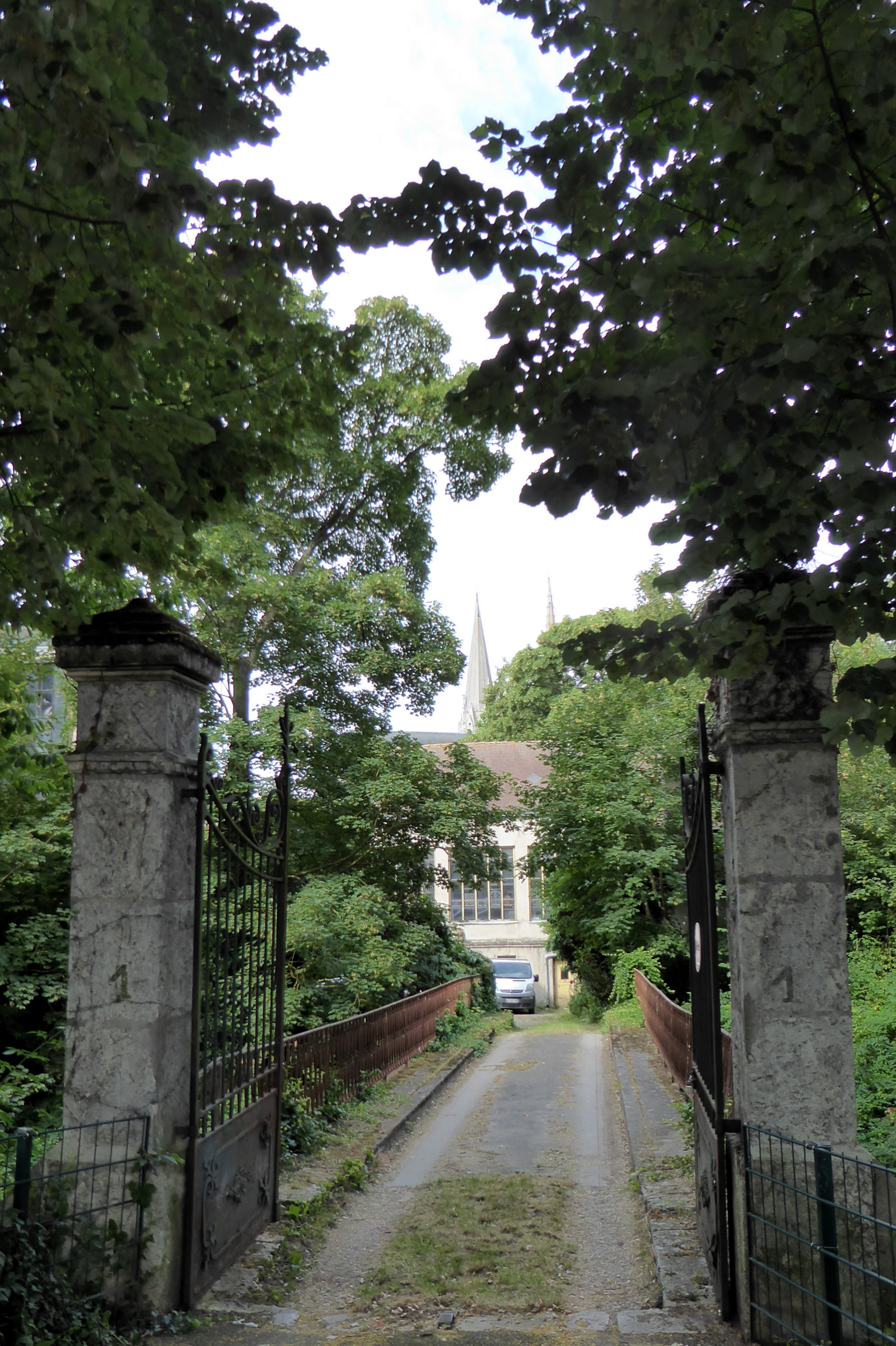
The Lorin premises in rue de la Tannerie make this organisation spatially legible. The municipality lists painting and firing rooms, glass stores, old furnaces and a display tower in which a lifting mechanism brought work into the light for inspection. The tower is particularly revealing: transmitted light could be part of checking the work before it reached its destination. Nearby storage and production spaces belong to the same process, although not every surviving machine remains in use. The city explicitly describes the old coal and gas furnaces as unused. Its account also identifies sketches, full-size designs, photographs, correspondence and invoices within the workshop archive. Alongside the rooms, these documents preserve another working arrangement: the passage from an order and design to a completed commission. The site holds both material equipment and records of the decisions surrounding it. City of Chartres: Lorin premises and archive
The Lorin premises viewed from the boulevard du Maréchal-Foch entrance, 20 July 2016. The photograph locates the workshop within the city; it does not show restoration in progress or establish current visitor access. Photo: Le Passant / Wikimedia Commons, CC BY-SA 4.0, original and rights record. Unaltered.

Keeping the records with the craft
The archive is useful precisely because a finished panel cannot answer every question about its production. An invoice might establish a transaction; correspondence might explain a change requested by a client; a design might record an intention that differs from the installed work. These are questions to take to the records, not discoveries claimed from unopened files. In a March 2026 municipal interview, the workshop director and the head of the city archives describe their complementary responsibilities in the Lorin site's restoration. Technical knowledge of drawing, painting, leading and workshop operation is brought together with preserving and communicating the archive. The interview presents an ongoing collaboration, not a completed inventory. It nevertheless identifies the practical people and disciplines through which a craft's history is being retained. Preserving a workshop means caring for more than its picturesque tools: it also means keeping usable the evidence that allows later readers to distinguish proposals, transactions and work actually carried out. Municipal interview on the Lorin restoration project
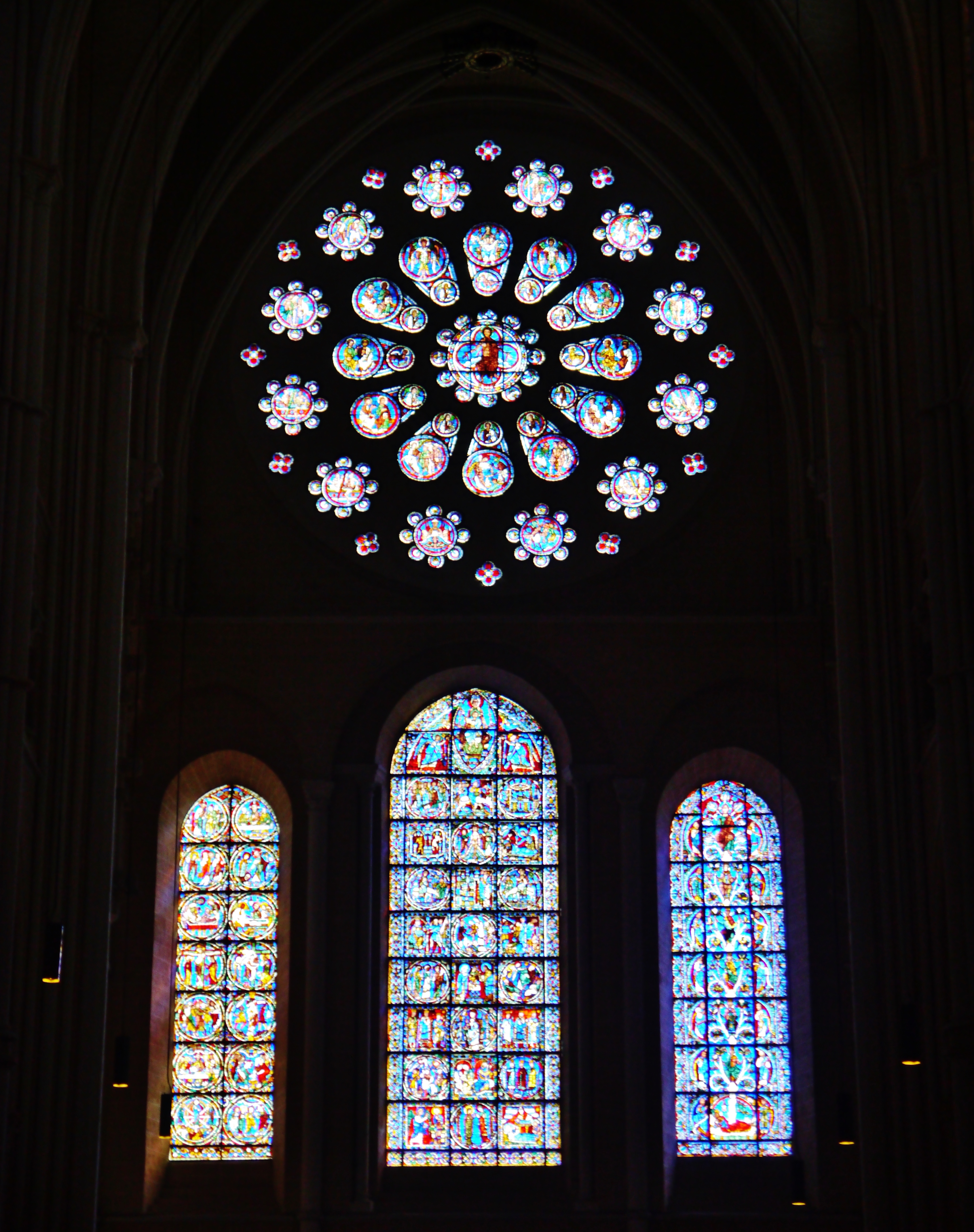
The cathedral's western glazing in its architectural setting, 15 June 2019. From the nave, separate panels become a larger visual ensemble: a useful contrast with the numbered components handled in a workshop. This is not the high-choir project of 2009, nor a condition survey of the glass today. Photo: Zairon / Wikimedia Commons, CC BY-SA 4.0, original and rights record. Unaltered.

Restoration has its own history
A DRAC briefing updated in May 2014 records a change in the protection of the cathedral's western glazing. An acrylic coating applied during work in the early 1980s had largely deteriorated. The later response described in the briefing was external protective glazing shaped to follow the relief of the medieval panels, together with work on their supporting components. This is a concrete reminder that conservation treatments themselves age and become subjects of assessment. The same document links the works to scientific examination of glass and earlier conservation products. Its value is historical and technical: it records the reasoning of a particular campaign, not the condition of every window today. For the craft worker, the inherited object can therefore include medieval material, later repairs and previous protective measures. Caring for it requires recognising those layers rather than simply making the colours brighter or returning an imagined untouched original to the building. DRAC restoration briefing, May 2014, page 4
Material retained inside a workshop can contribute to that investigation. In April 2026, the city reported research involving Maison Lorin and laboratories studying its surviving vitreous paints, enamels and related materials. The project combined an inventory of samples with analytical work and comparison with workshop documentation. Its questions concerned composition, colour, firing behaviour and deterioration. These are not simply recipes being recovered for immediate reuse. The article presents continuing investigation, including hypotheses about the browning of some colours, rather than a settled explanation applicable to all historic glass. That distinction is important in a city where a famous blue can easily become a story about one lost secret. The research instead makes colour a material problem involving samples, records and tests. It adds laboratory work to the chain of labour already visible in numbering, transporting, inspecting and repairing a panel. City report on research into Lorin's colour materials
The museum preserves a different journey
The Centre international du Vitrail supplies a revealing comparison with the cathedral windows. Its permanent Renaissance collection includes glass reused in Saint-Pierre after the loss of other churches. The Centre's account traces subsequent removal, storage and reassembly, including material kept in crates at the Lorin workshop and pieces returned to Saint-Pierre's triforium in 1950. Later study and conservation brought the works together for museum presentation. These are not cathedral panels permanently transferred to the museum. Their histories show another reason why a stained-glass object can become detached from its first architectural setting. Reuse helped preserve material while changing its arrangement and context. The museum's restoration account names both historical researchers and the conservators responsible for gathering, cleaning and consolidating the works. Survival here was not passive: it involved recognition, study and practical intervention after a complicated sequence of movements. The collection makes that sequence part of local glass history. Centre international du Vitrail: history of the Renaissance collection
In the same institution, models and explanatory diagrams present the cathedral's windows for study. Their purpose differs from that of the original Renaissance glass: they help identify scenes and understand an ensemble that is difficult to examine closely in its architectural position. This is a useful division of evidence. A model can clarify arrangement without possessing the material history of an old panel; an original fragment can preserve glass and paint without retaining its first context. The museum's own description distinguishes its collection from this educational presentation. Keeping that distinction visible allows interpretation to become more exact, not less engaging. It also explains why looking at glass in a museum is not merely a smaller version of looking up inside a church. Scale, lighting, sequence and explanatory material can be reorganised so that aspects otherwise hard to follow become available for sustained attention. Centre international du Vitrail: museum presentation
Passing on the work, not just the image
The Centre also describes demonstrations in its museum workshop and a separate programme of continuing professional training. Demonstrations introduce tools, gestures and traditional techniques; the professional pathway prepares for making or restoring stained glass. These should not be confused with one another: seeing a process or taking an introductory session is not evidence of professional competence. Their coexistence nonetheless gives Chartres's glass heritage a practical educational dimension. The cathedral provides demanding historic objects, the museum makes aspects of their art intelligible, and training addresses skills that must be learned rather than inherited from a city's reputation. This is institutional provision as described by the Centre, not a claim about enrolment, employment outcomes or a guaranteed course schedule. The significant local relationship is between interpretation and practice. A craft remains understandable when its objects are explained, but its continuation also requires opportunities to learn how materials behave and how work is assessed. Centre international du Vitrail: demonstrations and professional training
The numbered panel is therefore a useful counterweight to the familiar image of Chartres as a city of luminous windows. It directs attention to work that temporarily takes the glass out of view: recording, handling, examining and deciding how to conserve it. Neither workshop, archive nor museum tells that story alone. Together they reveal a heritage maintained through changing equipment, accumulated records and specialised judgement. The cathedral's light is the visible result; the work that makes its continued presence possible is part of the city's history too.
Location orientation
Chartres — general town map search is for orientation only, not a verified workshop entrance, accessible route or present opening arrangement.
Source register and editorial boundaries
Sources opened on 27 October 2026; no verbatim technical procedure is reproduced.
- C'Chartres Tourisme, cathedral restoration account: numbering and workshop examination. Its dated campaign narrative is not a 2026 completion report.
- Maison Lorin, conservation-restoration: firm's methods and high-choir project dated 2009; not an external performance audit.
- City of Chartres, Lorin heritage page: workshop spaces, unused furnaces and documentary categories.
- City of Chartres, 17 March 2026 interview: craft and archive collaboration; ongoing project.
- DRAC Centre, May 2014 briefing, page 4: western glazing and conservation history.
- City of Chartres, 12 April 2026 research article: sample analysis; hypotheses remain provisional.
- Centre international du Vitrail, Renaissance collection: reuse, storage and conservation history.
- Centre international du Vitrail, museum page: original collection distinguished from cathedral models and diagrams.
- Centre international du Vitrail, institutional home page: demonstrations and continuing training.
Remaining gaps: No original Lorin invoice, design or cathedral treatment file was inspected; archive categories and collaboration are documented by their custodians. An extended regional archive article and a laboratory-campus page failed to load. Public accounts differ over the date of municipal acquisition of Lorin's buildings/archives; that date is not asserted. No claim is made that Lorin manufactured the medieval cathedral glazing, handled every restoration campaign or retained an unchanged medieval technique. The Renaissance museum collection is not conflated with cathedral originals. Present condition, access, course outcomes and the completion of ongoing works remain unverified.