Free · France
Conques: Abbey sculpture and medieval pilgrimage
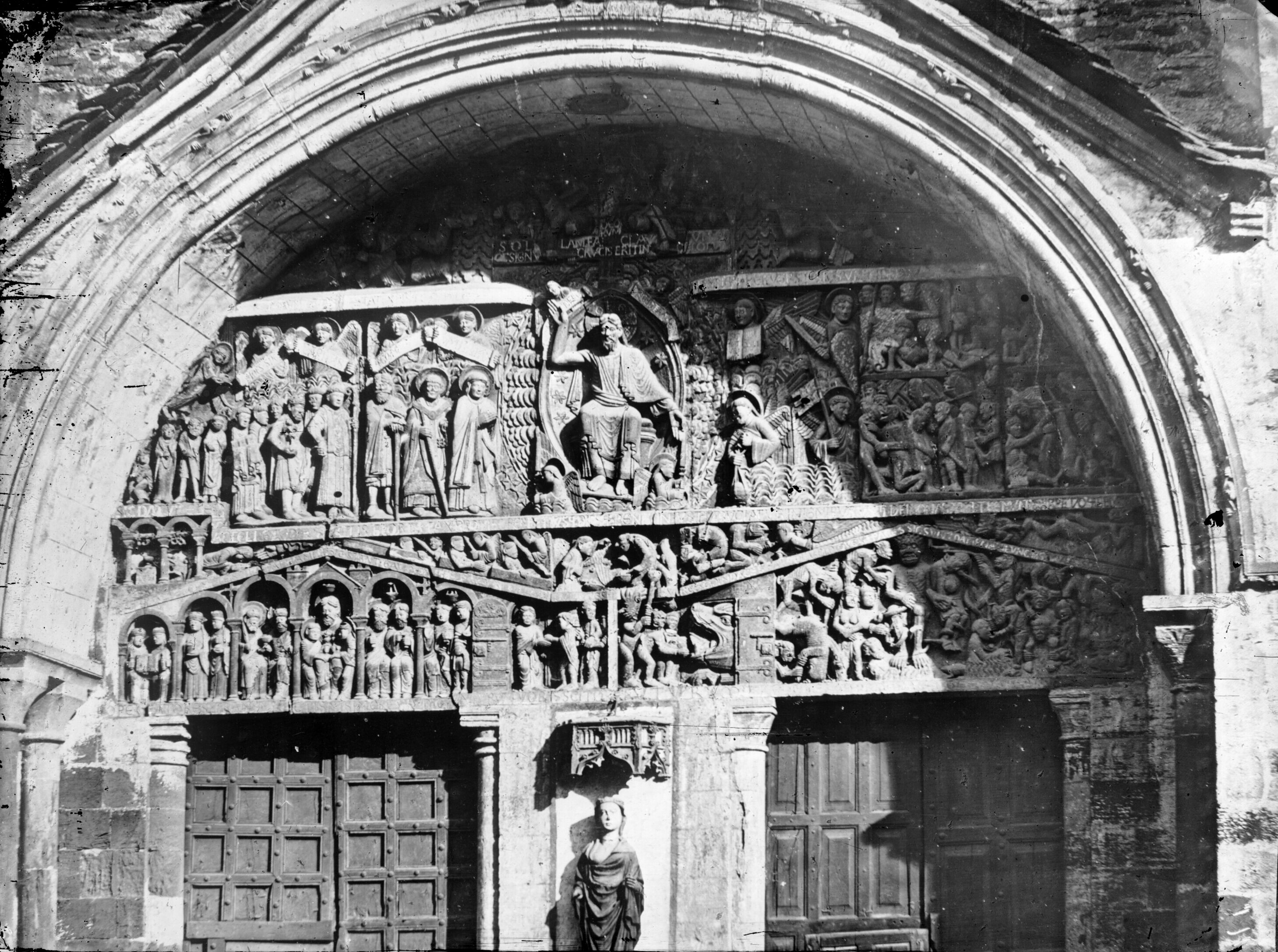
Before trying to name every figure above the western doorway of Sainte-Foy, decide whose left and right you mean. Stand facing the sculpture: Christ's right is on your left. This small correction changes the whole reading. A visitor following a description without fixing that orientation can put salvation and punishment on the wrong sides of the composition.
Conques rewards a slower approach than a checklist of remarkable objects. The portal is simultaneously a religious image, an entrance to a working church and a historic surface studied, rearranged and presented to successive audiences. Three questions make it more intelligible: What does the sculpture depict? Why here? How do we know what has changed? None requires a visitor to share the belief represented. All require a distinction between what can be seen and what a guide or document interprets.
Read the arrangement before the individual characters
The heritage service dates the Last Judgment tympanum to the first half of the twelfth century. Its account places Christ at the centre, with the saved on his right and the condemned on his left. Three horizontal registers organize the scene. Below Christ, the weighing of souls introduces a contest over judgment rather than a simple decorative symmetry. The service also identifies Sainte Foy interceding before the hand of God and monastic figures among the elect; some individual identifications remain qualified rather than certain. Conques heritage service: the tympanum.
Try a two-pass reading. On the first pass, ignore names and follow scale, gesture, grouping and direction. Which figure anchors the scene? Where are bodies orderly, and where crowded or entangled? On the second, consult an interpretation for one small group. This prevents a familiar failure: collecting a string of names while missing the visual organization that makes them meaningful.
Keep the wording of the explanation precise. “The guide identifies this figure as…” is stronger than pretending every proposed identity is self-evident. Likewise, a carved scene of intercession is evidence that intercession was represented. It is not documentary proof that the miraculous intervention depicted occurred. Respect for a religious tradition and careful historical attribution work well together here.
The result is not a complete decoding of the portal in ten minutes. It is a reliable first reading that leaves room for uncertainty. An unresolved detail is a reason to look more closely, not to invent a confident story.
Fix the orientation, then read the registers. In this historical image, Christ’s raised right hand appears on the viewer’s left. Trace the horizontal divisions before selecting a smaller group. The photograph also includes a statue below the tympanum; do not use its broad catalogue date to invent an exact removal year. Eugène Trutat, Jugement Dernier, tympan de l’église de Conques, Bibliothèque de Toulouse, TRU B 356, catalogued between 1859 and 1910; the record also notes a 1984 print by Jean Dieuzaide. Institutional image and catalogue description, marked public domain / no known copyright restrictions. Original digital image unchanged; not a current condition photograph or evidence of medieval colour.
Why pilgrimage belongs to the architecture
The abbey's architectural account links its plan to the reception and movement of pilgrims venerating Sainte Foy's relics. Side aisles lead towards the ambulatory around the choir. Construction began under Abbot Odolric in the eleventh century and continued through later campaigns. The same account documents major nineteenth-century restoration, including the raising of the façade towers from 1881. The building surrounding a medieval sculpture therefore cannot be treated as an untouched frame from a single moment. Conques heritage service: abbey construction and plan.
Think about the difference between an image and a route. The portal addresses someone approaching the entrance; an interior circulation system organizes movement after entry. A useful observation exercise is to sketch these as separate elements: approach → doorway → interior route, leaving the last section blank if access is restricted. Do not infer a complete medieval procession from a present-day visitor path.
Conques also has more than one pilgrimage story. The local heritage account distinguishes devotion to Sainte Foy from the arrival of travellers heading towards Santiago de Compostela along the route from Le Puy. It identifies the abbey church and the bridge over the Dourdou as components of the French Routes of Santiago World Heritage property. That is more precise than calling every street or every building in the village individually UNESCO-listed. Conques: pilgrimage routes and designated components.
For a modern walker, these histories can overlap without becoming identical. Someone stopping at the abbey may be pursuing a religious pilgrimage, an artistic interest or a long-distance walk. Appearance alone does not tell you which. Avoid photographing worshippers as if they were part of a staged medieval scene, and do not assume that a walking pack is a declaration of religious belief.
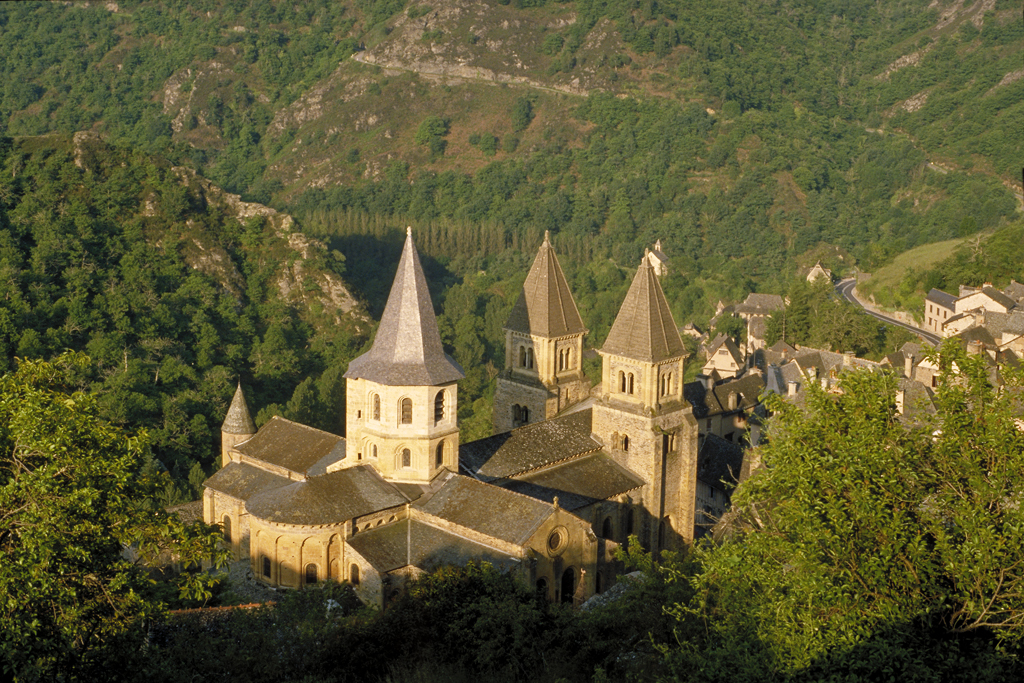
The church is larger than the doorway. Compare this exterior view with the portal detail: roofs and projecting volumes give a different reading of the building. They do not by themselves establish a medieval procession or today’s permitted interior route. Photo: Allan T. Kohl, MCAD Library, Abbey Church of Sainte-Foy, RQ032, May 1990, CC BY 2.0. Original image unchanged.
An archival detour changes the view of the doorway
The local heritage service recounts how Bernard de Montfaucon commissioned drawings through a correspondent in 1725–1726. It reports that the correspondence and two red-chalk drawings are preserved at the Bibliothèque nationale de France. One drawing included the lower doorway and a limestone Sainte Foy statue from around the 1450s. According to the service, that statue was removed during late-nineteenth-century restoration and is now at the Musée Joseph-Fau. This article consulted the heritage service's account, not the original drawings or letters. Conques heritage history: eighteenth-century study of the portal.
The value of this example is not just another date. It separates three objects that are easily collapsed into one: the surviving doorway, a historical representation of that doorway, and a sculpture now held elsewhere. A museum visit can restore a connection that the current façade no longer makes obvious—but only if the object is actually available to view that day.
If you follow that lead, ask a focused question at the museum: Is the Sainte Foy statue formerly associated with the doorway currently displayed, and does its label explain the removal? Record the answer and the label rather than assuming that an online collection reference guarantees display. A negative answer is useful too. It distinguishes an object in a collection from an object accessible during your visit.
For a deeper study, the next step would be to obtain the archival images and their catalogue references. Compare the location and outline of objects before comparing fine details. Old drawings can record a former arrangement while simplifying or misunderstanding individual forms. Their age does not make every line automatically accurate.
Modern light is another layer, not a time machine
Conques presents an evening illumination of the tympanum. Its published 2026–2027 programme distinguishes the summer sequence from an illumination-only arrangement after 11 October. Do not rely on a summer description promising a presentation and gallery visit for an autumn evening. Check the current dated programme before making an evening journey. Conques: illumination programme.
Projection can help the eye separate a crowded composition. It should nevertheless be recorded as a contemporary presentation. A colour seen during a light show is not, by itself, proof of the exact pigment or shade originally applied to that stone. Establishing original colour would require the relevant conservation evidence, not simply a photograph of the illuminated façade.
A productive comparison is modest: look in daylight, note one difficult-to-follow group, then see whether the presentation makes that group easier to distinguish. Write down what changed in your perception. Keep that observation separate from a claim about medieval viewers. You have learned something about your own reading under two lighting conditions; you have not recreated another person's experience nine centuries ago.
The practical limitation that changes an art visit
Access checked again online on 28 October 2026: the tourism office's main Conques page states that the Treasury is closed until further notice for safety reasons, while the Musée Joseph-Fau remains open. The explicit closure notice takes precedence over generic text on the same site advertising normal Treasury opening. Do not plan on seeing the Treasury's objects in person without a subsequent reopening confirmation. Museum opening on a particular day should still be checked separately. Conques: current visitor notice.
This is not a minor detail. A visit centred on the portal can still have a coherent purpose when access to a different collection is unavailable. What it cannot do is silently count an unseen object as something examined. Use three simple labels in your notes:
| Evidence encountered | Record it as | Do not turn it into | |---|---|---| | A detail you can distinguish from the public viewing position | Direct observation, with date and conditions | A complete conservation assessment | | A museum label or official interpretive page | An attributed explanation | Your own archival discovery | | An object listed online but unavailable during the visit | A research lead, not viewed | A confirmed display encounter | | A modern projection on the façade | Contemporary interpretation | Exact reconstruction of medieval colour |
The church is also a place of worship. Check local access instructions, allow services to proceed without interruption and leave space at the entrance. Do not touch carvings or seek a closer viewpoint from a restricted area. A useful study does not require obstructing people entering the building.
A compact reading you can take away
Choose one scene rather than trying to explain the whole portal. Give it three sentences: what you could see; what an identified source says; what remains uncertain. Then add one sentence about context—why this subject belongs at a pilgrimage church—and one about change, such as restoration, an object's removal or modern lighting.
This five-sentence method avoids two opposite mistakes. The sculpture is neither an unchanging postcard nor an occasion to tell any dramatic medieval story that comes to mind. It is a particular work in a particular setting, with an interpretation that can be tested against sources. At Conques, the most rewarding discovery may be noticing where the visible doorway, the archive and the museum no longer coincide.
Location reference
Search map: Abbatiale Sainte-Foy, Conques-en-Rouergue, France. This is an address-search link, not a verified entrance pin, accessible route or embedded map. Use the tourism office's current village plan and access guidance for arrival.
Source register and limits
Official local heritage-service pages were consulted remotely. No physical site inspection, curator interview or original BnF archival inspection is claimed. The archival and museum linkage is attributed to the local heritage service. Original archival corroboration remains a further research step. Iconographic identifications are attributed; miracles depicted are not independently verified events. The dated Treasury closure notice takes precedence over generic opening text, but needs current confirmation before travel. Both historical photographs retain their original credits and catalogue qualifications; they are not current-condition or original-pigment evidence.