Free · France
Millau: The viaduct and its relation to rural transport
The Millau Viaduct is an answer to one kind of transport problem: carrying a motorway across the Tarn valley. It is not, by itself, an answer to every journey made by someone living in the valley or on the surrounding plateaux. A driver continuing along the A75, a resident getting to an appointment and a visitor arriving without a car may be near the same landmark while needing entirely different routes.
That distinction is the key to reading the viaduct as part of rural life rather than only as an engineering spectacle. Start with the journey's purpose and endpoints. Only then ask whether the famous crossing belongs in the journey at all.
A motorway link above the valley
The regional heritage inventory places the structure west of Millau, linking the Causse Rouge to the north with the Larzac to the south across the Tarn valley. It records construction between 2001 and 2004. The operator distinguishes the inauguration on 14 December 2004 from opening to traffic on 16 December. Occitanie heritage inventory: IA12101023; Operator: presentation of the viaduct.
The distinction between a valley-floor town and a high-level through-route is more useful here than a list of record-breaking dimensions. A route can pass close to a settlement without entering its streets. That is precisely why a bypass can be valuable to through traffic—and why reaching a particular address remains a separate task.
On a map, identify three things before drawing conclusions: the town centre, the motorway approaches and the destination you actually need. Proximity to the bridge's silhouette is not the same as proximity to a usable interchange. Nor does seeing the bridge from a rural road mean that road provides an entrance to it.
What the historical public assessment can establish
A state audit of the concession describes the viaduct as the previously missing link in the A75 and records the completion of the Millau bypass in December 2004. Its discussion places relief of town crossings, traffic flow and the famous summer bottleneck among the project's transport purposes. This is evidence about the infrastructure and its public-policy context, not a live journey-time guarantee. State audit of the Millau Viaduct concession.
Be careful with old traffic totals or quoted time savings. Their date, measurement area and traffic conditions matter. A figure from an earlier assessment cannot establish how long a journey will take this afternoon. A bypass's existence also cannot prove, without separate evidence, that every local business gained customers or every household gained equal access.
A useful distinction is between moving past a place and reaching it. Through traffic may benefit from avoiding a town centre. A rural resident may still need the centre for services. A visitor may want to leave the through-route deliberately. These are not contradictory uses; they are different transport needs.
Rural mobility begins before the motorway
The Communauté de communes describes a large rural territory around Millau, with services and jobs concentrated in the town and substantial everyday distances for residents. Its mobility programme combines urban public transport with other arrangements such as demand-responsive transport and shared travel. The authority's own description therefore treats rural access as a network problem, not something resolved by a single landmark. Millau Grands Causses: mobility overview.
Consider a hypothetical appointment in central Millau. The relevant questions are where you can board, when you arrive, how far the final walk is and how you return. The motorway may be irrelevant. For an interregional drive, by contrast, the A75 crossing may be central to the route while the local bus network is irrelevant. Neither traveller's experience should be used as a universal description of the area.
This is particularly important when comparing places to stay or live. “Near the viaduct” is a visual description, not a mobility specification. Replace it with a complete test journey on the day and at the time that matters to you.
Urban MIO and rural TAD are different services
The authority states that the Millau–Creissels urban network became free to all, without a card or ticket, on 1 September 2025. Its purpose includes serving the centre, neighbourhoods and public facilities. That does not mean every service branded within the wider mobility offer is free or that every rural hamlet is on an urban route. Millau Grands Causses: MIO urban network.
The separately described transport à la demande, or TAD, connects defined stops in village centres and hamlets with Millau or Creissels. It runs Monday to Saturday and requires advance booking, normally by 16:30 the previous day; the booking service lists weekday operating hours and holiday exclusions. Confirm how the deadline applies to the particular travel day rather than assuming a weekend booking can be made at any time. Millau Grands Causses: transport à la demande.
As checked on 27 October 2026, that TAD page lists a general fare of €3 one way or €5 return and a newer under-26 fare of €1 one way or €2 return, adopted on 30 September 2026. It also notes possible timing variation. Recheck the current terms before booking. These are TAD fares, not motorway tolls or urban MIO prices. TAD information and booking conditions.
For a time-sensitive appointment, work backwards from the required arrival and allow for the stated uncertainty. Verify both outbound and return arrangements. A service that gets you into town is not automatically a service that gets you home after an evening event.
The station is another kind of gateway
The authority identifies Millau's central bus and railway station as an interchange between several modes and links to regional journey planners and individual coach routes. That makes it a useful starting point for a car-free enquiry. A general list of destinations, however, does not establish a direct service, a guaranteed connection or operation on every date. Millau Grands Causses: Millau station.
Plan the complete chain: arrival at the station, transfer to any local service, final approach and return. Check the travel date rather than combining departure times copied from different seasonal timetables. If the connection is essential, confirm it with the relevant operator.
For the viaduct visitor area, do not assume that a train to Millau includes transport to the attraction. This article has not verified a dedicated scheduled shuttle between the station and the visitor area. The absence of such verification is not a claim that no possible transport exists; it means the final leg still needs checking.
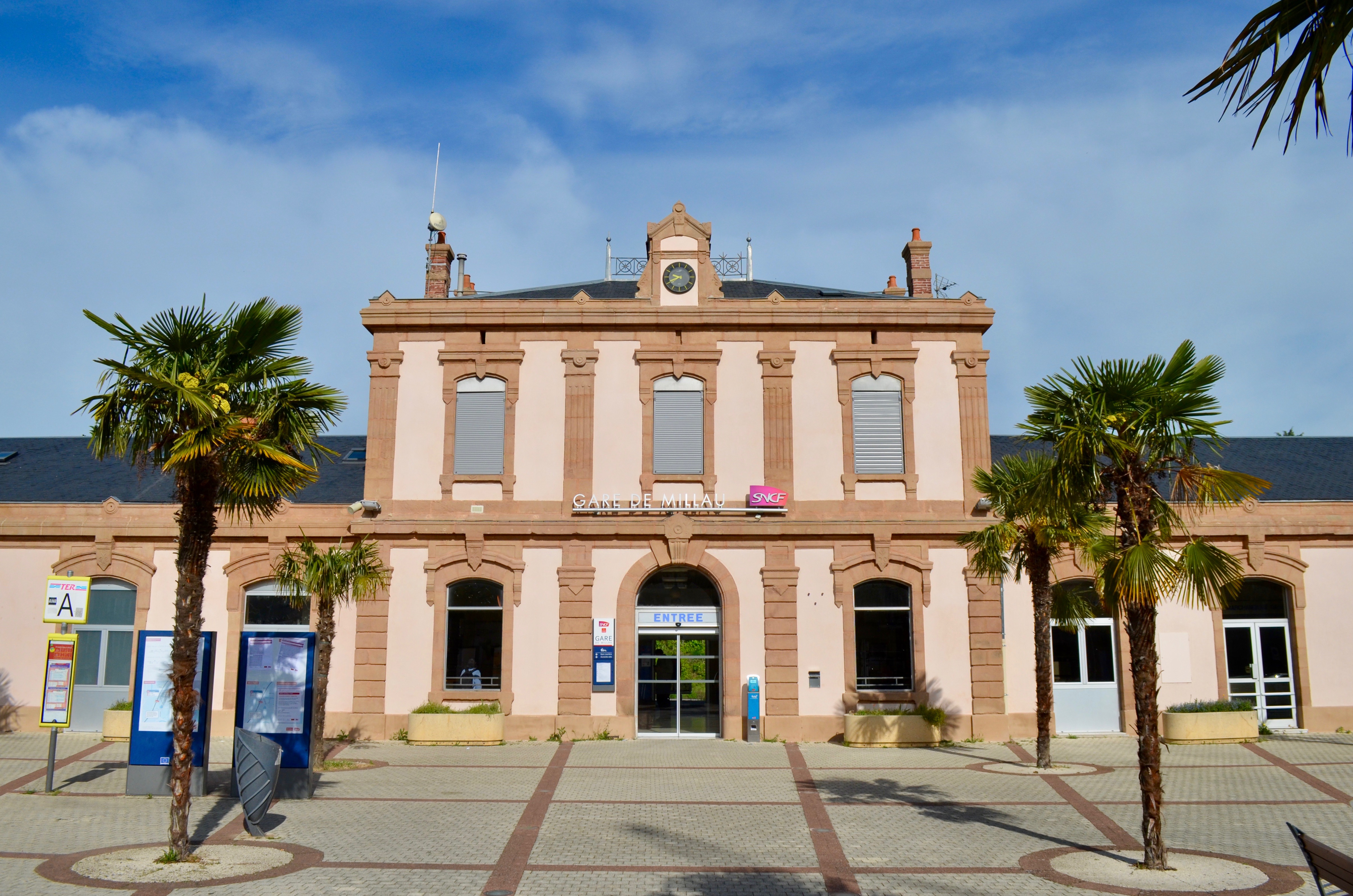
An arrival point is not a completed journey. Millau station, photographed on 12 May 2018, illustrates the article’s rail-and-coach starting point rather than the motorway crossing. The dated image does not verify today’s entrance layout, accessible transfer, departures or a shuttle to the viaduct. Read its visible signs as part of a historical photograph, not current journey instructions. Photograph: Snoopy 31, original and provenance, CC BY-SA 4.0, unaltered.

Visiting the viaduct is not the same as crossing it
The operator describes the bridge as a section of the A75, with nearby access north and south through motorway interchanges. Its FAQ makes clear that it is not an ordinary pedestrian or cycle crossing. Use authorised visitor spaces rather than attempting to walk or ride onto the motorway deck. Operator: access plan; Operator: viaduct FAQ.
The Viaduc Expo page states that the visitor area can be reached from either direction on the A75 or from Millau using the D911 and boulevard du Viaduc. It presents a free interpretation space with a model and construction imagery. This is an operator-run exhibition, not an independent municipal transport museum. Operator: Viaduc Expo.
The difference between the exhibition and the historical audit is worth keeping in mind. The former explains construction through objects and images; the latter examines a public infrastructure arrangement. Neither alone gives a complete account of how a resident without a car reaches work today. The mobility authority's current services answer that third question.
For 2026, the Expo page lists a closing time of 17:50 through 1 November, changing to 16:50 from 2 November; it also identifies annual closure days. Check its complete current schedule when planning. Do not transfer the opening hours of one facility to every service on the site. Viaduc Expo: dated opening information.
Test the trip, not the slogan
Use this short comparison before choosing a route:
| Your purpose | Main question | Check before committing | |---|---|---| | Continue along the A75 | Does the crossing serve this through-route? | Current traffic information and the toll for your vehicle/date | | Reach an appointment in Millau | Which local stop and arrival time fit? | Outbound and return service, booking deadline and final walk | | Arrive by rail or coach | What completes the journey after the station? | Dated connections and the final leg | | See the viaduct | Which authorised visitor area suits the visit? | Access route, facility opening and any tour booking | | Travel by bicycle or on foot | Which lawful local route is appropriate? | A route designed for that mode, not the motorway deck |
The operator says tolls depend on vehicle type, period and any applicable subscription. Use the live tariff rather than an old price quoted in a travel story. Similarly, an old traffic count is historical evidence, not a current congestion forecast. Operator's FAQ and tariff link.
For orientation, the Aire du Viaduc de Millau location search identifies the visitor-area name rather than a point on the motorway deck. It is not a surveyed entrance pin, a rendered map or an assurance of access for any particular mode.
The viaduct's role becomes more precise when it is not asked to stand for everything. It carries a major through-route across difficult terrain. Rural mobility also depends on smaller connections, timetables, booking arrangements and the ability to finish a journey. Seeing both scales is a better way to understand Millau than confusing an impressive crossing with universal accessibility.
Source register and limits
Remote sources include the state concession audit, regional inventory, transport authority and operator-run interpretation. No interview, physical visit, museum-object inspection or dedicated station-to-visitor-area shuttle verification is claimed. Historical traffic figures are not live forecasts. Free urban MIO, reserved and charged TAD, and Expo hours remain separate. The dedicated TAD page gives 16:30 booking, while an older station page states 17:00; confirm the actual journey rather than combining notices. One authentic 2018 Millau station photograph is reproduced, not a current access survey. A second relevant image was not secured: operator/municipal reuse terms and blocked bus metadata checks are documented; no generic transport filler replaces it.