Free · France
Understanding French Visa Categories
Start with the journey and the activity—not the visa name that sounds most familiar.
Two people may arrive on the same flight, stay in the same town and need different immigration arrangements. One is visiting family; the other has accepted a job. Another traveller may not need a visa at all, but still needs to meet the conditions for entry. “I am going to France” is the beginning of the question, not enough information to answer it.
This guide explains how to organise that question before using the official application process. It is general orientation, not an individual eligibility decision, legal advice or a substitute for the conditions attached to your own documents. Immigration rules and procedures can change; confirm your particular circumstances through official sources before committing to travel or work.
Begin with five facts
Write a short description of your plans using five headings:
- Person: nationality, passport or travel-document type, country of lawful residence, and any relevant existing residence permit or family status.
- Destination: the actual French territory and any other countries on the route.
- Activity: what you will do, including employment, study, training or joining family—not simply the address where you will sleep.
- Dates: intended arrival and departure, earlier relevant travel, and whether the plan is a visit or a move.
- Route: where you enter, whether you change airports, and whether you must leave an international transit area.
These are planning prompts, not a complete application checklist. Their purpose is to make missing information visible. Do not fill a gap with the category a friend used: that friend may have a different nationality, permit, family relationship or employment arrangement.
The official France-Visas visa wizard is the starting point for checking your situation. Keep the result associated with the facts you entered. If those facts change, an old result should not be treated as a permanent answer.
Short stay: separate the visa from the permitted days
For the Schengen short-stay framework, the central limit is generally 90 days in any rolling 180-day period. Whether you need a visa depends on circumstances including nationality and existing status. A visa exemption is not permission to ignore the applicable stay limit.
A multiple-entry visa's validity period is also different from the time you may spend inside the area. A document valid for a long period does not, by itself, authorise continuous residence throughout that period. Check its entries, dates, permitted duration and territorial scope together. France-Visas explains these distinctions on its short-stay visa page.
An original planning habit helps: keep two separate lines in your notes—“document validity” and “days of presence.” Do not use one as a substitute for the other. Where a rolling calculation is relevant, collect the actual travel dates before trying to assess remaining time. An uncertain travel history is a reason to resolve the records, not to assume a fresh allowance.
Long stay: the purpose and the endorsement matter
A stay exceeding 90 days generally points towards the long-stay framework, unless an exemption applies. France-Visas distinguishes purposes such as personal stays, work, study and family. It also identifies visa exemptions for certain nationalities, including EU, EEA and Swiss nationals, for metropolitan France. Avoid the blanket claim that every foreign national staying more than three months must obtain the same visa.
Within this framework, VLS-TS means a long-stay visa serving as a residence permit. A temporary long-stay visa, often abbreviated VLS-T, is a different category. Some visas instead require the holder to apply for a residence permit after arrival. The official long-stay overview is a guide to these distinctions, not an invitation to choose a label independently of eligibility.
The practical lesson is to read the actual endorsement on the document you receive. “Long-stay visa” alone is not a complete instruction for what happens next.
Arrival is not the end of the administrative process
France-Visas states that a VLS-TS must be validated online within three months of arrival. For a long-stay visa requiring a residence-permit application, it specifies a two-month deadline and contact with the prefecture for the place of residence. Follow the procedure applicable to the actual document and check the current official channel; do not substitute another person's route.
Entry requirements also remain a separate question. The authorities may request supporting documents concerning accommodation, resources, insurance or the purpose of travel, subject to applicable exemptions. A visa should not be described as an unconditional guarantee of admission. See France-Visas: arrival in France.
Create a personal arrival note with the document's exact wording, the relevant official procedure and a deadline calculated from your real arrival date. Keep this separate from a holiday itinerary. If the instructions seem inconsistent, resolve them with the competent authority rather than choosing whichever deadline is later.
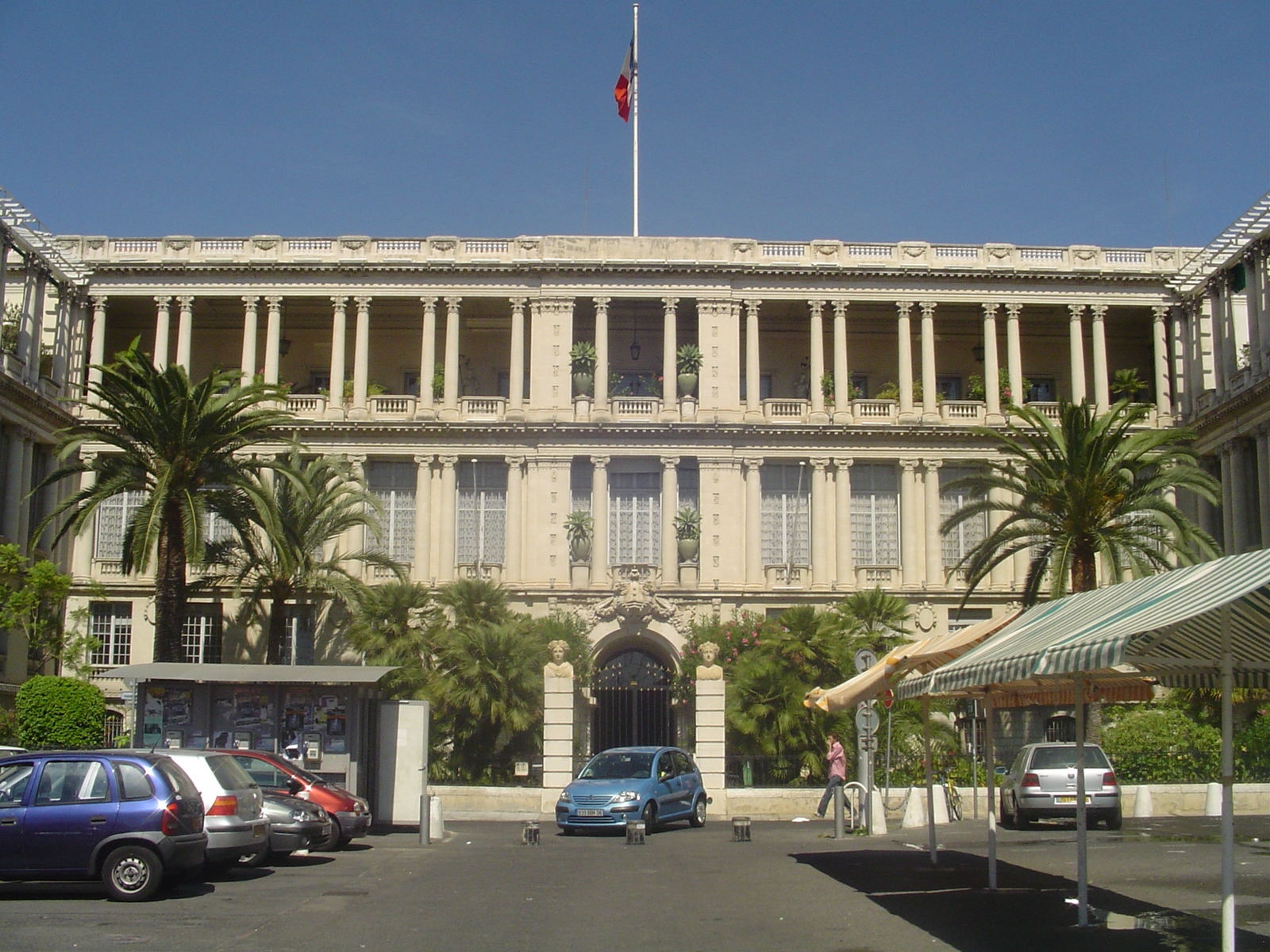
Nice's historic Palais préfectoral, 5 September 2007. Photo: SHERWOOD / mwanasimba, CC BY-SA 2.0. Administrative heritage illustration, not a visa counter or recommended application venue. The Alpes-Maritimes prefecture's history identifies the palace as a prefectural residence since 1982. Original photograph, unaltered.
Transit is its own question
An airport transit visa, commonly called type A, concerns certain travellers passing through an international airport transit zone. Requirements and exemptions depend on nationality, documents and circumstances. It does not authorise entry into the Schengen area.
Changing airports or needing to leave the international zone changes the problem. An overnight connection may also require careful checking of whether remaining airside is possible. Read the official airport-transit guidance alongside the actual itinerary; do not assume that the word “connection” means no entry formalities.
For planning, draw the route as separate steps: arrival terminal, baggage arrangements, next terminal or airport, overnight location, onward flight. Mark every point whose airside status is unknown. An airline itinerary is evidence of the flights booked, not by itself a complete immigration assessment.
The activity cannot be hidden inside a duration
A short trip is not automatically a tourist trip. France-Visas has separate salaried-employment guidance, including work-authorisation requirements and defined exemptions for particular situations. Visa and work-authorisation questions must therefore be considered together where employment is involved.
Describe the real activity before looking for an apparently convenient category. If an employer or host is involved, ask which official route they are using and what supporting steps they must complete. Do not relabel paid activity as tourism simply because the stay is brief. Conversely, do not assume that every professional visit follows the same employment procedure: the exact activity matters.
Three ways to ask a better question
These fictional examples illustrate information gaps; they do not establish anyone's eligibility.
A two-week visit: “I am staying fourteen nights” is incomplete. Add nationality, travel document, destination, purpose and relevant previous travel. The useful next step is a situation-specific check, not an automatic visa application or an automatic assumption of exemption.
A six-month move: “I need a long-stay visa” may still be too broad. Is the person studying, joining family, working or planning a personal stay? Is an exemption relevant? What will the issued document require after arrival? The category and the follow-through belong in the same plan.
A connection through Paris: “I never planned to visit France” does not settle whether the route involves entry. Identify airport changes, baggage collection and overnight arrangements. The operational route and the traveller's documents determine which questions must be resolved.
In each example, the improvement is not a clever shortcut. It is a more accurate description of the situation presented to the official process.
Leave with a question sheet, not a guessed answer
Before acting, you should be able to state your actual destination and activity, identify the documents already held, and distinguish travel dates from document validity. Keep unresolved points explicitly marked unknown. Record the official page or authority used and when you checked it.
This structure will not decide an application for you. It will help prevent three avoidable mistakes: treating a familiar label as universal, confusing permission to enter with permission to stay or work, and overlooking an obligation that begins after arrival.
Sources and scope
Official France-Visas guidance and the Alpes-Maritimes prefecture's historical page were checked remotely on 29 October 2026. This article is general category orientation, principally for metropolitan France; it does not assess individual eligibility or explain every overseas-territory rule. Confirm the exact destination in the official process. No application, appointment, visa-wizard assessment or immigration decision was performed for the reader. The photograph is a dated contextual illustration, not current administrative evidence.