Free · France
Maternelle, Élémentaire, Collège, Lycée
French school vocabulary describes several different things at once: a stage of education, a year group, a learning cycle, a particular establishment and sometimes a qualification route. Understanding the difference is more useful than finding a single English translation for every word.
Start with four broad stages: maternelle → élémentaire → collège → lycée. This is a map of the system, not an individual placement decision or a promise that every pupil follows the same route at the same age.
First, learn the year-group names
Maternelle is usually organised into petite section, moyenne section and grande section. The Ministry places it at the beginning of compulsory instruction, which starts at age three. Elementary school generally covers ages six to eleven. Treat those ages as orientation, not a substitute for the school authority's decision about a particular pupil. Education Ministry: organisation of school.
| Stage | Labels you will encounter | Read the label as… | |---|---|---| | Maternelle | Petite section, moyenne section, grande section; often PS, MS, GS | Early school year groups, not separate qualifications | | Élémentaire | CP, CE1, CE2, CM1, CM2 | Five successive elementary year groups | | Collège | Sixième, cinquième, quatrième, troisième; 6e, 5e, 4e, 3e | Four secondary year groups; the number decreases as pupils progress | | Lycée, baccalauréat routes | Seconde, première, terminale | A route towards a baccalauréat, with the pathway identified separately |
The elementary sequence expands to cours préparatoire, cours élémentaire première/deuxième année and cours moyen première/deuxième année. The Ministry also clarifies that primaire includes both maternelle and élémentaire. It is not simply another name for CP–CM2. Education Ministry: elementary school, dated 20 January 2025.
A notice saying “école primaire” therefore does not, on its own, tell you which classes a particular site contains. Read the establishment's actual class information. Likewise, a numeric class label is not an age: sixième is not a class for six-year-olds.
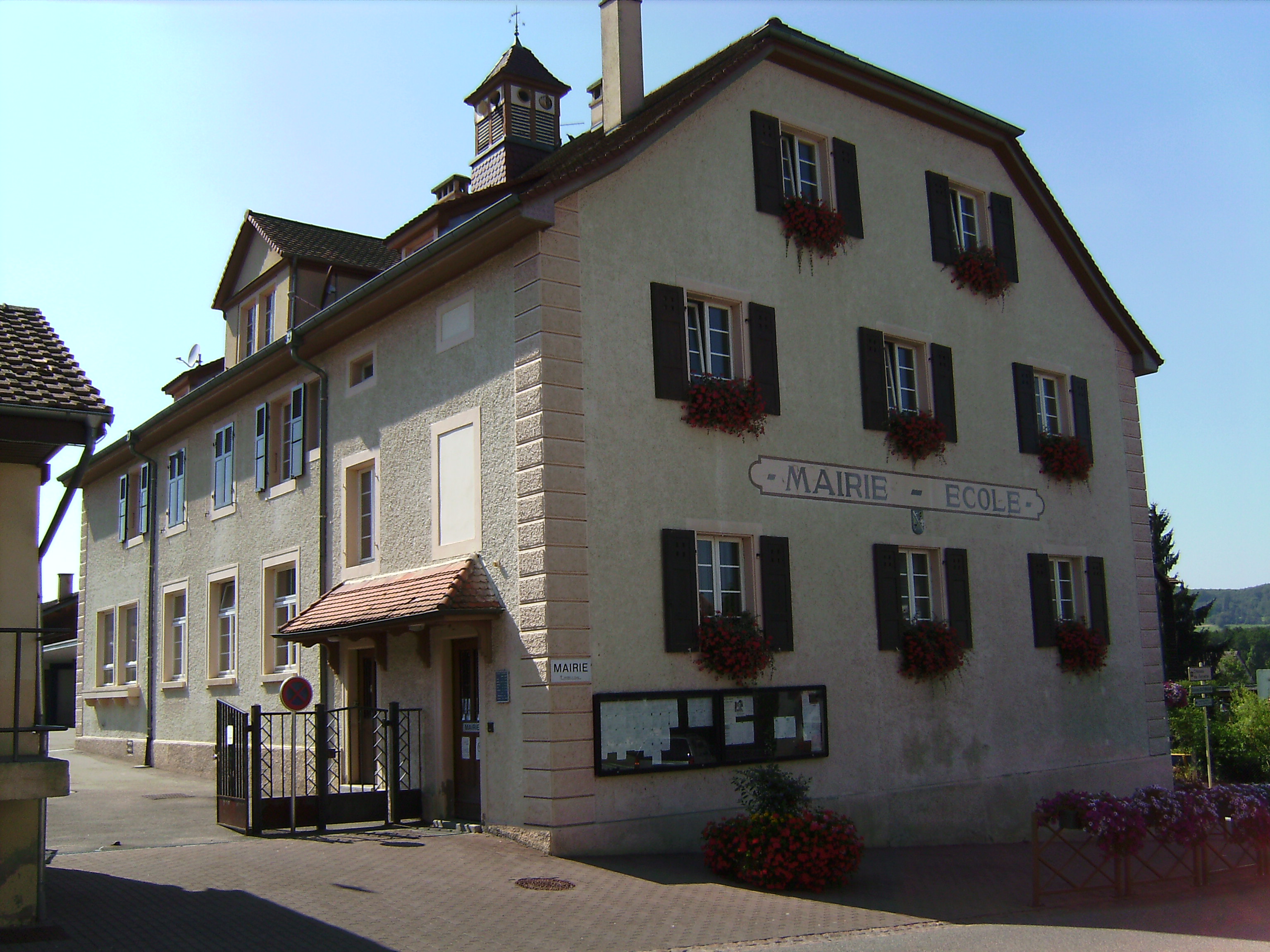
“Mairie–École” lettering in Leymen, photographed in an image uploaded in 2007. The sign illustrates school vocabulary; it does not establish whether the premises served maternelle, élémentaire or both. Photograph: Vitaly Volkov, original, CC BY 2.0. Capture date unverified; image unchanged.
A cycle can cross a building boundary
A cycle groups years of learning; it is not always confined to one kind of establishment. CP, CE1 and CE2 form cycle 2. CM1 and CM2 begin cycle 3, which continues into sixième at collège. This cross-boundary structure explains why a pupil can change establishment while remaining within the same learning cycle. The detailed elementary-school page linked above makes that continuation explicit.
The collège page identifies sixième as the end of cycle 3 and cinquième, quatrième and troisième as cycle 4. It also describes collège as the entry into secondary education after elementary school. Education Ministry: collège, dated 4 December 2025.
This distinction is especially helpful when reading a meeting invitation. “Cycle 3” might concern continuity between primary and secondary teams; it does not mean a third year in the same building. Ask whether the notice is about the pupil's class, a whole learning cycle or a transition to another establishment.
Lycée is not one undifferentiated destination
The standard baccalauréat sequence uses seconde, première and terminale. The general and technological route has a common seconde before the later distinction between those pathways. A professional baccalauréat uses seconde professionnelle, première professionnelle and terminale professionnelle. But vocational education also includes other qualifications: the Ministry describes CAP preparation after troisième as a two-year route, and notes that CAP and the professional baccalauréat can be prepared through apprenticeship. Thus, “after collège” does not always mean the same three-year timetable. Education Ministry: lycée, dated 21 January 2026.
These are structural examples, not an exhaustive catalogue of qualifications or an individual recommendation. When comparing two options, record the qualification, pathway, establishment and training status separately. Two programmes in a building called a lycée can lead to different qualifications and involve different arrangements.
The AEFE's overview confirms the broad four-stage sequence and distinguishes general/technological and professional lycée education. Its context is French education abroad; that does not establish the fees, admission process or availability of a particular school in France. AEFE: main stages, published 11 January 2024.
Decode a school notice in four passes
Use this original reading method before turning an unfamiliar label into an action.
- Find the stage. Is the notice about maternelle, elementary school, collège or a post-collège route?
- Find the exact class or qualification. Copy CM2, 6e, seconde professionnelle or the named CAP without translating away the distinction.
- Identify the purpose. Is it information, a request for preferences, an allocation decision or an instruction to register? Similar-looking documents can do different jobs.
- Extract the next action. Write the responsible office, the requested item and the deadline actually printed on that notice. If one is missing, ask rather than supplying a generic date from another town.
This is a reading tool, not a new administrative procedure. A family still follows the instructions issued for its own case.
Three fictional misunderstandings
“The next class has a smaller number, so this must be a step backwards.” A move from 6e to 5e follows the ordinary collège sequence. The numeral alone does not express a judgement about progress.
“The document says cycle 3, so it cannot concern a collège.” Sixième belongs to that cycle. Check the class and establishment rather than rejecting the notice because of the cycle label.
“We have a place allocated, so there can be nothing else to do.” The Ministry's collège page explicitly distinguishes allocation from registration when describing the move to lycée. Read the designated establishment's enrolment instructions and retain evidence that the required step was completed. Do not infer registration from an allocation notice alone.
A compact school-stage note
Keep this note alongside the actual school document. It deliberately contains no automatic age-to-class calculator.
| Field | Your entry | |---|---| | School year concerned | ___ | | Stage and exact class/pathway | ___ | | Establishment named in the document | ___ | | Qualification being prepared, if relevant | ___ | | What the document does: information / preference / decision / registration | ___ | | Action, recipient and actual deadline | ___ | | Remaining question and where to ask it | ___ |
Do not use the note to predict a placement for a newly arrived pupil or to equate a foreign qualification automatically with a French one. Its job is narrower: to make the vocabulary visible, preserve the wording of the actual decision and prevent a missed next step.
The most useful understanding is not “French schools are just like my home system with different names.” It is that stage, class, cycle and pathway are different coordinates. Once those coordinates are separated, a school notice becomes easier to read without oversimplifying the pupil's route.
Sources and scope
Five official pages were read remotely on 29 October 2026; links accompany the relevant claims. This overview explains the basic structure, not admissions eligibility, compulsory-instruction exceptions, examination regulations or individual orientation. No automatic equivalence with another country's grades is asserted. Local deadlines and personal placement remain matters for the appropriate educational authority and establishment.