Free · France
Guérande: Walled town markets and maritime hinterlands
The most useful feature for understanding Guérande’s market is the relationship between its covered hall and the open space around it. The municipality places the regular market both inside the hall and on Place Saint-Aubin, within the walls. This is a working arrangement, not merely a picturesque setting: trade occupies a building but also needs surrounding public ground. Looking closely at that arrangement reveals a town connected to a wider coastal economy without mistaking the town centre for a harbour. Ville de Guérande, Les marchés de Guérande.
Guérande is today in Loire-Atlantique, in the administrative region of Pays de la Loire. Its historically Breton context is a different geographical frame, not a competing statement about its present department. The municipality describes its position between the ocean-facing ports, Brière and the salt marshes. Those surroundings matter here as places of production and movement, rather than as additions to a sightseeing itinerary. Ville de Guérande, Guérande au cœur de la Presqu’île.
An old market does not mean a medieval roof
The Musée de Guérande’s architectural account dates the present hall, facing the collegiate church of Saint-Aubin, to 1912. Its metal roof structure succeeded the timber-framed hall dated to 1686. The museum also describes the earlier building as a halle-auditoire: a market hall associated with a courtroom. It formerly opened towards the collegiate church’s cemetery, subsequently transferred elsewhere. The relationship between commerce, civic functions and neighbouring ground has therefore changed, even where the market’s central position remained recognisable. Porte Saint-Michel Musée de Guérande, Une architecture civile, p. 2.
This chronology deserves more care than the convenient label “historic market.” The council’s current event page calls the hall nineteenth-century, whereas the museum’s specialist architectural account gives 1912. For the building’s date, the more specific museum account is the better evidence; the event page is useful for the present market’s location and operation. A long-standing activity and the age of the structure accommodating it are separate questions. Calling the whole scene medieval would erase the rebuilding that helped it continue as a place of exchange. Ville de Guérande, Le marché de Guérande.
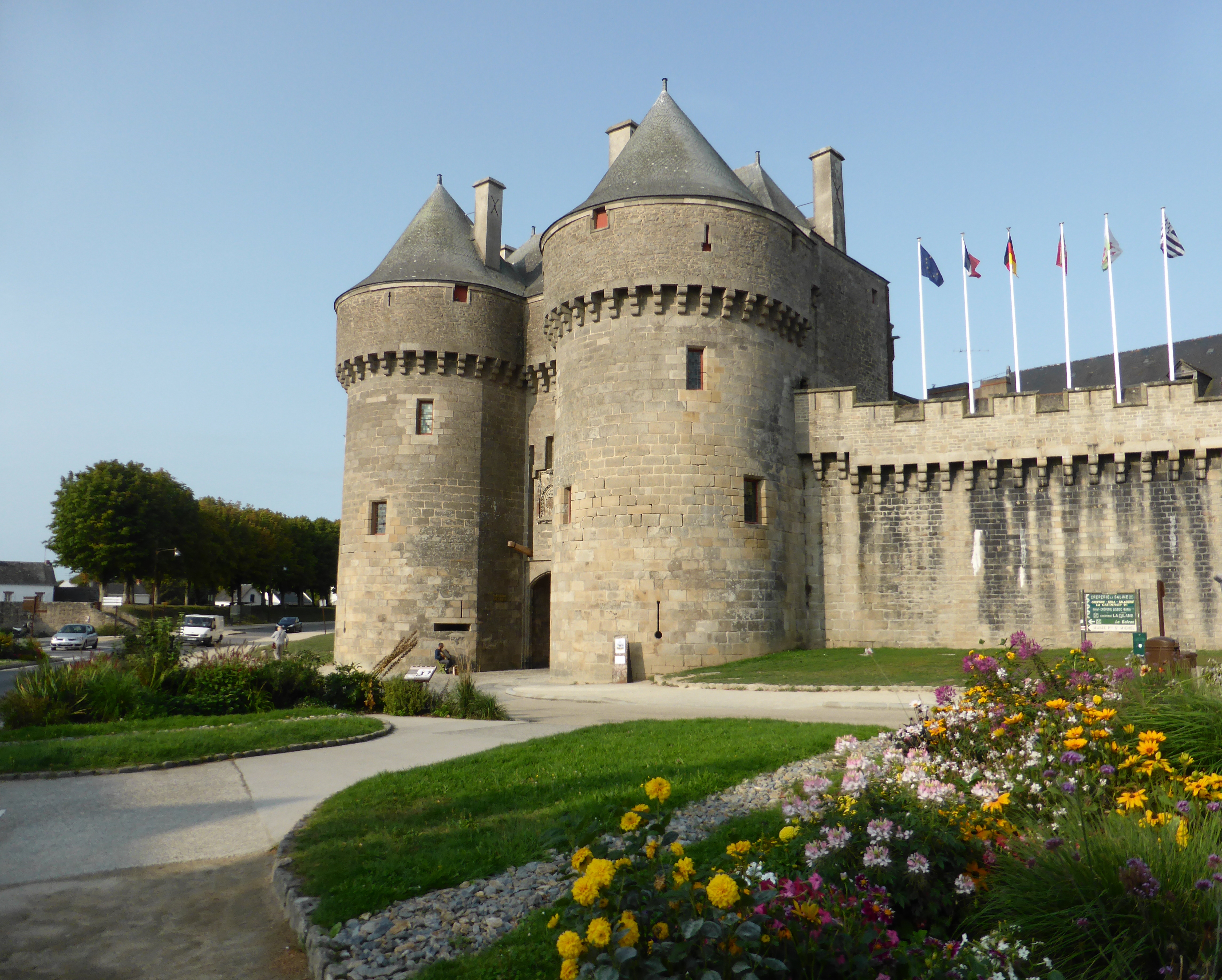
Porte Saint-Michel in August 2017. The gateway gives a visible setting to the museum account of controlled entry and provisioning. This is not the market hall, nor evidence of the particular routes or tolls used by past traders. Photo: Andrea Corsica, Wikimedia Commons; CC BY-SA 4.0. Unmodified by publisher.

The threshold was part of the market system
The walls are easiest to read as a boundary against attack. The museum’s account of the Porte Saint-Michel adds another function: the town captain, resident in the gatehouse and representing the duke of Brittany, was responsible for provisioning as well as defence, and controlled taxes and entry. His responsibilities brought the movement of supplies into the same institutional frame as the protection of the town. Porte Saint-Michel, Histoire et architecture.
That evidence changes how the market’s enclosure should be understood. A protected centre still needed things to arrive from outside; a gate was a managed opening, not a declaration of economic self-sufficiency. This does not establish that every seller followed one route or paid the same charge. It does suggest a useful way to connect the hall to the wall: the selling space and the controlled threshold belonged to different stages of getting supplies into town. The military-looking entrance cannot explain the market alone, but neither should it be detached from the everyday question of provisioning.
The maritime part lies beyond the market square
Le Croisic’s municipal history offers a physical counterpart to Guérande’s market space. It describes the port’s artificial quay-side platforms and the Mont-Lénigo and Mont-Esprit as places formed from ships’ ballast, discharged before vessels loaded Guérande salt for export. It also records the use of the Traict for communications between the Guérande area and the Croisic peninsula until the middle of the nineteenth century. Here maritime exchange left different built forms from an inland covered market. Ville du Croisic, Laurent Delpire, Histoire du port.
The distinction is essential. A commodity bearing Guérande’s name could pass through a neighbouring port, while the walled town performed other commercial and administrative functions. A quay, a market hall and an office are not interchangeable evidence. Their coexistence helps explain a connected territory, but does not demonstrate that export cargoes were first assembled on Place Saint-Aubin. The maritime hinterland belongs in the market’s explanation without being squeezed inside its walls.
A coastal economy also needed food and paperwork
The regional heritage inventory explains that the expansion of salt production reduced space available for subsistence production and encouraged the return of cereals by sea through exchange for salt, known as troque. It also cautions that the fleet called “Guérandaise” was largely associated with Le Croisic. These are regional relationships, not a manifest of goods delivered to the hall. Région Pays de la Loire, Inventaire général, Marais salants de Guérande, IA44003705, Présentation.
The same inventory’s historical synthesis gives Guérande a specific administrative role in 1817: permits for the restored land-based salt exchange were issued there, and customs officials required travellers to follow supervised routes. The connection with the marshes thus involved authorisation as well as buying and selling. This published interpretation of historical evidence is not an inspection of the original permits. Nevertheless, it prevents a misleadingly simple picture in which “local commerce” means only goods offered at an open stall. Movement itself could require a journey to town. Inventaire général, IA44003705, L’activité et le commerce salicoles.
Maritime authority was not the same thing as a harbour
An educational history published by the Loire-Atlantique departmental archives identifies an admiralty seat at Guérande, a jurisdiction concerned with maritime affairs. Its discussion separately names ports from which vessels departed, including Le Croisic. Although the page chiefly explains Nantes’s growth, this distinction is useful for reading the smaller town: an institution could exercise maritime authority without occupying a waterfront loading place. Archives départementales de Loire-Atlantique, L’essor d’un grand port 1500–1700.
This does not locate the admiralty inside the former market hall. The hall’s courtroom history and the archives service’s maritime jurisdiction are different pieces of evidence, not permission to merge their premises. Read alongside the later customs account, they show why administration belongs in an economic reading of Guérande. The market was one kind of central place within a territory whose business also required decisions, records and supervision.
What the museum adds to the supply picture
The museum’s retrospective account of its 2024–25 exhibition Moulin, tu dors ? restores an easily overlooked activity to this coastal setting. Its windmills were used for flour milling, an essential part of everyday local life. The museum describes their declining use towards the end of the nineteenth century as industrial flour mills gained ground. This is evidence about food processing and changing technology, rather than another account of salt harvesting. Porte Saint-Michel, Les expositions temporaires passées, Moulin tu dors.
Milling makes the market’s wider setting more intelligible. A territory associated with a valuable export also needed the unglamorous work of making staple food usable. Production, processing and sale should not be collapsed into one activity simply because all contribute to provisioning. Nor does a mill’s existence identify the customers for every batch of flour. The exhibition supplies a missing economic function, not a proven delivery round to the hall.
The collections catalogue brings this wider working landscape into a named object. It identifies Ferdinand du Puigaudeau’s Moulins de Guérande, dated 1910–1930, as a preparatory drawing representing one of the six Moulins de la Place. The museum situates that group on the Guérande hillside facing the salt marshes. Its cautious identification of the individual mill matters: the catalogue says which one is probable, rather than treating the attribution as certain. Porte Saint-Michel, Les collections et l’histoire, Dernières acquisitions.
A drawing preserves a selected view; it is not a flour account or a transport register. Its value here is spatial and interpretive. It places another kind of productive building in the landscape around the town and counters the tendency to let the marshes stand for the entire economy. The hall can then be understood as a space serving a mixed territory, rather than as the architectural expression of one commodity alone.
A market kept working through organisation
The present municipality describes a year-round intramural market on Wednesday and Saturday mornings, with a larger footprint in high season. It also identifies Frery as the company entrusted with organisation, management and development through a public-service delegation. The contemporary market therefore has an operating structure as well as a heritage setting. Ville de Guérande, Les marchés de Guérande.
The event page adds that summer expansion reaches streets around Saint-Aubin. That seasonal use of adjoining ground is important to the narrow subject of the hall and its square: the building alone is not the whole market. This official description establishes the stated arrangement, not independently measured attendance or the provenance of every product. Ville de Guérande, Le marché de Guérande.
The architectural implication is that the market’s capacity cannot be read from its roofline. Covered accommodation is one resource; adjoining streets offer another. The municipality describes the two being used together, with their relative extent changing seasonally. Preserving a market in such a setting means considering the relationship between building and public space, rather than treating the hall as an isolated object whose story ends at its walls.
What persists is not an unchanged medieval scene. The evidence instead reveals a market accommodated by replacement structures, organised access and a larger supplying territory. Museum interpretation identifies buildings and working practices; civic publications describe contemporary use; archival and inventory accounts explain institutions and circulation. Together they make Place Saint-Aubin more than a decorative space within famous walls. Its significance lies in the practical relationship between a selling place and a world outside it, while the exact paths taken by particular goods remain questions for more detailed records.
Locate the town
For regional orientation, open a Google Maps search for Guérande. This community-level search is not an exact building entrance, a verified walking route or permission to enter a workshop, museum or private property. Check the institution’s own current access information separately.