Free · France
Meaux: Brie cheese production and regional markets
A wheel with a town's name
Brie de Meaux connects a large, shallow cheese to a particular market town, but the connection is not a promise that every wheel was made within Meaux. INAO describes a production territory extending eastward from Seine-et-Marne towards the Meuse, with additional historically established locations permitted for ripening. It also recalls a trade in farm-produced cheeses sold at Meaux to Parisian affineurs, the specialists who brought them to maturity. The town's name therefore carries a history of exchange as well as manufacture. INAO, Brie de Meaux
The narrow feature followed here is the wheel as it passes between different kinds of work: forming, ripening, presenting and selling. Its shape makes a useful starting point because it can be related to a documented tool. The market hall then supplies a second scale of evidence: not the skilled movement of a hand, but the civic arrangements that brought products and buyers together. Neither can explain the cheese's local identity alone.
The hand inside the specification
The production specification linked by INAO, published in 2020, gives unusually concrete meaning to hand-moulding. It describes thin successive layers of curd transferred into cylindrical moulds with a pelle à brie. This is a broad, perforated, round implement, with a handle extending above and back towards its centre. Its holes let whey escape. The document distinguishes the horizontal cutting performed by the tool from the permitted vertical cutting of curd in the basin. Ministry of Agriculture, specification, section 5.2.2
This is more informative than calling the cheese simply “traditional.” Tradition here includes a specified operation and an implement suited to it. The maker is not merely placing a finished object into packaging; the wheel takes form through repeated transfers of a still-changing material. Reading the specification as evidence of work also avoids turning a protected name into a vague claim that all aspects of production have remained unchanged for centuries.
An implement with a recorded workplace
The Musée départemental de la Seine-et-Marne's teaching dossier provides an object-level comparison. Its entry for a pelle à brie de Meaux, inventory 2001.23.2, records use at the Société fromagère de la Brie in Saint-Siméon. The description identifies a slightly concave, perforated circular blade and an upper handle. Beside it, the dossier identifies a different implement, a ladle, for Brie de Melun. These are departmental collection records, not objects claimed here to be housed in a Meaux museum. Departmental museum, cheese workshop dossier, PDF page 8
The recorded workplace matters as much as the outline of the tool. It locates one example within a regional manufacturing network rather than assigning it automatically to the town on the cheese's label. Nor does an inventory number tell us how many wheels a particular worker made, how that worker was paid, or whether the task felt monotonous. Those questions require evidence beyond the surviving implement.
Between making and selling
The Confrérie du Brie de Meaux's explanation makes the affineur a distinct participant rather than an invisible interval between dairy and shop. It describes cheeses arriving after initial manufacture, losing excess moisture in controlled rooms, and undergoing supervised ripening with repeated turning before distribution. Its account presents this work as a link between production and consumption. Confrérie du Brie de Meaux, fabrication
Read as the explanation of an organization devoted to promoting the cheese, this is evidence of how local advocates describe the craft. It is not a neutral assessment of every business. Yet the distinction it draws is useful: selling a ripened wheel involves time, storage and judgement, not just moving milk from countryside to town. The market's historical importance need not imply that every stage occurred under one roof or within one municipal boundary. A place can become closely identified with a product by organizing its circulation and recognition as well as by making it.
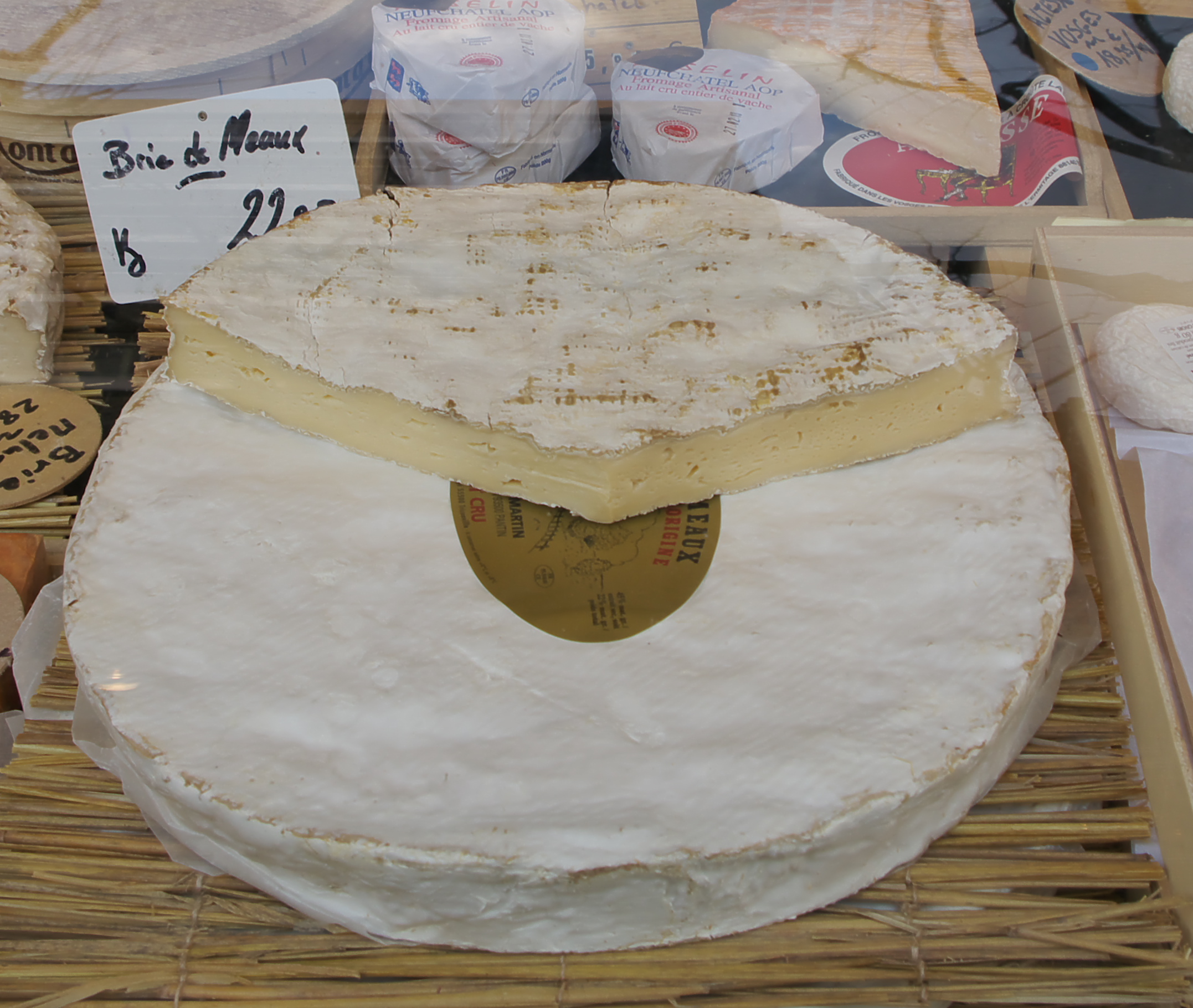
Brie de Meaux offered at a market in February 2013. The wheel, cut portion and handwritten label show a retail presentation; the photograph does not identify this as Meaux’s historic market hall, verify current prices or endorse a producer. Photograph: Dinkum, CC0 1.0; unmodified.

The hall was not a cheese factory
The regional heritage inventory dates the inauguration of Meaux's metal market hall to 25 October 1879, following the replacement of an older wooden building. Designed by Miret, it was quickly associated with the name halle aux fromages. The inventory nevertheless describes different internal trading areas: tiled cement stalls for meat and fish in the north, with wooden trestles and boards for cheese in the south. Its structural account records cast-iron columns supporting an iron frame and zinc roof. Île-de-France heritage inventory, IA77000662
The contrast with the dairy is decisive. The hall arranged encounters between goods and purchasers; it was not the apparatus that formed or matured the wheel. Its more durable materials also should not make us imagine an unchanging interior. The inventory explicitly records repeated alterations. A recognizable building could accommodate adjustments in trade, equipment and the distribution of space. The name preserves a strong association, not a complete inventory of everything ever sold there.
A municipal archive complicates the name
Meaux's municipal archives offered a sharper qualification in the city's 2022 journal. Their account reproduces the history of Miret's projects and explains that an early scheme envisaged four halls, although only one was built. It also says the building called the cheese hall was not dedicated to that use, while listing cheese among the diverse goods traded. The same article describes competition over trading positions and charges, and the development of market policing. Archives municipales de Meaux, “Trésors d'archives,” printed page 42
That wording should not be silently converted into a claim that cheese was absent. Read alongside the inventory's account of cheese tables, it supports a cautious conclusion: the hall's identity was broader than its nickname. The evidence also restores an administrative side to everyday exchange. A stall was a position within an organized market, not simply an empty patch of ground. Space had to be allocated and competing claims managed.
Making Brie in Meaux is a specific fact
Documented local production can be considered without pretending that the wider appellation contracts to the town's borders. The regional public brand Produit en Île-de-France's profile, consulted on 27 October 2026, lists the Société fromagère de Meaux Saint-Faron on rue Jehan de Brie and includes Brie de Meaux among its products. Its historical profile dates the enterprise to a merger in 1998 and describes a subsequent concentration on other cheeses, especially Brie de Melun. Produit en Île-de-France, Saint-Faron profile
A local tourism account reproduced in the government's May 2025 accessibility compilation describes Terre de Meaux as made and ripened in the city, with hand-moulding and a maturation period longer than the appellation's minimum. That is a dated description of a particular product, not a universal production timetable. Délégation ministérielle à l'accessibilité, Meaux section, PDF page 23
Together these sources suggest a more interesting local story than an uninterrupted survival narrative: a working enterprise can change its product emphasis while retaining and renewing regional skills.
From a shared method to different wheels
The interprofessional organization groups milk producers, manufacturers and affineurs. Its production explanation ends with cheeses being weighed and wrapped for sale either whole or in portions. This final step is easily overlooked when the circular wheel becomes the emblem of an entire locality. The product encountered by a customer may be only a segment, separated from the full form through which it was made and matured. Union interprofessionnelle, fabrication
The distinction helps connect the tool to the market without inventing a single journey for every cheese. A production method does not disclose an individual wheel's route, and a retail counter does not reveal all the work behind it. Labels, producer information and business records would be needed to reconstruct that route. The interprofessional body's account explains a sequence; it does not supply a census of Meaux's traders or their customers.
The point is not to rank the maker above the seller, or the countryside above the town. Each source makes a different activity legible. An account concerned with moulding naturally foregrounds the hand and curd; a record concerned with stalls foregrounds placement and competing uses. Bringing them together changes the questions we ask of a familiar food. Instead of asking only where it originated, we can ask where its form was established, where its maturity was assessed, and where its name acquired commercial recognition. Those are connected questions, but they need not have the same geographical answer.
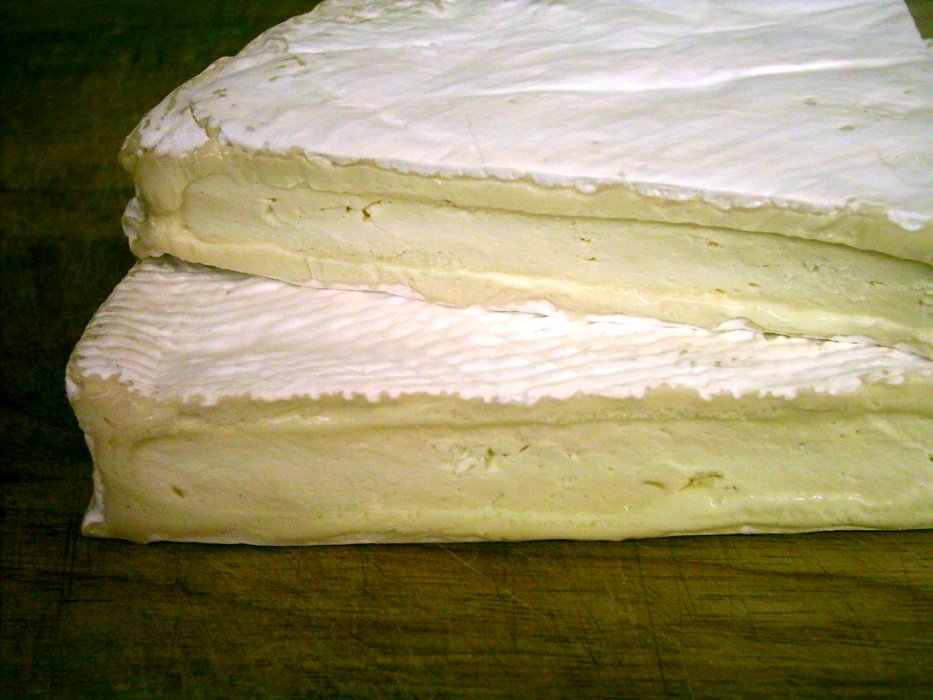
Cut portions of Brie de Meaux photographed in January 2005. The close view distinguishes rind and interior; it does not reveal the individual cheese’s manufacturing site, exact maturity or route through the market. Photograph: Dominik Hundhammer, CC BY-SA 3.0; unmodified.

What the name holds together
The documentary contrasts are the point of this local history. A technical specification tells us how a recognized product is formed. An accessioned tool anchors that process to a particular workplace. An architectural inventory describes the trading building, while a municipal archival account questions an overly literal reading of its name. A producer profile identifies an enterprise, but cannot stand for every maker across the region.
Keeping those scales separate makes Meaux's role clearer. The town does not need to contain every farm, ripening room and seller to have a substantial connection with the cheese. Its identity emerges through relationships among them. The broad wheel and the mixed-use market hall are complementary traces of those relationships: one shaped through skilled handling, the other maintained through construction, allocation and civic oversight. Neither is only a picturesque survivor. Each invites attention to the work required before a familiar local name can arrive at a customer's table.
Location orientation
Meaux, France — general map search. This town-level orientation is not a verified entrance, accessible route, opening schedule or permission to enter a production or heritage site.
Source register and evidence limits
Opened 27 October 2026. All linked sources above were opened as full text or extracted PDF text, rather than used only through search snippets.
- INAO: product geography and historical market/affineur relationship. The record also lists a September 2026 temporary amendment; feed rules are deliberately not summarized here.
- Ministry specification (2020): moulding section only; not presented as a complete consolidated legal guide.
- Departmental museum dossier: object 2001.23.2 and provenance; screenshot retrieval failed, so the account relies on catalogue text, not visual inspection of the object.
- Confrérie / interprofessional organization: identified industry and promotional voices, used for their descriptions of work rather than independent quality judgements.
- Regional inventory / municipal archives: building history and mixed uses. The 2022 journal's page was also opened as a screenshot. The inventory's non-communicable archival images were not accessed.
- Regional producer profile / government-hosted 2025 account: identified business and dated production description. No employment, supplier-count, market-share or current opening-hours claim is made.
Gaps: Maison du Brie municipal/tourism pages and a tourism booklet could not be fully opened; no detailed exhibition claim is drawn from their snippets. The 2026 amendment's Journal officiel page returned a fetch error, so current livestock-feed requirements remain outside scope. The archive and inventory differ in wording about the hall's cheese use; their shared evidence for mixed commerce is retained, without claiming exclusive use or absence of cheese. No transaction ledgers, maker interviews or verified continuity of city production were obtained. Current market arrangements and any publication-sensitive technical requirements require a fresh check before release.