Free · France
Fontainebleau: Civic and military life in the town streets
A barracks name on a university address
Fontainebleau's military history is not confined to ceremonial scenes at the château. On the university's current location page, the Institut d'études politiques is still identified by the words Caserne Damesme, followed by its address on rue du Docteur Clément-Matry. The old designation survives within the practical directions to a place of study. Université Paris-Est Créteil, Fontainebleau campus
The narrow feature examined here is the changing relationship between this former barracks site and the surrounding streets. Its reuse raises questions more concrete than whether Fontainebleau is a “military town” or a “university town.” Which parts are occupied? What remains to be converted? How does activity inside affect space outside? The name alone cannot answer them. It does, however, provide a starting point for following successive uses of one substantial urban site rather than assembling a catalogue of monuments or regiments.
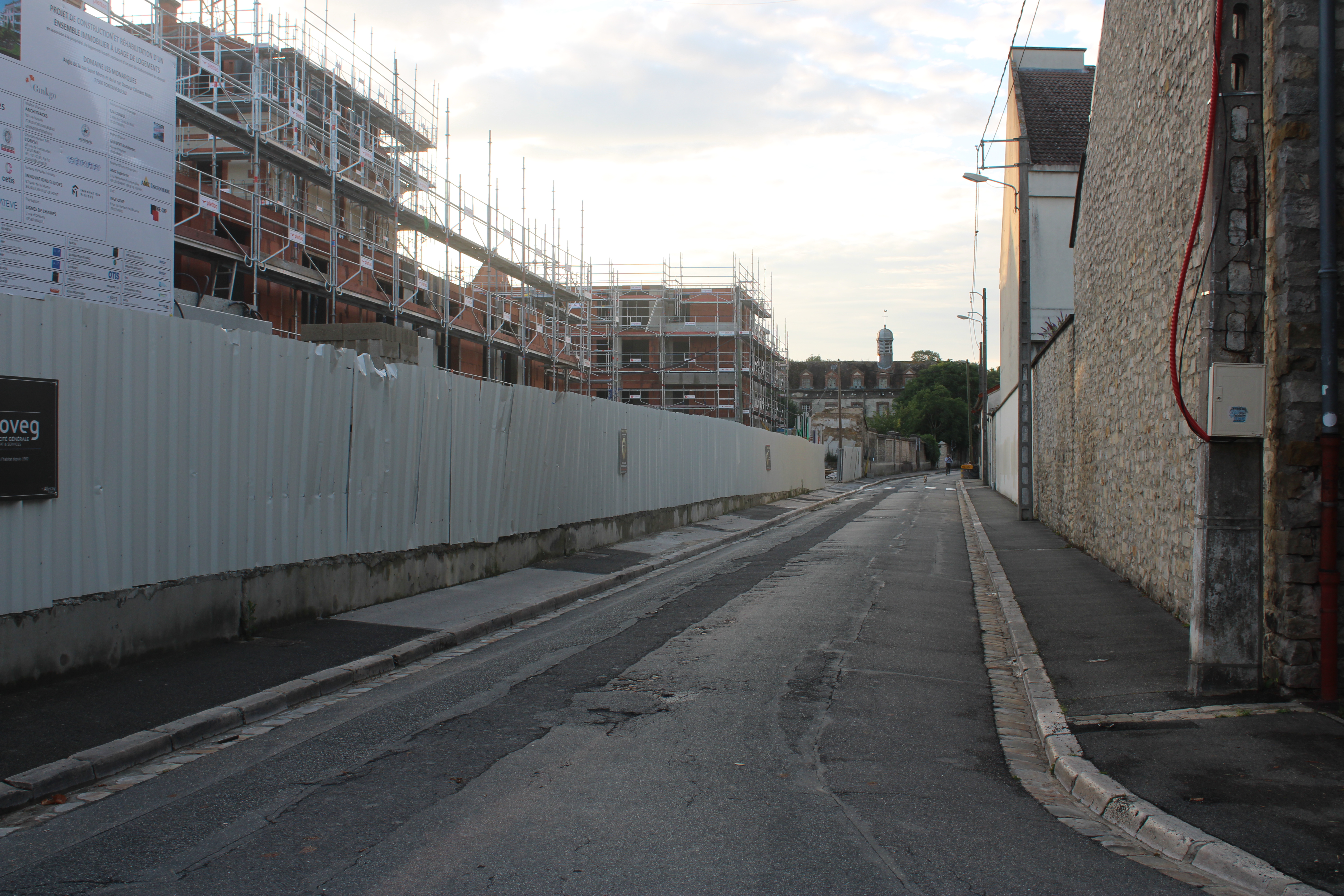
Rue du Docteur-Clément-Matry seen from boulevard Damesme in August 2021. The street view provides dated spatial context, not proof of campus completion, the purpose of the visible construction or current access conditions. Photograph: Baidax, CC BY-SA4.0; unmodified.

Instruction brought people back repeatedly
The departmental archives' account of the army in 1914 identifies Damesme on rue Saint-Merry as the depot of the 46th Infantry Regiment and the lodging of one battalion from 1886. It also describes reservists returning for periods of instruction after completing their active service. The barracks therefore supported repeated arrivals and training, not simply a permanent body of men waiting behind walls. Archives départementales de Seine-et-Marne, army of 1914
For a street-level history, that rhythm matters. Military presence included accommodation, instruction and administration over time. It cannot be represented only by a departure parade or the biography of a commander. Yet the archival account does not measure what local shops earned, where individual soldiers spent their leisure, or how nearby households viewed them. Those would require different records. The evidence supports an institutional relationship with the town, not an invented picture of universal economic benefit or enthusiasm.
A museum offers a different scale
The château's own educational dossier explicitly defines the Musée Napoléon Ier around the emperor and his family, rather than as a museum of the entire First Empire. It also notes that the Louis XV wing had accommodated the École spéciale militaire between 1803 and 1808 before receiving a different interior arrangement. Château de Fontainebleau, Napoleon dossier
This local museum evidence is useful precisely because it does not substitute for Damesme's history. A palace wing, an imperial collection and a later regimental barracks are distinct places and institutions. Their juxtaposition shows why the town's military past cannot all be folded into Napoleon. It also supplies a longer perspective on reuse: a military educational function has occupied space that subsequently served another purpose. That comparison concerns changing buildings, not a claim of continuous institutional descent between the earlier school and today's IEP.
The difficult layer cannot be omitted
Damesme also appears in a darker departmental archival account. During the German Occupation, the prison on rue du Sergent-Perrier and the barracks, identified there as its annex, held hostages and members of the Resistance. The account relates these detention sites to the repression remembered through the discovery of victims' bodies near Arbonne-la-Forêt in December 1944. Departmental archives, the victims of Arbonne-la-Forêt
This source should not be stretched into an assertion about the exact room occupied by any named prisoner. It establishes a use and an association, not a complete building-by-building reconstruction. Nevertheless, a pleasant story of conversion from soldiers to students would be incomplete without it. Reuse does not erase the need to identify coercive uses of a site. Nor does acknowledging that history require treating later occupants as responsible for it. The task is to keep distinct periods visible rather than make one convenient narrative stand for all of them.
Occupation is not the same as completion
The IEP's account of its December 2023 inauguration describes two renovated buildings already in use, together providing about 2,000 square metres. In the same announcement, other accommodation, student-life and housing elements remained future projects. IEP de Fontainebleau, inauguration account
That distinction is essential when reading the site from outside. A functioning institution does not imply that every former military building has been converted. Conversely, unfinished portions do not mean the whole campus is inactive. Different phases can coexist inside one familiar place-name. The inauguration marks an institutional event and confirms occupied premises; it does not certify delivery of everything described in the announcement. This is particularly important where a town's redevelopment story is told through ambitious future images rather than the more complicated sequence of usable rooms, vacant buildings and decisions still to come.
Neighbours ask about the space around it
The city's account of a Damesme neighbourhood visit on 24 May 2025 records questions about the campus's future and pressure on parking near educational and health facilities. Its response described study of the main barracks building's rehabilitation, a student residence and a cafeteria. It also discussed a possible multi-storey car park and a conditional redesign of Place Clémenceau, then used for surface parking, as a greener social space. These were proposals, not reported completed works. Ville de Fontainebleau, neighbourhood visit, page 5
The document shifts attention from the institution's rooms to the streets that serve several activities at once. Its published questions are evidence of concerns raised in that process, not a representative survey of every resident. They nevertheless show that reuse has consequences beyond a property's boundary. A campus can be discussed as teaching space by its operator and as a generator of competing demands on nearby public space by neighbours.
Plans have their own chronology
A university project update in June 2025 described a funded extension involving nursing and physiotherapy training, while placing further IEP development and the relocation of the Fontainebleau part of the IUT among longer-term projects. UPEC, campus works update
This later institutional account should not be treated as an automatic completion notice for the ambitions discussed by the city. Funding, design, construction and occupation are different stages, and the sources do not necessarily describe identical packages of work. Reading them together gives a phased picture rather than one definitive opening date. For the surrounding streets, the important question is not only what the site might eventually contain, but which uses are active at a particular moment and which demands remain anticipated. A clear local history needs dates attached to those claims.
A temporary gathering makes the boundary visible
The IEP's report published on 22 September 2026 describes a welcome forum held four days earlier. It says state property authorities authorized temporary use of additional space on the future campus area, before renovation of the buildings was complete. The institution reports roughly forty exhibitors and nearly three hundred students, bringing together university services, associations and local partners. IEP, September 2026 forum report
Here there is a reported event, not merely an invitation. It offers a specific example of the site's changing use while also revealing a limit: permission was temporary. The gathering does not prove unrestricted public access to the entire former barracks, and its participant count is not a count of neighbourhood residents. The most useful evidence is the arrangement itself. Space not yet fully incorporated into the permanent campus could be used for a defined occasion through an agreement with its owner.
Civic life also depends on small arrangements
The university's May 2026 funding documents record the welcome project more prosaically. They identify authorized use of state-owned space, a fee, and municipal support through lending equipment such as stands and barriers. The approved funding differs from the sum originally requested, after a reduction in promotional items. UPEC, CFVU decision of 18 May 2026; CVEC annex of 6 May, project 2026-41, PDF page 7
This is not evidence that every budget line was eventually spent as planned. It is evidence that a seemingly informal day required property permission, funding choices and practical cooperation. In that respect, the document makes “civic life” tangible. It was not produced simply by changing the sign on a barracks. Institutions had to arrange how people could gather there and what resources would support them. The later event report and the earlier funding decision answer different questions: one describes the occasion, the other the authorized preparation behind it.
Reading the street without a simple replacement story
Damesme is best understood as a place of overlapping transitions, not a clean swap from a military past to an educational present. Archival accounts establish older training and detention uses. The museum helps distinguish the town's imperial narrative from the barracks' later histories. Civic and university records show occupied premises, unfinished phases and negotiations over surrounding space.
None of these sources establishes a single opinion shared by soldiers, students and neighbours across time. What they do reveal is how an institution's presence becomes part of a town through repeated, practical relationships: arriving, being accommodated, entering a controlled site, requesting another use and managing the space around it. A street view can suggest continuity because an old name remains legible, while the documents disclose changing responsibilities and permissions behind it. Neither view cancels the other. Together they turn reuse from a slogan into a sequence that can be examined. The continuing barracks name is therefore not merely a historical curiosity. It marks a place whose role in Fontainebleau is still being worked out, building by building and through its connections to the streets beyond.
Location orientation
Fontainebleau, France — general map search. This town-level orientation is not a verified entrance, accessible route or permission to enter a heritage building, forest area or institutional site.
Source register and evidence limits
All cited sources opened 27 October 2026 as full institutional page text or extracted PDF text.
- UPEC location page: current institutional address, not an access guarantee or proof that all faculties have moved.
- Departmental archival histories: regimental training and German Occupation-era detention. The latter spells the barracks name “Damesne”; no precise prisoner-to-room attribution is attempted.
- Château museum dossier: explicitly bounded imperial/family interpretation and a separate historic military school location.
- IEP inauguration / UPEC 2025 update: completed occupation distinguished from planned extensions.
- Municipal 2025 neighbourhood record: questions and conditional responses, not a resident census or completed parking scheme.
- 2026 funding annex / post-event report: authorization and budget distinguished from reported participation. PDF screenshots failed; text was readable, and detailed table arithmetic is not reproduced.
Gaps: No full property-transfer dossier, construction acceptance records, current comprehensive campus completion schedule, original barracks plan or original prisoner register was obtained. Wider economic impacts, traffic volumes and resident attitudes have not been independently measured. Older forecasts are not promoted to present facts. No claim is made that the prison annex remains identifiable in a specific surviving room. Current campus access and all future parking, housing and building phases require rechecking before publication.