Free · France
Fontainebleau: Forest villages outside the château
Start with an inn, not a royal residence
The forest around Fontainebleau can be understood through the villages that supported people working in it, rather than only through the château. This account takes one tightly bounded case: the Auberge Ganne in Barbizon, where lodging, meals and painted interiors connect a village household to nineteenth-century landscape art. Barbizon is a separate commune, not a quarter of Fontainebleau. Its municipal history dates its separation from Chailly-en-Bière to 1903; during the painters' best-known period, it was still a hamlet within that older municipality. Mairie de Barbizon, history
That distinction keeps the geography honest. “Fontainebleau” here names the forest setting, while Barbizon supplies the particular street, business and rooms. The narrow question is what those rooms reveal about the support behind painting outdoors. A landscape might appear to arise from a solitary encounter with trees and rocks, but the artist still needed somewhere to eat, sleep, store equipment and meet other people. The inn makes that less visible part of artistic life accessible to historical enquiry.
A household became part of the artistic landscape
The museum's building history identifies François Ganne as a tailor and Edmée Ganne as the operator of a grocery serving the hamlet. It describes a gradual adaptation to artists seeking accommodation and meals. Later, the family's successors moved to a more comfortable establishment, the Villa des artistes, taking painted furniture and decorations with them. In the 1930s, Pierre-Léon Gauthier bought those elements back and returned them to rooms in the former inn. Musée des peintres de Barbizon, two buildings
This is not the history of an interior that remained sealed when its famous guests departed. Objects moved as a business changed, and their return was an act of recovery. It also restores the hosts to the story. The Gannes were not simply picturesque supporting characters around celebrated painters: their household and commercial activities made a repeated stay possible. Recognizing that practical role is different from assuming that every relationship between host and guest was equal, friendly or financially straightforward.
Rooms combined work and domestic life
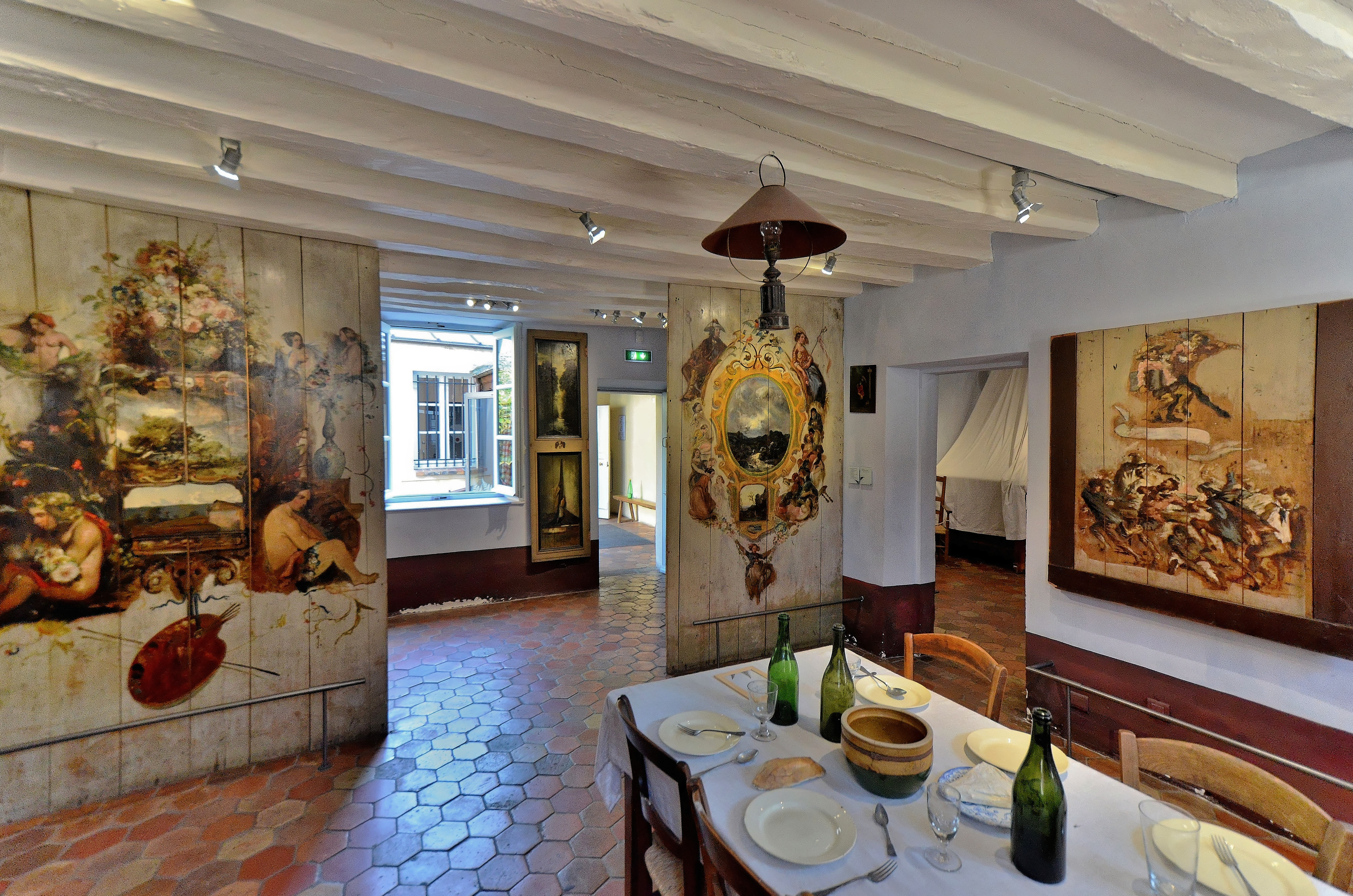
A departmental museum interpretation booklet describes the small street entrance opening into a central room used as grocery, kitchen and the innkeepers' sleeping space. Dining rooms followed, while upper rooms accommodated artists. The booklet presents the surviving wall decorations as traces of those guests' presence. Seine-et-Marne departmental museums, interpretation booklet, printed page 10
The overlapping uses of the central room are more revealing than an image of carefree artistic sociability. Selling provisions, preparing food and maintaining a household occupied the same establishment that visitors remember for painting. Its domestic functions did not disappear because artists found the village inspiring. Nor should the current museum arrangement be mistaken for a complete record of every movement through the building. What survives can indicate how closely hosting and household labour were connected without telling us who performed each task on a particular day, or how that work was divided over time.
Auberge Ganne’s museum interior in June 2017: painted panels stand beside a laid table, while a doorway leads towards another display. This is a later museum presentation, not a photograph of an artists’ meal or evidence of an untouched nineteenth-century room. Photograph: Patrick Monchicourt / Morio60, CC BY-SA 2.0; unmodified.

Registers show arrivals, not a permanent academy
In a curatorial essay published for the museum's 2006 Grigorescu exhibition, Marie-Thérèse Caille discusses the inn's police registers. She reports evidence from 1848 onward of artists arriving from different European countries and the United States, with stays ranging from a day to a month. This is the curator's published reading of the records, not a new count made here from the original register pages. Museum exhibition dossier, Caille essay, printed page 8
The reported pattern matters because it suggests movement, differing lengths of stay and a business accommodating people who came and went. It does not resemble a single permanently assembled class. A register and a painted wall also preserve different kinds of presence. The former can record an arrival even when someone leaves no identifiable drawing; the latter can preserve a gesture without supplying a complete biography. Their combination is stronger than either alone, but neither should be made into a census of everyone involved in the village's artistic life.
The outdoor painter carried a small workplace
Jules Coignet's painting of artists working in the Fontainebleau forest provides a complementary view. The museum's interpretation identifies easels, colour boxes, parasols and portable stools among the equipment. It explicitly declines to locate the scene precisely, although the combination of trees and rocks is characteristic of the forest. The same discussion notes representations of equipped painters on the inn's own walls. Museum collection study, Jules Coignet
The useful connection is between an outdoor working arrangement and an indoor base, not a claim that the painting maps a recoverable itinerary. Equipment had to be transported and arranged before observation could become an image. The scene also unsettles the assumption that painting outside necessarily meant working alone: the museum discusses artists sharing a motif while producing distinct pictures. An inn could support such proximity without imposing a common style. Being in the same village, at the same table or before the same trees did not make its guests interchangeable.
A marriage crossed the boundary between hosts and guests
The departmental archives' account of Eugène Cuvelier adds a specific relationship to this setting. Cuvelier, trained as a painter and introduced to photography by his father, visited Barbizon in 1856 and married Louise Ganne in 1859. The account identifies Corot as his witness and links Cuvelier's subsequent photographic work closely to the forest and to his artistic friendships. Archives départementales de Seine-et-Marne, Eugène Cuvelier
This is a more concrete connection than a general claim that artists and villagers formed one harmonious community. One documented marriage joined the innkeeping family to an artist's life; it does not explain every social relationship in the hamlet. It also broadens what “village of painters” can mean. Photography belongs within the same network, not outside it. The forest could be observed through different media, while the links formed around the inn were simultaneously personal, domestic and artistic. The building's story cannot be reduced to famous names passing through anonymous rooms.
What was hidden, and what was later recovered
The Ministry of Culture's museum record explains that the municipality decided to acquire the Auberge Ganne in 1987. During rehabilitation in the early 1990s, nineteenth-century paintings and graffiti were discovered beneath wallpaper and old coatings upstairs. The new municipal museum opened in 1995, and departmental management followed in 2004. Ministry of Culture, Muséofile M0370
These layers change the meaning of “preserved.” The building had intervening uses, and some traces became legible only through later investigation. A recovered wall drawing is not evidence that the entire room remained unaltered. Conversely, alteration does not make the surviving trace meaningless. It gives that trace another history: concealed, found, conserved and interpreted.
The museum's present description distinguishes the decorations on furniture and walls from its collection of paintings, drawings and prints. That distinction helps separate evidence attached to the place from works assembled to explain its artistic world. Both contribute to the museum, but not every exhibited object was necessarily made in the room where it is now encountered. Museum, present collection
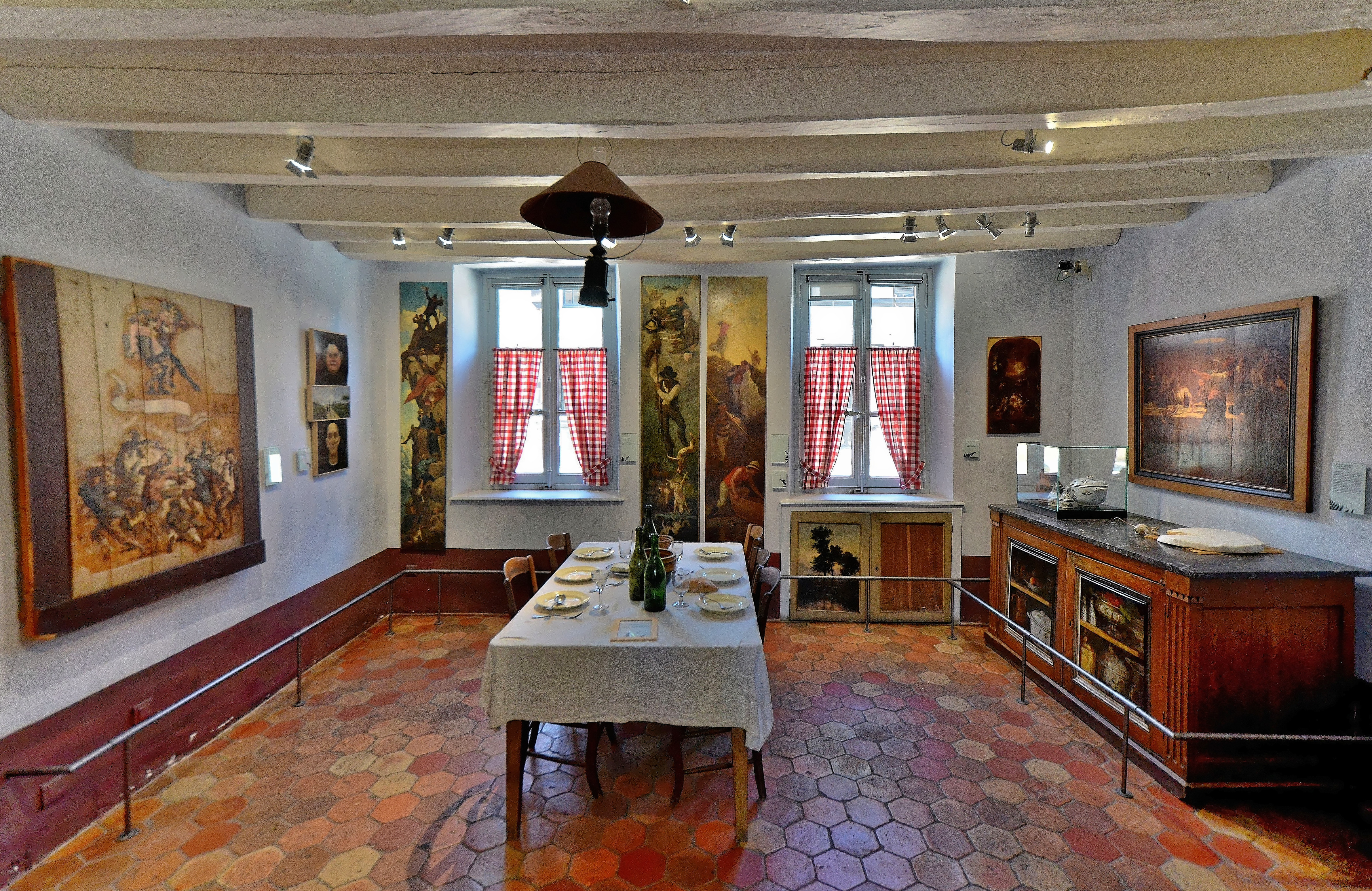
Another view of the same interior in June 2017 shows painted furniture, panels, display labels and visitor barriers. The visible museum arrangement helps distinguish preserved decorations from their later presentation; it does not identify every panel’s maker or original position. Photograph: Patrick Monchicourt / Morio60, CC BY-SA 2.0; unmodified.

The forest was not an empty backdrop
Looking beyond the inn need not mean replacing it with a list of scenic stops. ONF's history of Belle-Croix, a separate site within the Fontainebleau forest, records sandstone extraction, surviving quarry traces and routes associated with removing stone. It also describes grazing on the plateau in the 1850s and ponds used to water cattle. These are examples of forest work and use, not claims that the Gannes supplied those particular workers. Office national des forêts, Belle-Croix history
The comparison prevents a false division between a busy village and untouched nature beyond it. A painter's chosen view might exclude the activities that helped shape the surrounding landscape. That selection is part of making a picture, not proof that other uses were absent. It also cautions against reading a nineteenth-century representation as a record of present forest conditions. Historical evidence about grazing or quarrying is not permission to leave marked routes or enter restricted areas today.
A village base for looking outward
The Auberge Ganne offers a precise way to read Fontainebleau's forest villages without treating them as miniature appendages of the château. Its significance lies in the relationship between ordinary provision and extraordinary artistic attention. A meal, a bed and a place to return to were not separate from outdoor painting's practical conditions, even if finished landscapes usually leave those services outside the frame.
The evidence also sets a limit on that argument. It explains why accommodation mattered, but it does not reveal an individual guest’s complete expenses or the household’s profit. Calling the inn essential to this setting is therefore an interpretation of its documented functions, not a calculation of how much it contributed to the value of any painting.
The Auberge Ganne's painted interiors also require a double reading. They preserve something of the guests' activity, but their present visibility depends on later owners, municipal decisions, conservators and museum interpretation. Furniture that travelled and wall marks that were uncovered do not form an untouched capsule. They form a layered record. Keeping those layers visible gives the village more substance than a nostalgic image of artists perpetually gathering after a day in the woods: it reveals a place continually used, changed and reconsidered.
Location orientation
Barbizon, France — general map search. This town-level orientation is not a verified entrance, accessible route or permission to enter a heritage building, forest area or institutional site.
Source register and evidence limits
All cited pages and PDFs were opened during the 27 October 2026 author-side check. Artwork descriptions are attributed to the museum's curatorial text; no new visual identification of a painting's precise forest location is claimed.
- Municipal history: Barbizon's separate municipal geography and earlier connection to Chailly-en-Bière; promotional superlatives and visitor estimates not adopted.
- Museum building history / departmental booklet: household functions, changing accommodation and displaced decorations. Exact upper-floor nineteenth-century divisions remain uncertain in the detailed museum account.
- Caille's 2006 essay: published interpretation of police registers, not direct examination of the original volumes.
- Coignet collection study / Cuvelier archival biography: working equipment, shared motifs and a named family relationship, without generalizing to all villagers.
- Muséofile / current collection presentation: recovery, institutional chronology and distinction between site decorations and assembled collections.
- ONF Belle-Croix history: a geographically identified comparison within the forest, not a proposed walk from the inn.
Gaps: Published institutional accounts vary in early inn chronology and in some family names/dates; this account therefore does not assign a precise founding year, departure year or disputed successor's forename. No original guest-register pages, household accounts or conservation treatment reports were inspected. Two supplementary museum pages and two object/building records failed to open and were not used as evidentiary foundations. Current access conditions, including any forest restrictions, must be checked separately before publication; no route, opening-time or accessibility guarantee is offered here.