Free · France
Chinon: Fortress, wine trades and medieval streets
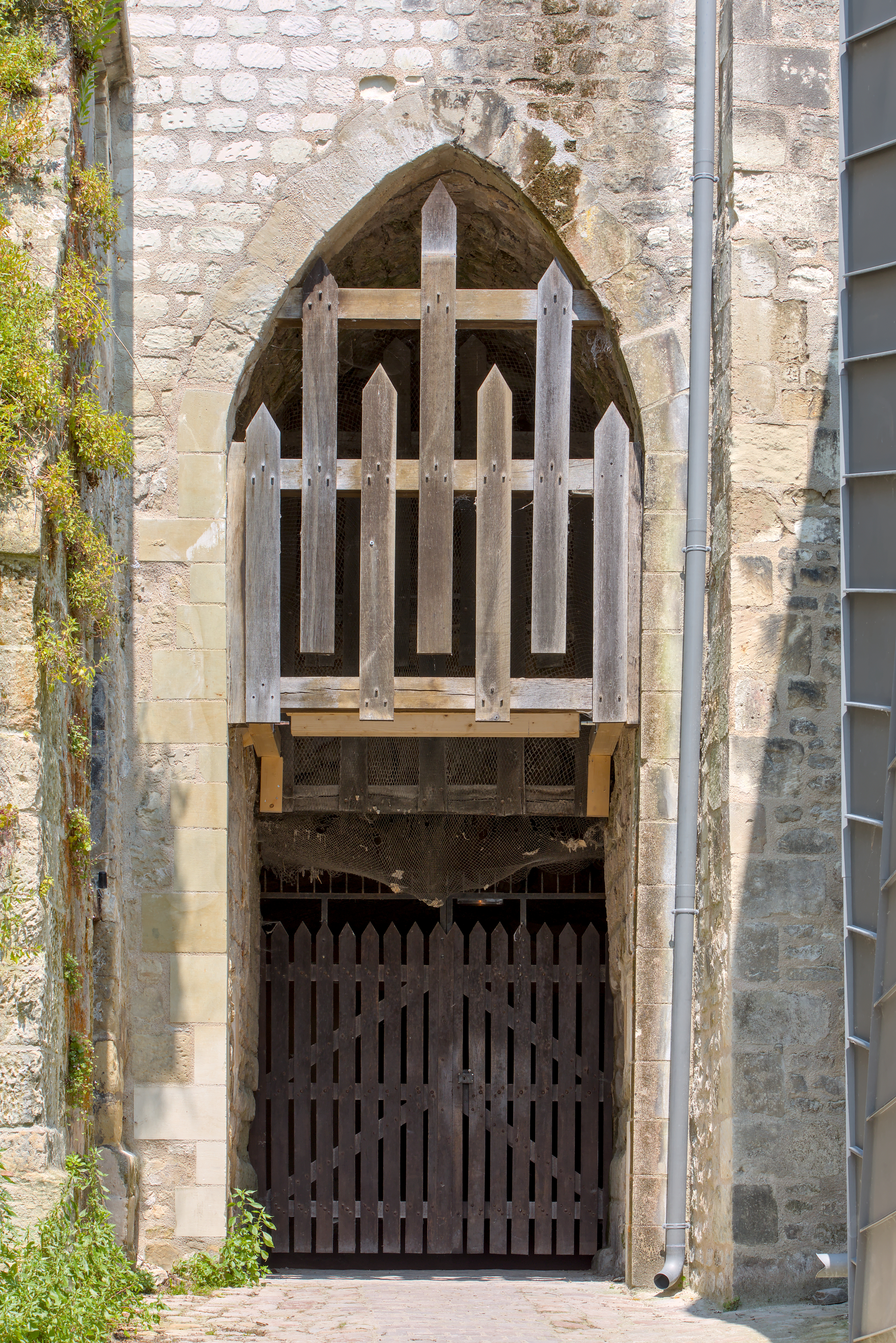
A cellar entrance beneath the fortress
The Caves Painctes bring three familiar parts of Chinon's identity into a single, tightly defined place. Approached through their named impasse, they extend beneath the fortress, occupy former quarry space and now serve the organised wine community. The local tourism office describes their conversion to cellars from the fifteenth century. That account provides a starting point, not a complete inventory of every chamber or phase. The useful feature is the change of use: an excavated void could become a place to keep wine, then a setting in which wine is presented and celebrated. Following that change avoids treating the fortress, medieval streets and vineyard as three unrelated attractions. It also avoids imagining that the present activities reproduce a medieval working cellar without alteration. Official tourism account of the Caves Painctes
The Caves Painctes entrance, 9 June 2025: the stone opening and fitted gates make the threshold visible, not the rooms beyond it. This exterior photograph does not establish the date of each building element or current access permission. Photo: Benjamin Smith / Wikimedia Commons, CC BY-SA 4.0, original and rights record. Unaltered.

Stone removed and space retained
The wine syndicate's account of the local terrain explains how extraction of tuffeau for buildings left cavities in the hillsides. It singles out the Caves Painctes as an example and associates their underground environment with wine conservation. This relationship is materially different from a picturesque resemblance between a bottle label and a castle. Removing building stone created spaces capable of another use. Yet the syndicate's promotional description of ideal temperature and humidity is not an independent survey of conditions in every gallery. Nor does it establish that all stone from these caves went into the fortress directly above. The supported connection is narrower and more interesting: building activity and wine storage could occupy successive stages in the life of the same excavated landscape. The underground town was partly made by work that supplied the town above it. Wine syndicate account of tuffeau and cellars
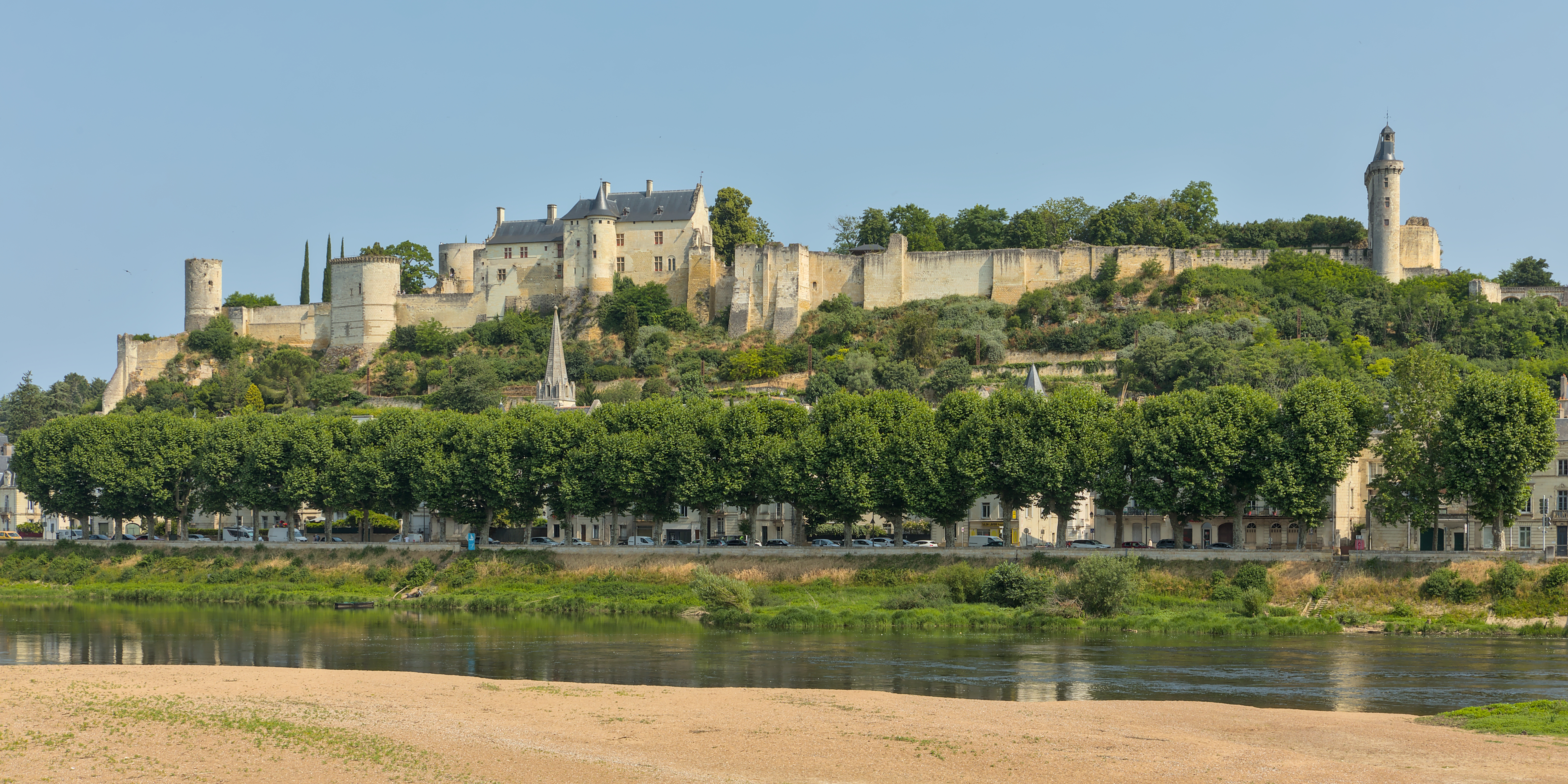
Chinon's fortress and lower town seen across the Vienne, 9 June 2025. The view helps locate the hillside above the built riverfront; it cannot reveal the underground chambers or prove where the fortress's building stone was quarried. Photo: Benjamin Smith / Wikimedia Commons, CC BY-SA 4.0, original and rights record. Unaltered.

The streets belong to a layered town
The fortress's own interpretation distinguishes the fortified residence on the rocky spur from the medieval settlement at its foot. It describes the fourteenth-century Ville-fort and an enclosing wall running towards the Vienne. The street-level entrance to the caves should be understood within that compressed relationship between hillside and river, rather than as a detached rural wine store. The fortress itself comprises three enclosed parts, not one building of a single date. Its surviving residential wing has also been adapted as museum space. These distinctions matter because a simple label such as medieval Chinon can conceal different construction episodes and later uses. The caves are part of this layered setting, but their position under the stronghold does not make every gallery a military tunnel or every cellar user a servant of the court. Fortress architectural interpretation
Early wine stories require careful scale
An early textual reference to Chinon's wine appears in the eleventh-century life of Saint Mexme, which describes wine going to Nantes. Samuel Leturcq's contribution to the University of Tours archaeological atlas treats this as an isolated mention, not proof of a large and continuous export industry. His wider reading of documentary evidence places substantial commercial expansion of Touraine's wines much later, towards the end of the medieval period. This is an important restraint on the cellar story. A reference to movement along the river cannot date a particular underground room, identify its occupant or establish how much wine was stored there. Nor should the fame of a later appellation be carried back unchanged into the Middle Ages. The documentary argument supplies a chronology of markets that architecture alone cannot provide, while leaving the scale of individual Chinon businesses unresolved. Archaeological atlas on medieval viticulture
A modern collective at an old address
The Syndicat des vins de Chinon dates its foundation to 1937 and its recognition as the appellation's defence and management organisation to 2008. Its published address is the impasse des Caves Painctes. The institutional chronology is much later than the quarrying and cellar history. That difference is not an embarrassment to heritage: it explains who now gives the place a collective purpose. A syndicate representing producers is not the same organisation as a medieval guild, and an appellation is not simply another name for the town's built-up centre. The syndicate's account distinguishes several sectors of the wine area. An urban address can therefore bring together people whose vines and workplaces lie elsewhere. The caves connect a regional production community to a recognisable site in Chinon without containing the whole process of growing and making its wine. Wine syndicate institutional history
Storage and ceremony are different uses
The operator describes the Caves Painctes as a setting for guided interpretation, tastings and ceremonial meetings of the Entonneurs Rabelaisiens. It also describes an equipped reception room and catering facilities. These uses require organisation, preparation and adaptation; they are not merely the survival of empty medieval chambers. The confraternity's ceremonies give the underground space a public language of membership and celebration. That tells us about contemporary wine culture, not automatically about the arrangements of historic trade. The same webpage associates the site with Rabelais and his father. Without a property deed or an independently examined archival record, that family ownership claim remains outside this account. The literary association is part of the place's present interpretation, but it should not be allowed to supply missing evidence about particular cellars. Operator's account of cave activities
The municipality also helps make the association
Chinon's published 2024 heritage programme announced the festival Les Nourritures Élémentaires as a collaboration between an association, the city and the wine syndicate. Its programme combined talks, performances and a banquet at the caves. The announced theme of giants tied the programme to a particular literary world; the cave banquet was one element within several days of activity, rather than the whole festival. This is useful civic evidence of how the link between literature, wine and place is actively organised. It is not a report proving attendance, commercial benefit or universal enthusiasm among residents. The event format also differs from a cellar's storage function. A gathering makes use of atmosphere, space and shared references; a merchant's stock needs appropriate custody and conditions. Recognising both activities prevents the word tradition from smoothing away changes in purpose. A historic place can acquire a new role through deliberate cultural work without becoming either a theatrical fake or a perfectly preserved fragment of the past. Municipal heritage programme for 2024
The museum offers another way to preserve local life
The local historical society's account records the establishment of its museum in the Maison des États généraux at 44 rue Haute Saint-Maurice after renovation in 1973. It describes later delegation to public authorities and the donation of the collection. This is a different form of continuity from a cellar remaining in use. Objects are selected, documented and moved into an institution capable of conserving them. The society also distinguishes its art-and-history collection from ethnographic material accumulated over time, some of which contributed to the development of the Véron museum. Those histories caution against assuming that every object associated with local work is displayed in Chinon's Carroi museum today. They also show that the medieval streets support more than commercial nostalgia: they provide settings for sustained decisions about what aspects of the town's past to keep and interpret. Historical society's account of its collections
Excavated objects need their own provenance
The fortress's archaeological collection supplies an especially useful check on imaginative storytelling. Its account identifies a small limestone face from excavations of the former Saint-Georges chapel in 2005 and a ceramic vessel from a much earlier burial discovered in 2006. Both belong to the site's material history, but neither can be turned into evidence for the Caves Painctes merely because it was found nearby. A vessel's shape is not enough to establish that it held local wine; a limestone carving does not identify its quarry of origin. Provenance connects an object to a find context, while further claims need additional evidence. This is the museum counterpart to reading the underground rooms carefully. The ability to place an artefact in a documented context is more valuable than making every surviving thing confirm the same attractive story. Fortress archaeological collections
An entrance is not permission to wander
A fortress notice for 27 October 2024 advertised a separately organised underground visit with local speleological bodies, advance registration and supplied helmets. Its meeting point was the impasse des Caves Painctes. This dated arrangement should not be confused with unrestricted access to an entire subterranean network. Nor does a common meeting point establish that all caverns share the same history or management. For heritage interpretation, the distinction reinforces the central argument: underground space is used through specific arrangements, not simply discovered beyond an old doorway. A special programme is evidence of mediation and controlled access, not a permanent invitation or a present safety assessment. Fortress notice for the 2024 underground event
The Caves Painctes consequently connect Chinon's fortress, streets and wine trades through successive uses of space. Quarrying, storage, collective representation and cultural gatherings belong to that account, but not to one undivided medieval scene. The place becomes more legible when the dates remain separate and the limits of each source stay visible. Its distinctive heritage is the continued usefulness of an excavated part of the town, coupled with the work required to give that usefulness a credible history.
Location orientation
Chinon, France — general map search. This town-level orientation is not a verified entrance, cave-access permission, safe river route, event booking or current departure schedule.
Source register and editorial gaps
Sources opened on 27 October 2026. Original English manuscript; no tasting recommendations or practical cave-access advice.
- Official tourism cave account — local institutional interpretation; broad conversion chronology only.
- Syndicate terrain account — extraction and storage relationship; ideal-condition wording not adopted as measured fact.
- Fortress interpretation — topography and different built phases.
- Tours archaeological atlas — original scholarly synthesis of documentary wine evidence; medieval export scale qualified.
- Syndicate history — institutional dates and address.
- Cave operator — present interpretation and uses, not a medieval ownership deed.
- City's 2024 heritage programme — announced collaboration and event format; no attendance inference.
- Historical society collection history — institutional first-person account, not a complete object catalogue.
- Fortress archaeological collections — excavation contexts; no unverified wine contents or stone provenance.
- Fortress underground event — explicitly 2024, not current availability.
Gaps and controls: no cellar deed, merchant ledger, storage inventory or original medieval manuscript was examined. The departmental archive guide mentioning a Chinon merchant's notebook returned HTTP 403 and was not used or bypassed. An INAO product page also returned 403; no production-rule claim depends on it. The historical society's bibliography opened and lists studies of Painctes/Vaslins in 1949–1951, but those articles were not inspected. The municipal May 2025 Vaslins PDF and older syndicate brochure failed to open; the BRGM report returned 502. A large 2024 press PDF exceeded the web fetch limit. The museum's former Paroles à boire exhibition page failed; no object claim is drawn from its search snippet. The Carroi institutional page and a 2016 INAO document opened as background, not substitutes for missing cellar records. Rabelais-family ownership, unchanged appearance since the sixteenth century, exact tunnel lengths, collapse narratives and claims of universal ideal storage conditions are not asserted.