Free · France
Saint-Émilion: Vineyard labor beyond the prestigious labels
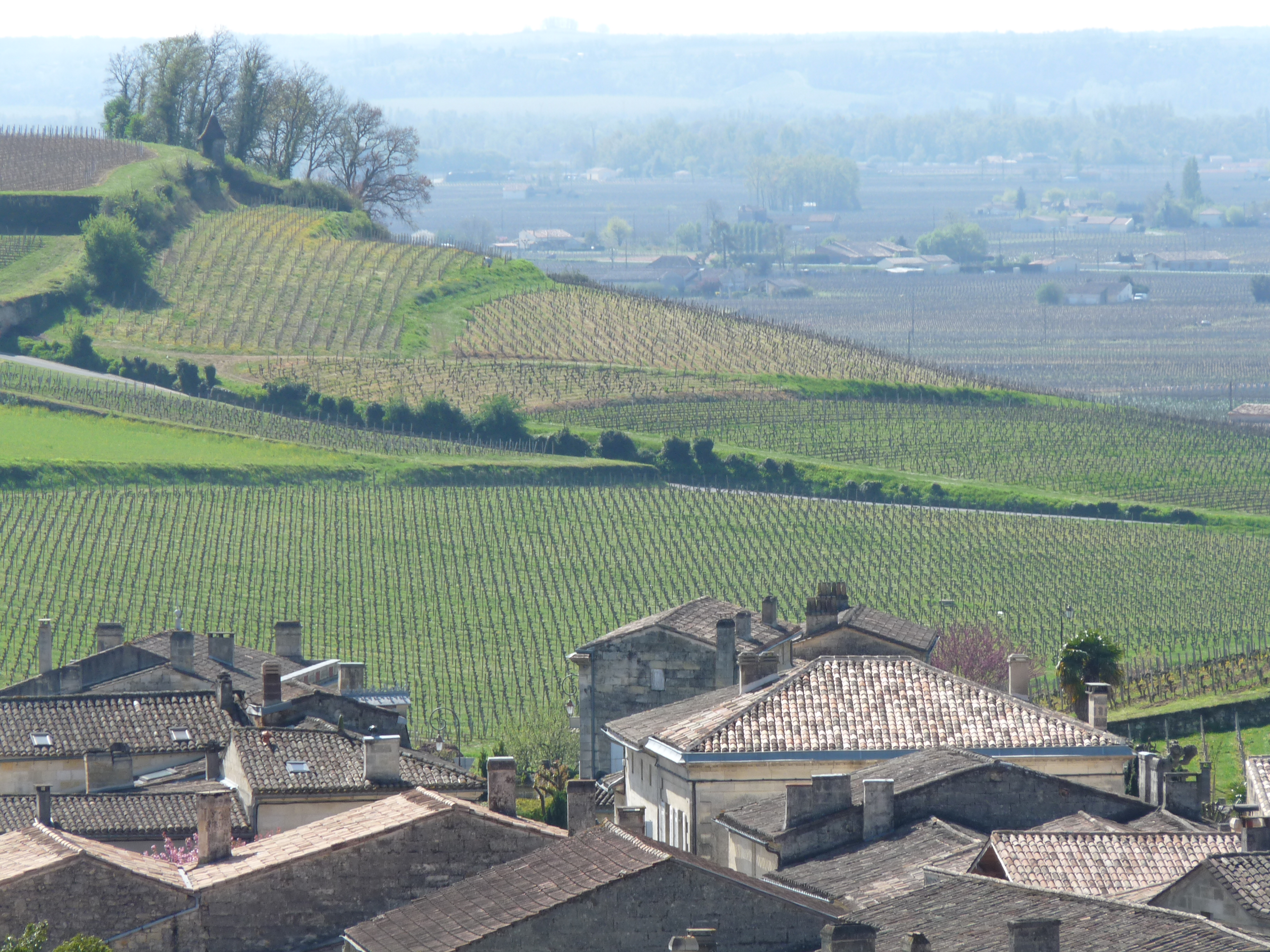
A bottle names a property, an appellation and a vintage. It rarely tells you who pruned the vines, how a seasonal team reached the parcel or where its members slept. Those omissions are not small details in the life of Saint-Émilion. They are the difference between looking at a famous product and understanding the working territory that produces it.
The most useful starting point is not to replace wine prestige with a single story of hardship or rural harmony. Both would flatten a varied workforce. Instead, ask three questions: what work is being done, who organizes it, and what allows the people doing it to remain in the area? Local professional sources, an operator's account and dated public studies answer different parts of that enquiry.
Saint-Émilion vineyards, photographed on 9 April 2009. The visible rows and buildings offer context for the article's questions about work and location; they do not identify an employer, a team, worker accommodation or conditions at any named property. Photo: michael clarke stuff, St Emilion 02, CC BY-SA 2.0. Original photograph unmodified.
Harvest is a moment, not the whole occupation
The Conseil des Vins de Saint-Émilion's seasonal explanation begins with pruning during dormancy, includes the removal of unwanted growth and follows the vine toward harvest. It makes clear that picking dates vary with climatic and viticultural conditions. This is a cycle of interventions, not a timetable that every property follows on identical days. Conseil des Vins: a year in the vines
For an observer, that distinction changes the meaning of an apparently quiet vineyard. No visible harvest team does not mean no work. Conversely, a photograph of busy picking cannot represent the entire year's labor. The finished landscape is the accumulated result of tasks that are easy to overlook when attention rests on the château frontage.
ANEFA Gironde, the agricultural employment network, describes vineyard work across the seasons, including winter work and travaux en vert during growth. It also distinguishes pruning and machine operation from seasonal jobs that may not require prior specialist experience. Its information concerns Gironde, not a census of the Saint-Émilion commune. ANEFA Gironde: seasonal agricultural work
This suggests a better question for a visit than “when are the harvests?” Ask which tasks occupy the team at that point in the year and which require particular training. Let the answer remain property-specific. A general seasonal diagram is a guide to questions, not authority to operate equipment or carry out vineyard work.
The estate name is not necessarily the employer's name
In its March 2024 study of seasonal-worker housing, a'urba describes the growth of outsourced vineyard services in Gironde. In such arrangements, the business organizing and employing a team can differ from the vineyard owner. The study also links housing availability to recruitment and distinguishes the Libournais and Saint-Émilionnais from more intensely tourism-driven coastal markets. It does not provide a universal description of every estate or every worker. A'urba: seasonal-worker housing in Gironde, pp. 15–17
A simple diagram helps: property → work organizer → person carrying out the task. Sometimes the first two positions are occupied by the same organization; sometimes they are not. Do not fill the diagram from the label on a bottle. Nor should the presence of a contractor itself be treated as proof of poor conditions. Evidence about an actual arrangement is needed.
The distinction also changes how we hear accounts of tradition. “We have always done it this way” may describe ownership, a cultivation technique, a permanent team or a remembered harvest gathering. Those are different continuities. Asking who “we” includes is a respectful way to make a property's story more precise.
A local service team makes the range of skills visible
APAJH Gironde describes the ESAT Cressonnet as both a producer and a provider of vineyard services to local growers. Its own holdings include Bordeaux and Lussac Saint-Émilion appellation land; Lussac Saint-Émilion should not be silently relabelled as the Saint-Émilion appellation. Its listed services range from winter pruning and handling cut wood to shoot management, hand harvesting and tractor work. The organization explicitly presents professional inclusion of people with disabilities as part of its activity. APAJH Gironde: viticulture services
This example is valuable because it names work rather than simply praising a finished wine. It also complicates the assumption that vineyard labor is adequately represented by either a lone proprietor or an anonymous harvest crowd. Different teams can bring different organizational models and forms of support.
The source is the provider's description, not an independent assessment of outcomes. It establishes the activities it offers and the professional purpose it states. It does not justify invented interviews with its workers, claims about their experiences or an assumption that every neighboring estate uses its services.
A place to sleep is part of the production geography
A job can be located in a renowned landscape while an affordable room is somewhere else. That is why the map needed by a worker may look very different from a visitor's map of tasting appointments. It must connect a place to stay with the actual work location, working times and a realistic way to travel between them.
The regional audit chamber's report on seasonal-worker housing, deliberated on 4 March 2025, included Saint-Émilion. It called for a more developed local diagnosis and recorded uncertainty about accommodation needs. Its table's approximate Saint-Émilionnais agricultural-seasonal-worker figure drew on older evidence for the wider intercommunal area; it is not a count of people simultaneously needing beds in the town in October 2026. Chambre régionale des comptes: report, pp. 15–18
The distinction between workers and bed demand matters. Some workers already live locally; others need temporary accommodation. A yearly employment total, a peak-season headcount and a number of beds are not interchangeable measurements. Repeating a large number without its geography and period can obscure the problem rather than explain it.
This article does not turn that dated audit into a claim that no improvement has occurred since. Nor does it certify any accommodation as suitable. The point supported by the document is narrower: labor-related housing belongs in the account of the territory, and the evidence needed to measure it must be made explicit.
One property has changed what its château is for
Les Joualles de Cormeil-Figeac supplies a concrete, local contrast to the assumption that a château building exists principally as an owner's residence or a visitor spectacle. On its own site, the family says the historic building was converted into accommodation for workers during the season and for other guests outside it. The estate, which adopted its present name in 2024, also describes an agroforestry approach and a diversified team including market-gardening and agronomic work. Les Joualles de Cormeil-Figeac: who we are
Use this as a documented operator example, not a representative survey. The statement does not establish vacancy, price, eligibility or independently inspected living conditions on any particular date. It does, however, show why the built environment belongs in a discussion of vineyard labor. A change in a building's use can be as relevant to production as a change in machinery.
For a reader, the important comparison is not whether this property is more picturesque than another. It is which everyday needs a working estate chooses to accommodate on site. That question can be asked without turning workers' private rooms into visitor attractions.
Training and neighbor relations are also part of the landscape
The Conseil des Vins' page on people and the living environment identifies recruitment and working conditions as subjects for improvement. It describes a field-based training initiative associated with Les Vignerons du Vivant and Apprentis d'Auteuil, and discusses dialogue between growers, residents and local representatives. These are the professional body's stated activities, not proof that recruitment difficulties or neighborhood disagreements have disappeared. Conseil des Vins: people in the vineyard
This widens what counts as vineyard knowledge. Someone must learn a task, coordinate it with others and carry it out in a place that is also inhabited. The boundary between a residential garden, a road and a working parcel is not just a line of scenery. Different people use the same area for different purposes.
A considerate visitor need not investigate a worker's personal circumstances to recognize this. Avoid blocking access, remain in permitted areas and ask before photographing people. A person at work is not an illustration supplied automatically with a landscape. If a host explains a training program, distinguish the existence of the program from measured results that would require separate evidence.
Remembered harvest sociability needs a date
The jurisdiction's January 2013 management plan worried about the weakening of shared harvest meals, accommodation traditions and the gerbaude, the end-of-harvest celebration. It presented these as aspects of local cultural life worth sustaining, alongside the more visible ceremonial identity of the wine region. That is a dated institutional diagnosis, not a statement that every such gathering has vanished or a survey of current practice. Jurisdiction management plan, pp. 61–62 and 105
This offers a useful way to approach memories without idealizing them. Ask whose memory is being told and from which period. A proprietor's account of a convivial meal, a permanent worker's experience and a seasonal worker's recollection may not describe the same arrangement. Sharing a table is an important social practice; it is not by itself evidence of fair pay, good housing or equal power.
The older plan and the current estate example should therefore sit beside each other, not cancel each other out. One records concerns at a particular moment; the other describes a particular response. Neither authorizes a sweeping verdict about an entire workforce.
Four questions that go beyond the label
| Question | A useful answer would identify | What not to infer | |---|---|---| | What work is happening now? | A task, season and needed skill | That harvest is the only labor-intensive period | | Who organizes the team? | The actual estate, service provider or other organization | The employer solely from the bottle's name | | How is the work location connected to everyday life? | Housing and travel arrangements where the speaker can substantiate them | That local employment means local residence | | Which tradition is being described? | A period, participants and supporting evidence | That a ceremony proves unchanged working conditions |
These are questions for informed conversation, not a compliance inspection or employment guide. Current job terms, transport and accommodation arrangements must be checked directly with the relevant provider. No room, job opening or service is promised here.
Looking beyond prestigious labels does not diminish the skill embodied in a wine. It makes that skill more visible and less abstract. Saint-Émilion is not only a landscape that produces bottles: it is a place where people repeatedly organize work, learning, travel and shelter. Those ordinary arrangements are part of what keeps a celebrated vineyard alive.
Source register and limits
Checked 27 October 2026.
Local professional and provider accounts are explicitly attributed. Wider Gironde findings are not presented as commune-level measurements. The 2013 management plan and 2025 audit are dated evidence, not current compliance findings. A'urba's 2024 study supplies regional employment-organization context; no allegations against a named employer are inferred. No worker interviews, property visits, payroll inspection or housing inspection were conducted. The Cormeil-Figeac page was retrieved as public HTML after web extraction timed out and its body text was read. No source photograph is reproduced without rights verification.
For broad orientation only, this Saint-Émilion place-name map search is not a worksite, accommodation or access assessment.